
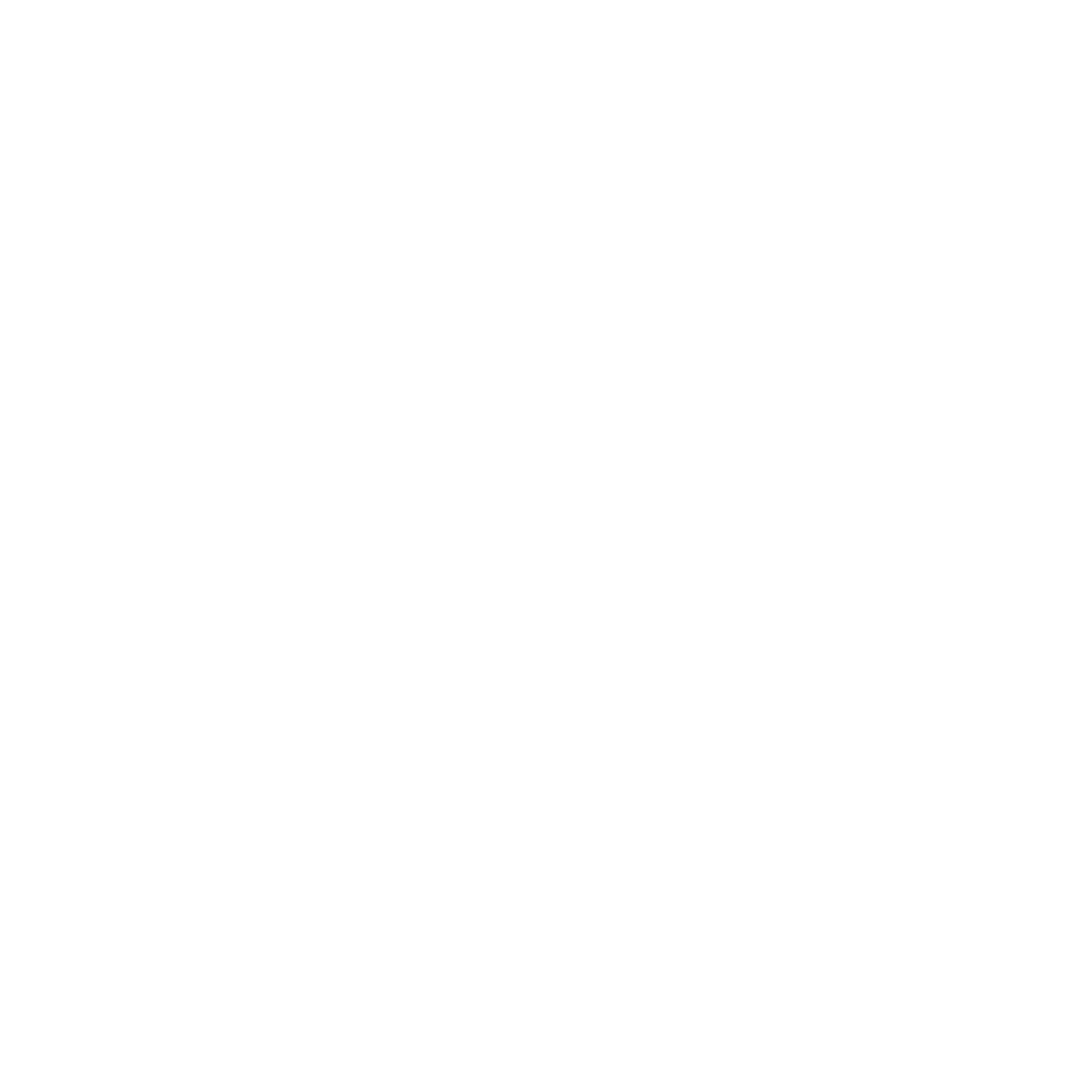
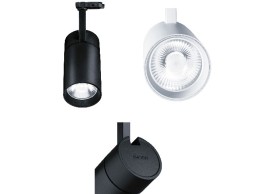
Thorn Tonic Family
The Tonic family boasts CRI >90, so true colours of in-store displays and products are vibrant and vivid. With their minimal tubular appearance, the family has a common aesthetic, making it easier for designers to create consistent looks. Thanks to its LED technology and efficient optics, Tonic achieves high efficacy of 90 lm/W, meaning savings of more than 40% compared to 35W and 50W metal halide fittings. It is available in warm (3,000K) and neutral (4,000K) colour temperatures, with lumen packages of either 1,800lm or 2,800lm.

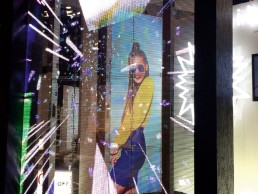
Unibox Kino
Kino is the latest innovation from Unibox, retail display specialists. Ideal for eye-catching window and in-store displays, Kino is a transparent video screen with programmable LEDs that have been designed to provide both high-quality video content and transparency - drawing shoppers to latest products and promotions without blocking sight lines.
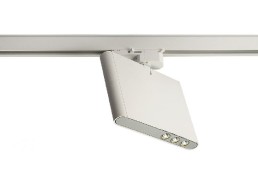
HALLA VIMA
Designed by Serge Cornelissen, VIMA is a professional LED projector with the integration of state-of-the-art LED components. The design is the result of an innovative layout in which the LEDs, heatsink and driver are arranged asymmetrically on the same level. The luminaires can be equipped, in addition to highly luminous LED, with a colour rendering index of Ra>80 or Ra>90 as well as with LED sources with RealColour technology ensuring a high rendering index of Ra>97. RealWhite technology for white colour, or a wider range of StrongColour variants for specific requirements.
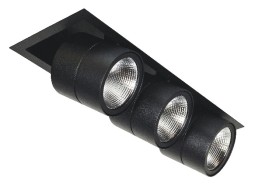
Fagerhult Touch range
Fagerhult’s Touch spotlight range offers flexible and sustainable options for shop lighting. A stylish luminaire that will fit smoothly into any retail environment, Touch is dedicated to highlighting retail merchandise. Its LED-module is characterised by a pure, white light offering brilliance and excellent colour rendering. With track mounted and recessed versions in alternative shapes, it can be used on three different track systems: standard 3-phase track or Fagerhult iTrack and Control track – the latter two intended for DALI. Touch comes in black, white and grey.
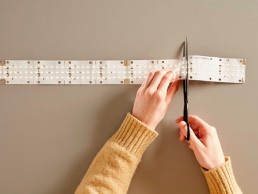
Cooledge LINE
Designed for fast, simple, and foolproof installation without specialised training or tools, LINE can be trimmed to length onsite for the perfect fit. Its Constant voltage design means that the same LED driver can power up to 20’ (six-metres) of LINE and that layout changes required to meet onsite conditions don’t require resizing power sources.
It also has typical 2 SDCM colour consistency and a standard CRI >80.
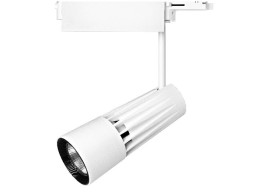
Lledó Carson/Logar family
The Carson/Logar family is a range of accent lighting for retail environments. Incorporating wall, surface, track and suspended models, the range features a compact form and PHI- reflector technology for precise concentrated light beams with minimal dispersion. With a CRI >95, a textured lens ensures colour consistency in the beam, regardless of LED emission angle. The range is flexible, ranging from 16W to 57W, with beam angles from 8° to 41°.
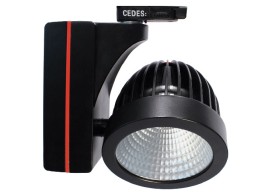
Cedes Celed RGBW
Celed RGBW spotlights can stage light variably, making it particularly suitable for shop windows. RGB and neutral white are combined on a COB, meaning the four-channel COB not only contains the red, green and blue, but also a white LED chip as a light source. By adjusting the three primary colours and different intensities, each colour nuance can be realised up to white. However, since the white produced is not pure white, white LEDs have also been placed in the RGB LEDs. This allows rooms, backgrounds or objects to be illuminated in white or coloured light, depending on the desired mood.

Rune Marthinussen
Rune Marthinussen, CEO of the Scandinavian group of companies, Glamox, discusses its business strategy moving forward and looks back at 70 years of history.
What is your role in Glamox and how did you get there?
I have been leading Glamox for almost two years now. With a mechanical engineering background, I started my career as a development engineer building subsea oil production systems at Kvaerner. I worked almost fifteen years for Kvaerner and as my last assignment was running the thermal power division. In 2003, I started as MD in Titech, a leading supplier of sensor based automatic sorting machines for recycling plastic and paper. The company was acquired by Tomra, and the business was expanded globally through strong organic growth and key acquisitions to become one of two divisions in Tomra. It was probably my international industry experience that earned me the CEO position in Glamox.
This year Glamox celebrates its 70th anniversary. Can you give us a history of the company and how it all began?
Glamox was founded in 1947 by the Norwegian civil engineer and entrepreneur Birger Hatlebakk. Hatlebakk is known for inventing the “glamoxation” process, a method for electrochemical surface treatment of aluminium. This process allowed Hatlebakk to use an inexpensive type of aluminium to create energy efficient luminaires that emitted a pleasant light. The invention proved to be a crucial asset for many years to come. In the following years a number of successful lighting products were developed, and a purpose-made factory was built in Molde, Hatlebakk’s home town.
Since then, Glamox has expanded its business throughout the Nordic and North European professional building market, and we are recognised as one of the leading companies within this market. We made luminaries for fishing boats as early as the 1960s, and we started deliveries to the offshore industry in the 70s. Our marine and offshore business now has a global reach and we are covering a wide range of applications in the cruise, navy, commercial and offshore segments. Today, Glamox has 1,300 employees with operations in 60 countries. I find Glamox a great place to work. We have dedicated and skilled employees in all parts of our organisation.
The Glamox Group owns a range of lighting brands. What are they and what markets do they service?
Currently we offer six product brands targeting different needs in the market.
Glamox is a leading lighting brand for professional markets, onshore and offshore. The rich assortment of Glamox products is available for a wide range of applications – including challenging environments.
The Luxo brand comprises mainly arm-based innovative, ergonomic lighting products. Luxo products improve lighting conditions, taking particular care of individual needs.
Norselight is a world name for search light systems that work reliably under extreme conditions, adding to safety and security at sea.
Aqua Signal has been delivering marine lighting solutions since before the age of electricity, providing lighting products designed and manufactured to meet all relevant standards for quality and performance at sea.
The Høvik Lys brand represents lighting products made with high quality materials and with exclusive finishing details that grace elegant buildings and vessels with their pleasant light.
LINKSrechts offers a comprehensive range of naval LED lighting systems, including design, integration and programming. The product range consists of specialised lighting products for all naval applications, including naval aviation.
You acquired Luxo in 2009. What was the strategy behind that decision?
Luxo was, and still is, a well-established and reputable brand. The acquisition gave us better access to parts of the market, and products that complimented the portfolio we already had.
Are there more acquisitions to come?
In 2015 Glamox acquired the Dutch company Bell Licht. Bell Licht had at the time been responsible for sales and distribution of Glamox products for more than 30 years. German LINKSrechts was acquired in 2016. LINKSrechts manufactures advanced LED-lighting systems for the navy industry worldwide. This goes to show that we are always interested in strengthening our position both when it comes to markets, products and technology.
What is the strategy of Glamox going forward - particularly relating to LED and control?
Since 2012 we have almost exclusively been developing LED products. The LED share is increasing and now constitutes more than 80% of the turnover in some markets. Glamox has been supplying lighting management systems for some time, but we expect that Light Management Systems (LMS) will make up a larger part of our deliveries in the years to come. LMS offers our customers an opportunity to reduce energy consumption and at the same time increase comfort and productivity. Human Centric Lighting (HCL) is also a technology of high interest to us. We believe that HCL can improve health and wellbeing in institutions as well as workplaces. Glamox has in recent years supplied HCL lighting to several schools and health institutions, and we are also engaged in scientific research on this topic.
How do you see the lighting industry developing in the future?
We currently observe a consolidation process in the lighting industry. At the same time we see new companies entering the market with interesting value propositions and business models. In the aftermath of the LED transitions, we see a whole range of new opportunities appearing as different technologies converge into new lighting applications and services. Connectivity, Light Management Systems, Internet of Things are buzz words today, but they will change our lives and the industry in the future.
What do you do outside lighting?
I enjoy biking in the summer and snowboarding during the long and fantastic Norwegian winter. However, my biggest dedication outside Glamox is big band jazz music. I have played trombone since I was a kid and played the bass trombone in Røa Storband (Big Band) since 1994.

Domingo Gonzalez and AC Hickox
Domingo Gonzalez and AC Hickox share leadership of New York City-based Domingo Gonzalez Associates (DGA), now in its 32nd year as lighting design consultants. Both principals are a study in contrasts, as is their firm. Gonzalez studied and practiced architecture; Hickox was a theatrical lighting designer. Their bright and airy top fifth floor studio is located in a modest vintage building on Park Place in the city’s financial district where a visitor has to look closely not to miss Number 25.
They credit a mix of public and private sector commissions as one of the reasons that their firm has grown to its current number of 20 designers and support staff who are involved in numerous projects around the country. “Both of us have been through a number of recessions in our careers,” says Hickox. “We consciously work to maintain a diverse practice and project mix,” she points out. “While we have most often been associated with high-profile public sector commissions, we welcome private sector projects by taking on just about any and all opportunities that land on our front door.”
“Quite frankly,” Gonzalez indicates, “when we are asked, ‘Can you help us with this?’ we say, ‘Yes, sure.’ We’ve found that our ability to say ‘yes’ has made for very interesting experiences that have been rewarding over the years.”
Their primary practice areas are education, transportation (Hickox is a long-time train buff), historic preservation (a favorite of Gonzalez), corporate, and landscape projects.
“When examining possibilities on any complex project, there is a certain amount of drilling down that we often have to do,” Gonzalez believes. ‘‘In many ways, the right lighting solution starts with familiarising ourselves with the project typology. This strategy explains our interest in understanding why and what is most appropriate to a given kind of project. Simply stated, the way we approach a school is not the way we address an airport. The way we approach a hotel is not the way we plan for a library, or a medical project,” he explains. ‘‘The final product is often a result of this investigation, combined with an understanding of technique, technology, sustainable goals, budget, and identifying the owner’s particular interests.”
Hickox had been a theatrical lighting designer before joining DGA in 1999. ‘‘I grew tired of solving the same stage lighting problems over and over,” she states. As a result of this, she decided on transitioning to architectural lighting design and accepted Gonzalez’s offer to become a full-time member of DGA.
“As an architect-led firm, we have a deep interest in buildings and how people will experience the lighting in those buildings,” Hickox points out. “We are very architecturally focused, individually and as a firm,” she says. “Domingo and I have a similar problem-solving approach even though we have very different backgrounds. We both want to understand a project’s constraints and use those constraints as jumping off points for problem solving,” she notes. “Within our body of work, we do have our technical side. But we pay a lot of attention to understanding the character and identity in a project that is not only appropriate in expression but also wonderful to experience.”
Gonzalez has long been fascinated with the many paths leading to becoming an architectural lighting designer. “Educational programs in architectural lighting design were quite unknown to me when I was starting out in practice 38 years ago. At that time,” he explains, “there were no front doors to architectural lighting…there were only back doors and side doors. Today, because of excellent educational programs such as those at Parsons, Penn State, and the Lighting Research Institute at RPI as well as several programs in Europe, there are now many front doors where young people can actively pursue their interests in this field that weren’t available before.”
Hickox agrees that the firm’s staffers who are trained as architectural lighting designers…‘‘can really perceive light, and apply it to their projects. Our staff is the best! We have a remarkable group of dedicated lighting designers who can problem-solve, render, calculate, illustrate, and detail. Domingo and I have worked very hard to provide opportunities that nurture a very fine group of excellent professionals.”
Gonzalez enthusiastically agrees: “Our interns are fabulous! We have a core group of interns, many of whom started while still in high school. One young lady interned for five years here when in high school, and then went on to study at Cooper Union. She stayed with us for a year afterwards as a junior designer, and then went to Harvard. One of our current interns joined our firm while in high school and is now in his fourth year of architecture school. We like to consider local colleges in our region so these students can work with us in the summers and over winter break.” DGA is also involved with intern programs around the country, having hired students from Northeastern University in Boston, which has a cooperative school/work program.
Staff participation in every aspect of the design process is a critical part of DGA’s project approach. “We try very hard to not pigeon-hole people,” Gonzalez comments. “We will play to their strengths, of course. However, we want everyone to become highly skilled practitioners so they can advance to larger projects and management roles. Our ultimate goal is to cultivate a very strong cadre of well-rounded, ambitious designers.”
Senior designers actively engage with clients during the course of a project. “We are normally there just as back-up,” says Hickox. ‘‘When they need reinforcements, they are free to call Domingo or me. They know they have the ability to handle all phases of the project, win the award, and are responsible to keep the firm moving forward,” she relates. “Much of my time is spent making sure that the staff is properly supported, and that impeccable documentation is executed.”
DGA has created an in-house training program that Hickox describes as robust. “With all of the changes in technology—from conventional legacy lighting sources giving way to LEDs to wireless controls and the on-going evolution of energy codes—there is a tremendous need for continuing education,” she states. “We sponsor brown-bag lunches to understand such factors as optics that are changing with the new technology on the market. So we all have a lot to learn.”
Such ongoing support prepares staffers to maintain involvement with the firm’s often challenging, long-term large-scale projects. Over the years, DGA has completed more than ten million square feet of corporate offices, numerous historic restorations, plus several bridges, schools, and public sector projects that can extend into decades. The firm began work on the 85-acre Brooklyn Waterfront Park in 2003 and is still in the process of a phased completion. The Hyatt Times Square Hotel, which underwent several operational changes, took seven years before opening. The East Side Access project started in 2000 and won’t open until 2019. The re-lighting of Bryant Park in Manhattan extended from 2005 to 2013.
DGA designers bring a very active participation presence to the design process. “We are relatively fearless when it comes to generating ideas, and speaking up on the merits and challenges of certain approaches,” Gonzalez affirms. “We appreciate being engaged in projects from the beginning. We offer expertise and opinions to realise the lighting potential.”
A favorite DGA technique is helping clients to understand a project by generating multiple options, sometimes well over a dozen. He cites the belief that there is not one answer to solving a problem. “Discussion of the alternatives for lighting opens a productive dialogue about what is good, better, and best… examining the costs, constructability, procurement, and other factors so the client can make better decisions. Mock-ups are a critical part of this process in helping them, and us too, to better visualise final results.”
Current projects include finishing touches on NYC’s Second Avenue Subway, now carrying passengers after 156 years of planning, designing, modifying, and updating the design, followed by years of construction. The lighting program included lighting for all four stations plus illumination for the art works in the line’s stations, commissioned by the Metropolitan Transit Authority’s Arts and Design Division from such notable artists as Chuck Close. Other current projects include the upgrade of the c.1919 Brooklyn Army Terminal by famed architect Cass Gilbert who also designed the Woolworth Tower. Other assignments include upgrades to La Guardia Airport, and projects in Washington, D.C., Florida, Tulsa, Burlington, San Antonio, and several large-scale park projects in Chicago.
Sustainability is a large part of the DGA process. All DGA staffers realise the importance of sustainability and most are accredited. According to Gonzalez, the sustainability movement has provided a common language to help designers to educate their clients and has propelled the evolution of code updates. As for the advancements coming thick and fast in LED, he calls it “astonishing. Usable innovation in lighting used to occur once every 24 months. Today, it’s more like once every 24 weeks, or even 24 days.”
Gonzalez cites one important tenet of good lighting that hasn’t changed is to create outstanding lighting installations based on the principle of simplicity and consistency of elements. “It’s like cooking… making a fabulous meal out of very few ingredients. I like to think that everyone’s mother had this sort of talent (mine certainly did).”
In his estimation, a true test of lighting skill is the designer who can work with anything that is dependable and produce excellent results. “Consider the subway projects we completed for Second Avenue that relied on just two types of fluorescent lamps. Despite this apparent limitation, the result has drawn considerable praise, and has become a source of inspiration for the firm’s future. Everyone shares in its success.”

David Morgan Review: iGuzzini Laser Blade XS
Having originally reviewed iGuzzini’s first Laser Blade range in 2013, David Morgan looks at the new, smaller XS version which was shown at Euroshop as part of the world tour launch.
When a new version of a product is launched that I have already reviewed it is a good opportunity to compare what I wrote last time with my latest thoughts.
Looking back at the 2013 mondo*arc review of the original iGuzzini Laser Blade range I am struck how small the range was when first introduced and by how much it has grown in scope while simultaneously shrinking in size in the latest version, the Laser Blade XS.
The Laser Blade XS, which was launched at an event in London recently, is around 36% smaller in linear dimension than the size of the original version, being only 28mm wide, and yet produces only around 3% less light than the current Laser Blade light output, according to figures from iGuzzini.
The miniaturisation in size is definitely a benefit in making the luminaire disappear into the ceiling but the lower lumen output might be an issue for some projects. Given the range of five sizes of Laser Blade now available, one of the larger sizes is likely to be powerful enough.
Continuing advances in LED technology mean that the light output per circuit watt increases every year from physically smaller packages. In this instance the type of LED used has changed from a Cree XPE type used in the Laser Beam to a smaller type without a built in lens. The specific brand has not been revealed by iGuzzini at this point. In order to capture and control the light output to produce an efficient and attractive beam requires higher levels of reflector precision. The original miniature Laser Blade reflectors incorporated a series of mini facets to control the light distribution and also mix the light to give a homogenous output without striations, hot spots or colour break up. The tiny Laser Blade XS reflectors have taken the art of facetted reflector design and production to a new level of miniaturisation and complexity. Below the reflectors, a moulded louvre cell controls glare effectively giving a UGR of under ten. iGuzzini has applied for a patent for aspects of the optical design and branded them Opti Beam technology.
I understand from optical design guru Richard Hayes, of 42 Partners, that while the design of complex reflector optics has few theoretical limits, the problem in the past has been how to translate the precise geometry via a hardened steel injection moulding tool into a plastic moulding that can then be vacuum metalized to produce a working reflector. Developments in the use of laser-etched hard copper for tooling of this type instead of tool steel allows greater precision and therefore miniaturisation. iGuzzini may have employed this material and technique to create the new micro-reflector for the XS.
The result of the miniaturisation effort appears to be worthwhile. In the rather limited presentation of examples from the range made in my office, the beam on the downlight versions was clean with no imperfections or colour issues. The original claim that a circular distribution is achieved from a linear downlight without any dots still holds true given a reasonable mounting height.
In my original review I mentioned that a wall washer version would be a useful addition and iGuzzini introduced that option for the Laser Blade a while ago. The wall washer version of the Laser Blade XS performs remarkably well and, with the aid of two internal linear reflectors, a linear prismatic lens and a miniature kick reflector, light is pushed right to the top of the wall. The uniformity across the wall also seems to be good so that even quite wide spacing will fully and evenly wash the wall. The XS is claimed to be the smallest wall washer of its type on the market.
The range of only five downlight versions of the Laser blade that were first launched in 2013 have now grown to four sizes ranging from the 28mm wide Laser Blade XS up to the Laser Blade XL at 144mm wide. The total number of versions is over 90 and if the colour temperature, tuneable white and housing colour options are included then it runs into hundreds of options.
The XS range includes downlights in six linear formats from a single cell up to fifteen cells and two square formats with either four or nine cells. Up to three beam angles are available for the downlights, 24, 36 and 55 degrees. The wall wash versions are only available in a linear format from 60mm long up to 276mm long. LED options for colour temperatures range from 2,700K up to 4,000K all with 90 CRI LEDs. A tuneable white version is also available in the wider downlight beam angles although figures for the colour temperature range are not shown in the literature so far. Both downlight and wall wash types are available in either bezel or frameless mounting options.
An aimable downlight option is not available yet for the XS size and may not be possible to achieve in such a tiny luminaire although this is included in the much larger XL size.
A variety of colour finishes for bezels includes white, black and grey. The anti-glare cell louvres are available in black, white, polished gold and polished chrome.
The detail luminaire design and construction is very well executed and even the wavy heat sink fins from the Laser Blade have been retained as they provide up to 10% more heat sink surface than a simple linear pattern. They also give the range a distinctive appearance that is so important at the specification stage of the sales process. Massimo Gattari, iGuzzini Innovation Lab Director, who was responsible for the development of the original Laser Blade, also led this new development for the XS range.
The XS version is likely to be a useful addition to the already highly successful Laser Blade family.
David Morgan runs David Morgan Associates, a London-based international design consultancy specialising in luminaire design and development and is also managing director of Radiant Architectural Lighting.
Email: david@dmadesign.co.uk
Web: www.dmadesign.co.uk
Tel: +44 ( 0) 20 8340 4009
© David Morgan Associates 2017
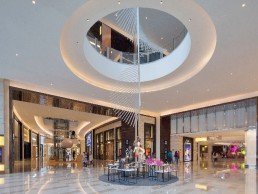
T Galleria, Macau
City of Dreams is an entertainment resort, leisure and entertainment destination located on the Cotai strip in Macau, China. Developed, owned and operated by Melco Crown Entertainment (MCE) the property currently features a 420,000sqft casino, with 450 gaming tables and approximately 1,300 gaming machines; over 20 restaurants, various entertainment options including the House of Dancing Waters, one of the largest aquatic themed live theatre shows in the world, soon four luxury hotels with 2,200 rooms and, since December 2016, a 400,000sqft luxury shopping experience exhibiting an impressive array of some of the world’s most sought-after retail brands. This retail experience, T Galleria, is a sophisticated department store concept created, managed and operated by DFS, a leading international luxury travel retailer.
Opened in phases between April and December 2016, the City of Dreams’ T Galleria - the one-mile-long retail complex consisting of two beauty and fragrances halls, two fashion and accessories floors engulfing a central male and female shoe salon and the watches and jewelry boulevards - surround the central casino and create a 24/7 pedestrian link to the hotels, leisure and public areas, forming the largest luxury retail complex in southern China.
The lighting design development started in 2013, leading to a nine-month staggered opening throughout 2016. DFS’ client brief asked for a contemporary, high-end, sophisticated department store with a residential feeling throughout different neighbourhoods - focused zones of related merchandise - as coined by the interior architect team of Charles Sparks. To deal with the immense scale of the property (with ceilings up to 21-metres) the first steps of the lighting concepts were to apply urban planning principles of vistas, landmarks and elaborating the sense of space. Large light feature objects and walls were developed and strategically placed, creating a sense of rhythm established by deliberately darker zones in portals, dissecting the long boulevards into a navigable human scale of smaller side streets. Each neighbourhood has been distinguished by special ambient light colours and different lighting methods in contrast to the neutral piers between the shops. This visual dramaturgy for an intuitive, relaxed and free orientation through the multi-storey retail complex has been further expressed in a design language unifying the different brands by architecturally integrated shop frame lighting, which establishes warmth, rhythm and vertical lighting. Combining architectural lighting integration with continuous perimeter cove lighting and low glare, minimally intrusive, non-technical looking pinhole downlights, a relaxed peripheral perception and intuitive orientation of the customer was promoted.
Most theme-based lighting integrated landmarks and features, allowing further differentiation of the various neighbourhoods, were developed until detail design but for budget reasons were superseded in the building process by more flexible visual merchandise, art and design installations. Also, the lighting was adapted post opening to a mainly track and spot approach, serving the intended visual merchandising retail theatre.
Due to the nine-metre corridor ceiling height in the fashion area, and the wish to simplify the electrical installation throughout all parts of the store, Lichtkompetenz designed an LED pinhole downlight family (bespoke by iGuzzini) to further help a uniform, non-technical and glare-controlled appearance, safeguarding visual comfort and residential feeling in all ambient and retail areas. ‘‘Designing our own visually consistent downlight series was a necessity,’’ said Jörg Frank Seemann, Lighting Design Director, Lichtkompetenz. ‘‘Not only to react to budget constraints and different lumen packages provided by the same outer fixture appearance over the different ceiling heights from two, seven to nineteen-metres, but mainly to allow for well-balanced contrast ratios of artificial product, ambient and natural lighting to help guide attention (lux levels & light temperature).’’
The nature of the collaboration between MCE and DFS required an immense amount of coordination, clear budget control and five months of alternative lighting reviews with Chinese lighting manufacturers. This involved a lot of budget weighing and the celebration of the luxury goods with excellent quality of light for true colour and material perception, enhancing and respecting the human perception with mild colour temperature contrast and high colour rendering in mind. After all, lighting a Jimmy Choo with CRI 80 is simply not an option.
‘‘These bespoke work horse fixtures also allowed Lichtkompetenz to keep within the lighting power density standards of the LVMH sustainability requirements for each ‘maison’, i.e. the standards our client DFS has to meet,’’ explained Seemann. Whilst reducing maintenance and energy costs, it further supported the dimmable day and night scenography (control system) in the clock-free casino environment under the burning sun of Macau.
Where during day time the three-storey main atrium - housing southern China's largest male and female shoe salon and a restaurant arranged around a grand staircase - receives up to 16,000lx of daylight through a curved glass roof, designed by the base built and coordinating architects Woods Bagot, the ground floor woman’s shoes department display still needed to attract attention and not appear like a cave. Therefore artificial lighting intensities double during the day, whilst at night time less light is needed to cross the significant contrast threshold.
For its psychological and energy saving benefits, Lichtkompetenz embraced the intent to use daylight as part of a well balanced visual atmosphere and developed light guiding and shading louvers with integrated artificial lighting under the twenty-metre-long skylight, which had to be omitted in construction stage due to cost savings.
Moving towards a consistent day and night appearance, promoting a sense of height and luxurious spaciousness, the 21-metre high Esplanade ceilings day lit via clearstory windows were intended to show the same effect during night time with the help of concealed indirect artificial uplights. Provided in different light qualities and intensities, these luminaires enrich the space throughout the evening, starting at a 6,000K and ending at 2,700K at sunset, uniting with the overall ambient lighting.
Indirect cove up-lighting at the lower levels void perimeter balances the brightness of the day-lit Esplanade ceilings.
In other daylight openings, the artificial lighting was intended to mimic the naturally given direction of light (central court glass roof), or vertical emphasis, to pattern walls, simulating a daylight effect by the employment of light slots and floating ceiling effects to create suggested architectural lightness.
Upon reflection, Seemann concluded: ‘‘Throughout three and a half years of budget and concept changes of sixteen tender addendum packages, our testing and ongoing physical testing and virtual lighting mock ups, it was ensured that the product is the most important element; illuminated in appealing colour temperatures and in line with human perception of visitors and workers so that the slots can keep ringing, fountains flowing and lights beaming - outside.’’
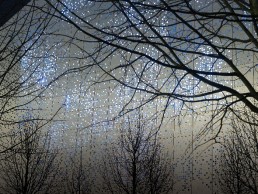
Théâtre de Sénart, France
The new Théâtre de Sénart is both a national stage and a major cultural centre for the region of Grand Paris Sud in Évry on the outskirts of the French capital.
Designed by chief architect of the project Atelier d’architecture Chaix & Morel et associés, an astonishing silhouette of 10,600sqm (6,400sqm footprint) that rises 29 metres in height emerges from the retail park Carré Sénart.
In plan, the building respects the square geometry of the site yet breaks out in volume through its differing heights and its diagonals. The theatre envelope adheres to the internal volumes, like a sculpted block, to give the building its identity and unity whilst revealing its constituent parts. The main forms that emerge are recognised by the space they accommodate: the large auditorium with its fly tower (29m high) alongside the simple shape of the open stage, small auditorium.
This single form unites the volumes to create a coherent and strong image within the site. The theatre possesses a morphology, at the same time complex and hierarchical with its reliefs in balance, whilst playing with the dynamism of the diagonals. This architectural device imposed itself; an independent, iconic building that serves as a new landmark, a signal within the landscape. From a distance, like a large ship in full sail, the isolated theatre silhouette punctuates the horizon.
The envelope of the building is a fundamental and emblematic element of the Théâtre-Sénart project. When seen from afar on the vast Carré Sénart plain, it needs to be given special attention. Nothing should emerge from this spectacular volume. Installed between the waterproof roofs and the external perforated skin, the technical plant and ventilation ducts remain invisible.
The envelope fabric, whose joints fold continuously in façade and roof, gives form to a monolith that suggests the volumes of the auditoriums within. The square, the structuring geometry of the Carré Sénart and its grid, has been exploited in three ways: two perforations and one stamp size. When deployed in eight configurations applied to each side of the cladding, the dispersion of the different perforation sizes projects graphic variations.
The grey pre-lacquered aluminium skin is randomly stamped and perforated with a grid of 1500x1500mm panels. Stemming from standard metal cladding techniques, this system has been adapted to the entire envelope. The size and spacing of the perforations were studied so as not to weaken the panels whilst, conversely, the stamps reinforce its rigidity. The soft, grey shade is very close to the natural anodized colour.
A pre-lacquered PVDF layer gives a reflective finish. As the indirect LED lighting system is installed under the skin, the grid of small perforations lets light pass to create a vibration. These scattered sequins give movement and vibration to the envelope to metamorphose the building at night.
Focused on an energy efficiency strategy, the Chaix & Morel sustainable development approach for the project addressed two issues: a bio climatic approach that, in priority, naturally achieves as many building functions as possible: building orientation, quality outdoor spaces, natural lighting, sun shading and natural ventilation; and an energy support systems concept that favours the use of a high performance plant - insulation and energy consumption controlled primarily by a high performance thermal envelope with external insulation.
Enhancing the sustainability, the lighting concept was a collaborative effort between French lighting design practice Atelier H. Audibert and Chaix & Morel. The exterior lighting design is delicately dynamic. The façade reveals a myriad of abstract cloud-filled skies. To create this effect, Atelier H. Audibert designed a set of dynamic LEDs between perforated double-surfaces. The massive scale of the façade is large enough to give the illusion of creating movement as that of a giant low resolution video screen. By showing faint, yet readable images for those who stop and take a moment to look, Atelier H. Audibert wished to bring a poetic vision to the new Théâtre de Sénart at night.
The idea behind this project is to transform the façade into a transparent-like structure through which a cloud-filled sky crosses. The sheer mass of this diurnal vision turns into an empty envelope welcoming the sky.
The exclusive use of Philips Color Kinetics iColor Flex LMX, flexible strands of large, high-intensity, full-colour LED nodes designed for extraordinary effects and expansive installations without the constraints of fixture size, shape, or space, make for an uncommonly simple implementable installation and very easy to maintain. Each iColor Flex LMX strand consists of 50 individually addressable LED nodes, featuring dynamic integration of power, communication, and control. The flexible form factor accommodates two- and three-dimensional configurations, while high light output affords superior long-distance viewing for architectural accent and perimeter lighting, large-scale signage, and building-covering video displays. The overall power used to create the façade lighting is 2,000 watts, equivalent to the energy consumed by just two household irons.
An extensive island of greenery of almost 500sqm that provides light and natural ventilation, the patio area is located in the centre of the complex. It serves as a transversal, light-filled lobby within this deep building. Located between the public and performer spaces, it is accessible from either the foyer or the corridor alongside the small auditorium.
Located within the Théâtre-Sénart complex, the 227sqm partitioned restaurant area that operates independently from the theatre, is extended by a large, protected outdoor terrace on sunny days. The restaurant kitchen is 97sqm in area.
Depending on the chosen configuration for each service, the restaurant accommodates up to 100 persons seated, excluding the terrace space. Both bars are integrated within the theatre foyer and on the first floor concourse to operate before and during performances.
The foyer that comprises different functional spaces (reception desk, bar area, restaurant and bookshop corner), on the south façade opens onto the parvis (the enclosed area in front of the building). Designed as an architectural promenade, this linear and fluid space is planned as a gallery, an internal street 80 metres long, about ten metres wide. Internally, rough concrete is dominant, punctuated by contemporary way finding. The space is homogeneously illuminated by recessed LED fixtures producing a subtle, delicate scheme accentuated by spotlights and natural light. The different elements of the space are highlighted with LED spotlights that provide a depth of field.
