
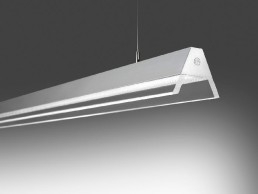
3F Filippi 3F Mirella
Essential and at the same time refined, 3F Mirella is a suspension luminaire, consisting of an aluminium body that houses the LED technology and a methacrylate shaped volume that leads the luminous flux. Available in various versions and finishes, it is designed to fit discreetly in rooms. The integration of the two elements allows the visual perception of the lamp in the space to change during the day.


Self MULTIFRIO
A multi-functional product, MULTIFRIO was designed to satisfy lighting requirements for all types of retail cooler and shelf systems. Its modular structure satisfies various requirements of length and height to suit application. Only 1.4cm thick, MULTIFRIO is available in 300, 600, 850, 1,200 and 1,700mm lengths, which can be combined to provide a flexible solution. Adopting wall-wash technology in its optical design, MULTIFRIO generates homogeneous light rays. Optimised CRI and colour temperature highlights product’s natural colour, providing a more inviting retail space for customers.
Ansorg Coray Family
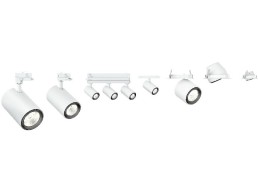
These recessed, surface-mounted and semi-recessed spotlights cover, individually or as a group of three, all applications, from large hall lighting to showcase illumination. With horizontal, 360° flexibility with maximum pivotability, Coray luminaires can be adapted to every lighting situation. The variety of models within a product family in the sizes small, medium and large as well as the use of different reflectors, glasses and films ensure the best possible light distribution with brilliant quality and excellent colour rendition.
Thorn Tonic Family
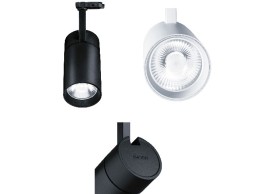
The Tonic family boasts CRI >90, so true colours of in-store displays and products are vibrant and vivid. With their minimal tubular appearance, the family has a common aesthetic, making it easier for designers to create consistent looks. Thanks to its LED technology and efficient optics, Tonic achieves high efficacy of 90 lm/W, meaning savings of more than 40% compared to 35W and 50W metal halide fittings. It is available in warm (3,000K) and neutral (4,000K) colour temperatures, with lumen packages of either 1,800lm or 2,800lm.
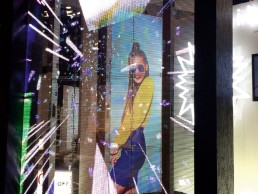
Unibox Kino
Kino is the latest innovation from Unibox, retail display specialists. Ideal for eye-catching window and in-store displays, Kino is a transparent video screen with programmable LEDs that have been designed to provide both high-quality video content and transparency - drawing shoppers to latest products and promotions without blocking sight lines.
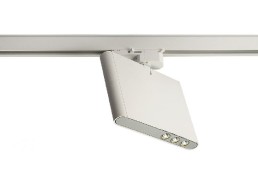
HALLA VIMA
Designed by Serge Cornelissen, VIMA is a professional LED projector with the integration of state-of-the-art LED components. The design is the result of an innovative layout in which the LEDs, heatsink and driver are arranged asymmetrically on the same level. The luminaires can be equipped, in addition to highly luminous LED, with a colour rendering index of Ra>80 or Ra>90 as well as with LED sources with RealColour technology ensuring a high rendering index of Ra>97. RealWhite technology for white colour, or a wider range of StrongColour variants for specific requirements.
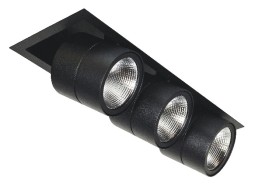
Fagerhult Touch range
Fagerhult’s Touch spotlight range offers flexible and sustainable options for shop lighting. A stylish luminaire that will fit smoothly into any retail environment, Touch is dedicated to highlighting retail merchandise. Its LED-module is characterised by a pure, white light offering brilliance and excellent colour rendering. With track mounted and recessed versions in alternative shapes, it can be used on three different track systems: standard 3-phase track or Fagerhult iTrack and Control track – the latter two intended for DALI. Touch comes in black, white and grey.
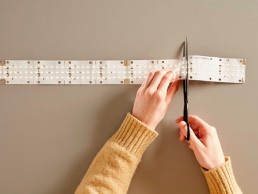
Cooledge LINE
Designed for fast, simple, and foolproof installation without specialised training or tools, LINE can be trimmed to length onsite for the perfect fit. Its Constant voltage design means that the same LED driver can power up to 20’ (six-metres) of LINE and that layout changes required to meet onsite conditions don’t require resizing power sources.
It also has typical 2 SDCM colour consistency and a standard CRI >80.
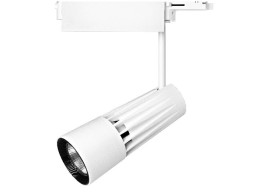
Lledó Carson/Logar family
The Carson/Logar family is a range of accent lighting for retail environments. Incorporating wall, surface, track and suspended models, the range features a compact form and PHI- reflector technology for precise concentrated light beams with minimal dispersion. With a CRI >95, a textured lens ensures colour consistency in the beam, regardless of LED emission angle. The range is flexible, ranging from 16W to 57W, with beam angles from 8° to 41°.
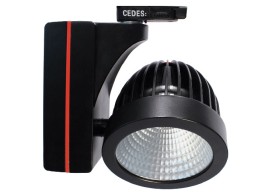
Cedes Celed RGBW
Celed RGBW spotlights can stage light variably, making it particularly suitable for shop windows. RGB and neutral white are combined on a COB, meaning the four-channel COB not only contains the red, green and blue, but also a white LED chip as a light source. By adjusting the three primary colours and different intensities, each colour nuance can be realised up to white. However, since the white produced is not pure white, white LEDs have also been placed in the RGB LEDs. This allows rooms, backgrounds or objects to be illuminated in white or coloured light, depending on the desired mood.

Rune Marthinussen
Rune Marthinussen, CEO of the Scandinavian group of companies, Glamox, discusses its business strategy moving forward and looks back at 70 years of history.
What is your role in Glamox and how did you get there?
I have been leading Glamox for almost two years now. With a mechanical engineering background, I started my career as a development engineer building subsea oil production systems at Kvaerner. I worked almost fifteen years for Kvaerner and as my last assignment was running the thermal power division. In 2003, I started as MD in Titech, a leading supplier of sensor based automatic sorting machines for recycling plastic and paper. The company was acquired by Tomra, and the business was expanded globally through strong organic growth and key acquisitions to become one of two divisions in Tomra. It was probably my international industry experience that earned me the CEO position in Glamox.
This year Glamox celebrates its 70th anniversary. Can you give us a history of the company and how it all began?
Glamox was founded in 1947 by the Norwegian civil engineer and entrepreneur Birger Hatlebakk. Hatlebakk is known for inventing the “glamoxation” process, a method for electrochemical surface treatment of aluminium. This process allowed Hatlebakk to use an inexpensive type of aluminium to create energy efficient luminaires that emitted a pleasant light. The invention proved to be a crucial asset for many years to come. In the following years a number of successful lighting products were developed, and a purpose-made factory was built in Molde, Hatlebakk’s home town.
Since then, Glamox has expanded its business throughout the Nordic and North European professional building market, and we are recognised as one of the leading companies within this market. We made luminaries for fishing boats as early as the 1960s, and we started deliveries to the offshore industry in the 70s. Our marine and offshore business now has a global reach and we are covering a wide range of applications in the cruise, navy, commercial and offshore segments. Today, Glamox has 1,300 employees with operations in 60 countries. I find Glamox a great place to work. We have dedicated and skilled employees in all parts of our organisation.
The Glamox Group owns a range of lighting brands. What are they and what markets do they service?
Currently we offer six product brands targeting different needs in the market.
Glamox is a leading lighting brand for professional markets, onshore and offshore. The rich assortment of Glamox products is available for a wide range of applications – including challenging environments.
The Luxo brand comprises mainly arm-based innovative, ergonomic lighting products. Luxo products improve lighting conditions, taking particular care of individual needs.
Norselight is a world name for search light systems that work reliably under extreme conditions, adding to safety and security at sea.
Aqua Signal has been delivering marine lighting solutions since before the age of electricity, providing lighting products designed and manufactured to meet all relevant standards for quality and performance at sea.
The Høvik Lys brand represents lighting products made with high quality materials and with exclusive finishing details that grace elegant buildings and vessels with their pleasant light.
LINKSrechts offers a comprehensive range of naval LED lighting systems, including design, integration and programming. The product range consists of specialised lighting products for all naval applications, including naval aviation.
You acquired Luxo in 2009. What was the strategy behind that decision?
Luxo was, and still is, a well-established and reputable brand. The acquisition gave us better access to parts of the market, and products that complimented the portfolio we already had.
Are there more acquisitions to come?
In 2015 Glamox acquired the Dutch company Bell Licht. Bell Licht had at the time been responsible for sales and distribution of Glamox products for more than 30 years. German LINKSrechts was acquired in 2016. LINKSrechts manufactures advanced LED-lighting systems for the navy industry worldwide. This goes to show that we are always interested in strengthening our position both when it comes to markets, products and technology.
What is the strategy of Glamox going forward - particularly relating to LED and control?
Since 2012 we have almost exclusively been developing LED products. The LED share is increasing and now constitutes more than 80% of the turnover in some markets. Glamox has been supplying lighting management systems for some time, but we expect that Light Management Systems (LMS) will make up a larger part of our deliveries in the years to come. LMS offers our customers an opportunity to reduce energy consumption and at the same time increase comfort and productivity. Human Centric Lighting (HCL) is also a technology of high interest to us. We believe that HCL can improve health and wellbeing in institutions as well as workplaces. Glamox has in recent years supplied HCL lighting to several schools and health institutions, and we are also engaged in scientific research on this topic.
How do you see the lighting industry developing in the future?
We currently observe a consolidation process in the lighting industry. At the same time we see new companies entering the market with interesting value propositions and business models. In the aftermath of the LED transitions, we see a whole range of new opportunities appearing as different technologies converge into new lighting applications and services. Connectivity, Light Management Systems, Internet of Things are buzz words today, but they will change our lives and the industry in the future.
What do you do outside lighting?
I enjoy biking in the summer and snowboarding during the long and fantastic Norwegian winter. However, my biggest dedication outside Glamox is big band jazz music. I have played trombone since I was a kid and played the bass trombone in Røa Storband (Big Band) since 1994.

Domingo Gonzalez and AC Hickox
Domingo Gonzalez and AC Hickox share leadership of New York City-based Domingo Gonzalez Associates (DGA), now in its 32nd year as lighting design consultants. Both principals are a study in contrasts, as is their firm. Gonzalez studied and practiced architecture; Hickox was a theatrical lighting designer. Their bright and airy top fifth floor studio is located in a modest vintage building on Park Place in the city’s financial district where a visitor has to look closely not to miss Number 25.
They credit a mix of public and private sector commissions as one of the reasons that their firm has grown to its current number of 20 designers and support staff who are involved in numerous projects around the country. “Both of us have been through a number of recessions in our careers,” says Hickox. “We consciously work to maintain a diverse practice and project mix,” she points out. “While we have most often been associated with high-profile public sector commissions, we welcome private sector projects by taking on just about any and all opportunities that land on our front door.”
“Quite frankly,” Gonzalez indicates, “when we are asked, ‘Can you help us with this?’ we say, ‘Yes, sure.’ We’ve found that our ability to say ‘yes’ has made for very interesting experiences that have been rewarding over the years.”
Their primary practice areas are education, transportation (Hickox is a long-time train buff), historic preservation (a favorite of Gonzalez), corporate, and landscape projects.
“When examining possibilities on any complex project, there is a certain amount of drilling down that we often have to do,” Gonzalez believes. ‘‘In many ways, the right lighting solution starts with familiarising ourselves with the project typology. This strategy explains our interest in understanding why and what is most appropriate to a given kind of project. Simply stated, the way we approach a school is not the way we address an airport. The way we approach a hotel is not the way we plan for a library, or a medical project,” he explains. ‘‘The final product is often a result of this investigation, combined with an understanding of technique, technology, sustainable goals, budget, and identifying the owner’s particular interests.”
Hickox had been a theatrical lighting designer before joining DGA in 1999. ‘‘I grew tired of solving the same stage lighting problems over and over,” she states. As a result of this, she decided on transitioning to architectural lighting design and accepted Gonzalez’s offer to become a full-time member of DGA.
“As an architect-led firm, we have a deep interest in buildings and how people will experience the lighting in those buildings,” Hickox points out. “We are very architecturally focused, individually and as a firm,” she says. “Domingo and I have a similar problem-solving approach even though we have very different backgrounds. We both want to understand a project’s constraints and use those constraints as jumping off points for problem solving,” she notes. “Within our body of work, we do have our technical side. But we pay a lot of attention to understanding the character and identity in a project that is not only appropriate in expression but also wonderful to experience.”
Gonzalez has long been fascinated with the many paths leading to becoming an architectural lighting designer. “Educational programs in architectural lighting design were quite unknown to me when I was starting out in practice 38 years ago. At that time,” he explains, “there were no front doors to architectural lighting…there were only back doors and side doors. Today, because of excellent educational programs such as those at Parsons, Penn State, and the Lighting Research Institute at RPI as well as several programs in Europe, there are now many front doors where young people can actively pursue their interests in this field that weren’t available before.”
Hickox agrees that the firm’s staffers who are trained as architectural lighting designers…‘‘can really perceive light, and apply it to their projects. Our staff is the best! We have a remarkable group of dedicated lighting designers who can problem-solve, render, calculate, illustrate, and detail. Domingo and I have worked very hard to provide opportunities that nurture a very fine group of excellent professionals.”
Gonzalez enthusiastically agrees: “Our interns are fabulous! We have a core group of interns, many of whom started while still in high school. One young lady interned for five years here when in high school, and then went on to study at Cooper Union. She stayed with us for a year afterwards as a junior designer, and then went to Harvard. One of our current interns joined our firm while in high school and is now in his fourth year of architecture school. We like to consider local colleges in our region so these students can work with us in the summers and over winter break.” DGA is also involved with intern programs around the country, having hired students from Northeastern University in Boston, which has a cooperative school/work program.
Staff participation in every aspect of the design process is a critical part of DGA’s project approach. “We try very hard to not pigeon-hole people,” Gonzalez comments. “We will play to their strengths, of course. However, we want everyone to become highly skilled practitioners so they can advance to larger projects and management roles. Our ultimate goal is to cultivate a very strong cadre of well-rounded, ambitious designers.”
Senior designers actively engage with clients during the course of a project. “We are normally there just as back-up,” says Hickox. ‘‘When they need reinforcements, they are free to call Domingo or me. They know they have the ability to handle all phases of the project, win the award, and are responsible to keep the firm moving forward,” she relates. “Much of my time is spent making sure that the staff is properly supported, and that impeccable documentation is executed.”
DGA has created an in-house training program that Hickox describes as robust. “With all of the changes in technology—from conventional legacy lighting sources giving way to LEDs to wireless controls and the on-going evolution of energy codes—there is a tremendous need for continuing education,” she states. “We sponsor brown-bag lunches to understand such factors as optics that are changing with the new technology on the market. So we all have a lot to learn.”
Such ongoing support prepares staffers to maintain involvement with the firm’s often challenging, long-term large-scale projects. Over the years, DGA has completed more than ten million square feet of corporate offices, numerous historic restorations, plus several bridges, schools, and public sector projects that can extend into decades. The firm began work on the 85-acre Brooklyn Waterfront Park in 2003 and is still in the process of a phased completion. The Hyatt Times Square Hotel, which underwent several operational changes, took seven years before opening. The East Side Access project started in 2000 and won’t open until 2019. The re-lighting of Bryant Park in Manhattan extended from 2005 to 2013.
DGA designers bring a very active participation presence to the design process. “We are relatively fearless when it comes to generating ideas, and speaking up on the merits and challenges of certain approaches,” Gonzalez affirms. “We appreciate being engaged in projects from the beginning. We offer expertise and opinions to realise the lighting potential.”
A favorite DGA technique is helping clients to understand a project by generating multiple options, sometimes well over a dozen. He cites the belief that there is not one answer to solving a problem. “Discussion of the alternatives for lighting opens a productive dialogue about what is good, better, and best… examining the costs, constructability, procurement, and other factors so the client can make better decisions. Mock-ups are a critical part of this process in helping them, and us too, to better visualise final results.”
Current projects include finishing touches on NYC’s Second Avenue Subway, now carrying passengers after 156 years of planning, designing, modifying, and updating the design, followed by years of construction. The lighting program included lighting for all four stations plus illumination for the art works in the line’s stations, commissioned by the Metropolitan Transit Authority’s Arts and Design Division from such notable artists as Chuck Close. Other current projects include the upgrade of the c.1919 Brooklyn Army Terminal by famed architect Cass Gilbert who also designed the Woolworth Tower. Other assignments include upgrades to La Guardia Airport, and projects in Washington, D.C., Florida, Tulsa, Burlington, San Antonio, and several large-scale park projects in Chicago.
Sustainability is a large part of the DGA process. All DGA staffers realise the importance of sustainability and most are accredited. According to Gonzalez, the sustainability movement has provided a common language to help designers to educate their clients and has propelled the evolution of code updates. As for the advancements coming thick and fast in LED, he calls it “astonishing. Usable innovation in lighting used to occur once every 24 months. Today, it’s more like once every 24 weeks, or even 24 days.”
Gonzalez cites one important tenet of good lighting that hasn’t changed is to create outstanding lighting installations based on the principle of simplicity and consistency of elements. “It’s like cooking… making a fabulous meal out of very few ingredients. I like to think that everyone’s mother had this sort of talent (mine certainly did).”
In his estimation, a true test of lighting skill is the designer who can work with anything that is dependable and produce excellent results. “Consider the subway projects we completed for Second Avenue that relied on just two types of fluorescent lamps. Despite this apparent limitation, the result has drawn considerable praise, and has become a source of inspiration for the firm’s future. Everyone shares in its success.”