
Light Trend, France
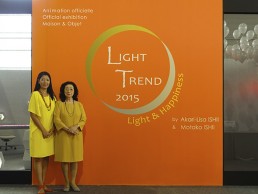
Maison et Objet Paris 2015 saw Japanese lighting design team Akari-Lisa Ishii (daughter) and Motoko Ishii (mother) present the latest trends in lighting, after the success of their previous exhibition at the show over the past two years.With M&O’s redesign and new target marketing, the importance of lighting is prominent, notable in the wide coverage given to lighting designers in the thematic exhibition of their designs. The Japanese duo’s stand Light Trend was placed in the 'Projet' hall, along the red carpet linking the must-see stands throughout the fair.
With increasingly evolving technology, lighting plays an ever more important role in interior design; Light Trend aims to present the latest technologies in lighting while suggesting integration of light and fixtures in a space. The different spaces presented live exclusive lighting experiences comprised through a collaborative effort between lighting manufacturers and designers. Under the sub-theme of happiness, Light Trend strives to bring happiness to the heart, body and environment in honour of the UNESCO International Year of Light and M&O’s 20th anniversary, to be shared with leaders of light and guests within the field of lighting design from all over the world.
Light Trend consisted of seven rooms, presenting different approaches to the pursuit of happiness. Visitors walk through each one, experiencing diverse expressions of light throughout. The first room, titled <em>'Perception of Happiness' featured a video realised by I.C.O.N., Akari Lisa Ishii’s lighting design office, and Motoko Ishii Lighting Design, demonstrating the relation between facial expressions and light, using a Japanese mask of Noh as an example. In this space several lighting fixtures were presented to create a cheerful effect, with Artemide’s Cata and Picto lights behind the reception desk, and Artemide’s acoustic Egg Board to reassuringly stifle aggressive noise. The room also featured Artemide’s Spectral Light, a multi-coloured conceptual light object dedicated to well-being based on the concept of perceptible wave length of light.
The second room then focused on 'Happiness to the eyes'. Here, organic LED (OLED) presented a colourful light composition manufactured by Sumitomo Chemical, showing the word happiness, using exclusive technology to create dual-colour OLED panels. Moving through to the third room, 'Happy Time!', guests were greeted with a colourful lighting effect through ERCO's Cantax RGBW and balloons, while tasting sweets and sparkling drinks to activate the brain and complement the cheerful ambience.
In the fourth room, 'Do I look happy?', guests were given the opportunity to experiment with how the angle of light cast across a face can affect mood and attitude projection in diverse scenes in daily life, demonstrating how light influences the way we perceive and are perceived by others. Lumenpulse Alphaled Spot Apto shone down above the guest, standing in front of a mirror, watching the way the shadow changed.
'Mental Happiness', the fifth room, featured a meditating room that used KKDC lights of soothing colours and healing music within an aluminium structure developed by Technilum, filled with Shiseido perfume to enhance feelings of mental happiness and tranquility. The sixth room focused on the idea of SOHO (Small Office Home Office) systems, titled 'Environmental Happiness'. This room presented propositions of lighting products by Okamura and Stanley Electric launched at M&O that aim to balance the productivity of a working space while maintaining the comfort of a home.
The seventh room by the name of 'Technology and Happiness', used an interactive control system linked to a moving detector and an original chandelier, custom-made for M&O, demonstrating previously unseen lighting effects, all manufactured by Stanley Electric. This room also included educational demonstrations of tips on lights in interior design, such as colour temperature and colour rendering.
With all rooms designed by the mother and daughter duo, Light Trend presented a variety of applications in architectural lighting with a focus on its human importance in emotion and impact. The exhibition was a collaborative effort between leaders and trend setters in the field, and stood as a strong exhibition along the red carpet of Maison et Objet.
All pics courtesy of I.C.O.N. and Motoko Ishii Lighting Design

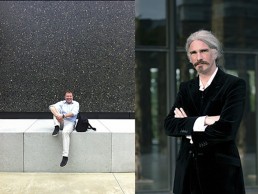
Rik Nys and Alexander Schwarz
David Chipperfield Architect’s portfolio of international work spans over 30 years with examples of their prestigious buildings found in diverse nations from Mexico to Sweden. With offices located in London, Berlin, Milan and Shanghai they are well placed to deliver their expertise globally.
The Berlin practice has recently been highly acclaimed for the renovation of the culturally significant Neues Museum in Berlin; an intricate and difficult project, which took over twelve years from start to completion. It boasts some of the most carefully considered and beautifully detailed design ever seen in a museum refurbishment project; all of which works to deliver impressive, flowing and tactile spaces glowing with natural light. It is this very specific approach to light as an intrinsic part of architecture that can be argued as breathing life into DCA’s designs.
The Berlin office is now working on another renovation project for Die Neue Nationalgalerie from Mies van der Rohe, also based in Berlin. This is one of Germany’s most important contemporary art galleries and a jewel of late modernist design in which the play of light, shadow, space and the structure of the building are as important as the exhibits. The practice admits to having a democratic and consensus approach to the design of their projects, which is promoted by David Chipperfield himself. This is facilitated through specific team structures that help to deliver clarity of communication. Each office around the world is staffed by architects and support staff but led via a team of directors who shadow and enable the project managers and architects in their work. Many of the directors have unusual and diverse backgrounds, which help the offices with the delivery of their specific approaches to design. I spoke to Design Directors Rik Nys, from DCA London and Alexander Schwarz from DCA Berlin to try and find out how they work with light as part of their architectural palette.
Schwarz originally trained as a violin maker, but despite being rewarded and happy in this profession, found it lonely and partly based in a bygone time and culture. He wanted to extend his expertise to deliver more holistic and universal designs, so decided to study architecture in Stuttgart at the ETH Zürich (Eidgenössische Technische Hochschule). It was in Stuttgart where Schwarz met Chipperfield who was working as a guest professor there and asked Schwarz if he would like to join his practice. In 1996 Schwarz went to work for DCA in London on the competition for the Berlin Neues Museum. After winning the competition he moved to Berlin in 1998 and became one of the founding members of the Berlin office. DCA was the first architectural practice that he had worked for and he found this experience, together with that of the design for the Neues Museum, as life changing. He describes the design process for the museum as being like a ‘second study’ for all the designers and the museum directors who worked on it, and seminal to the definition of the DCA office culture and attitudes.
When asked about the most interesting and influential projects for DCA in terms of lighting design Schwarz cited the Neues Museum, the James Simon Gallery and the Gallery building ‘Am Kupfergraben 10’ which are located near to the Neues Museum in Berlin; but also The Hepworth, Wakefield gallery in West Yorkshire, UK, the Museum Folkwang in Essen, and from a personal perspective the Museum of Modern Literature in Marbach am Neckar; which is located near to his home town, and is the birth place of Friedrich Schiller and houses many of Kafka’s original works, including ‘The Trial’.
Schwarz considers daylight to be the most important form of architectural lighting with it often acting as the richest material. He believes it to be at the core of architecture and the most interesting phenomenon with its ever-changing fluid nature lending the experiential qualities to space and the perception of the architecture. In the context of the Neues Museum, it is used with subtlety to help guide visitors through the exhibition spaces enabling them to democratically choose how to view the exhibits without being specifically directed. He sees this approach as particularly successful in the Egyptian courtyard where the valuable Armana collection is displayed.
Schwarz considers that careful modulation of both natural and artificial light are important when defining and controlling space, right through from the skin of the building to its interior. He describes the recycled glass cladding of the Folkwang museum as having a special quality somewhere between that of glass and stone as it “kind of eats up the light and then radiates it back”. In the Museum of Modern Literature, lighting is used sparingly to protect the valuable manuscripts but also to create the appropriate contemplative atmosphere. He believes that lighting defines the mood of a space and that “if you light a room well, a person and the art can be seen in the same light”.
Achieving the specific lighting in a building requires attention to its material qualities and working with those who understand them. DCA have often worked with engineers Arup in the UK and Germany to achieve this, and with key designers such as Andy Sedgwick, who Schwarz describes as “being a pleasure to work with”.
Schwarz’s experience as a violin maker taught him the process of making, and gave him an understanding that architecture is also about making things albeit doing so in a dirty and heavy environment with a specific palette of materials including light. He believes that in this environment you must discover where the boundaries lie; learning to work with and love these boundaries thus defining the limitations of architectural possibility and the starting points for creation; bearing in mind that these boundaries are culturally specific and need to be respected. Any battles waged to be carefully chosen.
DCA’s approach to lighting design varies according to projects and within the different offices and as relevant to the design brief. The London office is now working on retail projects including the refurbishment of and design of new space for the Selfridges department store on Oxford Street, London. According to Rik Nys, Design Director in London, this project requires a number of different design solutions including those for shop windows, which interface with the street and connect the merchandise environment with customers and the products available inside. Within the retail space, market streets are created to connect specific brands and sales messages using material and light to sign routes and directions through the store. The aim of this is to create holistic identity but not to override individual brand identities. Here design is often used to focus attention and provide orientation.
The contrast of light and dark, umbra and penumbra are allowed to define space using a variety of different lighting fixtures and luminaires but also importantly natural light. Nys who said: “and when I say light, I almost always mean natural light,” is adamant about the importance of daylight as part of architectural design.</p> <p class="p1">Similar to Schwarz, Nys has an unusual and varied background; as a Belgian he studied architecture in Ghent, Louvain and at the Architectural Association in London. He also studied history and philosophy and has taught extensively in schools of architecture. Again like Schwarz and the DCA approach, he champions an understanding of the processes involved in actually making things as integral to the production of good design. This vitally includes for the building of scale models of buildings and building components which can be used to tangibly understand space and model light together with other aspects of a building’s design such as façades and shading etc. Such models are also important to communicate designs and design intentions to clients and are often much more useful than digital models in achieving this.
Nys admits that creating the desired lit environment for a space also often requires the production of special luminaires and to do this DCA have built up relationships with a number of manufacturing and design partners including Artemide, Viabizzuno and Zumtobel. The production of such individual design items means that the identity of the architecture can be reinforced and supported, but also creates design items that can be used as part of other projects and potentially by other architects and designers.
Schwarz and Nys have different but similar ideas about the use of light in architecture, but their combined approaches start to describe an overall DCA philosophy. A central theme of this is the use of natural light as a key design material but also the use of intricate and careful details and a respect for cultural significance and meaning. Light is used to build architecture and experience, and to focus, guide and reflect attention within physical, emotional and intellectual space, allowing for relevant boundaries to be observed.

Barbara Horton
Barbara Horton, FIALD, MIES, LC, oversees five HLB Lighting Design offices around the US. She is president of the International Association of Lighting Designers, is a member of the Illuminating Engineering Society, serves on the Board of Directors of the Nuckolls Fund for Lighting Education, has served as a judge in the Next Generation Luminaires competition sponsored by the Department of Energy SSL Steering Committee, and is an affiliate member of the American Society of Landscape Architects. What’s Horton’s biggest challenge? “Time!” she answered emphatically.
In her role as president and chief executive officer of HLB Lighting Design, Horton combines a visionary perspective of the firm’s growth with a pragmatic approach to every design. Now, as president of the International Association of Lighting Designers, she is intent on giving a strong voice to all the organisation’s geographical components, and to gaining support for credentialing for lighting designers worldwide.
Horton, a native New Yorker, earned a degree in interior design at the Fashion Institute of Technology. She took on a temporary three-week assignment in the office of Jules Horton. “It stretched into three months, then three years, and now it’s been over 30 years,” she affirmed. Horton has maintained the high-energy profile that characterised the office that she initiated, and has focused on encouraging a firm-wide entrepreneurial spirit as a major factor in the firm’s growth.
With the opening this spring of the HLB office in Miami, the professional and support staff now numbers over 60, the largest independent multi-office lighting design consultancy in the US, with additional offices in New York, San Francisco, Los Angeles and Boston. Horton is a strong advocate of shared leadership. “If you want to describe our style, it is that collectively we are design and client-focused,” described Horton. “There are eight principals, they have strong input into go/no-go decisions in their offices for selecting work, design approach and managing their staff while working collaboratively among all offices,” she stated. Based in New York are Stephen W. Lees, Hayden N. McKay, and Lee E. Brandt; with E. Teal Brogden and Tina Aghassian in Los Angeles; Angela L. McDonald in the San Francisco office; and Carrie Hawley in Boston. Horton is leading the Miami office while based out of New York. The firm will invest marketing and promotional efforts in introducing the HLB Miami office to professional designers in the southeast market along with other markets in which it sees strong opportunities.
“Our principals are looking ten years into the future with continued opportunities for growth. To support this objective, the firm has built a strong support infrastructure, employing a human resources specialist and a national multi-media marketing and communications manager. A succession plan is in place along with a detailed ownership transition guide. Adherence to high design standards and operational decision-making are on a near-equal par on any business day,” Horton estimated.
Approximately 80% of HLB’s projects are commissions from architects and interior designers, with the balance from developers and owners. Currently, there are over 250 active projects on the books, ranging from lighting master plans for mixed-use environments, to airports and other transportation facilities, corporate offices, embassies, plus academic, hospitality, and retail projects.
The HLB staff is a mix of designers with backgrounds in theatre, architecture, interiors, landscape architecture, and engineering. “It’s important to plant the seed for the future of lighting design into design schools… making very apparent to the students what makes the lighting industry exciting and rewarding, and establishing a welcoming environment for new talent,” Horton emphasised. She has been an instructor in lighting design at the Parsons School of Design, where her objectives included exercises in abstract thinking, the introduction of a practical design process, and the importance of developing communications skills, which she feels is a necessary ingredient in making presentations that explain a concept to others on the design team and to clients.
She approaches her duties as president of the IALD with the same type of wide-ranging, encompassing, empowering style that distinguishes carrying out her company’s managerial duties. Horton consulted with past IALD presidents and asked them about experiences during their terms, posing queries relative to what they felt had been successfully accomplished, and what they would do differently if they could. She created a wish list aligned with the IALD plan of work, and at the top was encouraging an increase in involvement in sharing ideas and experiences from chapters located at considerable distance from North America.
“An important goal of mine is membership outreach,” she stated. To express her agenda to its best advantage, she would do it in person. She established a travelogue that took her virtually around the world: Berlin, London, Paris, Tokyo, Singapore, and Sydney and Melbourne in Australia, where she met with many designers. “In this way, designers everywhere get to relate to an individual and see the IALD as a community, comprised of others who have the same issues as you do. The IALD and its members can provide the information that can help the membership with solutions that apply to the ongoing success of their practices,” explained Horton.
The designer pointed out that the IALD’s global growth initiative started well before she became president. “We recognise that we needed someone who can be on the ground in various locations to facilitate communications and create the synergy locally. In addition to those in Chicago, we now have staff in the UK, Japan, and Brussels.” With the accelerated pace of changes in the industry, she foresees the need for open dialogue connectivity and a working feedback system.
Horton continued: “The IALD has many avenues to foster community ‘glocally’ as we like to say. The Enlighten Conference is a key component of our professional development and educational programmes for our members and is well established in North America, Japan and Europe, in addition to our partnership with Lightfair and alliances with many other lighting design-related and professional organisations around the world.”
Horton’s activism in the global approach to the practice of lighting design started when she joined the IALD Board of Directors in 2009 and participated in the movement to accredit lighting designers worldwide. “IALD members and staff began a taskforce to study the possibilities, joined by other industry organisations, to evaluate the pros and cons. This process led to us retaining a psychometric consultant whose expertise is to help organisations develop credentialing. There is universal agreement that lighting design is a complex undertaking, from energy conservation to the effects of light on health and wellness and the psychology of light, that needs to be addressed on a day-to-day basis. One of the first tasks was to define just what a lighting designer is.”
On-going recognition by designers is a major component for the establishment of credentials to gain recognition from authorities in the governing bodies in countries around the world. Horton emphasised: “I am hoping that within a few years we will be well on our way with both. The CLD program was launched just prior to Lightfair in May 2015, which gained greater exposure through open forum discussion and overview sessions.” There is an independent governance body and 30 international reviewers to evolve the program that will meet the needs of lighting designers world-wide.
“I admire the resolve of the CLD task force, governing body and thoughtful industry leaders for giving their time and expertise throughout the process, and on to its fruition,” concluded Horton, voicing a strong positive outlook for the success of the program.

Zaha Hadid announced as 2016 Royal Gold Medal winner
(UK) - The Royal Institute of British Architects (RIBA) announces Dame Zaha Hadid as first woman to be awarded the prestigious honour in her own right.
The Royal Institute of British Architects (RIBA) has today (24 September 2015) announced that the globally-renowned architect Dame Zaha Hadid will receive the 2016 Royal Gold Medal, the first woman to be awarded the prestigious honour in her own right.
Given in recognition of a lifetime's work, the Royal Gold Medal is approved personally by Her Majesty The Queen and is given to a person or group of people who have had a significant influence 'either directly or indirectly on the advancement of architecture'. Awarded since 1848, past Royal Gold Medallists include Frank Gehry (2000), Norman Foster (1983), Ludwig Mies van der Rohe (1959), Le Corbusier (1953), Frank Lloyd Wright (1941) and George Gilbert Scott (1859).
RIBA President and chair of the selection committee, Jane Duncan, said: "Zaha Hadid is a formidable and globally-influential force in architecture. Highly experimental, rigorous and exacting, her work from buildings to furniture, footwear and cars, is quite rightly revered and desired by brands and people all around the world. I am delighted Zaha will be awarded the Royal Gold Medal in 2016 and can't wait to see what she and her practice will do next."
Zaha Hadid said: "I am very proud to be awarded the Royal Gold Medal, in particular, to be the first woman to receive the honour in her own right. I would like to thank Peter Cook, Louisa Hutton and David Chipperfield for the nomination and Jane Duncan and the Honours Committee for their support. We now see more established female architects all the time. That doesn't mean it's easy. Sometimes the challenges are immense. There has been tremendous change over recent years and we will continue this progress. This recognition is an honour for me and my practice, but equally, for all our clients. It is always exciting to collaborate with those who have great civic pride and vision. Part of architecture's job is to make people feel good in the spaces where we live, go to school or where we work - so we must be committed to raising standards. Housing, schools and other vital public buildings have always been based on the concept of minimal existence - that shouldn't be the case today. Architects now have the skills and tools to address these critical issues."
Hadid's other awards include the Republic of France's Commandeur de l'Ordre des Arts et des Lettres, Japan's Praemium Imperiale and in 2012, Zaha Hadid was made a Dame Commander of the Order of the British Empire. She was made Honorary Member of the American Academy of Arts and Letters and Fellow of the American Institute of Architecture.
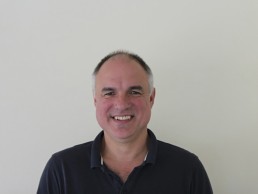
Architainment Lighting appoints new sales manager
(UK) - Neil Gamble brings extensive knowledge of the architectural and commercial lighting market, combined with sales management experience, to capitalise on company's expanding portfolio.
Architainment have announced that Neil Gamble has joined the company as Sales Manager.
Neil has been an active member of the lighting community for many years, and has been instrumental in developing the sales of a number of brands. These include EcoSense where he was Vice President of International Sales (Europe & Middle East), Philips Lighting as Director of International Sales for Value Added Resellers, and Color Kinetics where he was Director of Sales for Europe and the Middle East. In addition, he has also held international business development and sales roles for German architectural fixture manufacturer Wila Lighting, and Thorn Lighting.
Architainment Sales Director Paul Rees commented: "Our expanding portfolio is creating new opportunities, and we wanted someone with proven sales and commercial skills to ensure that we capitalise on these. Neil's extensive knowledge of the architectural and commercial lighting market, combined with his Sales Management experience made him the ideal candidate."
"We're delighted that Neil has joined the Architainment team. As a growing company, it was important to recruit someone with skills that would complement those that already exist within our team," said Nic Tolkien, Managing Director.
Gamble commented: " Having partnered with Architainment in previous roles, I'm excited to be joining a team with an excellent pedigree of delivering complex architectural and commercial lighting solutions. Their technical capability is evident from conception to completion, and I look forward to developing the sales further."

Paul Nulty Lighting Design rebrands to Nulty+
(UK) - Under new name, Paul Nulty focuses on developing team of lighting design leaders and growth and value of the industry.
Paul Nulty Lighting Design (PNLD) has rebranded after four years to create a workshop environment to nurture the next generation of lighting designers and promote the technical and creative expertise of the profession.
Under the new name, Nulty+, Paul Nulty will focus on developing a team of lighting design leaders and champion the growth and value of the industry as an integral part of the design landscape. Since its foundation in 2011, the practice has grown to 27 employees who bring experience from the creative, technical and architectural industries.
Over the past four years the practice has delivered high-end projects across the retail, hospitality commercial, residential sectors with clients including Harrods, Selfridges, Coutts, Clinique, Corbin and King, Hakassan, News UK and TfL. The recent promotions of Daniel Blaker to Creative Director, Ellie Coombs to Director and Emilio Hernandez to Associate have strengthened the senior team in what is now one of the UK’s largest lighting design agencies.
The decision to rebrand is in recognition of the strength and expertise of the team, many who have been with Paul Nulty from the beginning and who have grown to deliver some of the largest lighting projects in the UK as well as projects in Thailand, Dubai, Abu Dhabi and Russia. The team has cultivated a design ethos that balances commerciality and creativity to ensure projects deliver value as well as a strong aesthetic.
Paul Nulty said: “My ambition has always been to create an environment where young lighting designers can excel in what they love to do. I have a passionate and ambitious team delivering a pipeline of significant projects and the rebrand to Nulty+ is my way of saying it is over to them. I may be at the helm but my focus is on their development and the development of the industry."
“The team knows how to deliver commercially and creatively, a combination of skills that are vital to what we do. At Nulty+, we all have a passion to demonstrate the value that lighting design brings to architectural and interior projects and to ensure that it receives the recognition and partnership it deserves.”
Remember to check out our exclusive interview with Paul Nulty in issue 87 of mondo*arc.

Not to be missed at 100% Design
(UK) – 100% Design announces designers, installations, and collections featuring at this year’s event.
Multi-disciplinary creative and designer Ilse Crawford will open 100% Design with her headline talk about design that engages with the senses, from the Danish concept of ‘Hygge' to being driven by the human emotional side of design. Crawford will head up a programme of talks about how life can be influenced by design through the senses.
In the meantime, working with the largest of possible canvas at Olympia London, Studio Design UK has once again partnered with leading contemporary crystal manufacturer Lasvit and UK materials company Camira to create a suspended lighting sculpture installation to be featured at the entrance. Further to this, Original BTC will be showcasing a new china bone collection, Hatton, which uses highly skilled process to create multi-faceted forms exploring the material's luminosity.
For 2015, the show will thrive in its new venue for four days in September. Register to attend now to avoid missing out!
www.100percentdesign.co.uk
LewesLight festival supported by local lighting designers
(UK) - Graham Festenstein, Karen Van Creveld, Paul Nulty Lighting Design and Paul Pyant develop Lewes' first festival of light, exhibiting diverse programme of installations, talks and discussions.
LewesLight is the first festival of its kind in Lewes. This year the team wish to showcase what is possible and then move on to developing the event as an annual Festival of Light promoting the town, its history, architecture and creativity (not just in the arts but in all disciplines).
The festival will take place over a two day period and will include an exhibition, talks and discussion. In the spirit of the UNESCO International Year of Light 2015 there will be as diverse a programme as possible including science, astronomy, sustainability, health and, given its special location within the South Downs National Park, environment, wildlife and the impact of lighting in such a sensitive area. Of course, it wouldn't be a festival of light without some installations too. There will be approximately twenty buildings and sites in and around the town that will be lit. These are to be designed by professional lighting designers (all with a Lewes connection) and the equipment for these is being loaned by manufacturers; Commercial Lighting Systems, iGuzzini, Light Projects, Osram and Meyer. There will also be some Guerilla Lighting in which visitors can participate if they want to. As well as the architectural installations and those in public spaces there will also be an installation by projection artist Alex May.
As well as the participation of design professionals, this event is aiming to attract community groups and organisations. It is also intended to have a significant educational content and teachers have been encouraged to invite their students to attend as part of a STEM initiative.
Production Arts, Drama and Art and Design students from the local Sussex Downs College, will also be actively involved in both the organisational and design processes. There will also be a projection installation by the students.
LewesLight - Professional Team
Graham Festenstein A lighting designer and consultant with a practice based in Lewes.
Karen Van Creveld An independent lighting designer with more than twenty years experience. Although not based in Lewes Karen has family connections within the town.
Paul Nulty and Ellie Coombs - Paul Nulty Lighting Design Ellie is a Director at PNLD and grew up in Lewes whilst Paul Nulty himself was once a student at Sussex Downs College.
Paul Pyant Paul is an award winning theatre and opera lighting designer and long term resident of Lewes.
Alex May An internationally recognised artist exploring a wide range of digital and light technologies.
The event will take place on the 16th and 17th October 2015 and is to be based in the Linklater Pavilion within the Lewes Railway Land Nature Reserve.

darc night set to shine
(UK) - darc night, the darc awards ceremony, to take place at Testbed1 / Doodlebar in London on September 24th during London Design Festival.
All the darc awards votes have now been cast and the winners will be announced at darc night, the awards ceremony, which will take place at Testbed1 / Doodlebar in London on September 24th.
Free admission to darc night is available to independent lighting designers that voted as well as to interior designers and architects (lighting suppliers will be subject to a charge) turning the traditional awards ceremony protocol on its head. Admission will be strictly on a first come first served basis. The awards evening will be completely different with free street food and drinks all night, lighting installations by lighting designers who have teamed up with the sponsoring manufacturer partners, and a completely different format for presenting the evening.
There were over 400 entries for the darc awards, an amazing response to an inaugural competition and proof that designers are looking for something new and refreshing. Decorative lighting categories consist of Best Decorative Lighting Installation, Best Light Art Installation and Best Decorative Lighting Product.
Projects were shortlisted by an international panel of professional architectural lighting designers and light artists before being voted on by the lighting design profession in the first ever peer-to-peer lighting design awards.
Product categories (both decorative and architectural) went straight to the public vote so that lighting designers could genuinely vote for their favourite products from the last three years.
Manufacturer partners are Concord (who are teaming up with Speirs + Major); Cooledge (Light Bureau); Griven (Paul Nulty Lighting Design); Innermost (Elektra); KKDC (dpa); L&L Luce&Light (LDI); LSE Lighting (Troup Bywaters + Anders); Lucent (Michael Grubb Studio); Lumino (Electrolight); Megaman (Design In progress); Reggiani (BDP); and Zumtobel (Arup).
Each manufacturer / designer team will be responsible for creating a lighting installation that will be on display during darc night.
The technical partner at darc night is XL Video and the awards will be manufactured by Applelec from a unique design by Kerem Asfuroglu of Dark Source who's dark graphic novels were the inspiration for the branding of darc night. The event is curated by Light Collective and is part of the International Year of Light 2015 programme. The darc awards is supported by both the International Association of Lighting Designers (IALD) and the Society of Light + Lighting (SLL).
Lumino arrive in Lumino
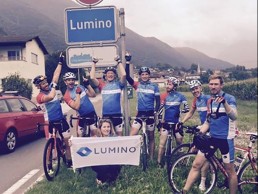
(UK) - Lumino To Lumino team return from charity cycle from headquarters in Essex to company’s namesake in Switzerland.
The Lumino To Lumino team return from their charity cycle from the Lumino headquarters in Essex to the company's namesake in Lumino, Switzerland.
In nine days each rider cycled a total of 1,253 kilometres, climbed 10,523 meters and burned 48,000 calories. Lumino's achievement was only made possible thanks to the dedication and training by the riders and hundreds of hours of meticulous planning by our support team at Lumino.
There is still time to donate here: www.justgiving.com/Andrew-Small4. Any donation benefits another family in the world by providing GravityLight to those without access to electricity.
The Lumino To Lumino team also thanks its sponsors, whose support drove the team on to the end, and whose money donated will make an incredible difference to GravityLight Foundation and the people worldwide whose lives will benefit from the work this young charitable foundation are doing.
LightingEurope and IALD announce cooperation agreement
(Belgium) - The two groups will collaborate to increase public understanding of the science of lighting and promote recognition of lighting quality.
LightingEurope and the International Association of Lighting Designers (IALD) are pleased to announce that they have signed a cooperation agreement in recognition that the two organisations share certain goals and objectives. Each group will focus on its own priorities and programs, and the two will collaborate where possible in order to increase public understanding of the art and science of lighting, and to promote the general recognition of lighting quality.
Diederik de Stoppelaar, Secretary General of LightingEurope said: "With the dramatic changes in lighting technology, we see the need to actively engage with lighting designers and other stakeholders along the value chain. We believe our partnership with IALD will further cross-pollination, education, cooperation and, ultimately, help bring the best new technologies and innovations to market."
The IALD, a 46-year old global organisation, opened its Europe office in 2014 in Brussels to serve the needs of its growing membership and to be able to serve its European members more effectively.
"2015 is a great year for lighting: technology is advancing, and quality of light is being more widely discussed by all those concerned with the built environment. This is also UNESCO's International Year of Light; specialists are uniting to share their contributions, from science and research to buildings and art. Our agreement with LightingEurope will allow both organisations to reach out more broadly and will strengthen the voice of the entire lighting community." said Marsha Turner, CEO of IALD.

Zumtobel acquires acdc
(Austria) - acdc to remain independent brand and flexible unit under umbrella of Zumtobel Group.
The international lighting corporation Zumtobel Group has acquired a majority holding in UK lighting company AC/DC LED Holdings Ltd (acdc). The company based in Barrowford, north of Manchester, is a supplier of high-end LED lighting solutions with a focus on the architectural façade and hospitality segments.
acdc started off its business with high brightness LED luminaires in 2001. In 2014 it posted annual sales revenues of approximately 17 million euros with a current headcount of around 120 employees. This dynamic enterprise develops and manufactures high-end LED luminaires in the international specification and project business and benefits from an excellent client network of lighting designers, architects and interior designers.
As a first step, the Zumtobel Group has acquired a majority shareholding of 60% in acdc lighting. An option to purchase the remaining shares exists as a second step. The amount of the transaction will not be disclosed. acdc's long term CEO and majority shareholder Gareth Frankland will continue to head the brand and drive forward its dynamic development within the Zumtobel Group.
Zumtobel Group CEO Ulrich Schumacher commented: "For the Zumtobel Group, the acquisition of acdc is an excellent strategic addition to our existing brand and product portfolio. With acdc, we are bringing an extremely innovative, highly successful and well-positioned premium brand under the umbrella of the Zumtobel Group. Architectural façade and hospitality lighting are precisely the areas where we see major growth opportunities, which we can leverage with the new setup. Furthermore, the acdc team has a highly developed innovation culture, which enables them to provide a fast and dynamic response to market requirements. This culture will also inspire the employees of the Zumtobel Group. It is our declared aim to retain acdc's dynamic innovation culture and their excellent customer relationships. For that reason, acdc will be managed as an independent brand and, in terms of our organisational structure, will be integrated into the Zumtobel Group as a flexible individual unit."
The key markets for acdc are currently its domestic UK market and the Middle East, along with a selective presence in other European countries and the USA. Huge growth potential exists for the acdc brand, particularly with regard to marketing the acdc product portfolio through the Zumtobel Group's worldwide sales organisation, which currently encompasses around 1,750 sales staff within the lighting segment. The specialists from acdc will play a key role in providing their expertise for their new colleagues.
"Joining the Zumtobel Group represents an important milestone for us on our path to further growth and the global development of acdc," said acdc CEO Gareth Frankland. "As part of the Zumtobel Group we will benefit from a worldwide sales network and from the benefits of a global and group-wide purchasing organisation. In addition, we see technology and development synergies and I will continue to rely on the knowledge, experience and the dedication of our employees for the further development of acdc within the Zumtobel Group. Together, we will continue to dynamically drive forward the acdc brand and strengthen its position in the global lighting market."
