
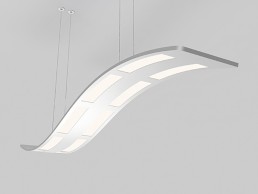
Acuity Brands Olessence Curve
Duet SSL Technology blends OLED and LED in the same luminaire, optimising both for superior aesthetics, performance, lighting quality and cost effectiveness. Light becomes more architecturally sensitive and engaging, while breaking boundaries in efficient and holistic design. The Imoni and Olessence concept families showcase stylistic embodiments and applications of this new approach in lighting design.

Modular Lighting Instruments Vaeder
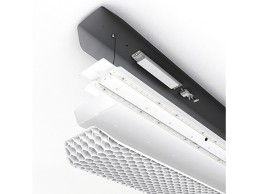
Vaeder is a new fixture that feels equally at home in an energy-efficient, ergonomic office environment as in a sleekly designed home office. Its characteristic honeycomb structure in combination with a wafer-thin diffusor reduces glare to a minimum, whilst its LED lighting results in an energy-efficient and high-performing office fixture.
Iluminarc Colorist Pod 18Qa
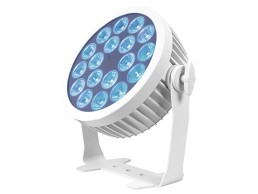
The Colorist Pod 18Qa from Iluminarc is a sturdy LED-fitted luminaire ideal for washing façades indoors or outdoors. Compact construction and off-white design allow it to blend seamlessly in any environment. Colorist Pod 18Qa features eighteen quad-coloured RGBA LEDs with a life span of 50,000 hours. Installed optics at 15° with a 27° field angle.
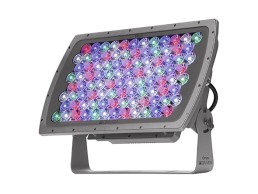
Griven ONYX
Specifically for architectural projects demanding sustainable lighting performance, the newly engineered ONYX features a functional, ultra-narrow, sharp, long-shot beam of light capable of reaching great distances with precision and even light distribution. ONYX is fitted with a combination of 96 RGBW, cold, warm or dynamic white high brightness LEDs that provide an astonishing light output quality. The dynamic white configuration stands out for a stunning visual rendering of warm tones, natural hues and cool shades altogether.
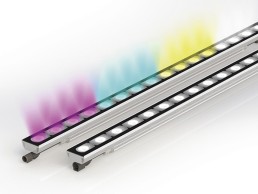
GVA Lighting STR9 RGBW
GVA Lighting recently introduced its RGBW version of STR9 wall grazers. The colour mixing is done in every single lens and creates homogenous pre-mixed light beam immediately adjacent to the luminaire. LED pitch is maintained within and between fixtures resulting in no dark spots. This top of the line luminaire is built on two proven technologies – Unibody and Infinity enabling to run these fixtures end-to-end for 300+ metres using only a single power and data source.
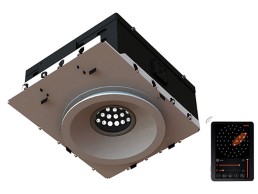
OSRAM SYLVANIA OmniPoint
The OSRAM OmniPoint is a wireless, array-based LED lighting solution that offers flexible light placement and intensity options. It consists of an array of independently controllable LEDs that can switch on/off and dim in coordination with others in any combination, and produce ambient and spot lighting from a single light package at the same time. The light output and placement are quickly reconfigurable via a wireless device and Android app. As a result, the user has the ability to adjust the effective beam direction and angle, beam shape and distribution at the touch of a finger.
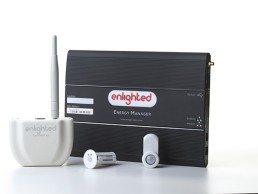
Enlighted Enlighted System
The Enlighted System is a unified digital sensor and data analytics system from Enlighted. It collects, analyses and implements big data to drive down operational costs, increase operational efficiencies and improve indoor environments. Enlighted digital sensors are integrated in every light fixture [1:1] to collect granular environmental, occupancy and activity data. They are able to accurately distinguish people from other heat sources, as well as human and non-human. Additionally, sensors have an on-board processor that can make independent decisions without relying on direction from a central machine.
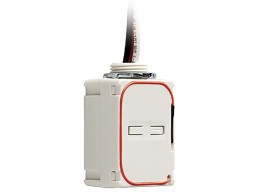
EnOcean LEDR / D Control System
A wireless LED control system including self-powered sensors and switches, LED fixture controllers and a commissioning tool to simplify installation and setup. The LED controller family includes: a transceiver module (TCM 330U) for integration into drivers/modules and LED fixture/zone controllers, with relay (LEDR), and without relay (LEDD). The application firmware enables dimming, occupancy, daylighting and Title 24-compliant controls out of the box. With a navigan commissioning tool to link devices and setup parameters over the air.
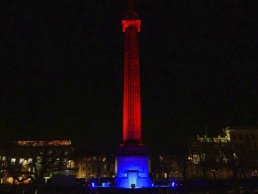
AC-ET supplies LumenRadio solution to Black Light
(UK) - Black Light, Edinburgh use LumenRadio products to create wireless DMX connection for lighting of city’s Melville Monument for International Science Festival.
The Light Fantastic event, took place from sunset to sunrise between 12 March to 28 April 2015. It invited visitors to change the face of the Edinburgh skyline with a tweet. Organisers encouraged the public to tweet their favourite colours using the hashtag #lightfantastic, which would then change the lighting state at the Melville Monument automatically.
Black Light invested in a LumenRadio CRMX Nova TX2 RDM transmitter, four CRMX Nova transmitters and four outdoor-rated receivers, plus ancillary antennae and cables which were utilised on this event.
Heading up the team on the project was Black Light's Calder Sibbald, alongside moving light and systems technician Andrew Green, who was responsible for the Wireless DMX and ArtNet systems.
"Phil Haldane from Black Light created custom script allowing the software to poll the amount of tweets every three minutes. The most popular colour tweeted would then automatically change the lighting onto the monument", said Green. "The LumenRadio products were used to create a wireless DMX link between the control room in the centre of the monument, and the fixtures on the outside perimeter of St. Andrew Square."
"When choosing which wireless system to invest in we did a lot of research as our main concerns were reliability, range and functionality. As we were using the system in a heavy Wi-Fi traffic area in Edinburgh's city centre, it was imperative that the system was reliable, not prone to interference, and did not disturb other networks. LumenRadio's coexistence function was ideal for this, as well as its high range and durability."
Operating licence-free on the 2.4GHz frequency, LumenRadio's patented Cognitive Coexistence technology ensures optimum performance even when other wireless systems are operating in the same area. Its CRMX technology continuously scans the wireless frequencies, detecting activity from other networks and where gaps are available. The radio modules hop into these available frequencies, making best use of the available space whilst reducing the effects on other networks.
"I was most impressed by its ease of use. The SuperNova software provides an ideal interface to set up the devices and monitor them during use, whilst the capability to monitor RDM devices and Wi-Fi traffic in the area is also extremely useful," said Green. "I configured the system at Black Light's offices, and once onsite it worked first time, and for a further six weeks without fail, whilst enduring some typical Scottish weather - including high winds, rain, snow, and even sun!"
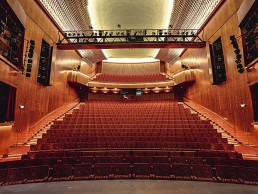
National Theatre of Iceland, Iceland
In 1873 economist Indriði Einarsson presented the first ideas for a National Theatre in Iceland. His ideas were formally published in a magazine article in 1905, but it wasn't until 1923 that they became a reality, when the government introduced an entertainment tax to build the National Theatre.
The first architectural drawings for the National Theatre where submitted in 1925 by government architect Guðjón Samúelsson. Samúelsson was also an urban planning enthusiast and took an important role in designing the master plans for the towns of Isafjorður and Akureyri.
It wasn't until 1929 that the construction drawings were finished and it then took two years to build the new theatre´s main structure and exterior walls. In 1932 the government stopped construction works due to financial shortage. Then, in 1941, during the Second World War the British armies occupied the unfinished building as part of a military operation to prevent the German Nazis invading Iceland. The British army returned to the theatre in 1944 and then the Icelandic government put a big effort in to finish construction. The National Theatre was officially inaugurated on 20 April 1950.
Originally the theatre had just one of the three current stages. The larger stage was equipped with a rotating platform which is still virtually unchanged. In 1968 an additional house was built as a workshop and today the theatre has three stages in these two buildings. The main stage seats 445 to 499 people; the box sits around 140 people; and the dome or children’s theatre that can guest 100 people. The main hall displays an architectural feature resembling the basalt column walls that exist in Icelandic nature.
In 1990 the theatre was put under crucial renovation works. The lighting design was updated as a part of this renovation to implement creative solutions using the existing technology at that time. Indirect light coves were lit with improvised light series using 40 to 60W incandescent lamps. It is estimated that all of these indirect light coves contained more than 2,000 lamps and the total energy consumption from these installations was around 125kW. Every year hundreds of these lamps were replaced adding considerable costs to the theatre operation.
In the spring of 2012 the electric box for indirect and general lighting failed causing a minor fire. A follow up inspection and evaluation concluded that the power charge for the indirect lighting features was extremely high and needed to be changed. As a result the theatre administration then called architects, engineers, lighting designers and maintenance managers to review its overall lighting and find new solutions.
Verkis Engineer Consultants, Ingólfur Arnarson and Guðjón L. Sigurðssonto decided to keep the same warm lighting atmosphere but switch to LED technology to improve efficency. The old incandescent lamp series were replaced with high efficiency LED strips carefully mounted and aimed to ensure the desired lighting effect. All 40W incandescent lamp series were replaced with 1.2W LED series from luminaire manufacturer Agabekov. This first scope of work in 2013 also served as a test to confirm the functionality of the new installation. After a successful result the project was extended to the main hall.
In 2014 the main hall's general lighting was renovated using LED technology. As in the public areas, the 60W incandescent lamp series was replaced with 1.2W LED series from the same manufacturer. Additionally, the integrated step light was completely renovated using LED strips from iGuzzini.
The overall power consumption for these light fixtures was reduced from the original 125kW to 10kW and has been running through winter without any problems.
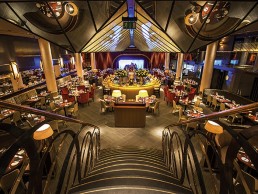
Quaglino's Restaurant, UK
The re-launch of the famous Quaglino’s restaurant in Art Deco style was to involve the creation of a theatrical and multifunctional lighting scheme. Whilst providing for live events, the lighting design by Into, was also required to bring intimacy and atmosphere to the huge basement venue.
The famous ‘W’ ceiling at Quaglino’s was retained as a classic design feature and revamped to include updated lighting. One of the biggest challenges was to create a more impactful lighting effect while working with the existing ceiling construction, which was designed around T8 fluorescent lamps. The colour temperature of the light when diffusing through the glass panels needed to match the warmth of the overall lighting scheme and dim to a very low level post-dusk.
A number of site mock-ups led to the selection of high output 2,400K LED profiles on a dimming system, while detailed drawings enabled correct positioning and housing for best effect. On the mezzanine level a tailored approach to lighting creates focal points. A bespoke halo detail consisting of a round aluminium heat sink with surface-mounted linear LEDs around the circumference was integrated as part of the wall design. This detail around globe wall lights creates a dramatic shadow effect through the fret cut screens, emphasising the Art Deco design. An integrated lighting treatment to the bar nosing on the mezzanine washes warm light onto the bar front from a linear LED source, while the red glass back bar is backlit from the top and bottom with LED profiles to create a uniform light effect.
The original grand staircase is the focal point of the restaurant and was to be transformed into a light feature with backlit marble-effect amberlite risers. Creating a uniformly lit riser was critical and Into worked within a tight void to develop a bespoke lighting detail incorporating side-emitting LED tape.
The design and detailing of the central bar at Quaglino’s was a collaborative effort between Into and suppliers. The challenge was to create an illuminated main feature bar which could be taken apart for special events.
The result of precise detailed drawings and wiring schematics is a fully illuminated bar of nine different sections (seven of the bar body, two of the central section). In each section two drivers are connected to the circuitry and provide digital dimming capacity alongside 1-10V rotary dimmers. The drivers can be unplugged from a power source and retain the programmed dimming levels, enabling each segment to retain individual illumination and dimming at different locations. 2,200K LED tape washes the bar front from a nosing detail and the Amberlite bar top is uniformly underlit with Applelec’s LED Light Sheet. The back bar bottle step is underlit with LED, and LED profiles are concealed within bar shelving to illuminate the bottle display and add to a layered lighting concept that uses the full height of the central bar.
The Quaglino’s refurbishment involves attention to detail in every aspect of the lighting scheme and the ambience has been created by blending many layers of light with carefully designed bespoke details.
Gerber Mall, Germany
Located in the city of Stuttgart, the Gerber Mall is a multi-functional space with high urban significance; a major shopping destination in the capital of the federal state of Baden-Wuertemberg. Pfarré Lighting Design collaborated with architect Quartier 'S' EPA Planungsgruppe & Bernd Albers, and interior designer Ippolito Fleitz Group, in order to take on the sizeable challenge of illuminating the 25,000sqm space.
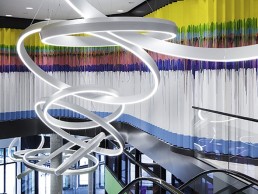
With three entrances on two levels, the mall reflects its complex urban situation and neighbourhood. In the light of a corporate design theme for all entrance areas, 31 Hatec Lichttechnik LED rings have been designed especially for the project. In the basement, the rings are integrated in the ceiling, while freely suspended from the high ceilings at other entrances. A hoola-hoop piece consisting of ten rings with an RGB system for special events, circles around a central column and is reflected in the fountain below, spanning the height of all three shopping floors.
Lightness, clarity and sophisticated minimalism are at the centre of the Gerber Mall interior lighting design. Lead by Gerd Pfarré, the team minimised the visual weight of a one-metre high ceiling package filled with air-conditioning ducts and other necessary technical features by illuminating the white flanks of the generous ceiling openings. To maintain a dynamic experience for shoppers, with a clean, modern feel, spotlights have been integrated into a recessed, matte-black channel system, appearing in clusters across the ceiling to provide a bright, homogenous light throughout.
The black channels correspond with the black escalator’s handrails and dividing gaps under the escalators, providing a contrast to the underside of the escalator illuminated by Hatec LED. Glare-reduced, honeycombed metal-halide spots enhance the public space and generate contrast to the ambient light emanating from Hadler Luxsystem SL seamless linear luminaires in the various shops.
A huge skylight allows the daylight to illuminate the enormous space from above. In order to hide the frames, Ippolito Fleitz Group designed a system of white baffles, with a blue LED strip from Hatec Lichttechnik - transforming the skylight into a source of light at night.
The modern and dynamic design of this mall reflects the hustle and bustle that flows through it on a daily basis, with the hoola-hoop piece defining the Gerber’s dynamic yet functional character.
