
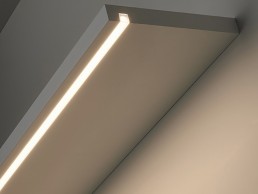
LightGraphix LD Line 15
New from LightGraphix is the LD Line 15, a miniature, exceptionally shallow, 24V light fitting with no LED spotting. It is ideal for the indirect illumination of shelves and steps, and for retail and bathroom applications. With a depth of only 15mm this linear light fitting is perfect for installation in shelves as shallow as 30mm and comes with a range of fixing options for both interior and exterior applications. IP54 and IP67 versions are available.

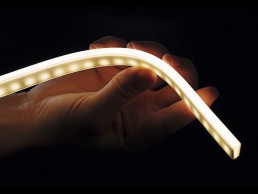
LED Linear VarioLED Flex AMOR
VarioLED Flex AMOR is a miniaturised, opal encapsulated, IP67 protected, flexible LED design light line. It is characterised in its uniformity of light in combination with an unequalled small cross section of 5 x 13mm that exemplifies the AMOR to make it an appealing and innovative product. The light line is horizontally bendable with a minimum radius of 3cm and offers easy installation and high resistance.
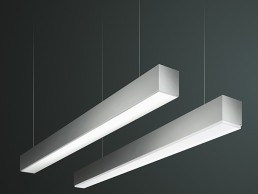
Insta Instalight Stripe
Instalight Stripe is a universally applicable light tool providing solitary or in-line, through-wired, linear 230V light bands. It can be surface mounted, built-in or suspended with two different DALI dimmable light inserts and 3,340lm/m or 1,670lm/m, offering an optimal light range for various applications. The cover profile with general diffuse can be installed into the luminaire housing of extruded aluminium either flush or with defined protrusion, lighting lines with sharp contours or a smoothly shining aura.
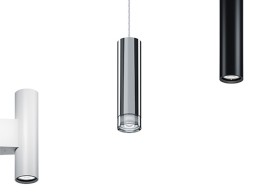
ERCO Starpoint Range
The Starpoint range is available as a pendant, wall-mounted, surface-mounted and recessed luminaire. The pendants and wall / surface-mounted luminaries feature an extra wide flood characteristic and offer high functionality with subtle decorative effects; the wide, uniform beam creates an intimate atmosphere with good visual comfort. With its complex yet compact lens system, the recessed version is designed to be as small as possible and produces brilliant and uniform light for accentuation, wash and ambient lighting.
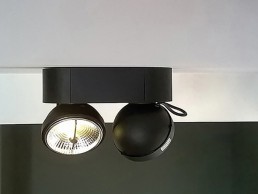
Azimut Industries Surface Range
The comprehensive and versatile Surface spotlight directional range allows projector adjustment of 180° or 360° (depending on the lamp) without any gimbals, thanks to the magnetic Azimut system. The metal housing disguises the electronic system and is available in mono, duo or quatro models; wall and ceiling, pendant or track fitting; warm LED, halogen or HID bulbs. Colours available are white, black and grey, with 20° and 45° beams available in dimmable or non-dimmable versions.
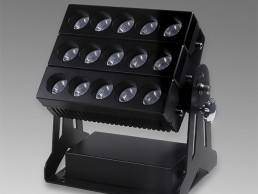
StrongLED Transformer Series
The Transformer Series TF3A floodlights feature eight LED models with a power range of 40-400W in eight form-factors (square, rectangle, and linear) to meet varied floodlighting applications. The Transformer Series is available in a range of whites and RGBW, narrow to mid beam angles, brightness control of 256 and 10 bits contrast control levels for stable, smooth and consistent colour change effect. The floodlights also feature precision die-cast aluminium housing with unique anti-glare cover over deep-seated light emitters.
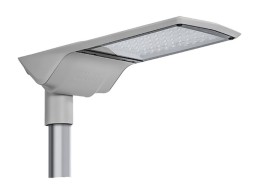
LUG Urbano LED
Urbano LED, a modern LED street and area lighting fixture, is suited to lighting new infrastructural projects as well as the modernisation of already functioning street lighting in conventional technology. The luminaire is equipped with a specialised optics system, which, combined with high quality LED light sources, allows for optimal street and area lighting to increase the safety and comfort of all infrastructure users. It is a product that caters to modern roads, incorporating light management control systems with high quality lighting.
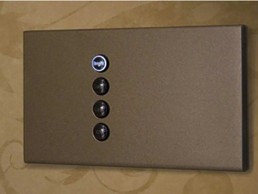
Hamilton Litestat Mercury Lighting Control
The Mercury Lighting Control provides multi-scene lighting control, with control plates featuring high quality switch plates and sockets. On show at this year’s May Design Series, the control system is available in numerous finishes including four sophisticated shades of bronze. The panels encompass eighteen unique plate collections available in metal, plastic, wood and glass.
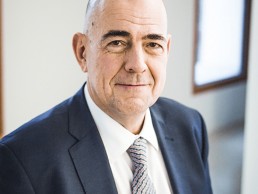
Zumtobel Group celebrates IYL 2015
(Austria) – Zumtobel Group host event in Dornbirn to mark IYL 2015 and the company’s 65th anniversary, as well as 10th anniversary of Dornbirn Light Forum.
For the Zumtobel Group, IYL 2015 represents an important year of strategic realignment in which a strong foundation for profitable growth is being laid. Under the leadership of CEO Ulrich Schumacher, the group has adopted a multi-brand strategy joining Zumtobel, Tridonic and Thorn to create a lighting ecosystem.
Thorn, Tridonic and Zumtobel are organised as business divisions within the Zumtobel Group. With the objective of strategically developing their product portfolios, sharpening brand profiles and offering customers tailored solutions, business divisions have been assigned product management, development, marketing and quality assurance functions.
The Group is focused on expanding its competencies in smart controls and data management, continuing to develop its service portfolio and leveraging innovative business models to drive international growth. The heads of the business divisions are responsible for profit and loss as well as the logistics process.
Schumacher explained: “With our differently positioned Zumtobel and Thorn lighting brands and our “electronic brain” Tridonic, we have everything we need to be a pioneer, setting the pace in the international lighting industry. In a highly competitive market characterised by shifting technology and increasingly short innovation and product life cycles, new business models are more necessary than ever. We continue to move our business in the direction of services in the future. With this in mind, it is important to build an interdisciplinary structure that will allow Zumtobel Group to meet modern needs and take specific advantage of opportunities presented by the technology shift.”
Zumtobel Group’s management team hosted a welcome dinner for its VIP guests, and held a tour of Zumtobel Group’s 1,600-square-metre production hall, recently converted to house application cubes displaying the latest product innovations. The tour included presentations of the latest Product Highlights from experts of the Thorn, Tridonic and Zumtobel brands from recently appointed Chief Design and Marketing Officer Rogier van der Heide and Chief Executive Officer Ulrich Schumacher.
At the Bregenz Festspielhaus, Icelandic-Danish artist Olafur Eliasson presented his keynote speech on the importance of Light in Life. Subsequent talks were given by marketing expert and brain management researcher Dr. Hans-Georg Hausel, and another by Alfredo Brillembourg and Hubert Klumpner, founders of the Urban-Think Tank. Expert on the Internet of Things (IoT) and recently appointed Tridonic IoT Architect Karl Jonsson concluded the speeches.
Zumtobel Group culminated the event with an evening gala dinner at the festival hall including talks from the curators of the Zumtobel Group Awards. Winners in “Applied Innovations” and “Buildings” categories were invited to talk about their current projects. Winner of “Urban Developments” category, architect Alejandro Aravena from Studio Elemental Chile discussed his winning project.
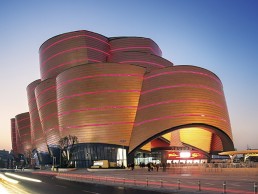
Movie Theme Park, China
Developed in conjunction with Dalian Wanda Group, the Wuhan Movie theme park is the creation of London-based Stufish Entertainment Architects. Having started on the project in 2010, Fisher sadly passed away in 2013 just eighteen months before the project’s completion and as such, the Wuhan Movie theme park was left in the capable hands of the Stufish team to carry out to fruition.
The Wuhan Movie theme park is a $690m project that sees the world’s first entirely indoor theme park stacked with dynamic attractions over multiple storeys. Using over 10,000 bespoke geometric golden aluminium panels, the building’s façade is lit in its entirety with linear LED channels that are fastened behind said panels in every 100mm gap of the 700m tall façade.
Nicknamed ‘The Golden Bells’, based on the 2,000-year-old local symbol of the bronze musical bells ‘Bianzhong of the Marquis Yi of Zeng’, Stufish architect Maciej Woroniecki told mondo*arc of the project’s beginnings: “We were approached by Wanda to propose a concept for the Movie theme park during the design phase of the Han Show theatre. The initial brief called for an iconic design that would reference symbols of Hubei province, while also push to express the nature of the content of the theme park movies.”
The façade of the Wanda Movie Park is set 300mm proud of a standing seam surface. This gap, according to Woroniecki, was utilised as a diffuser and lit in order to create a low resolution screen along the entire façade surface. “As there are 50mm gaps between every golden façade panel, there exists enough resolution to run live content along the façade to support both the internal attractions and the geometry of the façade itself, through a variety of different animations,” said Woroniecki.
The theme park’s original lighting scheme focused much more on amplifying the building’s form rather than animated content. According to Woroniecki, the one drawback from playing live content on the façade at night is the reduction in contrast between the physical façade volumes, as the delineations of the façade begin to blend separate surfaces into one another.
“One of the biggest challenges was securing a consistency in the spread and orientation of lighting between each housing,” said Woroniecki, “as any slight deviation from the required orientation would have become incredibly apparent from ground level.”
As the building is a movie inspired theme park that contained animated visuals, it was imperative the lighting reflected its purpose and so it was only appropriate that it was animated at night and while the resolution of the lighting is not able to directly represent the different content of the attractions, it promotes the general presence of an indoor theme park.
Summing up the Stufish experience, Woroniecki continued: “Unfortunately the requirements of the programme and the restrictions of the site dictated how expansive the building could be - in how far the façade could push away from where it met the ground.
“Had the site restrictions been less, moving the volumes apart to create indoor / outdoor spaces would have benefited the general layout and overflow areas. If the volumes could have shifted further apart from one another there would have been more potential for larger variations in the sizes of the façade forms – creating a much more striking and dynamic architectural proposal.
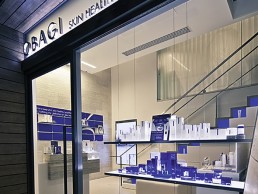
Obagi Skin Health Institute, USA
The latest Obagi Skin Health Institute has opened in Laguna Beach, California. A contemporary boutique-style health facility, Obagi focuses on creating and maintaining lifelong healthy skin rather than just treating it with various products. Overlooking the Pacific Ocean, the institute’s architecture is bold yet sleek, making a noticeable design statement within the beach community.
Heading up the Obagi brand is MD and dermatologist Dr Zein Obagi. It has been his lifelong passion to help people achieve, enhance and maintain healthy skin and for his most recent institute it was important that this passion was reflected in both the building’s design and lighting choices.
The building, designed by Horst Architects, makes prominent use of recycled and recyclable materials. A sculptural, accenting exterior wall features contours of silver Travertine limestone, recycled from mineral-spring deposits, while a contemporary illuminated glass sculpture features as part of a street-level entry garden that is visible street side and from the boardwalk.
With local zoning dictating site constraints in Laguna Beach, interior design and lighting challenges involved making the building feel open and larger than it actually is - all in just 1,661 sq ft of space. Design flexibility was essential for client accessibility and procedures, such as skin exams, laser treatments and highly specific skin-product application that takes place under multiple, dimmable, glare-free light sources that accurately define each person’s present skin colours and conditions day or night. Additional client functions at Laguna Beach’s Obagi Skin Health Institute include customised, formulated, corrective skin treatments for clients and educational group lectures that are fully accommodated in an inviting, crisply designed, low-energy two-storey space.
With natural daylight flowing throughout the building, lighting designer Rosemarie Allaire worked to create energy-efficient lighting that exceeds the State of California energy code requirements, while remaining minimal and subtle to complement the building’s design. Allaire created a dance of light shadows by integrating LED linear strips, TF linear fluorescents and compact fluorescent light sources into the building’s architectural elements, all of which are controlled by a dimming system allowing different moods in the space.
The building’s entrance, set off the Pacific Coast Highway, announces the building name with internally illuminated Obagi signage, while skin care products appear to float on custom made floor-to-ceiling suspended shelving in the entrance window, with Evo-Lite LumiSheet LED panels illuminating the products. As you move further into the building, the ground floor combines multiple light sources working in concert with one another as they also serve individual purposes. Eureka recessed low-wattage fixtures provide display / accent lighting, while alight recessed T5 linear fluorescent lights are used for wall wash. Evo-Lite LumiSheet LED display lighting panels also feature throughout the public space, along with Edge Lighting recessed task lights and Obagi Blue coloured squares backlit with LEDs – these are featured in the staircase to the second level.
Once upstairs, suspended, decorative, Ameba luminaires from Vibia are featured - providing warm, ambient, dimmable illumination adjacent to a skylight, which filters cooler daylight naturally and dims sunlight through additional electric shade control. A combination of controlled natural daylight and low-energy artificial light is used throughout the public space, exam rooms and office space. For the examination rooms, Obagi required even illumination at high foot candle level for skin assessments and so, the rooms feature a combination of three light sources that are dimmable - the Leucos Black P29 T5 linear fluorescent wall sconce; linear LED Edge Lighting under the cabinet for task lighting; and recessed alight T5 fluorescent fixtures that provide a wash of light along the Silver Travertine – creating visual, textural interest as a main feature of the room.
With a view of the Pacific Ocean to its horizon, the office uses dimmable indirect alight T5 fluorescent, suspended pendants, providing even illumination and unobstructed views, as Obagi wanted glare-free environments without veiling reflections for reviewing patient documents. The kitchenette also uses a single, dimmable, alight indirect T5 flourescent suspended pendant, in conjunction with Edge Lighting under-cabinet task lighting, to provide even lighting and an open feeling in the compact space.
Externally, the Obagi Skin Health Institute makes a statement on the busy Pacific Coast Highway with its soft glowing fins and illuminated architectural interiors, highlighted by Obagi Blue products. The Silver Travertine is bathed in warm LED in-ground uplights from Hevi Lite, illuminating the rectangular side wall signage and providing a splash of light on one of the principle walls of the building’s second level, to create the right mix of light and shadow.
The exterior stairwell leading down to the parking area features a slice view of the ocean; illumination is contained by vertically mounted 2ft tall alight T5, flourescent flush step lights providing a path of light for egress. The parking area under the building features uniform alight recessed T5 linear flourescent lighting. Overall, the choice of materials used throughout this project aimed and succeeded in reflecting Obagi’s interest in sustainability as a modern design statement, while featuring timeless forms.
Ham Yard Hotel, UK
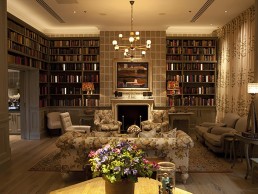
Ham Yard Hotel in London is the result of an inspired and eclectic vision from Kit Kemp of Firmdale Hotels. In a space that feels more like a friend's house than a hotel, Lighting Design International (LDI) was brought on board by the hotel group to work on this latest boutique project, having previously worked on The Potting Shed restaurant at Firmdale's Dorset Square Hotel.
LDI worked to create a combination of concealed lighting effects to complement the decorative elements without dominating the space. Architectural lighting in the form of Lucent Prospex 90 pinhole LED50 downlights, were discreetly integrated into ceiling slots and joinery wherever possible throughout the public spaces - allowing the feature chandeliers and quirky neon light art to make a statement on the design as a whole, adding depth to the spaces by complementing the vibrant colourful interior finishes.
With large pieces of art featured throughout the hotel, particularly the retro film posters that hang beneath a triple height ceiling, the project was a challenge to light. Notably, in the Dive Bar and meeting room breakout lobby, single and twin custom LED DR7 downlights from Remote Controlled Lighting are used to illuminate the tall spaces. For the oversized artwork featured in the meeting room breakout lobby, iGuzzini Palco MT58 LED spotlights featuring a 10Ëš angle and barn doors are used for framing purposes.
As you move through to the brasserie and bar, Tryka 2,700K linear LED fixtures are used in the coffers and integrated into the banquette and bar fronts, shelving and bottle backlighting. Then, in the dining space, a Firmdale-designed art installation of ceramic vases, fitted into wall niches, features on the restaurant's back wall. It was agreed to uplight the vases from within, creating a soft warm glow and to achieve this, a Toshiba E-Core GLS wide 7W dimmable lamp was fitted in each niche.Each ceramic vase is hollowed in the base and mounted on top of the lamp and the lamp cap and heat sink are sunken to avoid shadowing. The result is a warm understated lighting element that complements other features in the space.
Ham Yard also comes complete with a bowling alley, which makes use of lit brick wall niches at the end of the bowling lanes; lit up to create the effect of moving glowing candles. After much discussion and testing of fibre optic and LEDs, the glowing candle effect was achieved by using LED Feeling’s Flame Bulbs and the Ultimate Beeswax Candle sleeves.
Large prints by artist Howard Hodgkins decorate the bowling alley, all of which are lit by Lucent Prospex Plus wallwash trimless fixtures and Xicato XSM Artist Series LED modules. Moving outside, the courtyard terrace is a public thoroughfare in the heart of bustling Soho, drawing people through the arcade into the hotel courtyard by creating a river of lights recessed into the ground. For this, Cube marker lights in a winding stream pattern, that goes through the arcade to the courtyard, are featured. Above, warm white ERCO cylinder façade luminaires are found while under-canopy DAL Ambiance X100 Directional ID44 LED Xicato downlights in cool ambience surround the entrance to the hotel apartments.
On the whole, the design of the hotel owes its success to a true collaboration between decorative and architectural lighting, which leaves guests with the impression of being in a truly unique environment, which is fun, cutting-edge and unpretentious.
www.lightingdesigninternational.com
