
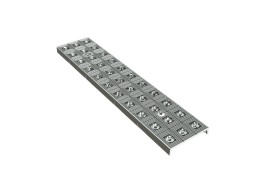
Khatod PIXEL 11X3 Reflectors
Three-row modules
configured with 33 reflectors, optimised for 3030 LEDs, designed to comply with
Zhaga standards. Fit for creating linear luminaires of desired length. PIXEL
11x3 are made of black PMMA HT with aluminium reflective coating, allowing to
work at -40°C to approximately 110°C temperature. The accurate design and the
surface finish make them excellent for architectural and interior design. Great
also for industrial lighting and the most diverse indoor and outdoor
applications.

Issue 112
arc Oct/Nov 2019 – Issue 112
I would like to start things off in my first editorial column by saying a huge thank you to Paul for the kind words last time around, and for passing on the responsibility of running this magazine to myself and Sarah. I’m already well aware of his standing within the lighting design community - at every show or event I’ve attended over the past three years, at least one person has asked “So how’s Paul?” - so I know that I have some big shoes to fill! We’ve already got some really exciting things planned for the next few issues though, and we’re well up for the challenge!
But, as we head into the start of this new era, we typically find ourselves not looking forward, but back from whence we came, as this issue marks our 20th anniversary as a publication. I won’t tell you how old I was 20 years ago, but it is surely a testament to the industry that we as a magazine have been going for so long. We’ve had a great time in the office digging through the archives to take a closer look through some of our back issues (some of the layouts: *chef’s kiss*), to see which wonderful projects and designers we’ve featured over the years, many of which I’m delighted to say are still going strong! We’ve cherry picked some of our favourite covers from the past 20 years in a special retrospective feature that you can check out in this issue.
As a signpost to how far we’ve come as a magazine since our humble beginnings way back when, last month we hosted the third instalment of our [d]arc room event. This time held at the Old Truman Brewery as part of London Design Fair, we were thrilled by the turnout, with visitor numbers doubling compared to last year. Such numbers are a huge encouragement for us, so another big thank you to everyone who came.
We’re also eagerly awaiting this year’s [d]arc awards. Voting will open on October 22nd, so keep your eyes peeled for the all-important announcement and remember to cast your vote when the time comes. Make sure to mark 5th December in your diary too, as we’ll once again be hosting our famous (or should that be infamous?!) [d]arc night awards party! We hope to see you there!
Matt Waring Editor arc

Follow the Light: Where to search for useful research information
Asst. Prof. Dr. Karolina M. Zielinska-Dabkowska IALD, IES, CIE, MSLL, RIBA, looks at the importance of research, and the best places for lighting designers to find this information.
Architectural Lighting Design (ALD) has never been a standalone professional discipline. Rather, it has existed as the combination of art and the science of light. Today, third generation lighting professionals are already creatively intertwining these fields, and the acceleration in scientific, technological and societal studies has only increased the need for reliable multidisciplinary information. Therefore, a thorough re-examination of all aspects of ALD and how it relates to those particular changes is an urgent necessity.
Further research is required to develop a new body of knowledge about ALD so that lighting professionals can improve their expertise in the field and receive better remuneration for their complex work. In the near future, we should be aiming for professional recognition as experts and join other recognised professions such as: architects, doctors, dentists, lawyers, engineers etc.
While lighting designers (LD) need to constantly update and re-examine their knowledge, they face two dilemmas. First, WHERE should they search to obtain useful information on lighting in related fields? And secondly, HOW should they successfully evaluate the viability of this information in a time of “Google-isation”, Wikipedia, “lobbying” and data manipulation.
In order to answer the above questions I undertook a research study in 2016 with French lighting designer Anne Bureau. More than 100 independent lighting designers, researchers, educators, journalists and manufacturers connected to the lighting field participated in an online lighting survey (Fig. 2). We wanted to understand where the profession stands in regards to research.
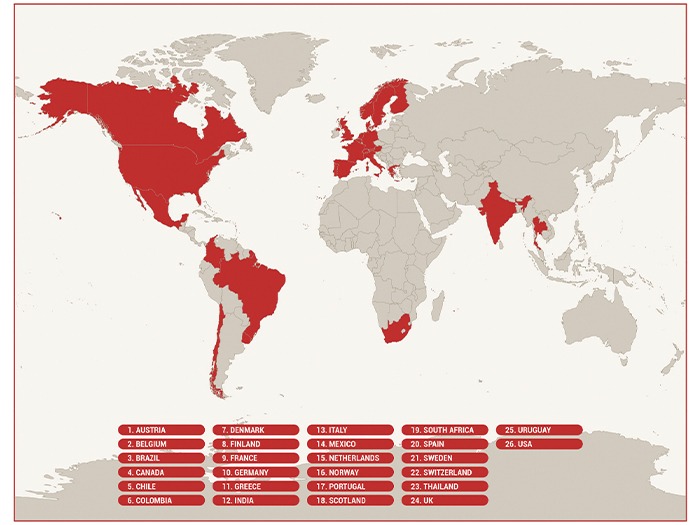
Participants from 26 countries around the world took part in the survey, with the majority from Europe and North America (Fig. 3).
The outcome of this investigation was presented at the IALD Enlighten Conference in Prague, Czech Republic. Unfortunately, this research was never published by IALD to a wider audience, (the conference format does not provide a publication of conference proceedings), hence the article in this issue of arc.
It is important to acknowledge this work included inputs from top independent lighting designers in the field who understand that research is vital and tightly connected to their day to day work. For instance, Mark Major, Principal at Speirs + Major believes that:
“Research is the life-blood of lighting design. Whether carried out as an integral part of a project or as an independent academic exercise, the thorough investigation of problems and opportunities through the evidence-based gathering of knowledge can lead to new creative thinking and more robust technical solutions. Not only can we learn from the past and the present by projecting our future visions and testing them, we can also ensure that our understanding of light and darkness constantly progresses.”

© by Anne Bureau & Karolina Zielinska-Dabkowska
Where to search?
Two distinct levels of understanding that determine the usefulness of research information have been identified:
1: basic level (“found” on the internet via googling, and the source is difficult to verify) and 2: advanced level (research that is provided by scientists or practitioners, which is often documented).
The main source of useful research information that can be applied in lighting design projects for the majority of participants is still print media (for example, peer reviewed publications, books and lighting magazines, newsletters and even student’s master theses) as well as internet media, while the younger generation tends to prefer to use Twitter, Pinterest, Instagram, Facebook, YouTube and Vimeo. Additionally, people attend live events and public talks related to light and lighting.
There was also an indication from survey participants that sometimes they are unable to find the information they are looking for. Often, they felt relevant data was either published by disreputable sources or simply it didn’t appear in searches. Moreover, the desired information was missing (not enough research has been done on this topic). Some people even believed it is difficult to find lighting specific research that reached a sufficient level of consistency for a specific topic. Sometimes information was unavailable due to open access restrictions, for example, some journals have restricted access to the free downloading of papers. Similarly, norms and regulations involve a charge or fee and the paper may be unavailable on the internet in digital format. This may mean a printed version needs to be ordered but it’s no longer available, or it takes time to deliver and/or it’s a costly process.
Also, two distinct levels of accessing/gaining knowledge have been identified. Firstly, with international, global reach, (e.g. conferences, international magazines), and secondly, with national or local reach, which is often country specific, (e.g. smaller seminar events and publications in the local language).
What to search for and how to evaluate information viability?
For more than 50% of participants, the most interesting topics seem to be interdisciplinary research connected to medicine, environment, biodiversity, biology, sociology, behavioural studies, culture, art, etc. as well as new developments in lighting technology, materials and tools.
As lighting practitioners are overwhelmed with information and there is not enough time to digest it all, the aspects of verifying content seems to be of enormous significance.
Based on a performed study, three methods have been identified. Firstly, participating in established events that provide CPD accreditation (e.g. http://bit.ly/35OmXMT, http://bit.ly/33CJOcG). Secondly, reading books and articles by established scientists and practitioners who share their knowledge (https://go.nature.com/2OBHcry, https://amzn.to/2P3iS0N, http://bit.ly/2Y768dE), and lastly, searching the websites of established universities, research institutions and organisations/associations (http://bit.ly/2Y768dE, http://bit.ly/37PkLqi, http://bit.ly/2OYQzAz).
It appears that few lighting designers would read through actual academic papers. Instead, most try to distill information from relatively commercial outlets that have translated academic text into a short summary or quotation. However, it is still unclear “how” lighting designers translate gained “knowledge” into their work. Gaining knowledge is one thing, what designers do with it is another - and their interpretations or translations of it are of interest and value, and need to be further investigated.
© by Anne Bureau & Karolina Zielinska-Dabkowska
To share or not to share?
There are two distinct levels of sharing knowledge:
1: information that is shared publicly (some general aspects in articles, such as talks at professional conferences or on company websites), and 2: information that is typically not shared (detailed internal knowledge that is shared only with respectable, trusted competitors. This knowledge provides unique insight and advantages, so it’s wise not to give it away to everyone). Some information is proprietary and kept confidential or it is limited to a small group of insiders.
Design driven by research
At the turn of the 21st century, when I joined the lighting design community, light was used as a medium to create mood and increase the appeal of places at night for visitors. The emphasis was on aesthetics. Lighting professionals relied on dramatic illumination effects to celebrate power and the significance of their clients and to make statements. At the time, the more visible light that was used, the better. Fortunately, the days are gone where floodlit towers that cause light pollution and an enormous negative environmental impact are given international awards. Back then, those in the lighting field couldn’t envision how rapidly the use of light would change, all thanks to transdisciplinary research and its available outcomes. Only ten years ago, a lecture given at Light Focus Euroluce Conference in Milan on What defines excellent lighting design for humans and animals was questioned and some people didn’t want to believe that the thoughtless use of light would have a detrimental impact on human beings, but also on the natural environment. Today, this is simply accepted as fact.
In my view, in recent years, we have matured as a profession by designing carefully thought through lighting projects, which take into consideration the impact of artificial lighting on humans, flora and fauna. This is also evident by the many conferences and seminars, and established quality lighting design Master’s programmes around Europe, US and Asia, as well as increased PhD interests in research topics related to light and lighting.
Catherine Perez Vega is one such person to have forged a new path. I first met Catherine in 2015. She was one of the international students under my tutelage at the Master’s Programme in the Architectural Lighting Design at Hochschule Wismar, Germany. Later, I supervised her Master’s thesis titled: The Environmental Impact of Lighting Design on Flora and Fauna, Recommendations for Lighting Designers. This work obtained the highest grade possible.
After her graduation in 2016, Catherine was chosen as one of four designers from around the world to present the results of her research during the Light Symposium Paper Competition 2016 (LSPC2016) at the Light Symposium Wismar 2016, and she was awarded first place. Later that day, she was approached by the organisers of the eighth edition of LEDForum in Sao Paolo, Brazil, and asked to be an opening speaker at that event. In order to continue her research on light pollution, ecophysiology and urban lighting design for sustainable lighting design applications, Catherine was offered a research opportunity in Germany by the Freie Universität Berlin (FUB) in collaboration with Leibniz-Institute of Freshwater Ecology and Inland Fisheries (IGB) and Hochschule Wismar. This unique doctoral project, called The Environmental Impact of Artificial Lighting in Urban Settings: Approaches for Sustainable Lighting Design is supervised by a team of scientists and practicing lighting designers that includes: Assoc. Prof. Dr. Franz Hölker, Prof. Dr. Jonathan Jeschke, Prof. Michael F. Rohde and myself. The aim is to create an interdisciplinary approach that provides guidance on relevant issues for lighting design practices, based on science that includes the impact of urban artificial lighting on flora and fauna and its contribution to light pollution. After the completion of her PhD studies, Catherine will be granted a doctorate degree in biology at FUB, one of the first of its kind in a subject related to lighting design, biology and light pollution. Catherine has completed her first year of research. The work produced so far will be published in an open access publication in the 2019 Sustainability Journal, and shared soon within the lighting community.
Due to climate change and the development of environmental and health state policies, the engagement with specialists in various fields, and the transfer of knowledge have now become a necessity. I predict the future of lighting design practices will involve positions for lighting designers and researchers like Catherine and other newcomers. There will also be more focus on individual responses and the needs for light and lighting dictated by age, gender and race to improve general health and wellbeing - all based on available research information.
The Takeaway
• It’s essential to provide a multidisciplinary approach outside normal design boundaries and to create solutions based on a new understanding of complex knowledge and new research.
• More ideas on how to bring interdisciplinary knowledge to the light and lighting field are required.
• We must reduce the knowledge sharing gap and improve the current culture of communication between knowledge/research creators and its users, e.g. lighting designers.
• It’s crucial for ALD that research as a form of systematic inquiry involves the practical application of science. Without a theoretical foundation tested in practice, there is no true profession.
•Lighting practitioners should provide more opportunities in their design practices for younger designers/scholars to work on research topics related to applied research in ALD.
• The design of a platform to exchange and share peer-reviewed and well administrated research information will be extremely useful, as not a single, respectable, contemporary and up-to-date database exists
David Morgan Review: Technilum Creille-That-Grows
Fresh from its appearance at [d]arc night, David Morgan puts Technilum’s Creille-That-Grows lighting pole system under the microscope.
Plant illumination is a well-established part of the lighting designer’s palette and is often achieved with buried uplights or surface-mounted projectors.
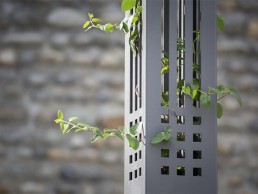
A less familiar approach is using the luminaire itself as both a planter and support structure for the plant as it grows.
Technilum, located in the southern French town of Beziers has recently incorporated both these functions in an elegant and effective manner, in the customisable version of its Treille lighting pole system, Creille-that-Grows.
Originally founded in 1971 by Guy Jullian, Technilum has been run as a family-owned business by his daughter Agnes since 1994. The company focus has always been on exterior street and amenity lighting and early products included conical street lighting poles. Technilum now offers both ‘off-the-shelf’ systems as well as bespoke designs. Its creative approach enables it to work with lighting designers and architects on high-end projects around the world.
In the early years, Technilum poles were designed for use with other manufacturers’ luminaires, however in 2010 Technilum introduced its first LED luminaire and now offers a complete range of poles and lighting elements, all of which are manufactured in France.
The Treille range was originally developed by Technilum in 2007. It was designed in conjunction with French lighting designer, Jean-François Arnaud, specifically for the Thiais Village project - a large open-air luxury shopping mall in the Paris area. The aim was to provide a high-quality lighting column that would act as both a decorative and functional lighting addition to the project.
Treille (French for trellis) takes its name from its perforated aluminium structure. Technilum has always used aluminium for its products and utilised weld-free production techniques from an early stage to avoid weakening the column structure and to avoid corrosion. Mechanical bolts are used in combination with industrial strength adhesive systems.
The square 177mm x 177mm extruded aluminium profile used for the Treille system has gentle concave surfaces, adding visual interest while increasing rigidity. Each face of the pole can be perforated by the Technilum in-house water jet facility with a wide variety of decorative patterns. The system can be used to create complete structures as well as various heights of lighting poles and bollards. Up and down light luminaires are housed within the profile so that the perforations are backlit and provide attractive light patterns on the surrounding surfaces. The housing also serves to protect the luminaires from vandalism and provides space for drivers and connection boxes, so the pole remains aesthetically pleasing.Projectors and amenity lighting luminaires can be mounted at various heights and positions on the poles.
A wide variety of Smart City equipment such as CCTV, speakers, electric car charge points, Wi-Fi hubs, Li-Fi, USB, power sockets, and even water taps for landscape maintenance can be added to provide a completely integrated system.
The development from the original Treille system into the latest version, Creille-that-Grows, which also integrates planting, started in 2013 as a design project with French landscape architect, Maxime Saisse. The aim of the project was to increase the use of plants and greenery in the limited spaces in cities around the world. As urban centres around the world continue to grow, the demand for more ‘green space’ and the connection with nature will increase.
The first project using the Creille system was in the Hedas neighbourhood in the French city of Pau. A series of 3.5-metre-tall columns integrating downlights and four-metre columns with twin projectors were used as part of a historic city centre renovation scheme. The downlights provide up to 4,200 lumens from a sixteen LED, IP67, IK08-rated luminaire that can be fitted with optics to produce either a wide batwing or medium beam distribution. Lighting design for this project was by Lionel Bessiers with landscape design by Villes and Paysages
The Creille-that-Grows system includes all the elements needed for healthy plant growth while also providing attractive amenity lighting. A buried cast concrete base, large enough to support the plants, is installed first. Holes for the plant roots to grow into the underlying soil are provided. The base is covered with a 760mm x 760mm die cast aluminium cover with grid openings to allow water through to the planting. The lighting post passes through the cover plate and is supported by the concrete base. Access to the electrical junction box is via a door concealed in the side of the post.
It is understood that a limited number of rather hardy plant types will thrive when used with the Creille-that-Grows system including Roses, Clematis and Jasmine, but this will depend on the particular local climate where they are installed. It is however envisaged that replacing the plants may be needed on a regular basis so being able to lift the cover plate to renew the soil and remove dead vegetation while leaving the lighting elements in place could prove very useful.
The Creille-that-Grows system is an interesting development from Technilum as it evolves the Treille range based on project demands. Several installations have now completed using the Creille-that-Grows system including South Quay Plaza in London and the Marrakech Royal Golf club. No doubt many more will follow as demand grows to refocus cities into more livable and ‘green’ areas.
Technilum claims to focus on creation, innovation and design in an urban and architectural environment, and it seems fair to conclude that all three of these key drivers in the company’s heritage have been achieved with the latest addition to its range with the Creille-that-Grows.
Ellen Goulmy
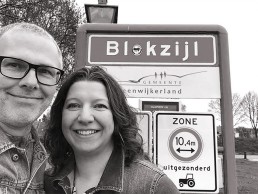
The internet-famous selfie couple Ellen Goulmy and Berry van Egten, of Berlux Lighting Design, are notable figures in the lighting industry. arc sat down with Goulmy to discuss the pair’s next venture into the light festival world. Taking a leaf out of Lights in Alingsås’ book, the couple’s Lights in Blokzijl debuted this December.
How did you both get into lighting?
I have a background in journalism and worked for the Dutch radio station Radio3FM as producer for several shows. Then one day, I just decided to quit and look for something new. Just by coincidence, I started working in Amsterdam in a design store with lighting.
Here, I fell in love with lighting, so went on to study lighting design at ROC Midden Nederland, and then went on to open my own store (later studio).
Eight years ago, I fell in love with a lighting designer and we decided to work together as a team! That was the beginning of a successful journey together, both in lighting design at Berlux Lighting Design and in the field of teaching at the Lighting Design Academy.
The guy I fell in love with is Berry van Egten. He started in the lighting industry 25 years ago, where he worked for several manufacturers in the Netherlands and Belgium, before starting his lighting design firm in 1993, with only five members of staff. He’s passionate about light and lighting, and for that reason he started the Lighting Design Academy to share knowledge about lighting.
Together we run both companies to get as many people involved in lighting design and share the same passion as we do!
Your most recent big project was Lights in Blokzijl. What was the concept behind it?
We both love Lights in Alingsås, and like to see it as our festival’s big sister! We visit the festival almost every year to see the students and staff on the last workshop evening and attend the opening ceremony. Berry was also one of the workshop heads in 2008. Around the world there are a lot of festivals, but not many with the concept of a workshop and sharing knowledge in a short period of time. It’s a perfect opportunity for students and one of the reasons we wanted to bring a bit of Alingsås to the Netherlands.
The idea to play and experiment in the surroundings of a city is made possible in the city of Blokzijl. It’s a very small town in the Netherlands where we also happen to live.
Who participated in the first edition of the light festival?
For the first edition we invited seven teams (a total of ten people) to guide the participants on their learning paths.
At the beginning of 2019, we had a call for workshop leaders through the IALD website and selected the following: Roberto Corandini of Light Design Workshop in Italy, Sjoerd van Beers and Juliette Nielsen of Beersnielsen in the Netherlands, Luciana Alanis in Switzerland of Lichtgold, Korhan Şişman of Planlux in Turkey, Anuj Gala from Lighting Design Collective in Finland and Rogier Hengeveld of Lighting Business Consultancy in Netherlands, Kapil Surlakar of Light@Work Design Consultants in India, and Johan Moritz, Senior Lighting Designer for the city of Malmö and Tina Wikström of Licht Kunst Licht from Sweden.
In February we will release a new call for participants for the 2020 edition of the event.
What happened during the event’s debut?
The workshop ran from 6 until 12 December 2019. The official opening of the event was held on the 11 December at 18:00, and then the festival was open for the public until 22nd of December (daily 17:00 until 23:00). There were a lot of other events that ran alongside the light festival, with details listed on the website and social media platforms during the course of the event’s programme.
After the success of the first event this year, what are your goals and aims for the it moving forward?
We want Lights in Blokzijl to be a yearly event in December. The aim is to get more students involved and therefore, have scholarships availabe for them to support their education.
Of course, professionals are welcome to join in on the workshops as well (but they would have to pay!).
We want Lights in Blokzijl to to be a new place where professionals and students meet and share their knowledge, and make friends for life!
Aside from Lights in Blokzijl, what are you both working on at the moment?
We have a few historical lighting design projects that we are working on, and in the field of teaching we are working on an e-learning platform that will be available around summer 2020. Our courses are only available in Dutch at the moment, but that’s going to change in 2020 due to the new platform. It’s a big step, but one we are really looking forward to!
What does the future hold for the lighting industry?
The industry is becoming more and more digital. A lighting designer does not only design lighting but is becoming more of a lighting programmer as well. We think it’s a good thing, but it’s important to keep educating yourself and stay up to date.
Also, the selfies! We need more for our book, so if you see us, please come and join us for a selfie!
www.berluxlichtarchitectuur.nl
David Ghatan
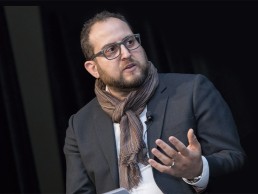
As he reaches the end of his two-year stint as IALD President, David Ghatan chats with arc’s Matt Waring on his career, his tenure as President, and what the future holds.
From an early age, light has been a constant source of fascination for David Ghatan.
“My mother would say it was from when I stuck a key in an electrical socket as a young child,” said Ghatan, of an interest that has taken him on a 20-year journey that has seen him progress from intern, to company president, to the president of the IALD.
Now approaching the end of his two-year tenure as IALD President, Ghatan opens up about this journey.
“Starting from a young age playing with blocks and Lego, I wanted to be an architect,” he said. “During my time at George Washington University, my interest in theatre design grew. I was able to combine my interests and craft a course of study combining theatre scenery and lighting design, architecture, and fine art in an exploration of design.
“The foundation of my degree programme was that through industrialisation we stopped training designers and trained specialists. It was important to me to find the core of design and the art of conceiving and creating, then to learn different fields in which to apply this foundation.”
It was during his studies, between his junior and senior years, that Ghatan took an internship with architectural lighting firm CM Kling + Associates. Here, under the tutelage of founder and mentor Candy Kling, he realised that architectural lighting was for him.
“I was very fortunate to find a field I loved and a mentor whom I learned from every day,” Ghatan continued. “While I thought I wanted to become an architect and pursue a Master’s degree, I was working with Candy and being exposed to world class architecture and designers, I was able to engage my design skills and work on many different projects at the same time.
“I learned very quickly by consuming as much information as I could find and asking many questions of Candy. She was the consummate teacher, always willing to provide guidance and listen. She knew that on top of being a professional and providing the technical requirements, you had to enjoy what you were doing and imbue fun into the project.”
Ghatan worked under Kling for fourteen years, before succeeding her as President of CM Kling + Associates six years ago. In his formative years, he says that he hoped to bring designs that were “formed from a collaborative process, that were sensitive, well thought out, and possessed a bit of the unexpected”, and this is an approach that still rings true to this day, shaping his philosophy as a lighting designer.
“I would say that the designer’s responsibility is to push the project forward. That may mean in technology, science, or application. It can be in the final end product or as part of the design process,” he said.
“For me, this means that there is never one way of lighting something. You must explore the various possibilities and apply your knowledge and skill to reason why one is best for that project. It needs to be collaborative; lighting designers cannot exist without architects, interior designers, owners and end users. The design needs to be developed with the team and have consensus.”
Over the past 20 years, Ghatan has worked on a wealth of projects, ranging greatly in both scale and application, from stadiums and convention centres to hotels, spas and office spaces, always treating each with “equal importance and dedication”, no matter their size.
Reminiscing on some of the highlights from his career, Ghatan said: “I was fortunate in my design career, in that I joined a company that was already 20 years old, with a founder who had been in architectural lighting since the late 1960s. From early on I was a part of the design team working through solutions.
“Memorable early projects such as the Walter E. Washington Convention Center in Washington DC were notable for the scale and amount of coordinated drafting. We were seeing a shift in technology and the introduction of ceramic metal halide and compact fluorescent in place of traditional halogen sources, and the facility has been a public success since day one.
Other career highlights for Ghatan include the renovation of the Watergate Hotel in Washington DC, the Boston Park Plaza Hotel in Boston, the Music City Center in Nashville, the Phoenician Resort & Spa in Scottsdale, Arizona, and Vancouver’s BC Place Stadium. “BC Place was a very large scale project, with a colour-changing roof and façade,” he explained. “On top of the design work, we were later engaged to develop the content for the façade. This meant learning new software and storyboarding through the sequences of dynamic façade lighting.”
This experience led to Ghatan co-founding sister company Pixelumen Lab in 2014, which in turn allowed him to “re-engage with my fine art and scenic design skills, now applied to burgeoning interactive technology”.
Because of the variety of projects that he has worked on over the years, and the sheer scope and potential of lighting design in general, Ghatan revealed that he doesn’t ascribe to a particular “signature style” in his work.
“I feel that in lighting design it is important to be fluid and comfortable in many techniques,” he said. “If I had a style, I would say it is timeless. I want my designs to be as resonant in ten years as they are today. This means finding ways to integrate the lighting with the architectural concept – note I did not say specifically with the architecture. I think this is often confused. If the lighting is part of the overall design concept, and embraces and enhances it, I find no fault in that lighting being exposed.”
This focus on integrating lighting design within the overall architectural concept is a core consideration for Ghatan when developing lighting schemes, as he elaborated: “Light is perhaps the most important element in our lives. Be it in the built environment, the natural environment or our health and wellbeing. Yet it is very likely the most misunderstood and the one we know least about.
“When planning a project, I look to the concept. The design we are collaborating on originated somewhere and has a series of core values or purposes. I try to distil those, sometimes even before the architect has clarity on these themselves. I then set myself the challenge of achieving those goals while trying to not simply ‘paint by numbers’ using techniques or applications I have used before. You have to repeat yourself sometimes, but you need to push for new approaches when you can. I look at knowledge and research on what is current with regards to light and its impact.”
For the past two years, Ghatan has been President of the IALD, taking over from Victor Palacio at the beginning of 2018. Ghatan has been involved with the association for almost as long as he has worked in the lighting industry, rising through the ranks much in the same way he did at CM Kling + Associates.
“When I first started in the industry, my boss put the application for IALD on my desk and simply said ‘fill this out’. It was important to her that her staff and company be a part of the IALD,” he said. “Later, I attended an IALD Enlighten event, one of the first ones, and found the community and family of lighting designers resonant.”
From there, Ghatan became a chapter coordinator, and shortly after put his name forward to run for the Board of Directors. “I was placed on the ballot and elected as a Director at Large,” he explained. “When that term was finishing, I was approached by the then Treasurer and asked if I would consider running for that position. I said yes.
“Similarly, once the Treasurer term was winding down, I had both an interest in running for President, and had some wonderful colleagues who had confidence in me. Overall, it has been a long run on the Board of Directors, and wonderful to see the growth of the IALD not only in numbers, but in depth and substance.”
While Ghatan joked that his first ambition as IALD President was “to simply not screw up”, he explained the primary goals for his two-year term: “The role of the IALD President is foremost to steer the Board of Directors in their work. Work that was begun before my term and will continue after. Advancing this and maintaining a strong and effective association was primary.”
“Over the past decade, the IALD Board has been developing and reviewing the framework of who we are and why we exist. This normal Board work must be pulled up for analysis on regular intervals, and the Board of Directors held an intensive two-day strategy workshop this summer. This effort will influence and frame all of the activities of the IALD. It was my honour to be able to serve as President during this effort, and I look forward to future Boards using these tools to lead the IALD into the future.”
In a wider sense, over the past two years, the IALD has developed a growing influence on policy makers and legislators worldwide through its global Public Policy efforts, as Ghatan explained: “We have had great success, including addressing key staff at the US Congress, in Australia working on fair and applicable lighting legislation, evolving the WELL Standards with regards to lighting, and with the EU through a number of contacts directly with EU legislators, leading to the IALD being formally recognised as a subject matter expert on lighting.”
Ghatan’s Presidential term has also coincided with the IALD’s 50th anniversary – a landmark that has seen the association hold a number of celebratory events throughout the year, culminating in the IALD Enlighten Americas conference, held in Albuquerque this October. “It was an immense honour,” said Ghatan. “I had honestly not focused on it prior to running for President, then it dawned on me that this milestone would occur during my term.
“At IALD Enlighten Americas, we had fourteen IALD presidents and two IALD founders in attendance; spending time with this group of lighting leaders was amazing and inspiring. Throughout 2019, IALD has celebrated 50 years at all of our events, from local chapter-level meet-ups, to social media postings, all the way through to the gold-inspired birthday party to close the Enlighten conference. We felt it would allow more people to celebrate our past, champion our present, and lead the future of lighting.”
These celebrations, and the continued expansion of the lighting design community will remain as highlights for Ghatan’s tenure, as he looks back on his Presidency: “The process has been extremely rewarding. I have been fortunate to connect with IALD members and lighting designers around the globe – from Singapore, to Tokyo, Shanghai, London, the United States and South America. In a time when IALD’s membership has grown by nearly 100%, I am reminded that lighting designers globally are a family, and we seek to find community and connection.”
In the new year, Ghatan will step down as IALD President, passing the torch on to Douglas Leonard, Director of DLLD Lighting Studio, although he will still be active in the IALD as Immediate Past President. “This allows for continuity on the Board and in the role,” he said. “There are also a number of committees on which I serve, but even after these roll off I am certain that I will be an active citizen of the IALD. It is central to my beliefs and ethics as a professional lighting designer.”
Outside of his work with the IALD, Ghatan added that he’s looking forward to getting back to his work with CM Kling + Associates. “As 2020 begins, I plan to take some time to thank my team for their tireless efforts over the past few years,” he said. “CM Kling and Pixelumen Lab have both seen growth and development during this time. Now we will take some time to look at what we do, how we do it, what we want to be doing, and what our customers want from us. I think this effort will allow us to provide a better ultimate design effort.”
During Ghatan’s time as President of the IALD, he has seen membership figures nearly double, and he has offered some advice for the next generation of lighting designers: “This is an amazing time to be a lighting designer. We are at a unique moment in time where anything we can think up is technologically able to happen. It takes imagination, storytelling and skill.
“Younger designers should embrace the new, learn everything they can about emerging technologies, but never forget the core tenets of design. We are designing for people, we have to have their interests and needs in mind.”
Finally, he believes that it is through this constant development of new technologies that the lighting industry, and lighting design, will continue to evolve. “We are headed to a world of personalised lighting where individual interaction with your lighting will be standard,” he said. “However, this requires a lot of thinking and design on what is controlled, how it works, and what exactly interconnects to it.
“We must be careful that the technology does not lead the design, but that quality light and quality techniques founded in knowledge and facts are the leaders. This to me ensures the future of architectural lighting designers.
“As I said previously, we are at the first moment in our history where technology outpaces our creativity. If we can think it up it is doable. It is on us to push for greater and better.”
Self Portrait, UK
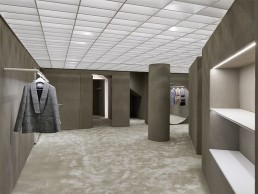
High-end fashion label Self-Portrait has recently opened its new, flagship store in London’s Mayfair. To create this space, the brand turned to Casper Mueller Kneer Architects, a firm renowned for its work for arts and fashion clients, such as White Cube Gallery, Barbican Art Centre, and collaborations with fashion house Céline.
As the first stand-alone store for Self-Portrait, the design concept, which features a lighting scheme from Lichtvision Design, will set the standard for further stores to follow.
Set over ground and lower ground floors, the 233sqm store offers a sequence of spaces that flow into each other, creating zones with distinct spatial and material qualities.
Three design elements characterise the space – the custom-designed terrazzo flooring with pink and white marble insets, the open grid ceiling that creates a continuous ‘luminous horizon’, and the dark and heavy Cornish mineral clay render, applied to all wall and ceiling surfaces.
Simple geometric forms structure the space: at ground level, two semi-circular metal screens with coloured aluminium inlays provide the hanging rails, as well as visual shelter, while at the lower floor, the main space is triangle shaped. Smaller ante-rooms with deliberately odd geometries are located off these main spaces, while two staircases allow a playful loop of discovery.
Lichtvision was asked to support the architects with the lighting design, having worked with its London office on a number of other projects in the past. Karen Ihlau, Design Director at Lichtvision, told us more: “Our support for them has ranged from basic lighting advice such as technical product advice to full design services where we also contribute on concept finding, visual perception, lighting submission packages and on-site support.
“For Self-Portrait, we worked closely with the architects from concept through to site commissioning. We also did a full-size mock-up on site so that the client could sign off and visualise the end result.”
Echoing the minimalist design of the store, Lichtvision created a very minimal lighting scheme, as Ihlau explained: “The architects only use a small number of materials for each project; it is a very reduced palette that is carefully selected and often used in its original state or finish. I call this a very honest approach.
“We reacted to this minimalism with another minimalistic, almost abstract lighting design. The intent was to blend the lighting into the surfaces, but at the same time to ensure that the product presentation is good.”
To create the ‘luminous horizon’ in the ceiling, sought after by the architects, the lighting designers used Flashaar’s NauticProfile system, suspending linear luminaires behind the open grid ceiling. “With this honest architectural approach and a complete open grid ceiling, we knew everything behind the ceiling grid would be on show,” Ihlau said.
“For the linear system, we found a product that would look continuous and have small dimensions, had the right technical abilities for the retail space, could be suspended, but could also reduce the amount of cabling running behind the open ceiling.
“In order to visually blend into the ceiling, we modelled and mocked-up the best location. In the final solution we placed the fittings at a small distance above the cassettes directly shining down, but also always directly above the ceiling structure. By placing the fittings above every second cassette, the lighting gets distributed more evenly along every cassette.”
Additional direct spotlights – in this case Steng’s Bell Pro, with Xicato engine – enhance materials and sculptural interior design, as well as the products.
This ‘luminous horizon’ effect was created on both the ground and lower ground floors, in spite of the different ceiling heights – something that caused some concerns for Lichtvision. “The basement height was very low and different to the ground floor, although using the same ceiling and layout. We were able to ensure that the solution could be the same on both floors and visually very similar,” explained Ihlau. “Several beams run across the space on the ground floor, and the reflected light picks up differently on these. However, the eye still puts everything together as one luminous ceiling.”
Lichtvision also convinced the architects to include localised lighting underneath the shelves, inside the clothes rails on the lower ground floor, and to increase the designated spots on rods above the curved metal screen and clothes rails. This was achieved through the use of LED Flex’s Ecoflex 120 fixtures. “This was important to us for product presentation, but also for the ability to adjust the atmosphere in the spaces by dimming those layers of light differently,” Ihlau explained.
The curved, semi-circular metal screens, through their open design, create a playful shadow and light effect from the directional light from the ceiling. The rhythm of spacious atmosphere and the surprising element of light and shadow effects structure the customer experience, while the integrated linear shelf lights support the product presentation in a discrete and subtle approach.
The curved screens bring a sense of structure to the space, creating two distinct rooms without enclosing either completely, but they also double up as display structures and background. Visitors perceive two different colours when they move around them, an effect that has to do with the rotation of their elements.
Because of the brief, Lichtvision sought to retain a very clean, minimal approach to the lighting design, meaning that no decorative elements were considered. Instead, the lighting complements the sleek, sparse layout of the store, something that Ihlau feels adds to the appeal of the store.
“We complemented the minimalistic architecture with a minimalistic lighting scheme. There is power and beauty in contrast as it appeals to the eye,” she said. “The contrast in this project is given by the tension between the rough and minimalistic space that sells fresh, feminine, sometimes floral and sometimes light dresses and other ranges of female clothing.
“The lighting adds to the abstract perception of the space and its architecture. It’s simple, and contributes to the clear identity asked for by the client.”
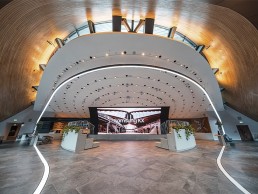
Samsung KX, UK
Designed by Heatherwick Studios, Coal Drops Yard is an architectural marvel. Adjacent to London’s King’s Cross Station, the chic, high-end retail space is dominated by two curved, ‘kissing’ rooftops, making it instantly recognisable as one of the city’s newest landmarks.
Situated underneath these swooping rooftops is Samsung KX, a new ‘retail and experience space’. Working alongside project managers Portview, architects KSS and interior designers Brinkworth, Nulty was brought onto the project to complete the lighting design and to find an impactful way to illuminate Heatherwick’s remarkable architecture.
“Our brief was to create a rational lighting solution for the space,” explained Anna Sandgren, Associate Lighting Designer at Nulty. “We were working with a clear architectural blueprint when it came to Coal Drops Yard’s curved rooftops, so our lighting scheme had to work sympathetically with the building. Architecture always took priority.”
As such, Nulty created an all-LED lighting scheme that was befitting of its architectural backdrop, enhancing the iconic appearance of the near-identical gabled roofs - an element that had to be factored into the lighting design too. “Everything about the final scheme needed to be symmetrical to ensure that the lighting design is consistent throughout both linear structures,” Sandgren added. “The fixed parameters of the space are what made this such a unique project.”
Inside, the complexity of the infrastructure of the building, and the changing functionality of the Samsung KX space, required the team to create a day-to-night lighting scheme that is constantly visible through the floor-to-ceiling windows, and can be modified depending on how the experience-led space is used.
“Our role was to master the technical challenges that the building presented and ensure that this didn’t impact on our ability to deliver the quality of light throughout that the client needed,” continued Sandgren. “We were always respectful of the building, so the success of the project lay in creating a lighting solution that could work harmoniously within it.”
A key facet in this lighting solution is a continuous ribbon of light that soars throughout the east and west retail showcases, unifying the two sections of the building. Created by The Light Lab, the circular swoop of light travels up through the floor, walls and ceiling to form a central architectural feature for Samsung KX, designed to host masterclasses, workshops and talks. Visible from every aspect of Coal Drops Yard, the ribbon of light mirrors the curves of Heatherwick’s original design, while enveloping the space in a layering blanket of light.
“A number of the manufacturers that we approached said that it couldn’t be done because of the sheer scope of the space that we were dealing with,” said Sandgren. “Thankfully, The Light Lab had the vision to understand what we needed.”
The bespoke fixture provides the majority of the illumination in the main area of the space, alongside Targetti’s surface-mounted Zeno spotlights. Positioned across the ceiling in a concentric circular formation, the tunable white spotlights work with the curved contours of the building, and can be adjusted from cool white through to warm white to create different moods.
Speaking of the lighting in the main space, Sandgren said: “We were confident that the ribbon of light would provide the right level of illumination throughout. It brings symmetry and balance to the space.
“Beyond this, we needed to think technically about how to create different lighting moods, because the functionality of the space changes almost daily. This is why our lighting scheme is flexible at a lower level.
“The entire space is controlled by a DALI system, which has the capacity to be totally transformative. Every one of the LED lights that you see in the space is individually addressable and can be adjusted according to how Samsung KX is being used.”
By creating this flexible, tunable lighting system, Nulty were able to achieve the client’s desired cool white light - something fundamental to the Samsung brand and how they display their products, Sandgren explained - while making it work within a space dominated by a warm timber aesthetic.
While the light ribbon and its complementary spotlights provide the right level of illumination in the main body of the space, other areas required different solutions. For instance, in the kitchen/entrance area of the space, LED Flex’s Lumen Line linear fixtures interplay with a wooden slatted ceiling, while the manufacturer’s Eco Flex fittings provide linear lighting behind the banquettes in the showcase east and customer service area, creating a gentle, diffuse illumination to offset the primary lighting feature.
However, the instantly recognisable ‘kissing rooftops’ required special consideration, as Sandgren explained: “The kissing rooftops were undoubtedly our biggest architectural consideration. It was where all of the design decisions began and ended.
“The area under the kissing rooftops was the one area of Samsung KX where we couldn’t have too much light, so we had to work out how to achieve consistent levels of illumination throughout the east and west showcase, without allowing the quality of light to drop across the building.
“Our response was to frame each of the east and west showcases with surface mounted LED spotlights, but then let the light levels naturally drop away where the rooftops meet. By doing this, we have created a pocket of calmness at the kissing point, but also preserved a layering blanket of light throughout.”
By letting the light drop away towards the kissing rooftops, it also reduced any potential impact of light spill onto the Coal Drops Yard exterior – something that had to be taken into consideration, on account of the vast windows in the space. “Coal Drops Yard is dominated by floor to ceiling windows, so we had to appraise every decision to ensure that the lighting scheme looks great from every angle,” Sandgren elucidated.
“We also had to work out how to avoid unnecessary light spill. Testing each and every fixture on site and reviewing how they read from the exterior of the building was how we made all of this work.”
Indeed from the reduction in light spill, to the flexible, tunable lighting system, Sandgren believes that the scheme that Nulty has created works in harmony with the overall architectural design of the space. “The architect’s vision for Samsung KX was in place right from the beginning so we worked within the parameters of what was set,” she said.
“Our team worked hard to make sure that the overall lighting scheme pays homage to Heatherwick Studio’s design legacy, and that every part of our final solution contributes to preserving the building from every angle.”
The end result is a lighting scheme that serves to complement and highlight the unique architecture of the space – an important aspect that Sandgren was keen to implement in the lighting design.
“We strongly believe that a great lighting scheme isn’t always what you can see – the role of lighting is to enhance a space and give it depth,” she enthused. “And lighting shouldn’t distract from the architecture that surrounds it.
“Samsung KX is a great example of this. Lighting is deliberately restrained to bring the space to life, but it is respectful of where it sits. Everything that we’ve done to illuminate it has been about celebrating important architectural details, but also about creating a calm and welcoming environment throughout.”
Although Nulty as a studio, and Sandgren personally, have a great deal of experience in creating lighting schemes for retail environments, the opportunity to design the lighting for such a remarkable site meant that this remained a unique project.
“How often do you get asked to create a lighting scheme for a project of this scale? And how often do you have to create a workable solution for two gabled rooftops?” asked Sandgren.
“Everything about this project was unique – especially the building itself. Heritage, an architectural legacy, structural challenges, an innovative retail concept; this project had it all.”
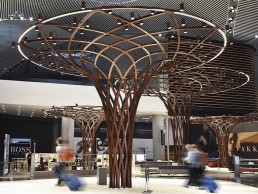
Unifree Duty Free, Istanbul Airport, Turkey
Istanbul Airport, located in the heart of Asia, Europe, and the Middle East, is shaping up to be the world’s highest capacity airport. Overall, it has the potential of welcoming up to 200 million passengers yearly by 2023, travelling to 300 different destinations.
The first phase was completed and opened in October 2018, and hopes to welcome 90 million passengers annually. This presents a huge retail opportunity, not missed by Tabanlıoğlu architects, which has drawn on the architecture of Istanbul as inspiration for the 26 Unifree duty-free shops with twelve different concept designs. These various cultural concepts and symbols include the Bosphorous, Grand Bazaar, and the famous Judas trees that populate the city, whose pink blossoms line the city streets from spring.
This architecturally-inspired design was curated in conjunction with ZKLD studio, responsible for the lighting design, and therefore responsible for drawing attention to these features. Speaking to arc, Mustafa Akkaya, Design Director and Senior Lighting Designer at ZKLD, said: “The architectural team had an idea map in the context of the concept, inspired by the dynamic structure of the Bosphorus. The client gave feedback about the lighting levels that would be eye-catching, drawing from their previous experience.” These directed lights were used to foster a sense of luxury, eye-catching design and visual comfort, as well as draw further attention to other design aspects, such as the abstract tree structures littered through the circulation areas.
“Architectural forms and elements are based on the abstraction of the concept of Istanbul, and in this context, the forms of all lighting instruments in which we take part in the design represent different elements that will complete this scene of Istanbul,” Akkaya continued. For the abstract tree structures, a linear LED line with an opal cover had been custom-made to suit these focal points. During this design process, special products such as telescopic rail spot arms and mounting brackets were also developed.
Fundamentally, the goal of the lighting design was to create an attractive atmosphere through the emphasis of architectural details and the duty-free stores. This would be aided through DMX controlled RGBW and 3000K linear LED fixtures from Osram and Arlight, alongside various façade lightings.
Interior areas were divided through general and focal areas: Unifree requested a standard 1/5 ratio for illuminance levels, in order to create a visual contrast and attract attention to the desired places. For this reason, the vertical illumination of gondolas is set to 1500 lux on average, whilst in general spaces, such as circulation areas, this is reduced to around 300 lux. In order to keep things comfortable and eye-catching, ZKLD developed product-oriented lighting solutions, and used the same warm white light temperature to gather all areas under one roof and create an overall sense of synergy and unity of design within the duty-free stores. This also allowed for ZKLD to counter aspect the clinical and homogenous nature of airport spaces. Akkaya continued: “Our aim was to bring forward the stores with warmer colours of light on the products in this overall white airport volume.” For general lighting, a homogeneous light distribution was used; this included custom-made 3000K suspended lighting fixtures with line textured opal diffusers, courtesy of TLTpanel. These were designed and used in almost every store at cashier points.
The whole project required a rapid flow of action, which required a great deal of co-operation and communication. Akkaya described his experience of the process: “Throughout the process, conceptual ideas have changed slightly during the construction phase. By keeping interdisciplinary communication constantly active, the variables were quickly adapted… At the point of solution, it required a product-oriented lighting scheme for the illumination of all these organic-form architectural elements.”
Throughout the project, ZKLD took part in the designs, brainstorms and the mock-ups, maintaining a high level of participation and exchange of ideas. For example, flexible light directions were implemented to accommodate for the potential last minute changes in furnishings, whilst a shadow-free display area had also been supplied with Zumtobel’s Onico adjustable track spots at a twelve-degree beam angle.
Besides its ambition to become the highest capacity airport, Istanbul Airport’s architecture aims to make a name for itself. For the duty-free shops of the airport, they remain the most common but arguably also the most attractive areas of the project. ZKLD kept the centrality of retail in mind from the outset, using light design to outline and accentuate these areas. Akkaya said, in closing: “It is a great pleasure to see that the targeted fiction has been realised after the completion of all the processes of the project. Of course, in the construction of such large-scale projects, there will be factors that will affect the outcome, but each step followed one by one has allowed us to minimise this.” With the help of lighting design that highlights the architecture, bold and eye-catching ambiances have been created for the passengers of a new world transport hub.
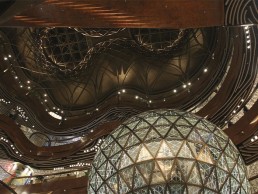
K11 Musea, Hong Kong
Hong Kong’s Victoria Dockside is a vibrant new art and design district that knits hotel, office and cultural components with outdoor public gardens, reactivating the waterfront public realms. Designed by KPF Architects, the architectural diversity of the site emulates its varied elements, while the use of stone, glass and metal finishes provides a rich materiality.
Sitting in the middle of this development is the K11 Musea, a new 1.2 million square foot development envisioned by businessman Adrian Cheng. Home to cutting edge retail, world-class contemporary art, culture and gastronomy, the Musea is intended to completely reshape the retail experience for the consumer.
As a key member of the creative team behind the project, Speirs + Major worked to design the light for all of the interior and exterior public spaces in the project. Keith Bradshaw, Principal at Speirs + Major, explained how the firm got involved in the project: “We were already working on the site of the development on both the Avenue of Stars and Salisbury Gardens. We met with the client, and he felt that our depth and breadth of experience was right.
“He could also see how we could help to knit the development into its context, in the sense that the interiors would become an extension of our work on the external areas.”
Cheng’s vision for the project, Bradshaw explained, was to assemble a team of ‘100 Creative Powers’ who would shape the design and experience of the project, led by himself in a curatorial role. He provided Speirs + Major not with a traditional brief, but instead “an expression of the character, atmosphere and experience he wanted to create”.
“The brief called for an atmosphere that would not normally be associated with a shopping mall,” Bradshaw explained. “‘Bespoke’, ‘Welcoming’, ‘Crafted’, and ‘Contrast’, were all keywords. Our client envisioned K11 Musea as a creative environment with an independent and memorable atmosphere – a place where people would feel relaxed yet inspired. Our job was to deliver that across a vast, complicated and hugely varied series of spaces.”
Bradshaw and the Speirs + Major team quickly understood the importance that lighting would play in bringing together the various elements of the vast project, to create a sense of cohesion across the spaces. “I think we were the only members of the design team that contributed to the design of every part of the Musea, so in that sense light is the common thread that stitches all the elements together,” he said.
However, the need to create something ‘bespoke’ and ‘crafted’, while shaping an ‘independent and memorable atmosphere’ in the context of a busy retail/cultural hybrid environment made this particular project completely different to other retail scenarios that Speirs + Major has worked on. Bradshaw continued: “We had to break away from all pre-conceptions of retail lighting.
“The challenge was complex: we needed to find the right compositional balance so that the light would connect the spaces together; highlight the key architectural features, art pieces and cultural insertions; deliver for the retailers; and all the while keep the atmosphere we were trying to create at the front of our minds.”
To do this, Bradshaw developed a lighting concept based on the notion of a bespoke collection of luminous objects. The lighting details in each space are distinct, but the deliberate coherence in design language and materials across the collection works to bind them together as a whole, delivering a sense of cohesion while retaining the flexibility to address the individual, idiosyncratic spaces and shape the character of the development.
Details are carefully integrated and arranged to create a sense of energy and dynamism, yet balanced to avoid detracting from the retail shop fronts or overwhelming the art pieces.
Recurring ‘crystal ball’ luminaires are placed in various configurations throughout the space, appearing in their most dense clusters nearest the atrium. Although seemingly bespoke-made, these fittings are more of a customisation than a fully bespoke product, comprising downlights fitted with a crystal cover, which made them simpler to source and install.
Bradshaw explained the inspiration behind these fixtures: “We were considering the idea of a motif that could further act as a source of visual connection. The ‘crystal ball’ concept delivered on a number of levels.
“The glow and sparkle of the cut crystal offered the ‘crafted’ feel that we wanted, and we could create a sense of dynamic energy and movement that would draw the eye vertically by arranging and clustering them in certain ways.
“We were also able to influence the ceiling design to support our concept – the pattern of curved wooden channels that support the crystal balls were created as an extension of the lighting concept.”
Because of the sheer scale of the project, a large number of interior architects were involved, each working on different spaces within the project. For each space, Speirs + Major worked closely with each of them to ensure that the materials and textures they had chosen were well expressed, and that light was properly integrated.
“Throughout the project, we were careful to ensure that the quality of the light remained a consistent and common factor across all of the varied spaces,” Bradshaw explained. “Our luminous objects are designed to be recognisable as a collection despite their varying sizes, scale and arrangement. Each individual piece responds to its setting, with details that contribute a decorative element as well as a soft, flattering light to visitors.
“We also played with extremes of scale, exaggerating these with lit highlights to create a sense of spectacle, and balancing them with relatable human-scale details.”
Such an approach is evident in the ‘Opera Theatre’, where a spectacular five-storey-high glazed, illuminated ‘Gold Ball’ dominates the void, while the miniature cut crystal balls cluster at the edges of the atrium ‘galaxy’, suspended from the ceilings and recessed into the floor.
The main structure of the ‘Gold Ball’ incorporates Stoane Lighting’s Iris, alongside Linea Light Group’s Iris 67-3 projectors, which illuminate the feature structure.
“The ‘Gold Ball’ was designed by us as a singular luminous object,” said Bradshaw. “As such, we integrated the light within the frame of the structure to highlight the cut crystal patterns.
“We designed it to be deliberately majestic in scale, but also to exude warmth. It is balanced by the crystal balls, which provide a more relatable human scale.”
Above the huge ‘Gold Ball’, Radiant Lighting’s 3D LED Flex 40 fixtures are located within the skylights, adding additional downlighting to the structure.
Elsewhere, cultural insertions including art installations, pop-up stores and artisanal displays are located along the concourses and dotted throughout the entire Musea. Speirs + Major approached the lighting for these ever-changing elements in the same way that they would an art gallery, providing a lower than usual level of general light, allowing for contrasting highlights, adding the flexibility to change sources, texture and focus through track lighting.
These showcases are illuminated via a range of methods, from Delta Light’s SuperLoop and Midispy in the Beautilicious area and Lumenpulse’s Lumenfacade Interior at the Rain Forest showcase in the Maison of Fashion area, to Rosco’s Litepad HO90, located in the lift lobby showcase.
Throughout the Musea a number of green walls and columns bring a feeling of nature and the outdoors inside, alongside various plant displays. Stoane Lighting’s Baldican XIM Wallwash, the X-LED Mesh from Carl Stahl, and Luci Lighting’s Power Flex Indoor highlight these green walls, while plant displays in the Beautilicious area are illuminated by LightGraphix’s LD51.
Away from the main spaces, people can find a variety of eccentric, independent atmospheres to enjoy. Bradshaw continued: “Our client wanted the traditionally back of house areas to act as places of comfort and respite, so the light for each of the eleven lift lobbies and seven toilets is carefully and elegantly integrated, to accent their characteristic surfaces and materials. Lanterns and vertical light structures provide points of focus.”
Capping off the development is the Bohemian Garden, found on the roofscape. Visitors access this garden via an escalator that ascends through a cage of layered metal and suspended crystal lanterns, emerging into a serene, delicately lit garden. After dark, the curvaceous features - vertical greenery, cascading water, esoteric play structures and modular canopies - are softly highlighted. When required for events, the central lawn may also be dynamically lit from discreet lighting rigs.
Despite the vast size of the project, and the almost bespoke feel of the lighting solution, Bradshaw revealed that the lighting elements used to create the scheme were surprisingly straightforward. “Although there are a select number of bespoke details and customisations, the bulk of the scheme is built on core lighting techniques such as concealed slots, coves and downlights. Even the luminaires that appear bespoke are often standard products that have been cleverly applied or adapted.”
The lighting scheme created by Bradshaw and the Speirs + Major team adds to the luxurious, glamorous nature of the K11 Musea, helping to create a lasting impression on visitors, as Bradshaw concluded: “We are exceptionally pleased by the way in which the lighting delivers on the brief. As a hub of what is essentially a brand new district in Hong Kong, the lighting has provided K11 Musea with a very distinct and memorable character that is proving very popular.
“Lighting works to bind the various eclectic spaces together and highlight the cultural insertions so they can be readily enjoyed, while also delivering functionality.
“And, while it is undoubtedly photogenic, we find the experience of the spaces to be just as good in reality as it appears on screen.”
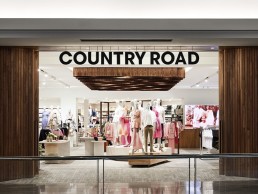
Country Road, Australia
In August this year, Country Road, an Australian-based lifestyle fashion retailer, launched Australia’s first fashion store to be awarded the 5-Star, Green Star Design Review Rating.
The lifestyle brand’s flagship store in the Chadstone Shopping Centre represents the most sustainable, ethical and innovative material. Symbolising a new era of luxury, the store was designed to enhance the customer experience at every touch point, while revitalising old materials into beautiful new store features. The result is fixtures made from recycled yoghurt containers, carpet crafted from fishing nets and recycled paper wall cladding.
Along with interior architects, HMKM London, Ambience became involved with the project through its already existing, close relationship with the Country Road Group. Dave Buchanan, Senior Design Coordinator at Ambience, told arc: “The initial brief focused on sustainability and flagship innovation. The project took approximately eighteen months from initial briefing to completion.
“The key challenge was achieving a certified 5 Star Green Star rating while meeting budget, project timelines and implementing a creative yet functional solution for the brand. Our team of talented lighting designers overcame all challenges through collaboration with the Green Star consultant, innovation and a dedication to excellence.”
The Green Star certification is a rating system of stars and points issued by the Green Building Council of Australia, which encourages and assesses sustainable and environmentally conscious design, construction and operation of buildings.
Approaching the rating from a lighting point of view, it was important for the Ambience team to pay close attention to the lighting comfort levels and the Greenhouse Gas Emissions in the Country Road store.
“There are standard measures like using flicker free fittings and specific settings on the Colour Rendering Index,” explained Stephen Justice, Communications Director at Ambience.
“The back of house and store room were placed on sensors and shopfront lighting was placed on a timer. For the general illuminance and glare reduction, we specified diffusers, softening lenses and honeycomb louvres to all fittings in the nominated area, to reduce glare.
Applying localised lighting control to all the task areas allowed the ability to adjust the light levels in the immediate environment (counter and back of house areas) for staff members,” he continued.
To combat the greenhouse gas emissions, the team at Ambience achieved an incredible 40% reduction to the Part J6, 2016-2019 BCA.
“The approach to this was a lot harder than it sounds,” explained Justice. “We had to reduce the percentage of the illumination power density by specifying more efficient fittings that achieve the right light levels with less light and less power consumption.”
Buchanan added: “The architectural documentation went through multiple iterations to perfect the brand’s vision and create a benchmark of inspiration for the retail industry. As a result, the lighting design, specification and layout was continually refined to suit the documentation. The modifications introduced regular assessments of the Green Star requirements to ensure compliance.”
Using Ambience’s own fixtures, the team had to create a scheme that would work around the architectural features of the store. Internal artistic ceiling features include formed ceiling channels and oak curved wood timber curtains. Integrated light sources are concealed within the curtain wraps to provide subtle, dappled lighting to the oak finish.
“The lighting design captured the essence of the brand’s commitment to sustainability and the celebrated Australian lifestyle through pioneering best industry practice, the latest luminaire technology and a considered architectural lighting approach. The garments exuded luxury through excellent colour rendition and precise aiming,” explained Buchanan.
“The architecture, lighting and brand ethos elegantly dovetail to produce a fashion forward, iconic installation.
“Country Road Chadstone was one of the most challenging yet rewarding and educational projects. A career defining milestone for all involved.”
Country Road Managing Director, Elle Roseby, said the relaunch of the Chadstone flagship store was a milestone for both the brand and the industry: “Our Chadstone flagship revolutionises the retail experience, maintaining our commitment to quality, while demonstrating our connection to the environment. It shows that sustainability in fashion extends into retail store fit-outs, as well as garment production.”
Paul Digby, Creative Director from HMKM in London, commented: “Country Road is a truly Australian lifestyle brand, brought to life through a ‘Curated landscape’, where the outdoors effortlessly flows in. Natural, local materials and craft tradition are celebrated through the store design, where the environment is cherished and respected. A unique retail landscape referencing the country’s riches, putting community and sustainability at its heart. All with the aim to be Australia’s first 5-Green Star lifestyle store.”
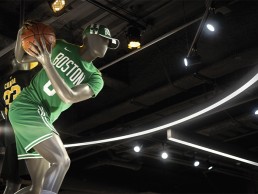
Pro Shop powered by '47, USA
The Hub on Causeway in Boston, USA, is a joint-venture development of Delaware North and Boston Properties, consisting of more than 1.5 million sqft of mixed-use retail, office, hotel and residential space, as well as an expansion of TD Garden - home of the Boston Bruins NHL team and NBA’s Boston Celtics.
This transit-oriented development is a significant investment that will bring substantial improvements to North Station, create major economic impact for the area, and enhance the vitality of this important district in the city of Boston.
As part of the project, the Pro Shop powered by ‘47, the official team store of the Boston Bruins and Boston Celtics, has been expanded and relocated to a prominent location at the Hub on Causeway entrance to TD Garden.
Bergmeyer, a Boston-based design collaborative channelled the core values of Boston’s sports teams - grit, heart, heritage and authenticity - when developing the designs for the new store, creating an immersive retail environment that celebrates Boston’s historic local sports franchises. The store design seamlessly blends exposed ceilings, honed concrete floors, large retail store fixtures constructed of rough-cut wood and welded steel, and an actual section of parquet flooring from the original TD Garden basketball court, complete with state-of-the-art audio-visual displays and digital signage.
The store experience is supported by a multi-layered retail and entertainment lighting scheme, designed by Hartranft Lighting Design. Merchandise lighting is largely accomplished with Bruck’s SMARTrack LED track lights, while the architecture is complemented with supplemental ambient and accent lighting, which includes linear lighting with acoustic baffles for sound dampening, provided by the likes of ETC, Philips Color Kinetics, QTRAN and Focal Point.
Alongside this, hat displays have integrated LED shelf lighting, courtesy of QTRAN, mannequins stand atop LED backlit pedestal bases, and a 16ft diameter ring of light – Zaneen’s Glorious 5400 Suspension - encircles an enormous, centrally located t-shirt display. One of the most striking features of the Pro Shop is a floor-to-ceiling rotating jersey wall that displays Bruins or Celtics merchandise, backlit with Philips Color Kinetics’ PureStyle Intelligent Color Powercore RGBA linear LED grazers, programmed for each team’s home colours of gold and green respectively on appropriate game days.
The use of dynamic, DMX-led lighting to support the teams and events at TD Garden extends much further beyond the backlit wall display, as more than 40 ETC theatrical wash lights and 20 ETC moving heads, programmed with shows created by the lighting designers, indicate 30 minutes to game time, half time, game wins and, in real time, when a goal is scored during Bruins hockey games. To add drama and impact to these moments, the store’s retail lighting dims down, returning to operational levels when the shows conclude.
When Hartranft Lighting Design initially presented concepts to the owners and store management staff, there were concerns about ease of use, due to inadequate lighting controls at the store’s former location, which resulted in store staff using circuit breakers to control the lights. As such, it was important to have a simple, reliable user experience for the Pro Shop management and staff. Management therefore requested that the lighting have a time lock control to turn the lights on before opening and also after hours for restocking, and to automatically set the colour of the theatrical lighting based on team schedules.
To meet these needs, the lighting designers knew that they would need one lighting control system that would integrate the retail store lighting and the lighting shows, and integrate with the lighting control system in the TD Garden arena and building exterior.
The merchandise types and store layout warranted an ability to group the track lighting by zones. The lighting designers felt that a wireless control solution would simplify installation, and allow for future ‘grouping’ of fixtures, if necessary. Further to this, they were intrigued by a new technology that would allow them to adjust the beam spreads of the track lighting without lenses or filters. This could then provide them with a tool to fine-tune the light distribution on the variety of merchandise displays from the shop floor.
They selected LEDRA Brands’ Bruck track lighting fixtures, which incorporate Xicato complete solution light engines with Bluetooth wireless control and LensVector beam shaping. This combination met the lighting control and beam shaping needs of the project.
When it came to integrating the store’s retail lighting and DMX-controlled theatrical lighting within the larger lighting control system of the TD Garden, Hartranft Lighting Design worked with local ETC representative Boston Illumination Group to specify components that would facilitate the eventual integration with the arena’s large-scale Pharos control system.
Through speaking with the technical and engineering staff members at Xicato, Hartranft learned that ETC and Xicato had previously collaborated on another project that would enable ETC’s Mosaic Show controllers to communicate with Xicato wireless gateways. The Mosaic Show controllers would also be able to send commands to other loads that include 0-10V and DMX control protocols. Again, this combination of lighting control capabilities met the needs of the project, and was incorporated into its drawings and specifications.
To facilitate commissioning, the lighting designers needed to identify and number each of the 250-plus wirelessly controlled track heads. Using reflected ceiling plan drawings, Hartranft developed a colour-coded numbering system by store department, which helped with putting the light fixtures into groups and scenes.
Xicato commissioning service representatives spent three days on site with the lighting designers, commissioning the wireless lighting system. During this time, they worked with the TD Garden’s IT department to create a closed WiFi network communication with the ETC lighting control system. The general lighting was commissioned to recall four scenes - pre open, store open, dynamic show and after hours.
Using the same lighting control panel, lighting designers worked to aim each track light and set beam angles. The ability to adjust each beam of light remotely from the shop floor made it very easy for the designers to make precise choices on various merchandise displays.
Alongside this, Hartranft worked with Barbizon Lighting to programme the theatrical wash and moving lights to create the desired lighting shows, which would be triggered from the arena’s lighting control system.
Speaking on completion of the project Hartranft’s Paula Ziegenbein said: “This was a very exciting design. Not only did the lighting need to reinforce the floor plan and make the merchandise look spectacular, we also needed to creatively integrate colour and movement to make the store come alive, and all of this needed to be flawlessly integrated, which was extremely technical and challenging to execute.
“This project demanded equal parts right and left-brain engagement, for sure. But how exciting to have these once unimaginable lighting tools available to make it all come together.”
With its highly complex controls design, this project is the first of its kind to combine Bluetooth wirelessly controlled lighting with beam shaping technology, that interfaces these light fixtures and others with 0-10V and DMX loads onto a single point of lighting show control that receives commands from the arena lighting control system.
Tracey Zaslow of AEC Solutions added: “The Pro Shop staff are thrilled with the lighting automation, and the enhanced ability to make programming changes quickly and easily from their smartphones.”
The end result is a seamless system that takes the burden of lighting control off the store staff, and facilitates a dynamic, immersive retail environment for Boston’s sports fans, concert goers, attendees of other TD Garden events, and rail travellers using Boston’s North Station as a destination.
