

MaxiLED MaxiEdge
The IP66 MaxiEdge DMX RGBW controllable fitting is perfect for window edge and corridor lighting. With a 180-degree viewing the MaxiEdge casts a sharp, precise beam of light around the surface area of window/door reveals or corridors. The unique design of the MaxiEdge allows seamless RGBW colour mixing and is available in intelligent white or any colour combination requested. Manufactured from quality materials and incorporating Patented 2 wire data over power technology, giving full DMX 512 control down the 2-power wires, makes it the simplest to install and most cost effective product of its type in the market place today.

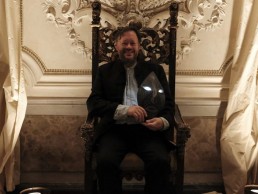
KSLD Joins EFLA Consulting Engineering
(UK) - KSLD has announced that it has joined EFLA Consulting Engineering with immediate effect, becoming the EFLA Lighting Design Division.
The two companies have been working together for some time, and this new merger allows the team to join forces, increasing the scale of practice and market access throughout the Nordic region.
“This move allows us to take our lighting design capability to exciting new levels, uniting remarkably complementary design teams focused on creating leading-edge solutions in lighting design,” a statement from KSLD read.
The increased resources available following the merger will allow for further expansion into other markets where KSLD is already active, including Europe and the Middle East.
Kevan Shaw, founder of KSLD, said: “I am very excited with the opportunities opened up by the merger with EFLA. In addition to the increased size and broader reach of the lighting design practice, close working with the other engineering specialisms in EFLA will open up new opportunities providing integrated design solutions.”
Kristján Kristjánsson, Senior Lighting Designer at EFLA, added: "These are exciting times for us at EFLA Lighting. KSLD and EFLA have been friends for some time and being able to go forward with one shared vision will make our fantastic team shine even brighter."
Since its inception in Edinburgh, Scotland in 1989, KSLD has built a strong reputation in a wide range of areas over the last three decades, building an extensive portfolio of award-winning lighting design projects, both in Scotland and internationally, including the Scottish Parliament Debating Chamber, which won the 2018 Codega Award.
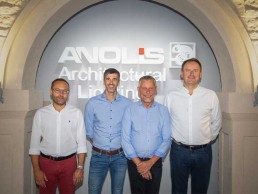
Anolis appoints Peer Oestergaard as Sales Director
(Czech Republic) - Architectural LED lighting manufacturer Anolis has appointed Peer Oestergaard as Sales Director.
Oestergaard will manage and co-ordinate Anolis’ global sales team as the brand continues to build its profile, visibility and reputation internationally.
Anolis Director Tim Van de Eede stated: “We are delighted to have someone of Peer’s calibre and talent on-board. His personality, approach to business and smart outlook is the perfect match for us, and we share the same core visions for taking Anolis to the next level of operation.”
Oestergaard brings years of experience and skills to the Anolis team, having most recently co-ordinated complex international business for two other well-known architectural/architainment lighting brands.
Oestergaard has been working as a professional lighting designer since the 1980s and has always had a keen interest in architecture and the way dynamic lighting can transform and bring to life different spaces, objects and environments, from artworks to industrial, commercial and residential buildings. He also brings with him extensive contacts and a skill of thinking out-of-the-box when establishing new business opportunities.
“I am lucky enough to have worked on lighting some truly landmark projects worldwide over the years,” explained Oestergaard.
“I see huge potential in the brand. Anolis is already well established in certain areas, and has a name for outstanding quality and for thinking laterally to deliver practical custom requirements as needed.
“Anolis is a company of the future and I am looking forward to being part of a very positive and long term journey,” he affirmed.
Van den Eede added: “We are hugely excited to welcome Oestergaard and are all looking forward to a great collaboration and to him embracing the spirit and essence of our brand. This is the first of several important upcoming announcements for Anolis over the coming months.”
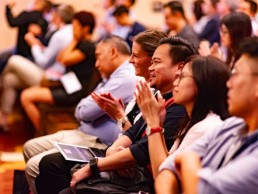
PLDC 2018 comes to a close
(Singapore) - PLDC 2018 had a successful event in their new location as part of their recent expansion to Asia and North America.
The well-known European conference cast its net further to capture audiences in Asia and North America with its latest edition in Singapore this year.
Aiming to demonstrate the changes in our society in terms of lighting, PLDC’s expansion to Asia was representative of the on-going development towards smart solutions for urban issues, such as lighting and public safety, mobility and IoT.
With an attendance of 774 international visitors, the event offered an array of interesting and educational talks, workshops and excursions, including the Gardens by the Bay, Atlas bar and the South Beach development.
Additionally, a further project that was presented in Singapore was the CPD platform, which will offer professional training from a wide range of providers, as well as encourage self-study on all levels. PLDCPD will deliver the structure and back-up required for high-quality continuing of education.
The concept is in line with the guidelines presented by the EU and fulfilled the requirements for applying for political recognition of Lighting Design as a scope of work that can be studied and a profession where practitioners can continue to expand their know-how and competence with time. The PLD Alliance, a movement founded to represent the international lighting community, took on the initiative to restart the process to achieve this goal.
It was also announced the Professional Lighting Design magazine will cease to be available in print, but will continue to be published online by the VIA publishing company. This recent online relaunch brought with it some new features to the platform, including a new aesthetic.
The next PLDC event will take place in the Netherlands at the Ahoy Rotterdam convention centre in 2019. The motto for this edition will be “merging masterminds”, which emphasises the importance of the experts and new talents involved in the PLDC events over the years. Rotterdam’s cityscape matched this motto well due to its combination of modern architecture, design and technology alongside its historically rich maritime and industrial background.
The Call for Papers to PLDC2019 is open until 16 November 2018.
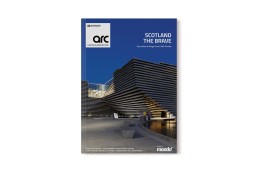
Issue 106
arc Oct/Nov 2018 – Issue 106
Take note and vote...
Vote in darc awards / architectural for your free ticket to darc night (or just the satisfaction that you’ve done something epic)...
The success of darc room, London Design Festival’s lighting destination, was an important statement about the future of events for the architectural lighting design profession. Other than the biennial behemoths of the likes of Light + Building and Euroluce, we have seen large annual events on the wane in recent years.
darc room brings something different to the table with a creative, boutique event in London’s design district.
The exhibition in Shoreditch brought together 50 architectural and decorative lighting exhibitors and a progressive educational workshop and live streamed seminar programme curated by Light Collective. Making lighting specification an integral part of a festival of design to promote cross-discipline discussion and knowledge-sharing was always top of our priority list when establishing darc room and we were delighted with the diversity of visitors eager to learn about lighting design and technology as interior designers, architects, product designers and coders joined the lighting fraternity for a great two days.
In a similar vein, our darc awards / architectural is a unique concept and event that is a game changer for traditional awards programmes. All the entries are now in (every project in this issue is an awards entry) and the voting period has now begun (closing on 9th November). As usual, all independent lighting designers and light artists who vote (suppliers or non-lighting experts are not eligible to vote) in the awards get a free ticket for darc night, the darc awards party. And if you can’t make the event then why not vote anyway - it’s a great exercise for junior and senior lighting designers alike to keep abreast of the best lighting schemes all over the world.
This year’s awards party will take place on 6th December at MC Motors, London. We have all mourned the demise of the industry Christmas party so this year we decided to organise our own! As usual there will be a free bar and street food as well as lighting installations created by the sponsors and lighting design teams so it promises to be another exciting and creative night.
Paul James
Editor
arc

Nulty’s Studio N appoints Managing Director
(UAE) - Alexander Holler joins Studio N, Nulty’s new architectural lighting design studio, as Managing Director
Alexander Holler has joined Nulty’s new Dubai-based architectural lighting design studio, Studio N, as Managing Director.
Studio N aims to provide creative, simple lighting design solutions on projects in the region with limited budgets, and since launching earlier this year has seen rapid growth. The appointment of Holler is the latest step in this growth.
With a background in sales and business development, and a strong foundation in premium lighting solutions, Holler hopes to use his experience to help grow Studio N into a leading lighting design consultancy service.
“I want to continue to develop Studio N as the go-to partner when it comes to a flexible, efficient lighting design consultancy service,” he said. “I believe that the lack of budgets for lighting design often leads to a negative effect on the whole project. I don’t think that free design services, or the supply of cheap alternatives are helpful. I’m a true believer in quality work in all aspects.
“My focus is on building strong relationships with our clients, so we can continuously elevate their spaces through simple and creative lighting solutions.”

Fagerhult to acquire iGuzzini
(Sweden) - Fagerhult has signed a Letter of Intent to acquire iGuzzini, and hopes to complete the transaction before the end of 2018.
Fagerhult has signed a Letter of Intent (LOI) with the shareholders of iGuzzini to acquire 100% of the shares of the Italian lighting manufacturer.
Based on this LOI, Fagerhult is targeting signing a Share Purchase Agreement before the end of 2018. The transaction will be funded from a combination of debt finance and a new rights issue in Fagerhult shares.
Upon finalising the transaction, the Guzzini family will receive a significant portion of the consideration in Fagerhult shares, with the aim of becoming shareholders of the combined entity. Adolfo Guzzini and Andrea Sasso, President and CEO of iGuzzini respectively - in addition to remaining in their respective executive roles within iGuzzini - will assume important roles in the top management of Fagerhult.
The addition of iGuzzini, who in the financial year ending December 2017 recorded sales of approximately €230million, will significantly strengthen the Fagerhult Group’s position in the professional lighting market both in terms of the geographic presence and by adding leading complementary product ranges.
www.fagerhult.com
www.iguzzini.com
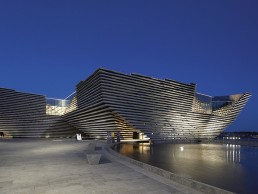
V&A Dundee, UK
If you’re in any way affiliated with the design world then you’ll no doubt have already seen countless images of the new V&A museum in Dundee, Scotland over the past few months.
The museum, designed by Japanese architect Kengo Kuma, opened in mid-September, and has been lighting up the design community with its unique, sloped façade, inspired by Scotland’s mountains.
As Scotland’s first design museum, V&A Dundee aims to tell a global story, investigating the international importance of design alongside presenting Scotland’s outstanding design achievements. At the heart of the museum, the Scottish Design Galleries feature 300 exhibits drawn from the V&A’s rich collection of Scottish design, as well as from museums and private collections across Scotland and the world.
The lighting brief for the museum was developed by Arup, in close collaboration with Kuma and the V&A, with Arup’s lighting team providing the design service for daylighting, architectural lighting to all front of house areas, gallery and exhibition lighting and the exterior façade lighting.
The distinctive architecture of the building presented clear objectives for lighting the spaces with an emphasis on daylight, architectural integration and sustainability. The lighting team brought with them experience gained from museums and art galleries across the world, including the V&A in London. Computational modelling allowed them to analyse the weather condition data and sun path across each day throughout the year in all areas of the building, allowing them to develop daylight strategies with the architect. It was particularly important that no direct sunlight entered the galleries, as exposure to UV lighting can be particularly damaging to some of the more sensitive exhibits.
This focus on daylighting played a key role in Arup’s designs, as a key aspect of the brief, alongside sustainability, was to reduce reliance on artificial lighting in the public spaces by providing daylight to spaces without introducing glare from direct sunlight.
Façade openings are formed to offer views out onto the water and across the city of Dundee, while providing good levels of daylight at the edges of the space. However, deeper into the space, daylight is provided by a series of large diameter sola-tubes that sit just above the perforated ceiling, delivering high levels of daylighting to the restaurant and main hall, giving the space a light and consistent appearance during the day.
For the temporary galleries, north-facing skylights integrated into the roof system bring in natural light where desired, while an adjustable blackout shading system integrated into the skylights allow the modulation of incoming daylight to meet different conservation requirements for different exhibitions.
Elsewhere, a series of small windows and one large window fitted with dual open weaved/black out blinds are strategically positioned in the Scottish Design Galleries to provide views out. An automated blind control system has also been installed here to ensure that the blackout blind is only deployed when the sun hits the picture window. This maximises the view outside, and the influx of daylighting, while protecting the sensitive exhibits inside. Above all, the careful use of daylight achieves an open and naturally lit environment without compromising sensitive exhibits.
Blending into this use of natural daylighting, artificial lighting has been sensitively integrated into the fabric of the building, providing comfortably lit spaces that enhance the architecture. For example, the main angled walls of the central foyer are softly lit from above, giving the space a warm and welcoming appearance.
Arup worked with exhibition designers ZMMA on the lighting for the Scottish Design Galleries, in consultation with the V&A. The artificial lighting for this space has been designed to accent and reveal the range of design objects, while light levels also vary, with the most sensitive exhibits being lit at levels just below 50lux. Track mounted projectors equipped with high colour rendering LEDs are carefully aimed and focussed to model and reveal the colours and textures of the objects on display.
Each of the galleries has its own lit character pertaining to the objects on display. This range of light qualities was achieved by using iGuzzini’s Palco track fittings, which provide a wide range of interchangeable optics and accessories to shape and direct light. These track fittings are installed on DALI tracks, and fitted with potentiometers to allow for local control. Within the display wall, Mike Stoane Lighting’s Surf is used to highlight the displays. These fittings are controlled via a local dimmer in each display, meaning that they can be set for the particular object on display.
A central feature in the Scottish Design Galleries is the Charles Rennie Mackintosh Oak Room (CRMOR) - an original Rennie Mackintosh oak tearoom reconstructed by Smith and Garratt. This has been designed as a truly immersive space, where the light quality of the original space has been reproduced using original glass fittings and concealed high quality LED light sources. Here, the original pendants and wall lights have been fitted with modern LED filament bulbs, retaining the desired feel of authenticity while ensuring that energy consumption is duly considered.
Concealed 3000k gobo projectors and cooler 6000k LED strips mounted behind glass provide a sense of depth and an abstracted quality of natural light to the space, while maintenance and emergency lights are cleverly concealed, so as not to disrupt the original ceilings.
The main hall meets a number of functions, and houses the ticket office/reception, a café and shop on the ground floor, and a restaurant at the first floor level. The unique angled walls of the space are softly lit from a high level, defining the edges of the space and providing a sense of warmth from the reflected light on the timber.
A simple concealed track system runs across the space at a dynamic angle, providing fixed general lighting and accent lighting to the café and retail spaces below. This also brings an element of flexibility for setting up the space for special events where additional lighting can be added to the tracks for this purpose.
The shop, designed by Lumsden Design, includes a feature display wall intended to represent the tidal flow of the Tay. The textural walls, and the merchandise, are lit from very narrow beam TTX2 track fittings from Mike Stoane Lighting, while the mobile retail units are lit from tracks above, and have integral linear strips under shelves to accent the smaller items on sale.
Adjacent to the main entrance and just into the main hall, visitors are welcomed with the café bar, smartly situated under the main stairs. The bar is illuminated mainly by the fittings integrated into the bar at various locations, providing a greater interest and distinctiveness in the otherwise dark under-the-stairs space, while a variety of LED strips from Deltalight are carefully hidden below the counter, under the shelves and into the food vitrines.
The first floor restaurant benefits from an abundance of natural light and an amazing view across the city. Wide beam projectors provide good general levels of daylight to balance the space, which are dimmed down at night automatically from the central control system, provided by Lutron. Between these, a series of accent projectors provide accent lighting to tables and the unique furniture details within the space. Accent lighting at the bar comes from shelves lit using Pixalux, and Rubn’s suspended Copolla amber glass pendants, that reflect the natural light beautifully during the day, and glow in the evening.
The restaurant features an open terrace for use day and night that is provided with battery-operated lanterns for the tables, while linear in-ground fittings uplight the façade, creating a backdrop for the space.
While the soft, warm interior illumination is evident during the day, it becomes a very inviting and key attraction at night, when you can see glimpses of the interior from outside, as the small windows built into the linear façade allow the interior lighting to glow out, giving the windows the appearance of small lanterns that reflect in the water around the building. Lights mounted in these reflecting pools surrounding the building uplight the exterior and reveal the complex forms and unique texture of the façade, designed to represent a Scottish rock face.
The central walkway under the building provides a dramatic space, where this uplighting of the detailed façade can be fully appreciated.
On completion, designers at Arup are pleased with the end result, and the way that the lighting, both natural and artificial, supports the architectural ideas for the building.
“The main double height foyer of the V&A is a great space to spend time in, and the longer you do, the more you become aware of the smaller details and geometries of the building,” said Laura Phillips, Associate Director of Lighting at Arup.
“The use of natural light in combination with artificial lighting to the angled walls is a key contributor to the success of this space and how it changes over the course of the day.”
Phillips also cited the collaborative nature of the process as another key factor in the project’s success, particularly in the gallery spaces. She continued: “Focusing the Galleries was a very collaborative process with the V&A team and ZMMA. The Scottish Design Galleries are quite unique in that they vary in colour and character depending on the exhibits on show. The lighting helps to bring out the inherent qualities of each exhibit, while providing a visually comfortable backdrop to the space.
“Creating the ambience in the CRMOR room through focusing and dimming of the custom decorative glass fittings was very rewarding, and is a very immersive space.”
Throughout the whole museum, Arup, alongside ZMMA, has created a remarkable, immersive visitor experience, that lives up to Kengo Kuma’s unique architectural design, and is certainly fitting for Scotland’s first design museum.
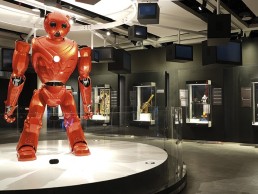
Sheikh Abdullah Al Salem Cultural Centre, Kuwait
With a gallery area covering a vast 22,000sqm, the Abdullah Al Salem Cultural Centre is one of the largest museum complexes in the world, housing 22 galleries and thousands of exhibits. Its central covered thoroughfare acts as the spine of the space and evokes the feeling of walking down a busy Kuwaiti street, tying the complex together. There are six main museums across the complex: Ecosystems, Human Body & Mind, Our Earth, Arabic Islamic Science, Transportation & Robots and the Space Museum, along with multiple cafés and restaurants, educational rooms and theatres. Outside the museum complex stands an array of large-scale sculptures, including a rocket that is illuminated with Pulsar’s colour changing spots, creating an effective visual impact.
The Cultural Innovations team assembled more than 140 members, of which 30 specialised in content creation, interpretation and content development, alongside 25 exhibition designers with additional expertise for graphics, and audio-visual development. This group of experts were brought together from a variety of backgrounds, including universities, zoos, botanic gardens, museums and organisations such as the European Space Agency to provide advice and ensure scientific facts and interpretations were correct. Alongside this extensive team of experts for the internal content of these exhibits, the landmark complex was delivered in its entirety with the efforts of architects SSH Design and contractors Alghanim International and Beck.
The lighting design was completed by Sutton Vane Associates (SVA), which worked alongside 96 other consultants and sub-contractors from thirteen countries to bring the large project together on time. SVA was initially appointed to design all of the lighting schemes back in 2015. However, construction had not started at this point and a soft launch opening deadline was set for 2017, not giving the team long to devise and input their lighting design. Mark Sutton Vane, Director of the lighting firm, commented: “To build this huge project so quickly, the lighting design process was carried out backwards. The electrical contractor, SI, had to know where the fittings and the wiring were going to be, to give them time to install it all before Cultural Innovations, the designers, had designed all the displays.” In order to combat this issue, SVA designed a “generic toolkit of very flexible lighting, which could start to be installed and then was ready to light the amazing exhibits that the exhibition designers developed,” explained Sutton Vane.
During the initial stages of planning, the team at SVA carried out daylight and sunlight studies for each gallery space to give the architects and exhibit designers a crucial insight into where the hot spots of the Kuwaiti sunlight was getting in to. These studies also aided the architects in placing windows, specifying glazing and designing of electrical window blinds.
The lighting was specifically designed to be different for each of the individual museums in order to maintain visitors’ interest and to keep elements of separation visible between the varying subject matters of the museums.
For many of the individual exhibits, SVA used a large selection of fittings to specifically illuminate the artefacts and installations. Mike Stoane Lighting provided a large number of spotlights, many of which were built into the exhibits and provided a useful range of optics and powers for the teams to work with. For the more subtle illuminations, Applelec and Cooledge provided LED Light Panels for backlighting the exhibits and graphics along with LED Linear, which integrated linear lines of LED tape into the exhibits.
One example that took particular advantage of the varied lighting designs put in place was the Ecosystems gallery. A live forest of trees, creepers and bushes was put into the centre of the museum space, which posed a challenge for the lighting designers. It was extremely important, financially and practically, to keep the forest alive and flourishing, as the task of removing a full-sized dead tree was not an option for the Cultural Centre. SVA sought advice from planting specialists for the lighting levels needed for the living forest to survive. 26,000 high-powered lumen floodlights by GE Lighting were used to provide growth lighting. Additionally, the forest can be flooded with colour for special events. Sutton Vane described the visitors experience further: “Visitors enter this forest on a ten metre high walkway that goes through the trees. At the end there is a long sloping travellator that carries them down to the forest floor. Changing images of eyes and snakes in a projected jungle background spook the visitors as they move downwards, seeing the visions appear as they descend. An aquarium is in the same gallery space and its lighting had to be much lower to prevent the growth of algae. So, a lot of careful aiming and timing of the lights had to be carried out. This was all made a little easier in the end because some of the forest was made artificial, so did not need the high light levels originally planned.”
Martin Professional changeable gobo projectors were used to create the projected effects that visitors experience when moving down the travellators.
In an equally large gallery, a huge display showing how white blood cells move towards and attack bad bacteria in the human body is formed out of several thousand LED spheres. These spheres are all programmed to chase around the gallery in spirals moving towards large glowing models of bacteria. Some of the spheres are lit red to represent the red blood cells and others are white. Several days were taken to programme the various attack sequences of the UFO built LEDs and supporting structures to create the desired dramatic effects in the spiralled blood cell display.
In the Innovate gallery, designers created a forest of hanging light fibres by UFO that visitors push their way through and get lost in. Sutton Vane explained the design of this gallery space further: “All of the fibres change colour in a complicated programme to support the story that is being told by the graphics and the audio visual displays. There is a large sphere-shaped Planetarium in one of the museums that can be seen from outside. At night, twenty moveable multi-gobo and multi-wheel projectors, by Martin Professional, light the huge sphere with imagery that is representative of the main planets and the sun. So the sphere first looks like Mars, then like Venus, then the boiling Sun and so on.”
UFO also provided an external LED fibre optic map of the stars of the universe for people to gaze at.
Throughout all of the museums and galleries, luminaires have been built in to heighten the displays and in some gallery spaces the exhibits all appear to be lifted off the floor with glows under their plinths. A large combination of fixtures were installed across the complex, including downlights from acdc, miniature spotlights from LightGraphix, downlights from Reggiani, Linear LED profiles with built in optics by UK LED Lighting, Linear RGB LED strips by LED Flex and spotlights by Concord, Mike Stoane and Erco.
Notably, the Space Museum is an incredible feat for the design teams to undertake. A full size accurate replica of the International Space Station was created for visitors to explore. SVA spent a lot of time and effort to research and replicate the specific light fittings used inside the space station and matched them as best as possible to make the true replica.
In total, SVA specified over 20,000 light fittings from the multiple suppliers. Most of the fittings are DALI dimmable and some work on local DMX control systems. Philips Color Kinetics and Pharos Controls, both supplied by Architainment Lighting, provided control systems for controlling some of the DMX controlled lighting, which demanded fast changes in the exhibits or were controlled by AV or visitor interaction. Helvar completed all of DALI control systems across all of the museums.
Once construction of the complex was complete, it didn’t leave a lot of time for the implementation of the fixtures. SVA had two or three designers on site for months to carry out the aiming and programming of this huge site. They also acquired a team of Nepalese abseiling workers to aid in the focusing and aiming of the fixtures in the fourteen-metre high galleries across the museums. Sutton Vane described the challenges his team had to face during this process: “We had to teach them how to adjust the beams on the thousands of track mounted Concord Beacon Muse DALI spots and how to aim the fittings really precisely - one degree of rotation from fourteen metres up is a big distance down on the floor. At ground level, we gave them sample fittings to practice with and taught them simple instructions like ‘rotate left’, ‘rotate right’, ‘bigger beam’, ‘smaller beam’ and so on. This was made more complicated because they only spoke Nepalese and their boss only spoke Arabic and Nepalese! So everything was translated from English into Arabic and then from Arabic to Nepalese, which was then shouted up fourteen metres.”
Some decorative elements were also added: Original BTC with the Titan Size 1 decorative pendant lights and a bulkhead with retro LED lamp for a model plane installation. Traxon Technologies installed individually addressable RGB LED Dot XL 3 with domes for a black hole exhibit in the Space Museum. Also used were Megaman dimmable globe E27 lamps with opal coating and Instyle LED 24V ultra violet LED tape for black light effect lighting.
The hard work has paid off for the SVA team, winning them the Public Building of the Year at the ABB LEAF Awards in 2017. It has also been entered into the darc awards / architectural 2018 awards.
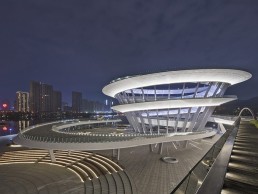
Meixi Urban Helix, China
Merging the natural elements of water with the urban development, the Meixi Urban Helix is a beautiful new structure, uniting the two worlds of nature and man-made constructions.
Located in the southwest of Changsha, China, this new urban axis, designed by German architects KSP Jürgen Engel Architekten, is a multi-functional public space where visitors can enjoy panoramic views of Lake Meixi, as well as the planned city expansion that it overlooks.
The structure ascends above a man-made plateau on the lake, spiralling to a height of 34 metres through an exposed ramp measuring six to eight metres wide. The interior of the helix provides visitors with a reversing path ramp leading from the structure’s highest point down to the new urban area.
Lighting for this impressive structure comes courtesy of New York-based lighting designers Office for Visual Interaction (OVI). By combining few directly visible lighting elements with a backdrop of indirectly illuminated architectural finishes and surfaces, OVI has created a consistent, balanced lighting scheme spanning the structure.
OVI regularly collaborate with architects and design teams very early in the design process, maintaining a regular dialogue as the project develops. This project was no different, as OVI worked with KSP Jürgen Engel Architekten from the competition stage of the project. Because of this, OVI was able to develop a strong lighting concept that remained consistent as the project progressed.
Markus Fuerderer, Project Lead and Product Design at OVI, explained: “We extracted the essence of the architecture to generate a well-conceived lighting design scheme.
“For Meixi Urban Helix, we envisioned an iconic gesture for the exterior nighttime identity with a continuous, flowing band of radiant light that creates a visual connectivity of the double-helix ramp and connecting bridge. To intensify this infinite metaphor, we kept all structural elements, such as the radiant vertical helix columns and the undulating wave structure of the bridge, dark in contrast.”
In order to effectively articulate the project as a flowing, infinite band of light, OVI sought to increase this character further by continuously up-lighting the helix ramp and bridge surfaces consistently. Colour capability was also included as a means of visually separating layers of the outer ramp surfaces from inner surfaces, creating visual clarity and added depth.
For the nighttime identity of this iconic new structure, concealed linear LED uplight coves illuminate the ramp undersides at night to articulate a continuous, spiralling ribbon of light. To increase visual depth, RGBW capable luminaires have been specified, allowing to distinguish the outer ramp surface from the inner surface by adjusting the light colour.
Elsewhere, handrail-integrated linear LED luminaires provide additional illumination for bridge and ramp areas to guide visitors through the ascending and descending paths, connecting between the structure and the new urban area.
While these lighting fixtures help to enhance the nighttime identity of the structure, OVI was keen to reduce the perceived amount of illumination for visitors to enhance the spectacular panoramic nighttime views. Fuerderer continued: “We designed a low-mounted guiding element of sparkle using miniature marker lights along the inner ramp perimeter that light the walkway and intuitively guide visitors up and down the helix.”
Situated on an artificial island with an area of about 20,000sqm, radiant in-grade lines of light correspond with the paving pattern that originates at the centre of the helix’s geometry. Zooming in, concealed step lights and under bench lighting details accentuate the stage and steps, while miniature in-grade LED uplights at the base of each vertical structural beam illuminate the edge of the vertical elements. This serves to generate a subtle visual framework for the spiralling ribbon, complementing the fluidity of the design and contrasting it against the nighttime backdrop of the city.
One of the most remarkable things about the Meixi Urban Helix is the consistent, uniform lighting across its span. This, according to Fuerderer, is an integral part of the structure’s design. “A key feature of the lighting gesture is the continuous appearance of the illuminated, flowing, infinite band of light along the bridge and helix,” he said.
“We designed a miniature linear cove detail at the bottom edge of the sectional profile. This cove accommodates a high performance linear wash luminaire with optimised optics by Electrix Illumination to generate a soft light gradient across the entire ramp overhang, reaching up to eight metres in distance.
“An important visual aspect of this detail is the shielding: the cove detail is dimensioned to avoid direct views into the light source, while maintaining the architectural integrity of the design.”
OVI’s overriding approach to lighting design, across an extensive portfolio that has seen it work with the likes of Zaha Hadid Architects, Foster + Partners and Grimshaw, is to “reinforce the architectural features and give life to a project ‘after dark’”.
And Fuerderer believes that this philosophy has been met again with the Meixi Urban Helix. “The lighting design should be a natural extension of the architectural language and we feel that is the case here.
“There are so many visitors at night that we hope we have given them the opportunity to experience a magical moment when they visit this unique place.”
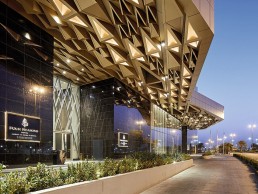
Four Seasons Hotel at Burj Alshaya, Kuwait
In Kuwait City, where the ever-expanding landscape is becoming overwrought with large, ostentatious skyscrapers, a new, altogether more subtle and sophisticated development has emerged.
The Burj Alshaya, a mixed-use project featuring the new five-star Four Seasons Hotel Kuwait, the corporate headquarters for global enterprise Alshaya Group, and a connecting podium, features a unique design concept that takes inspiration from the culture and tradition of the region.
Designed by architects Gensler, the Burj Alshaya was developed around the tradition of the ‘mashrabiya’, an element of traditional Arabic architecture that sees windows enclosed with a latticework – a technique that has been used since the Middle Ages to provide shade and privacy while maintaining views.
A hybrid architectural element that is both functional and decorative, the mashrabiya merges the form and function of the Islamic window screen with a conventional jalousie, taking on the materiality of local culture.
This element was one of the key design drivers in a concept that sought to develop a building envelope that was both efficient and iconic, related to Arabic architecture, whilst embodying a novel approach to reducing the effects of the high ambient temperatures and intense solar radiation that characterise the local environment.
Tom Lindblom, Principal and Global Hospitality Leader at Gensler explained: “Our inspiration was to redefine a vernacular tradition. Arabic architecture is one of the world’s most celebrated building traditions, known for its radiant colours, rich patterns and symmetrical silhouettes.
“We wanted to produce a coherent and practical design, rich in layered ornamentation, which emanates the luxury and quality that Four Seasons and Alshaya embody.”
The resulting design reinterprets this tradition, presenting a contemporary take on traditional patterns and forms, via a three-dimensional lattice in various scales and locations across the development. The diamond pattern of the lattice provides solar control for the building, and the approach integrates the project’s main elements by wrapping the east and west elevations of both towers and covering large sections of the podium with a mashrabiya type envelope. While there are no mashrabiyas on the northern or southern façades, fritted glass with diamond-like patterning helps maintain the design continuity, providing shading and privacy while also offering a sense of drama and dynamism both from the inside and outside of the building.
The geometry of the shading fins enhances climatic performance for the occupied spaces and continues over to wrap the roof terraces and shade outdoor activities from the sun, while providing a recognisable and significant addition to the city’s skyline.
Alongside the aesthetical appeal of the façade design, it offers additional economic benefits, as Lindblom explained: “Buildings with fully glazed façades offer tremendous views and natural lighting, but they also encourage heat gain when the sun comes out. We developed a unique response with the objective to reduce interior heat gains and glare.
“The size of the individual diamond modules changes according to the location, therefore ensuring the interior benefits from suitable amounts of daylighting.
“Having carried out daylighting and shading studies with façade engineers, we modelled the façade to ensure the design utilises natural sunlight from within whilst reducing reliance on electric light, maintaining human health and a productive work environment during daytime.”
At 22 storeys high, the Four Seasons Hotel features 284 rooms and suites, including two large ballrooms with conference suites, an expansive pool-level terrace, three restaurants and two lounges, and a world-class spa and fitness facility.
Gensler worked very closely with Toronto-based interior designers YabuPushelberg and engineering partner KEO International on the hotel’s interior design, striving to bring the design concept of the façade inside, creating a holistic, seamless experience for locals and international guests.
“The room layout and how the interior spaces work is extremely dependent on the architecture and the façade,” continued Lindblom. “Decisions on where to position the fritted glazing were key to maintaining and maximising the views out of the towers and also had a bearing on the furniture arrangement, so we had to work very closely with YabuPushelberg and all parties to ensure the final design delivers the functional requirement with an interpretation of local vernacular culture in a contemporary manner, echoing Alshaya’s philosophy and the Four Seasons’ brand.”
In keeping with the Four Seasons brand, the hotel provides a luxurious experience for its guests – something that Lindblom believes is exemplified by the scale of the facility. However, despite this grand scale, there is a sense of intimacy throughout, as Lindblom explained: “While the front-of-house components are grand in their own scale, they are all well-connected and intimately knitted with one another, and often visually connected with the exteriors for a total immersive ‘inside-out, outside-in’ experience.”
Inverse Lighting designed the lighting for the project, working collaboratively with Gensler to create a lighting concept that accentuated façade geometry at night time. Lindblom continued: “The other surrounding buildings are all competing for attention at night with elaborate and ostentatious lighting schemes, but with our towers we wanted something more sophisticated and understated, to complement the complex geometry of the building and to stand out from the rest of the skyline.”
Inverse’s lighting design incorporates programmed lighting that the client can animate and vary depending on their requirements. The standard illumination on any usual day is to graduate the light up the tower and through the canopy, bringing people’s eyes through the whole project. This is something that Lindblom feels was “core to the symbiosis” of the lighting design and architectural concept.
Onur Sunguroglu, Director at Inverse Lighting, added: “The façade lighting was developed to compliment the traditional patterns. Rather than floodlighting the whole cladding, we, after a full scale lighting mock up of a façade panel in London, decided to position the luminaires on the façade, not only emphasising the patterns but also the lighting itself, creating diamond shape patterns.
“We also developed structural details for fixing the lights to the façade so they became a part of it, not just an item attached on to it.”
As guests enter the hotel, they are greeted by a tall, dramatic entrance lobby, featuring a huge, freestanding spiral staircase that curls to a height of thirteen metres, the world’s biggest hanging crystal, created by Lasvit, and numerous complex works of art, including a Marc Quinn sculpture.
Alongside the huge lobby area, Inverse tackled the multifarious lighting requirements of large but flexible events spaces, an atmospheric spa and corridors to the 217 guest rooms and suites.
In illuminating these spaces, Inverse worked closely with YabuPushelberg, a firm that they have a long-standing working relationship with, to create a scheme that was “integrated within the fabric of the space as much as possible,” according to Sunguroglu.
“We mostly followed the lead of the interior designer, who created these majestic spaces,” he added. “So the unspoken brief was to enhance the guest experience by reinforcing the interior design with lighting.”
Throughout the hotel, the lighting is discrete, often recessed into the floor, ceilings and furniture so that fittings are out of sight. This brings the focus firmly on the high-spec brief and the larger decorative pieces.
Hidden lighting has also been used in the long corridors to transform what might otherwise have been prosaic passageways into dynamic, welcoming spaces, helping to gently ease visitors into the relaxing mood of the spa and lounge spaces.
“Integrated lighting plays a vital role in creating the luxury atmosphere,” continued Sunguroglu. “A prime example of this can be found in the spectacular lobby stairs, where light was completely integrated into the stairs, creating a glowing centrepiece and enhancing the effect of a swirling ‘stairway to heaven’.”
Elsewhere, Inverse implemented a number of decorative lighting elements with YabuPushelberg, to further exemplify the luxurious atmosphere. A rectilinear chandelier in the Al Soor lobby lounge, along with custom pendant lanterns produced by Viso, help to unify the design of the lobby and pool areas with the décor in the guestrooms.
The lighting design also covered meeting and prayer rooms, bar and dining areas, a pool deck and the rooftop restaurant, designed by Kokai.
The architecture and interior of the Four Seasons, and Burj Alshaya as a whole, reflect the city’s modernity, while paying tribute to the local traditions, while its sleek, avant-garde luxury places the building as the stylish new centrepiece of Kuwait City, creating a prestigious backdrop for business and the new focal point for the city’s social scene.
Indeed the reaction to the building is something that has not gone unnoticed by Gensler, as Lindblom enthused: “We think it’s great that everyone has reacted so well to it.
“During the design stage we made a conscious decision not to include a hotel sign at the tower top, as the architecture design is so unique that the building becomes immediately recognisable.
“The hotel is now so well known in the local community and people have no difficulty finding its location – I think that’s a testament to its strength.”
www.inverselighting.co.uk
www.gensler.com
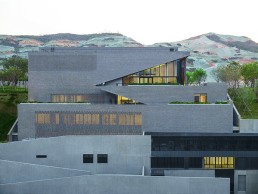
China Resources Land Archive Library, China
To the east of Shenzhen in Xiaojingwan, leaning against a mountain and facing the sea, sits the China Resources (CR) Land Archive Library, an exquisite new facility that houses archival storage, exhibition areas and office space, bringing a sense of culture and history to the surrounding coastal communities.
Designed by New York-based architects Studio Link-Arc, the library appears to lean against its surroundings, and features layers of platforms and long footsteps, based on the trend of its surrounding environment.
The building is covered in handmade grey bricks, which unify the structure and add texture to the exterior surfaces. These bricks are articulated in many different ways, bringing a sense of texture and calm to the building, while better expressing the flow of both natural and artificial light throughout.
Lighting design for the CR Land Archive Library came from Chinese firm Beijing Ning Field Lighting Design, the team behind last year’s IALD Radiance Award-winning Harbin Opera House.
Beijing Ning Field came on board with the project having met architects Yichen Lu and Qinwen Cai of Studio Link-Arc at the China Pavilion of the World Expo in Milan in 2015. Through conversations, the lighting designers learnt that Studio Link-Arc attach a great deal of importance to lighting design in their work, and when the CR Land Archive project came up, they recommended Beijing Ning Field for the job.
Dongning Wang, Director of Beijing Ning Field, explained the brief handed down by the architects: “The architect wanted the building to be elegantly lit with a balanced combination of natural and artificial light.”
This balanced lighting concept covers both the interior and exterior schemes, with a particular focus on “reducing the influence of outdoor lighting on the night sky”.
For the landscape and architectural lighting design, Beijing Ning Field mainly relied on internal transmitted light, supplemented with low-level ambient light, which minimises the negative effect of over-lighting at night. Hollowed-out brick walls bring daylight into the interior space at day time and extend the view of the space, while after dark, it adds a warm glow to the building outline, forming a contrast of light and dark and enriching the sense of the exterior space.
“With the lighting, we wanted to create a self-glowing building, which looks natural and in harmony with the surrounding environment,” Wang explained. “In Shenzhen, a city with great light pollution, we wanted to use light in a low brightness to create a peaceful and noble land at the top of the mountain.”
The idea of creating a self-glowing entity extended to the landscape design also, as Wang and his team utilised fibre optic fixtures to illuminate the plants and flowers on the path leading up to the building.
“The main purpose is not only to lower the illumination levels, but also to eliminate the inherent image of light fittings and create a romantic effect that the green plants and flowers are self glowing. The light from the fibre optics softly glows the plants nearby without polluting the quiet and dark night sky.”
As visitors approach the building, they are met with an entrance canopy of black steel. As part of its quest for a more subtle, hidden lighting scheme, Beijing Ning Field chose to use recessed downlights in black, concealing the light fittings in the daytime. These recessed lights are small in size, with a narrow beam angle to control glare.
Stepping inside to the lobby area, the design is implicit and steady. Light fittings from Erco and PAK are again all concealed to ensure the integrity of the interior design. Track lights are installed at the seams of the brick masonry walls below a large skylight, which keeps the aesthetic view of the surface while blending artificial and natural light.
The reception desk is softly illuminated by light fabrics, which help to create a welcoming atmosphere, while the warm glow from light coves on the ceiling outlines the perimeter of the interior space.
The idea of a subtle, hidden lighting scheme throughout the building is something that the architects and lighting designers worked on from the very start of the project, as Wang explained: “In the rendering images of the lobby submitted by the architects to the owner, you could feel the effective fusion of natural light and artificial light and the pursuit of the purity in the space.
“In the lighting proposal we submitted to the architect, the picture was even cleaner. There are hardly any exposed light fittings on the ceiling. Instead of having an even horizontal lighting in the space, we persuaded the architects to instead apply lighting by zones and emphasise ambient lighting, thus achieving a pure visual impression.”
Similarly in the lounge and exhibition areas, Geosheen strip lighting is installed with a perforated cover, intended to blend into the ceiling’s aluminium grilles.
“In order to conceal the light fittings and keep the ceiling clean, we communicated with the architects and decided to use an aluminium grille as a drop ceiling,” Wang elaborated. “The grilles are perforated where the light fittings are installed. The key was to find the optimal perforation rate for concealing the light fittings when the lights were off, while making sure that the light transmitted to the space evenly and without glare when the lights are on.”
To the rear of the lobby is a grand staircase glazed in a bright golden hue, which acts as a visual focal point for visitors entering the building. At the top of the staircase is a large skylight, filling the space with a natural light. However, to provide a shading element during the day, and an indirect light source at night, the lighting designers developed an electric ‘organ curtain’, following some natural light simulations carried out with the architects.
During the day, this organ curtain is fully opened, and natural light enters the space through the skylight, providing general lighting to the space. At night, the curtain is closed, and PAK spotlights mounted on either side are pointed up towards it. This light is then reflected and evenly scattered into the space, giving the appearance of daylight.
As with the architecture of the building, the lighting design remains very subtle and minimalist throughout, creating exactly the kind of gentle ambience that both architect and lighting designer strived for. “We want people not to focus on the techniques of the lighting design, but on the aesthetic atmosphere of the building itself,” Wang said.
“Lighting harmonises the relationship between natural light and artificial light, making people feel the beauty of the light.”
The harmonic relationship between natural and artificial light throughout the CR Land Archive Library is emblematic of the relationship between Beijing Ning Field and the architects at Studio Link-Arc, this despite the distance between the two firms.
“It was a challenge to communicate effectively with the design team over long distances,” Wang revealed. “The project is located on a mountain far away from downtown Shenzhen, while the architects are in New York, USA.
“However, we established several communication groups with the architects in WeChat. In these groups, we discussed the technical drawings and were able to solve problems by photos, voice messages, videos, etc.
“Despite the architects being far away in New York and the fact that we seldom communicated with each other in person, the trust and constant communication meant that we could achieve a good design result.”
Alongside the constant long-distance communication, Studio Link-Arc’s sound understanding of the importance of effective lighting design meant that the project was always going to be a success.
Wang continued: “Throughout this project, the architects had a better understanding of the process and function of lighting design. During the work, the architects communicated with us to make comments on the lighting designs several times, but they respected our professional opinions and rarely commented on technical aspects. From this point of view, we implemented our own lighting concept in a relatively complete way, and the architects and owners were both happy with it.”
With just reason, the lighting design seamlessly fits into the fabric of the building, providing a natural illumination inside, while casting a delicate glow on its exterior.
More than just providing an aesthetic detail, Wang believes that the lighting scheme brings an ethereal quality to the building.
“Lighting endows the building with a calm power, emanating from the inside of the building,” he said. “Light provides occupants with emotional power and the space with rhythmic change.
“Buildings are capable of moving the heart with the help of light. It is lighting that makes the CR Land Archive Library on the mountain more like a monument, depicting the enterprise’s glorious history.”
