

LiGHT 24 one week away
(UK) – There are now just a week to go until LiGHT24 opens its doors for two days of exhibition, events and unique opportunities.
Attendees can meet with exhibitors at their stands, chat over coffee at LiGHT LUNCH, enjoy the LiGHT WORK co-working space, or connect at the on-site café, Jacks. Welcome drinks will be offered on the first night, and the popular LiGHT LUNCH on day two add even more chances for industry professionals to catch up and make new contacts.
LiGHT LUNCH returns this year and is encouraging visitors to engage with a panel discussion on the “Importance of Women’s Industry Groups” for both men and women and how male colleagues can help change the narrative. Speakers include Carmela Dagnello of Ridge and Women in Lighting, Rachael Davidson of Smiths + Women in Architecture, Lauren Thompson of Women in Office Design and Zoe Brosner of the Women in Furniture Network.
Unibox will be participating in LiGHT's "reuse and recycle" initiative with a special LED Lightbox, previously showcased at the 2024 [d]arc awards party. Attendees can capture selfies in front of the vibrant setup and even enter to win a Limited Edition Mathmos Astro Lava Lamp, created in partnership with designer Sabine Marcelis – perfect for sharing on social media.
The Silhouette Awards will also be holding a special event at LiGHT, bringing together the global lighting community, featuring advice from mentors and mentees within the awards programme and offering sessions that cover mentorship, education, and essential career insights. It’s a chance for attendees to gain inspiration, network with global peers, and enjoy the event’s photo opportunities.
Attendees can also join the [d]arc thoughts talks programme, organised by the [d]arc media editorial team. These sessions will cover sustainable and human-centric design trends, with expert advice and project inspiration.
With LiGHT 24 just days away make sure you register now via https://register.visitcloud.com/survey/2my29bj4rukck


Alessandro Munge
Alessandro Munge, Founder and Principal of Studio Munge, discusses the importance of designing for longevity and how crucial it is to stay away from trends and fleeting design concepts.
In an age where social media’s influence drives every aspect of our lives and algorithms dictate our virtual consumption, the world of design is increasingly at risk of falling into a cycle of homogeneity. As designers, we face a challenge - perhaps even a responsibility - to resist the seductive pull of trends that promise instant recognition but offer little in terms of lasting value. While the global economy and mass accessibility to platforms like Instagram and Pinterest expand, we all risk becoming echoes of the latest fad, resulting in washed-out, pastiche identities that lack depth and originality.
Trends are, by nature, fleeting. They emerge, captivate, and then fade, often leaving behind a trail of design that feels dated and irrelevant just a few years later. This constant chase for the next big thing conditions our minds to create work that is visually engaging for the moment but lacks the substance required for enduring significance. Good design remains iconic for a reason, and it remains iconic because it lives in people’s minds. It’s the people, their experiences and memories that make it iconic, not necessarily just the space. Consider the club scene - a sector where trends are arguably most prevalent. Nightclubs are designed to be ephemeral, to capture the spirit of the moment. But can a nightclub ever truly be timeless? Studio 54 is often held up as an iconic example, but was it the design that made it timeless, or was it the people and the cultural moment it crystallised?
Good design becomes iconic because it is memorable, because it creates a lasting impression in the minds of those who experience it. It is not just about the physical environment but about the emotions and memories that space evokes. This is particularly true in hospitality, where guests return to a place not just for the amenities but for the feelings and memories it evokes. This is why I always push my team to go far beyond form and function to explore the emotive nature of the guest experience.
Originality in design is a quest. It requires a willingness to venture beyond the familiar and to question the status quo. It’s a process that demands curiosity, passion, and dedication - a relentless pursuit of the right answer rather than the convenient one. This journey often comes with personal sacrifices, as the search for true creativity requires time, effort, and a deep emotional investment. I see this dedication in my own life, in my family, and in my team. We all invest so much of ourselves into our work because we understand that design is more than just a job; it’s a calling.
The quest for true creativity often means navigating uncertainty and embracing challenges, pushing beyond the constraints that confine us. But the risk is the reward. True innovation comes from embracing the uncomfortable and unknown rather than settling for the safety of what’s been successfully done. For us, history feels as immediate as yesterday. What once spanned centuries now seems to unfold in a matter of days. And there is a certain beauty in creating spaces that transcend time - designs that are grounding and resonate on a deeper level because they are not tied to the whims of the moment. One perfect example of this is The Louvre in Paris, a testament to the timeless design that seamlessly integrates the past, present, and future. It’s also a brave act of rebellion. The juxtaposition of I. M. Pei’s modern glass pyramid with the historic grandeur of the Louvre’s classical architecture is a bold and courageous statement that preserves the essence of what was while inviting continuous reinterpretation. I always say: “You stand better as designers by not trying to replicate history. We can be inspired by it but don’t replicate it. The worst thing you could do is try to copy history.”
As we all navigate the pressures of designing in a trend-driven world, it’s important to remain optimistic and joyful and never lose sight of the fact that inspiration is boundless and all around us. True creativity comes from within, so what if, for a moment, we stopped following influencers and instead sought out a muse? As we evaluate the true cost of chasing trends, I invite all of you to seek the one who encourages you to look beyond the obvious, to dig deeper, and to embrace the process of discovery, someone who doesn’t direct you down a single path but ignites your own unique creative spark.

Jo Calver
Ahead of her talk at LiGHT 24, darc’s editor Sarah Cullen sat down with designer Jo Calver, Founder of Isla James Interiors, to discuss her journey into interior design, and her passion for lighting, which has woven itself into being a core offering in her studio’s services.
Isla James Interiors is an interior architecture and interior design practice that specialises in lighting design services. Headed up by founder and creative director Jo Calver, the studio is based in Pangbourne, Berkshire, and now has grown to seven full time designers. Within the team, every member has experience with lighting design, however, Calver works across interior design and lighting design and her colleague Amar Brar works solely as a lighting designer.
Calver grew up in the picturesque English town of Woodbridge in Suffolk, where she went to school with her now husband. During her time in education, Calver developed various musical talents, gaining high grades in singing, cello, and piano. Music, and in particular singing, remains a lifelong passion for her, as she was part of many choirs as a young adult and even had a stint as a backing singer for 90s British pop icon, Dina Carroll. Today, music is a staple in the Calver household, with rarely a quiet moment in the home.
After school, Calver went on to study nursing at Birmingham University before qualifying as a paediatric nurse, where she worked at the John Radcliffe paediatric trauma unit in central Oxford for three months. “I did a degree in paediatric nursing, nothing to do with interior design, because when I was at school, I loved art, I loved music, I was definitely creative, but I had no idea what profession to go into. I’m not even sure that I knew of interior design, let alone lighting design. I’m not even sure a lighting designer was a even a thing when I was that age. My whole family had been in the medical profession, so I just followed suit.
“Working in the NHS unfortunately meant I was underpaid and over worked. So, I jumped at the chance when head hunted by a pharmaceutical company. I worked for a smaller company for two years before moving to a large company, Schering Plough, for a further two years.
“Then, we moved to Newbury where we had our two children, Jamie and Isla. My husband worked long hours, and with no family nearby for support, it was impossible for us both to work at that continued pace. So, I spent 12 years at home looking after the children. During that time, while it was a privilege to have the time to spend with them, I was definitely frustrated and found myself wanting to do something more.
“16 years ago, a friend of mine said she was going to pay for an interior designer, or I could help her instead, and so it just started from there. I went on to help a few other friends and I felt invigorated and excited by not only having something for me, but I really loved what I was doing, and thought it was something I wanted to pursue more seriously.
“Shortly after, we moved as a family to Germany for my husband’s work. I couldn’t work as an interior designer there due to the language barrier. My husband’s work paid for me to complete a course of my choosing so I decided complete the KLC distance learning course in interior design. This taught me all the working-to-scale skills, with pen and paper and scaled rulers as back then there was no CAD involved. The course armed me with all of the important skills I needed when I came back to England.
“I set up the business the moment we returned in November 2015 and worked for five years on large projects solo, just my pen, paper and scaled ruler.”
When it came to inspiration for Calver, at the beginning of her design career, the internet was a very different place. She refers to using multiple design magazines as a key source, as well as visiting places such as Chelsea Harbour Design Centre. Pinterest was also a main source and would be heavily used for the creation of project concept boards and mood boards, all of which can now be created just as easily on digital software.
At this point, Calver’s workload began to significantly increase, which led her to employing a trustful team around her. “I then went on to complete a lighting course with Rebecca Weir at KLC as well, which was really inspiring. I was like a sponge sitting there, thinking how amazing lighting design was.”
When establishing Isla James Interiors (named after her two children), Calver was aware of many others delving into the interior design business and it becoming a potentially over saturated area. Using her previous sales experience, she knew she needed a USP for her studio.
“I thought “I’ve got to have something that sets me apart”. Making homes feel cosy has always been a priority and lighting felt a natural complement. I was always playing around with layouts and moving lamps and felt far more inspired by the technical aspects of the job. So, I started getting involved in the lighting design on a larger projects. I was learning so much about lighting but I really wanted to try designing it myself. Bruce Reynolds, Director of Xavio Design lighting consultancy had become a natural mentor for me with his kind words of encouragement and help. I asked him if I could design the lighting for my large residential projects and pay him to critique it and he thankfully agreed.”
Calver went on to use this approach for her next two large residential projects, gathering more feedback along the way and surrounding herself with reading and research, before she embarked on her first solo lighting project.
“I love being really knowledgeable about something, an expert. Interior design is an unregulated profession so you can experience a wide range of abilities from an interior decorator to an architectural interior designer with the same blanket title. I wanted to create a studio that people came to for expert advice. I deliberately focused on the technical aspects of design. The majority of our work is assisting clients and architects in perfecting internal layouts. AutoCAD, 3D visualisations, and lighting design are all part of our technical makeup. We design houses to the last accessory on the shelf even though the foundations have not yet come out of the ground. It’s the academic side of interior design that motivates me and I think the lighting plays into that toolkit perfectly.
“I have a passion for sciences, which is partly why I went into the medical profession. I think there’s not only a creative gene but also a scientific one and I think for me the combination of the two is why I love lighting so much.”
The luxury boutique Gate Hotel in London is a project Calver refers to as one of the hardest but most fulfilling in her lighting design portfolio. “Every single project we take on we care about, and every single project is made better by lighting. We actually don’t take projects now that don’t involve our lighting design because we know these projects will not be able to reach their full potential.
“One of the biggest accomplishments for me was maybe the most stressful, which is why it felt like such an achievement. The Gate Hotel was the very first hotel project that I did when I was solo, and the lighting design involved the level five member’s lounge, reception, bar, and entry reception. I didn’t have any of my team then and I didn’t have any CAD; I marked it up entirely by hand.”
Using her experience from the residential lighting projects that were aided with the critique of Reynolds, Calver was confident she could transfer the majority of those skills into a hospitality environment that followed similar lighting codes.
“Sure, you’re using more LEDs and you’re using more hidden lighting, but generally the principles are the same: to highlight the surfaces, to make it feel warm and cosy and to highlight artwork. “And another real triumph was I was doing it all by hand, which would then go to a CAD designer before coming back to me. There was a lot of backwards and forwards. At times I felt I’d bitten off more than I could chew. But in the end, it’s been a hugely successful project.”
Another notable project for Calver and her team at Isla James is The Store, a hotel in Oxford. Here, the team were responsible for designing the basement spa, ground floor spaces, restaurant, 101 hotel bedrooms and the level five bar and rooftop terrace, which brought with it some challenging light pollution restrictions from the local council. “This was a real team effort that was a really big project, which lasted almost three years, and they’ve only just opened.”
In order to work around the lighting limitations imposed by the council for the external level five areas, Calver implemented a smart lighting system. “We installed a computerised system that could dim the lights down really low. We used DALI so that we could have a dimming profile right down to about 2%. It was a fine balance between the need for lighting as the hotel guests and customers headed for the bar and needed to be able to see on the terrace when it got dark. We installed a wall wash in the ground that caressed light up the sides of the building, but very closely. And because it was preset to 5%, it gave a glow to the very lower part of the building and didn’t go any higher therefore staying within the pollution requirements.
“On the residential side of things, we had a project go viral on Instagram, which I honestly think was down to the interwoven combination of the lighting design and interior design. The project had a lot of panelling, so we set downlights within the upper parts of the panels. This lifts the eye up and creates a sense of drama. There’s also a lot of hidden lighting in joinery, which was a big part of the project. This allowed us to have lots of different layers of hidden lighting and it just gave it this really sophisticated look. And of course, when you’re using lighting to enhance interiors, a high CRI fitting means that all the colours you see are true. We also used a lot of 2400K to bring a real sense of warmth and depth.”
Layered lighting is the absolute foundation any occupied space needs, according to Calver. “We’re still seeing a lot of open plan residential spaces, but the more recent trend is to divide the spaces using separating screens or pocket doors so that you can close off areas and then open them up when you’re entertaining. There’s a big demand for houses to not only be suitable for the occupants living in it but perform as large areas for entertaining and bringing lots of people over. I think people are entertaining more so in their homes since the Covid-19 pandemic, and when you have got young families, it’s very expensive to go out nowadays. A lot of our clients are in their thirties and forties with young families.
“For this, we create a lot of light zoning. I don’t remember the last time that we didn’t put a computerised system into an open plan space. We use a system for all open plan spaces, anything above two zones. And actually, most of our projects have three, maybe even four zones if you’ve got pocket doors shutting off a playroom, that then gets opened up. The idea is to give the ability to unify the spaces when required, but also to pick out the interesting aspects with the lighting in each zone so that you give a character to every space, but also unify it with the lighting. We are often using Lutron or Rako controls in the main open plan spaces.
“In most open plan spaces with, say, three zones there might be roughly 22 circuits, which sounds like an awful lot, but each circuit is doing something completely different. When that’s installed, we go on site and tilt the lights to the right places so they’re delivering light to the right elements. The correct lenses should already be in there - we know what we’re specifying - but if they’re not, we can take them apart and tweak them at that point. Then, we set up the controls system. We will preset most control pads, which typically have six buttons, with one on, one off, one cooking, one entertaining, one party, one rainy day, one sunny day, whatever the client wants. Then, we manipulate every circuit to set it at a percentage to create a different scene, just like a play at the theatre. Quite often, the client will have the controls on their iPad, so if they want to adjust, they can do so. Three months later, we return to the project to ask how they are finding everything. Are there any aspects that they’re not liking? And we re-adjust accordingly.
“We’ve found that most people are turning on multiple lamps in their living room to create that cosy feel. But the message that we’re trying to get across to people is, yes, lamps are fantastic, but independently, that’s only one layer of lighting. You’re only ever going to get that sort of soft dewy glow in certain pockets of the room, and it feels one dimensional. Imagine if you add lighting to artwork on the walls, it makes you look up, it pushes the light out and actually makes the room feel larger than it is. If we’ve got a sideboard that has two lamps, we will always send a very focused light down into the centre so that you can have flowers in the middle highlighted or an object to really enhance the look and feel. The difference is astonishing, it adds those complex layers of feature and architectural lighting. The complexity of lighting is so powerful in interiors.
“We’re also seeing a lot of ‘over-fenitisation’, which means there are too many windows. We’re reducing the amount of glass in homes quite often now. If you live in Texas, it’s great, but we don’t. We live in England and for at least nine or ten months of the year the windows are going to be looking out at dark skies and rain. What we need are walls to have lighting against; glass cannot be lit, and you cannot create a cosy home if you’ve got walls of glass everywhere.”
After going through the various concept and designing stages of a project, which involve numerous meetings with the client to establish the plans for the space, behind the scenes, Calver and her team also work closely on the relationship between lighting and finishes. Towards the end stages of a project, when furnishings and paints are being finalised, the design team will test their lighting plans against the various fabrics, materials, and paint colours and textures to ensure they can adapt their lighting scheme accordingly.
“Anything shiny is a problem. When we are designing internally, we wouldn’t use any shiny finishes. When we are controlling the artificial light, we need to ensure the beam widths don’t interfere with the shiny surfaces. A good example is, if you’ve got a shiny floor in a bathroom and then you put an LED under the sink, all you see in the floor is the LED. So, it might be that we advise that the joinery is designed slightly differently so that the light washes across the cupboard rather than down onto the floor and the fixture is hidden in a lip that’s designed under the cupboard.
“Also, the Kelvin looks warmer in blue joinery than it actually is. So, if you want the same effect as the 2400K in blue coloured joinery, you need to use 2700K to get the look of 2400K. Anything in a dark colour, you have to go up in Kelvin because it can make it feel really rich and warm. And if you’re using deeper wood inserts as well, you need to move up a Kelvin as well because if you use 2400K, it turns really orange because the timber takes on some of the warmth. You are lighting not only the warmth of the light, but the warmth of the timber and it doubles it up and makes it more orange, so you have to step that back as well.
“We’ve got a massive kit bag in the studio with products that we plug in and test against various samples. There are times when designing when you have to recreate the situation and then hide the lighting by the dimensions that you want to try and gain the effect. We almost mock up the whole thing so that you can work out exactly where to place the lighting.”
Looking ahead to the future of Isla James Interiors, Calver has big plans to expand her studio with a lighting-dedicated service and studio in central London.
“The longer-term plan is that we will open a separate lighting design company and while we’ll still be totally integrated when we do our interiors and lighting, and there’ll always be a presence of a lighting designer here in Pangbourne, I think we need to come to London. We need to have a lighting design branch that is completely separate to the interiors, which is picking up those projects that we can offer lighting services for both clients and interior designers. We are maxed out now in terms of space at the Pangbourne studio, so the next move is to open Isla James Lighting in London.”
Part of her lighting design expansion services, Calver and her team produce monthly Instagram live sessions on
@islajamesinteriors called the Interiors and Lighting Clinic, which invite people to join and ask questions specific to their projects that are then answered in real time. Additionally, for their Instagram subscribers, the team provides lighting teaching sessions and host chats once a month where participants can upload plans and discuss lighting-related questions.
Elsewhere, Calver is working on writing a beginner’s lighting design course, which she hopes will launch in Spring 2025.
Catch Jo Calver speaking at [d]arc media’s lighting exhibition LiGHT 24 held at the Business Design Centre, London, on Wednesday 20 November at 3:00pm.
The Pinky Ring
One of Las Vegas’ highly anticipated openings this year was Bruno Mars’ The Pinky Ring cocktail lounge and live music venue at the Bellagio Hotel and Casino.
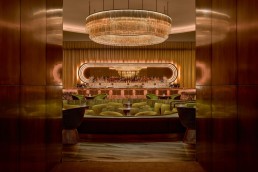
Designed as an opulent adult playground, The Pinky Ring immerses patrons in an alluring ambience reminiscent of a 1970s private penthouse party.
Bruno Mars, an iconic musician with a strong sense of style, needed a design studio that would match his level of detail for aesthetics. He brought renowned global design studio Yabu Pushelberg on board to bring his vision of a new hospitality destination in Vegas to life.
With an exclusive story on the lighting concept for the venue, darc’s editor Sarah Cullen caught up with George Yabu and Glenn Pushelberg, founders of the eponymous studio.
“Bruno had been searching for a design partner for The Pinky Ring for some time,” explains Yabu. “Together, we had a clear vision of the ambience we wanted to create: a sexy, smouldering cocktail lounge and jazz bar. We were introduced through MGM in September of 2022 and the project took off from there. It took about a year and a half to complete and opened in February on Super Bowl weekend, which was held in Las Vegas.”
Pushelberg adds: “Bruno was involved in the design process from start to finish. He wanted to create an adult playground reminiscent of a 1970s penthouse party, drawing from the legacy of The Rat Pack, Sammy Davis Junior, and Silk Sonic. The Pinky Ring is just that.”
“There was a clear vision for The Pinky Ring from the start — not just in how the space should look, but how it should feel,” elaborates Yabu. “The final design stays true to the original concept.”
From the moment you enter The Pinky Ring, a huge amount of consideration was taken into account to preserve the full experience of the space. Guests are greeted by a circular screen façade that protects the venue from external factors such as casino lighting and sound. Upon entry, guests are swept into another world that begins through a dimly lit mirrored passageway, outfitted with Bruno Mars’ Grammy Award collection. The corridor offers a visual palette cleanser from the outside noise of Vegas, taking inspiration from contemporary museum design, the display offers a discreet and soothing atmosphere.
“Crafting a simmering prelude to the bar and lounge, the arrival serves as a vestibule to entertainment,” describes the studio. “Guiding guests along an enticing arrival pathway, it seamlessly leads to the heart of The Pinky Ring sunken conversation pit, the centrepiece of the 5,000sqft space. See or be seen, each area is composed of its own suave and purpose that echoes into the next.
“With a clear direction for how The Pinky Ring should not only be seen, but felt, lighting played a crucial role in establishing the aura and atmosphere. In the pursuit of perpetual allure, where lighting not only transforms spaces, but perceptions, The Pinky Ring unveils a strategic lighting innovation, schemed to make people look and feel their best. Through a strategic interplay of low-level, contrast, and accent lighting, The Pinky Ring lighting design unveils the unseen.
“Circles are key symbols throughout the visual language, representing Mars’ records, awards and accolades in an abstract and tasteful way while alluding to visual nods of Palm Springs residences.”
The role of decorative lighting was an important one in achieving this desired aesthetic. “We wanted guests to feel sexy,” explains Pushelberg. “A huge part of this is the way we lit the space, so we turned to music video lighting as inspiration.
“Our lighting scheme emits the perpetual allure - it doesn’t just transform the space, it transforms perception. We wanted guests to look and feel their best.”
Yabu adds: “In music videos, people look good 100% of the time. We achieved this at The Pinky Ring by using low-level lighting positioned close to the ground. This approach allowed us to create the desired aesthetic and ambience, channelling the energy of a 1970s private penthouse party, just as Bruno had envisioned.”
“We wanted to create a distinctive lighting language that transforms the ambience throughout the course of the evening,” says Pushelberg. “When guests first arrive, they are welcomed into a warm, inviting atmosphere. As the night progresses, the environment transitions into a dynamic, vibrant setting with dramatic colour changes, perfect for dancing.”
Yabu continues: “We used the latest lighting control technology, DMX, as a system that allows multiple fixtures to be affected by a single controller. DMX lighting uses a data signal to control the intensity, colour, and other parameters of LED lights. We used LED lighting because of its adaptability. LED lighting is not only versatile and energy-efficient, but it’s also capable of controlling precise colour, temperature and intensity changes. The combination of these two technologies enabled us to create an immersive, customisable lighting experience, allowing us to achieve the music-video style lighting we were aiming for.”
“In terms of bespoke lighting, Lasvit created a custom chandelier that was designed as a replica to the chandelier that resides in Bruno’s Vegas home and hangs above the Conservation Pit,” adds Pushelberg.
The pair describe the design plan for the venue as a “performance in its own right” that pulled away from the gambling lifestyle of Las Vegas. “Yabu Pushelberg emphasised that rather than building a relationship to the happenings of the casino, it was their role to conceal it. Instead of having direct views from the casino into the bar, the studio created a strategic design plan that transports guests away from it,” explains Pushelberg.
Yabu adds: “The journey begins upon arrival, where guests are greeted by a circular screen façade, protecting The Pinky Ring experience. On the other side is the VIP booth, where we added linear grazer uplights to frame both sides of the rings. Once inside the lounge, accent lighting is woven throughout: concealed in the ceiling cove, under the countertops, in the bar shelf, and below the planters. We also added table lamps and a custom Lasvit chandelier to bring the space to life.
“The Champagne Room is one of our favourite areas; it’s intimate and secluded but has a perfect view into the lounge. We used adjustable accent lights here to spotlight the champagne bucket.
“We placed accent lights strategically to highlight and invigorate key design elements, like the lighting in the arrival corridor showcasing Bruno’s Grammy collection, but in a non-bombastic way. In the later hours, the contrast in lighting brings a new energy and vibrancy to the space, with the hues seamlessly shifting to create an ever-evolving visual experience.
“We have built and nurtured a team of talented lighting designers, who have been a part of our studio for more than five years. They help us bring our imagination to life. It is the unspoken and most impactful layer to projects. For clients who choose to bring our lighting service onto a project, like The Pinky Ring, it allows us to take the design process a step further, offering a more holistic approach overall.”
When it came to challenges on the project and with working alongside a very high-profile client, surprisingly there seemed to be very little the team couldn’t work out together.
“One of the design challenges we had was figuring out the right elevations for the Conversation Pit. It’s the centrepiece of the lounge, so we wanted to make sure it captured the attitude of the space while remaining elegant and functional.”
Pushelberg adds: One time during the creative process, Bruno was determined to go with a certain design direction that we did not feel was the best choice. Instinctually and in typical George fashion, he said: “No, no, no, no, no”. I think Bruno was initially taken aback by his response, but he appreciated the feedback and sincerity.
“Flash forward two weeks later when we were together in person, Bruno delivered the most bang-on impersonation of George: “No, no, no, no”. You have to have fun with one another. We are on the same team.”
“It was a joy to work with Bruno,” reflects Yabu. “He has a clear sense of who he is and what he wants, which made the design process smooth. He was open to collaboration and doing what is best for the project.”
With no structural constraints restricting lighting placement, it was just important for the team to ensure the decorative lighting “brought cohesiveness to the space”.
“As guests walk through each area, they can see and feel the fluidity from one space to the next,” explains Yabu. “The architectural and decorative lighting were designed together to create one layered, unified experience.”
Overall impressions of the completed project are positive ones all around. “The Pinky Ring exudes a slow-burn sexy feeling,” says Pushelberg. “Sexy can often be too obvious or cheap, but when you listen to Bruno’s music - it’s slow-burn sexy. That feeling is captured in the final design.
“We took on every aspect of the project, from interior design and lighting to styling, making sure to incorporate Bruno’s input along the way. Bruno kept things moving forward, and we had the most fun entering one another’s orbits, riffing ideas. This level of holistic involvement, and working so closely with Bruno, is what made the project stand out.”
If they could have changed anything, would they?
“I would have brought this project to life in the 70s, during the Studio 54 era,” adds Pushelberg. “There’s no way to fully recreate the energy of that time, but the closest we could get was by implementing a no-phone policy. There is freedom that comes from privacy that allows for deeper intimacy that disappears the moment someone pulls out a phone. We wanted to preserve that so people today can experience what we could at Studio 54.”
Linea Light Group to open new sensory showroom
(Italy) – Treviso-based lighting brand, Linea Light Group, is set to open a new “Light Hub” showroom in Milan.
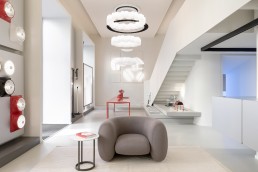
Located close to the city centre, the 300sqm space will showcase a combination of aesthetics, technology, and functionality. The hub is said to be a dedicated space to the discovery and experience of Linea Light Group’s Stilnovo products, without direct purposes.
The showroom offers a sensory experience where architecture and design inspire emotions. Created by Studio Giuseppe, Tortato Architetti, it spans three levels, and two staircases anchor the space: a white steel sculpture at the entrance and a second staircase leading to a central area where light can be experienced up close. A red table serves as a gathering spot for designers and clients. Neutral spaces showcase light fixtures in a dynamic and adaptable setting.
Gianni Bolzan, CEO of Linea Light Group, says: “The opening of our first showroom in Milan as Linea Light Group is an important step for our company. Through Light Hub, we want to offer not just an exhibition space, but a genuine innovation centre where design, technology and functionality come together to inspire and shape the lighting of the future. We are proud to do this in a city like Milan, the international design capital, where the Stilnovo brand has long standing connections. It is, at last, returning to a fitting space that truly reflects its identity and history. Our Group can now showcase and demonstrate its vision of contemporary lighting through the Light Hub.”

Materials: FW 24 Poldina Zafferano x Momonì
Momonì and Zafferano, both Veneto region-based brands, have come together to create an elegant second collection of Poldina portable lamps, with designs that take inspiration from Japan.
Following its successful collaboration during Milan Design Week 2024, Zafferano has teamed up again with Italian fashion brand Momonì to create a second collection of customised Poldina wireless table lamps.
Zafferano’s Poldina is well-known for its ability to be customised in various colours and artistic collaborations, from graffiti artist Mr. Savethewall, Peanuts (comic strip art originally by Charles Shulz in 1950), and British fabric studio Fermoie.
The new designs from Momonì’s FW 24 collection are printed onto the metal covers that transform the simple portable lamp into a piece of art.
“The strongest visual identity to convey the Momonì brand is tied to silk prints, a recurring theme that evolves each season based on the moodboard and defines the collection’s imagery,” explains the luxury fashion brand.
“Born in the Veneto region, Momonì has absorbed the historical influence of nearby Venice into its DNA, immediately identifying itself with the collective imagery of the “Silk Road”, known through the legendary Venetian merchant Marco Polo. Marco Polo’s iconic journey bridged the gap between the Occident and the Orient, serving as a symbol of the convergence of ideas, people, and cultures. Momonì is a brand that expresses sensory, emotional experiences and celebrates multicultural coexistence within its collections.
“The aesthetics of Momonì’s patterns this season are inspired by the hidden beauty of Japanese traditions: unique motifs and colour schemes reflect the essence of a creative vision that explores elegant shapes and precious fabrics, while further enhancing a useful and original product, making it even more captivating.”
“In this creative journey, where Italian design meets the art of fashion, the customised version of the Poldina battery lamp embodies the shared vision of two Italian brands: to bring joy and originality into everyday life.”
The new Momonì FW 24 Poldina collection is available as two items, one being the portable, rechargeable lamp in four colours, each paired with a metal cover printed in a matching pattern, and secondly the standalone patterned cover that can be used to personalise an existing lamp.
“Zafferano’s expertise in the world of home design made it the ideal partner to diversify our business, supporting its debut in a sector perfect for welcoming and translating our DNA,” says Michela Klinz, Momonì’s creative director. “We both have roots in the Veneto region and share a history of creativity built around values of authenticity and heritage projected into the future, which guarantee high-quality products, distinguished by their design and craftsmanship content.”
Federico de Majo, founder and president of Zafferano, adds: “Our inclination to capture and develop stimuli from different worlds found its perfect complement in Momonì and their shared creative approach, translated into an exclusive offering that embodies elegance, style, and functionality. This partnership allows us to showcase our great customisation ability, using motifs of great beauty and charm.”
Linea Light Group to open new sensory showroom
(Italy) – Treviso-based lighting brand, Linea Light Group, is set to open a new “Light Hub” showroom in Milan.
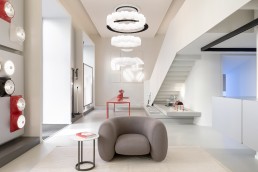
Located close to the city centre, the 300sqm space will showcase a combination of aesthetics, technology, and functionality. The hub is said to be a dedicated space to the discovery and experience of Linea Light Group’s Stilnovo products, without direct purposes.
The showroom offers a sensory experience where architecture and design inspire emotions. Created by Studio Giuseppe, Tortato Architetti, it spans three levels, and two staircases anchor the space: a white steel sculpture at the entrance and a second staircase leading to a central area where light can be experienced up close. A red table serves as a gathering spot for designers and clients. Neutral spaces showcase light fixtures in a dynamic and adaptable setting.
Gianni Bolzan, CEO of Linea Light Group, says: “The opening of our first showroom in Milan as Linea Light Group is an important step for our company. Through Light Hub, we want to offer not just an exhibition space, but a genuine innovation centre where design, technology and functionality come together to inspire and shape the lighting of the future. We are proud to do this in a city like Milan, the international design capital, where the Stilnovo brand has long standing connections. It is, at last, returning to a fitting space that truly reflects its identity and history. Our Group can now showcase and demonstrate its vision of contemporary lighting through the Light Hub.”
Lighting Alliances Join Forces to Standardise Smart Street Lighting Data
(Worldwide) - DALI Alliance (DALI), TALQ Consortium (TALQ), and Zhaga Consortium (Zhaga) have signed a landmark liaison agreement to streamline data and control systems for outdoor lighting.
This collaboration promises to simplify investment choices for cities and private operators, enabling seamless communication between interoperable components across outdoor lighting systems.
DALI’s specialty lies in developing digital lighting control specs, with widely recognised certification programmes like DALI-2, D4i, and DALI+, all geared toward ensuring smooth integration of lighting components. TALQ brings a globally accepted protocol that standardises data exchange across diverse smart city applications, from lighting to environmental sensors. Zhaga’s expertise in LED interface specifications has been instrumental in compatibility across LED modules from different manufacturers.
"The D4i certification programme plays a crucial role in enabling the seamless integration of streetlights into smart city applications, enabling interoperability and sustainability, while gathering critical data for asset management, diagnostics and energy monitoring," says Paul Drosihn, General Manager of the DALI Alliance. "By working closely with Zhaga and TALQ, we’re fostering a future-proof ecosystem that enhances supply chain longevity, security, and the right to repair – building resilient infrastructure that supports smart cities for the long term."
“For us, it is a logical step to work together with DALI and Zhaga. Not only do we share the same goals, but the composition of the member companies also has a large overlap. The better the standards in the street lighting environment become, the more sustainable and future-proof the investment decisions of cities and operators will be,” explains Simon Dunkley, Secretary General of the TALQ Consortium.
“We are thrilled to take this step forward together with DALI and TALQ. By combining our efforts and expertise, we are working towards a more interconnected and efficient future for smart lighting. This partnership ensures that we are all moving in the same direction, uniting our ambitions and promoting real-world interoperability," says Heinrich Thye, Secretary General of Zhaga.

LCA and EPD workshop for lighting producers
(UK) - Recolight has announced its first Life Cycle Assessment (LCA) and Environmental Product Declaration (EPD) training workshop, scheduled for 27 November in London.
This one-day, in-person session is designed to offer lighting manufacturers practical guidance on LCAs and EPDs. With a roundtable format limited to 12 participants, the workshop will cover essential topics such as product-specific rules, luminaire-focused guidelines (PSR-0014), and LCA case studies, including hands-on demonstrations of the One Click LCA tool.
The session will be led by Recolight’s Environmental Metrics and Training Manager, Dr. Max Robson, with representatives from One Click LCA also on hand to provide support. Recolight CEO Nigel Harvey emphasised the importance of LCAs and EPDs for lighting companies to meet increasing demand for credible, third-party environmental metrics.
Commenting on the news, Recolight CEO, Nigel Harvey says: “This workshop is intended to help lighting companies quickly get up to speed with LCAs and EPDs – to understand how to get started, what data they need to collect, and how to simplify and speed up the process.”
www.recolight.co.uk
IALD Awards winners announced
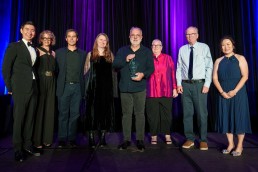
(UK) – Hundreds of industry professionals gathered in San Diego for the 41st IALD International Lighting Awards, celebrating 28 projects for exceptional lighting design. IALD co-chairs Yah Li Toh and Uno Lai enthusiastically hosted the evenings celebration. “Year over, the calibre of winning projects speaks to the passion and talent of lighting designers everywhere,” says Toh. “We can only imagine where the profession may evolve in years to come.”
The project with the highest score received an IALD Award of Excellence and the highest honour of the ceremony, the IALD Radiance Award for Excellence in Lighting Design. This accolade was given to the New York project ‘Lightfall’, a collaborative lighting design by the firms Loisos + Ubbelodhe and Lumen Architecture.
Elated representatives of the winning teams, including firm principals George Loisos and Susan Ubbelohde, joined the Awards Co-Chairs and IALD president Andrea Hartranft on stage to accept the Radiance trophy.
The following projects received the 2024 IALD Awards of Excellence:
- Battersea Power Station, London, United Kingdom, with lighting design by Speirs Major Light Architecture
- Gallo Azul Tailor Shop, México City, México, with lighting design by Lighteam Gustavo Avilés S.C.
- Lightfall, New York, NY, United States, with lighting design by Loisos + Ubbelodhe and Lumen Architecture
- Perelman Performing Arts Center (PAC NYC), New York, NY, United States, with lighting design by Tillotson Design Associates
The following projects earned the 2024 IALD Awards of Merit:
- Anyuan Bridge Lighting, Shanghai, China, with lighting design by RDesign International Lighting
- Casals Forum, Music Quarter, Kronberg im Taunus, Hesse, Germany, with lighting design by Licht Kunst Licht AG
- The Cathedral Basilica of St. Louis, St. Louis, MO, United States, with lighting design by Reed Burkett Lighting Design
- Chicago O'Hare International Airport Terminal 5, Chicago, IL, United States, with lighting design by HOK & Schuler Shook
- The Cross of Heroes, Vyshgorod, Ukraine, with lighting design by Expolight
- The Dark Line, Sandiaoling-Mudan, Taiwan, with lighting design by Artec Studio
- Eslöv Square, Eslöv, Sweden, with lighting design by Light Bureau
- Korean War Veterans' Memorial, Washington D.C., United States, with
lighting design by Flux Studio
- The Luminarium, Omaha, NE, United States, with lighting design by HDR
- Lungshan Temple Lighting Renovation, Taipei City, Taiwan, with lighting design by Originator Lighting Design Consultants, Inc.
- Matsu Beigan Power Plant, Beigan, Matsu, Taiwan, with lighting design by
YI.ng Lighting Design Consultants
- MUFG Park + Library, Yagisawa, Nishitokyo, Tokyo, Japan, with lighting designby Lumimedia Lab Inc.
- Red Box Cinema, Suzhou, Jiangsu Province, China, with lighting design by
Brandston Partnership Inc.
- Safeco Plaza, Seattle, WA, United States, with lighting design by Fisher Marantz Stone
- Saint Mark's Church, Philadelphia, PA, United States, with lighting design by BEAM, Ltd.
- Saint Nicholas Greek Orthodox Church & National Shrine, New York, NY, United States, with lighting design by DLR Group
- Sanxingdui Museum New Hall, Guanghan, Sichuan, China, with lighting design by Puri Lighting Design
- SIMOSE Art Museum, Harumi, Otake, Hiroshima, Japan, with lighting design by Lumimedia Lab Inc.
- SKP Chengdu, Chengdu, China, with lighting design by Speirs Major Light Architecture
- Sky Light Gallery, Mentougou District, Beijing, China, with lighting design by School of Architecture, Tsinghua University & One Lighting Associates (Beijing)
- Touro University Flagship Campus Lobby at 3 Times Square, New York, NY, United States, with lighting design by Anita Jorgensen Lighting Design
- Yanzi Academy, Shanghai, China, with lighting design by Guangzhou Yuanse Lighting Design Co., Ltd.
- YOYOGI SANGUBASHI TERRACE, Yoyogi, Shibuya-ku, Tokyo, Japan, with lighting design by Sirius Lighting Office Inc.
The following project was granted a 2024 IALD Special Citation for Integration of Light into the Architectural Fabric:
- Grace PARTY K Flagship Store, Kunming, Yunnan, China, with lighting designby Hong Kong Fei Shang Entertainment Design Ltd.
Awards Co-chair Uno Lai spoke highly of the variety of projects honoured for 2024:
“The domain-based rubric used by our judges allowed them to score each entry onits demonstration of aesthetic and technical excellence. It results in an array of winners that show how exceptional lighting transcends the built space.”
The collected audience joined the IALD in thanking the 2024 IALD Awards panel of seven volunteer judges. Five professional lighting designers serve on this year’s panel: Maria Dautant; Fang Fang; Clementine Fletcher-Smith; Chayot Kiranantawat; Andreas Schulz. The esteemed panel also includes interior designer Masako Fukuoka and architect David Greenbaum.

Studio N appoints New Design Director
(UAE) - Lighting design consultancy studio, Studio N, has appointed Josephine Dimalibot as Design Director.
Formally trained as an architect, Dimalibot has worked as a lighting designer for more than two decades and brings a wealth of experience from working in projects in the Middle East and Southeast Asia.
For 16 years she worked as director for Singapore’s leading lighting design practices and delivered lighting schemes for major projects such as the Four Seasons Hotel in Jakarkta, the Shangri-La Hotel in Bangalore, LinkedIn’s HQ in Singapore, and Terminal 1 at Changi International Airport.
In her new position, Dimalibot will oversee the studio’s work and set new benchmarks from creativity and innovation. The role comes at a pivotal time for the studio’s venture into new markets as it gains industry recognition for projects such as The Saudi Arabia Ministry of Tourism and Opso Dubai in The Dubai Mall.
Lama Arouri, Managing Director at Studio N, says: “Josephine’s appointment is a defining step for Studio N, as we continue to shake up the lighting design industry and attract world-class design talent. Driving creativity to new heights is ingrained in our DNA, so we want to have a visionary designer at the helm, as we look to nurture our team and build on the studio’s achievements over the past six years.”
Josephine Dimalibot Schneider comments: “I am excited to be working with Studio N’s young and highly driven team, and hope to foster a collaborative environment where our designers can thrive, be inspired and push design boundaries. It also gives me the opportunity to join forces with Managing Director Lama Arouri, who has incredible knowledge of the region’s ‘light culture’. Together, we will ensure that every lighting design project reflects our shared passion and creativity, while delivering streamlined and on target solutions that remain true to our motto – simply light.”

Fiona Cousins appointed as Honorary Fellow of Trinity Hall
(UK) - CIBSE President Fiona Cousins has been appointed an Honorary Fellow of Trinity Hall, Cambridge.
The promotion recognises Cousins’ outstanding contributions to the engineering industry and the built environment. Cousins, who graduated from Trinity Hall in 1989 with a degree in Engineering Science, currently serves as Arup Americas Region Chair and is a member of the Arup Group Board. Her portfolio includes prominent projects such as the US Embassy in London and Fulton Street Station in New York.
Cousins expresses her delight at receiving this honour, saying: “I am delighted to have been made an Honorary Fellow. I loved my time at College – studying, growing, and becoming myself – and have enjoyed alumni events too. It’s a great pleasure to be renewing the connection and I look forward to engaging more.”
As CIBSE’s President for 2024-2025, Cousins continues to inspire engineers globally while her recognition underscores the collective efforts of CIBSE members in advancing the field.