
Noctines: Contemporary Nocturnal Stories
Nicolas Houel, Founder of French studio L’Observatoire de la Nuit, shares his new research project, Noctines, dedicated to examining our “night time narratives”.
L’Observatoire de la Nuit recognises that preserving natural darkness and the health of all living things requires a deeper understanding of their intricate connections. By embracing this understanding, we can foster the creation of sustainable, high-quality nighttime environments, whether softly illuminated or left in their natural state.
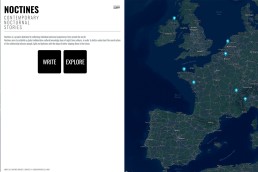
Noctines is dedicated to enriching the global conversation about the balance between darkness and artificial light in daily life. Through gathering personal stories – both real-life experiences and imagined aspirations – Noctines seeks to uncover how people shape their cultural perceptions of night and light.
Field action-research project
The term “Noctines” is a French neologism, combining “comptines” (lullabies) and “nocturnes” (nighttime), invoking the cultural stories shared at dusk across generations. Created by L’Observatoire de la Nuit, Noctines is committed to guiding individuals through the cultural transition to a renewed experience of the night. This project is inspired by my 2020 PhD thesis, “Pedagogy of Light Sobriety.”
Noctines’ ambition is to delve into personal nighttime narratives to better understand the cultural relationships people have with the night. By taking a research-action approach, Noctines not only contributes to scientific exploration in psychogeography and sensory mapping, but also offers valuable insights for urban planners, consultants, and designers. The ultimate aim is to enhance the quality of nightlife in various regions and to tailor nighttime environments to how people truly live and experience them.
Since 2021, Noctines has been mobilised during the following events:
• Grenoble (FR) Darkness experience workshop, 2024 (coming event)
• Montpellier (FR), LUCI AGM, 2024
• Beynes (FR), Darkness experience workshop, 2024
• La Roche-Sur-Yon (FR) lighting masterplan, 2024
• Mulhouse (FR) lighting masterplan, 2024
• São Paulo (BR), LEDForum, Darkness experience workshop, 2023
• Aydat (FR), Darkness experience workshop (Auvergne Volcanoes Regional Park), 2023
• Lisbonne (PR), IV edition of the International Conference on Night Studies, 2023
• Lum’Acte Game (national serious game in 12 regions of France), 2023
• Nantes (FR) night city council, 2023
• La Haye-Fouassière (FR) lighting masterplan, 2022
• Nantes (FR), Darkness experience workshop, 2021
These steps led to the collection of nearly 400 individual testimonials from a diverse group of contributors, including local residents and street lighting experts. The insights gathered took various forms, ranging from key words to full narratives and short stories. Initial analysis reveals that people’s relationships with nightlife centre around eight key themes:
• Social interaction
• Innovation
• Nature
• Introspection
• Safety
• Night sky
• Wonder
• Perception and soothing effects
These eight themes serve as a foundation for further exploration by the L’Observatoire de la Nuit team. While not exhaustive, they mark the beginning of a proposed framework to understand the emotions, sensations, and perceptions that shape both our collective cultural views and individual imaginations about the night. As more contributions are gathered, this analysis will evolve, aiming to provide a comprehensive view of the cultural factors that have shaped – and continue to shape – nightlife worldwide.
A Simple, Interactive Participation Protocol
Noctines’ approach unfolds in three steps:
1. Contributor Profile: Three questions establish an anonymous profile of the participant, covering gender, age, and their relationship with the night.
2. Location and Content: Contributors plot their stories on a dynamic map, allowing them to share the geographical context of their experience, followed by a freeform narrative of their story.
3. Story Classification: Participants indicate whether their story reflects real life or an imagined desire and link it to one of the eight pre-defined themes. There’s also room for them to introduce a new theme if needed.
This simple, didactic process invites broad participation and deepens the understanding of how people around the world connect with the night.
Noctines’ Framework
L’Observatoire de la Nuit seeks to balance the technical and sensory elements that shape nighttime environments. Often evaluated through performance, regulatory standards, and environmental considerations, the quality of life at night can sometimes feel reduced to issues like energy management, biodiversity protection, and compliance with norms. Through the Noctines project, however, L’Observatoire de la Nuit shifts the focus to personal narratives – whether real or imagined – to guide technical and technological decisions. In essence, it seeks to return lighting to its rightful place: at the heart of human experience.
The vision of the Noctines project unfolds in three stages:
Short Term: Develop a methodology for designing low-impact, shared, and sustainable nighttime cities, placing the experiences of living beings at the centre.
Mid Term: Explore the scale of societal representations of the night, moving from global to local, and from collective to individual perspectives.
Long Term: Investigate the “night-individual” system to understand both the tangible and intangible interactions that occur, and how these affect individuals and society at large.
A Free Platform for Everyone
L’Observatoire de la Nuit is committed to raising awareness, providing information, and experimenting with nighttime environments and artificial lighting. Our platform is open to all, believing that personal stories, whether real, imagined, positive, or negative, play a crucial role in shaping how each individual connects with the night. This anthropological perspective aims to shed light on various cultural aspects, including gender, accessibility, and safety in nighttime public spaces.
Utilising Noctines for Your Projects Noctines is a free platform designed to support projects focused on creating and sharing stories about night time experiences. Accessible on both PC and mobile devices, it integrates seamlessly into events and nighttime consultations. We offer occasional data extractions upon request and are open to developing customised solutions, such as tailored questionnaires, geographic targeting, and direct data access.
Feel free to reach out to us at
contact@lobservatoiredelanuit.fr and contribute your stories to the platform!
Why Contribute and Consult Noctines?
Noctines offers a unique opportunity to connect with others who share your experiences at the places you love to visit at night. By using the platform, you can explore a vast array of nighttime locations around the world, discovering new spots to enjoy after dark.
Noctines also provides a valuable resource for comparing and contrasting different perspectives on nightlife. It reveals the wide range of opinions, preconceptions, and cultural practices associated with nighttime activities globally. This insight allows you to appreciate the diverse ways in which people around the world experience and perceive the night.
Moreover, your personal stories and experiences play a crucial role in shaping the world’s first qualitative map of nocturnal experiences. By contributing to this map, you help create a comprehensive and nuanced understanding of nighttime environments, enriching our collective knowledge and fostering a deeper appreciation of the night.

Commision: Are you Breaking the Law?
Marcus Steffen broaches the issue of commission, providing some clarity on the process, and how to ensure that what you are doing is both ethical and legal.
How money is made and who is profiting is almost seen as a dark art within construction. There are always stories floating around about extra money made, people getting a cut and who is making what. With this article I want to try and demystify how this works, so that we can all achieve the ultimate goal: having a project delivered on time, on budget, that the client is happy with.
Our industry is young and growing fast, so it is essential we do not allow bad practices to mire our industry in controversy.
I have always believed that it is best to make things as clear as possible and allow clients to make an informed choice with expert advice. Within lighting, lighting designers, architects, and interior designers are often the ones who are providing that expert advice. As we all know, lighting is extremely complex and projects benefit immensely from having an expert coordinate it from the very start. Clients need to be able to trust that the advice they’re getting is in their best interests. This is where the issue of commissions often pops up and can cause significant issues, and even constitute breaking the law.
For full disclosure, I run two companies: MS Lighting Design, which I started 10 years ago; and Ember Lighting, which I started with a business partner approximately seven years ago. MS Lighting Design provides only lighting design services, whereas Ember provides specification and supply services. This, along with 20 years in the industry, means I have seen many sides of the supply chain and how it functions.
What is commission?
Commission for lighting designers can fall into two general areas: commission paid to people recommending you/your company for a project or to a client, and charging commission from suppliers that you/your company has specified on a project. To be clear, the payment of commission is not illegal in itself, as long as the client is aware that this relationship is present. Commissions might take the form of a lump sum or a percentage.
In other industries, this is how businesses might normally function. For example, mortgage brokers charge a commission, and when you have your mortgage agreed with the provider, it will show on there the commission paid to the mortgage broker.
UK Bribery Act 2010
I am discussing the UK in this article, though similar legislation is likely to exist in other countries. I would also say that I am not a legal expert, and am not able to provide legal advice, so you should seek this yourself. The Bribery Act 2010 covers what is relevant here. This is a simple summary:
“[It is] …an offence for a person to offer, promise or give a financial or other advantage to another person….where [that person] knows or believes that the acceptance of the advantage offered, promised or given in itself constitutes the improper performance of a relevant function or activity… ‘Improper performance’ …means performance which amounts to a breach of an expectation that a person will act in good faith, impartially, or in accordance with a position of trust.”
The key point here is if a person is providing advice with an expectation of impartiality, but they are receiving or giving payments to other parties.
Relevance to lighting design
In the lighting design industry, we could be either party. We could be a supplier, providing our design services on the recommendation of a project manager or interior designer, while they are asking for a commission from us to be recommended. We could also be the expert providing advice to the client, while receiving commission from the suppliers. In some cases, commission could be viewed not as a monetary payment, but other benefits, such as gifts and entertainment.
Different legal business approaches
In some cases, commission is just greed, with parties wanting to make more money from a project. Often though, there may be legitimate work and expense being carried out by the expert, for which they feel they are entitled to some sort of restitution. There are a number of legal ways of ensuring this work is covered without resorting to kickbacks:
Agreed percentage based on the entire value of the project: This is often the method used by architects for pricing their projects. This will involve having a set budget for the overall size of the project, and then portions of this are allocated to each design and construction phase. This could form part of an overall lighting design fee, or it could be used just for the construction element of the project. This can vary depending on the sector the project is in and the size, but is a way to cover expanding scope within a project. This fee can then cover the work involved in managing the supply of items or coordinating other parties.
Supply management fee: This is a common method used by interior designers who have clients who want to purchase directly from suppliers. They would charge their interior design fees, but when it comes to supply, they seek quotes from the suppliers, these are checked, given to the client to pay, and the interior designer charges a flat percentage on top. This fee is often in the range of 10-20%, and negotiated with the interior designer as part of their contract. They will take on some responsibility for errors in the supply since they are checking the quotes before the client purchases the items.
Hourly rate: An hourly rate could be agreed with the client to cover work involved in the organisation of the supply of products. This is dependent on the client and can be challenging since costs are not known before the project starts, making clients wary. It might be the only way to provide services on a bespoke, custom project though.
Unforseen commission - declaration: in some cases a supplier offers some sort of commission to a designer. In these cases, it could be declared to the client that this offer has been made, and then ask what they would like to do with it. Most clients would take the extra saving, but in some cases they may be happy to leave it with the designer.
Full supply: Some lighting designers provide both lighting design and supply services under one roof. In this case, it should be declared to clients before hand if it is not possible for the client to then source the goods themselves (i.e. manufacturer specification is not being provided as part of the design service or quotes are locked to the designer).
Gifts and entertainment
The issue of gifts and entertainment is a bit of a grey area. A lot of suppliers might offer a lunch alongside explaining products, or a trip to the factory to see how they are made. They might offer free samples to a specifier. But these can form an essential part of expanding expert knowledge and design skills. Seeing how products are made can give designers greater understanding of how they work, and learning about the unique benefits of products can benefit clients.
How this is approached and ensuring that they do not breach the bribery act is important. They should not be tied to any sort of performance target or expectation for specifying products on projects. A designer could also make it visible to clients via social media and discussions that they have participated in a trip with a supplier. For this, it requires common sense and a good sense of ethics to navigate. It is also important to put in place policies with staff explaining what activities are and are not ok to engage in.
The focus should be on the client’s outcomes
All of this is leading to one result: ensuring the client has a good outcome on their project, and they have full confidence in their experts. It is important that we as an industry encourage and enforce good practice, and we do not engage in these terrible practices that have plagued construction for many years.
Disruptia
Following its debut event in Mexico last year, Light Collective brought its “festival of disruption” to London this October, hoping to inspire its audience, and start new conversations on the future of the lighting profession.
What does it mean to be truly disruptive in the lighting industry? This is a question that Light Collective asked of the design community at Disruptia, its very own “festival of disruption”.
Held at One Friendly Place in Deptford (itself an act of disruption!), the one-day event looked to challenge the norms of lighting events and, as Martin Lupton said in his opening remarks, was a way to “gather the smartest minds in the world of tech and innovation with the smartest people in lighting, put them in a room, and get conversations going”.
The event was split between a series of “Inspiration” presentations on lighting-adjacent subjects, such as the dawn of new tech, VFX, and visual pollution, and “Conversations”, where attendees could meet with designers, engage with installations, or learn more about new, emerging technology in lighting.
Opening the event was an Inspirations session from Ghislaine Boddington, artist, curator, and host of the Fast Forward podcast series. Her talk, a mind-bending discussion titled Illuminating the Living Body: From Shadows to Sentience, explored the role of light in influencing our sensory and cognitive processes, how today’s lighting technology is transforming public spaces, immersive environments, and even our digital identity, with a glimpse into the future of human experience. Harnessing her background in dance, she discussed the “immersion world” – spaces like cathedrals and nightclubs that are designed to enhance our senses, before delving into the theory of ‘Telepresence”, and the eventual merging of physical and virtual worlds. A fascinating exploration into what may be possible in the future – and an intense way to kick off proceedings.
The second “Inspiration” talk came from Tom McLoughlin of Territory Studios, who discussed the interplay between design, fiction, and reality, examining how imagined worlds can challenge our perceptions and inspire solutions. Using examples from his work in digital art, concept designs, and science fiction films, McLoughlin demonstrated how otherworldly, forward-thinking and imaginative design for works of fiction can actually inspire real-world development, bridging the gap between fiction and reality.
Up next, MTArt Agency founder Marine Tanguy gave an incendiary talk on the power of visual literacy, and the harm that “visual pollution” and over-exposure to large-scale screen advertising can bring. In her session, she discussed the links between the overexposure to high levels of commercial imagery and lower wellbeing, contrasting with an improved wellbeing when exposed to the arts. Citing her book, The Visual Detox, Tanguy called for the need to build an inclusive visual world, and how, in times of visual cognitive overload, we can train our eyes to challenge what we see daily. As someone who regularly travels through London Euston train station and has to see the monstrous advertising screen that spans across its entire interior, there was definitely a lot to personally take away from this talk.
The final Inspirations talk came from German light art extraordinaire Christopher Bauder, who wowed the audience with some recent examples of his amazing, immersive creations. Throughout his career, Bauder has become well-known for fusing light with music in ephemeral, encompassing performances that transport viewers into a parallel world of space, light, and sound. In a free-flowing presentation, Bauder shared some behind the scenes insights from two of his latest works – Vektor, in Berlin, and Dialogue, created for Noor Riyadh 2023.
Interspersed within the Inspiration talks were a series of “Conversation” sessions. Occupying 13 different spaces across three floors, the format of these varied from interactive installations to demonstrations of new tech in lighting, to guided meditations, where lighting plays a key role.
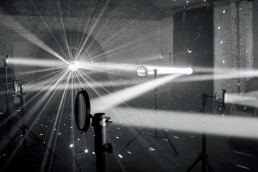
Lighting design studio Artin Light partnered with LEDFlex, creating a scenario in which visitors could create their own lighting installation in the main talks space of the venue, experimenting with form and colour to create unique scenarios. Elsewhere, WSP and Ayrton collaborated on Light Beam, an immersive artwork that merged cinema, sculpture, drawing, and sound. Guests could play with mirrors and three-dimensional beams of light to sculpt their own beautiful creations.
Merging light art and AI, Daniel Green of Into Lighting and Digital Gyoza teamed up with formalighting for Light P{AI}nting, exploring the crossover from virtual to physical with a specially developed interaction between formalighting’s latest range of moving lights, and realtime image generation using the Krea.AI system.
Demonstrating how new technology could shape the future of lighting design, tools such as VR, AR, content engines, intelligent sensors, and even video games were examined, in conversations with Juan Ferrari and Karam Bhamra of Hoare Lea; Claude Dutson of the Royal College of Art; Sarah Cox of Neutral Human; and James Simpson of Copper Candle.
There were further demonstrations from creative minds like Frankie Boyle, Tapio Rosenius, and Moritz Waldemeyer, who each shared their own takes on the future of art, light and design. Pixmob also demonstrated how its wireless LED technology can create immersive lighting experiences synced with music. Elsewhere, in a much-needed change of pace after seeing so much disruptive innovation, Kai Diederichsen and Magali Mendez slowed things down with a meditation looking to unlock emotional awareness through coloured coded light; and Maria Vera and Viviana Caro explored the notion of “Neuromance” with a beautiful installation that intertwined light and sound that sought to examine how humans experience light as both an aesthetic and sensory phenomenon.
As the event drew to a close, guests were treated to complementary tacos and tequila – a truly disruptive way to end an event – and sent into the night full of inspiration and disruptive thoughts for the future of the industry.
Disruptia was created by Light Collective, with support from Ayrton, formalighting, LEDFlex, and Light House.
www.lightcollective.net
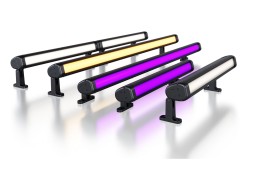
4750L Floodlights - Hydrel
4750L is an exterior linear floodlight designed for challenging outdoor applications, delivering high performance and efficacy. It is available in continuous runs, enabling the designer to create an uninterrupted line of light. With static white, tunable white, and RGBW options, 4750L brings a bold lighting aesthetic to elevate the nighttime experience for building and landscape features.
A new 2-foot RGBW version facilitates smaller projects requiring RGBW. It also paves the way for continuous runs that require more flexibility in the final length beyond the standard 4-foot fixture.
Mounting accessories are available for surface, ground and wall-mount. The new rotated knuckle mounting options, which are also shorter than the standard version, expand the application possibilities. Lighting designers can now place the luminaire in small spaces or closer to a facade when there is minimal set-back.
The 4750L linear floodlight family can deliver up to 2000 lumens per foot, with a high efficiency of 134 lumens per watt, for an exceptional lighting experience that requires fewer luminaires.
A modular Flow-Thru technology enhances water management: water flows around the independently sealed integral driver module and LED module. It is also equipped with field changeable LED and driver modules for ease of maintenance. The fixtures are IP67-rated.
www.hydrel.com
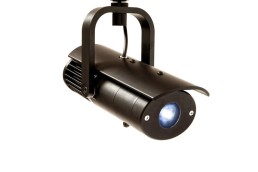
Evica - EP+ Superwide Gobo
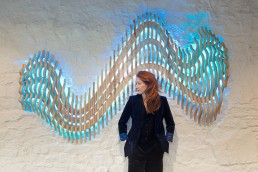
Frankie Boyle's Intra-spectrum to feature at LiGHT 24
(UK) - Intra-spectrum, Frankie Boyle’s latest creation will shine at LiGHT 24. The artwork, powered by Formalighting, invites all to embrace wisdom through light and colour.
The installation will take place at the Business Design Centre in London from 20 - 21 November 2024.
Combining scientific inquiry with creative expression, Boyle’s’s work is distinguished by her mastery of physics, colour theory, and the psychology of perception. Her installations explore the intricate interplay of light and emotion, creating immersive environments that prompt introspection and self-discovery.
Cultivating her heightened sensitivity to light and deep understanding of human behaviour, her latest upcoming installation, titled Intra-spectrum, has taken inspiration from her recent explorations of the narrative of consciousness and subconscious within her body of work through the harmony of reflection and refraction.
Boyle says: “I want people to immerse themselves within the light that we shine and the light that we hold within through an array of beautiful invigorating colours. This installation is all about eliciting introspection and connection.”
This relationship with colour is something that Boyle wanted to particularly focus on during Intra-spectrum. Colour theory is a fundamental concept in art, design, and psychology that helps explain how colours interact, how they can be harmonised, and how they affect human perception and emotions.
Boyle believes that as children we are attracted to colour as our eyes are more sensitive and stimulated by brighter colours, yet as we grow older, we start to eliminate colour from our lives because we associate it with immaturity and youth. Her work aims to “reignite those rich emotional experiences that influenced how we felt, thought and behaved through play when we were younger”.
To create the kaleidoscope of various colours in this artwork, Boyle is using dichroic film; a material that exhibits different colours when viewed from different angles due to interference of light waves - creating a colour-shifting effect. This phenomenon occurs because the film selectively reflects and transmits certain wavelengths of light while others pass through, creating a multi-colour appearance depending on the observer's position.
The concept of light has heavily influenced Boyle’s work as an artist. She has shared her experiences of growing up as a neurodivergent person, who used light as a communication tool from a very early age.
Boyle adds, “Light and human behaviour were definitely the first languages I understood. That is why I am so interested in the human response to my work, physically, psychologically and emotionally. Ultimately, light is a language that everyone speaks that taps into the subconscious, connecting us to a space.”
Visitors to LiGHT 24 will be able to view the exclusively created art installation ‘Intra-spectrum’ by Frankie Boyle, which is powered by Formalighting. The installation will be found in the space between the main exhibition and the conference hall, where it will aim to ignite and resurface memories and emotions as visitors move through this space.
Discover more about Frankie’s work here: https://www.frankieboylestudio.com/Find out more and register free for LiGHT 24 here: https://www.lightexpo.london/
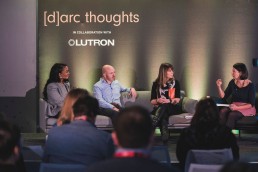
[d]arc thoughts programme announced for LiGHT24
(UK) – LiGHT 24, the UK's only high-end lighting exhibition, is set to be a must-attend event not just for lighting designers, but for professionals across the lighting, interior design, and architectural communities. Packed with networking opportunities and insightful talks, there's something for everyone.
Running over the two-days, the highly anticipated [d]arc thoughts programme will feature discussions with top experts in the industry. Curated and moderated by the [d]arc media editorial team, this year’s talks will explore how interiors and lighting shape our environments, with a focus on sustainability and human-centric design.
The programme kicks off on the Wednesday, covering themes on the Business of Design, Lighting and Interiors. Covering topics like: The Next Generation of Design, Time to Step Up – The Role of a Lighting Designer, Taking the Leap, and The Value of Light – AI Takeaway. Later, the "Lighting + Interiors" segment will feature talks such as Using Lighting Design to Enhance Accessibility in Interiors, presented by the BIID, and a discussion on the relationship between interior design and architectural lighting
Thursday’s programme focuses on Wellness, Sustainability, and designing for the Planet. The "Wellness" talks will address themes like Lighting Controls for People and Planet, Maximising Wellbeing in Residential Environments, and Neurodiversity & Lighting. The "Sustainability" focus will include an overview of environmental assessments in lighting, while the "Planet" section features topics such as Starlight Certification & Outdoor Lighting, A Pilot Project for Sea Turtle Conservation, and Dark Frontier: Dark Sky Friendly Lighting Schemes.
Discover the full talks programme here:
https://www.lightexpo.london/talks-programme/
Providing unrivalled networking, branding and socialising opportunities; visitors can meet with exhibitors on their stands, enjoy late-night welcome drinks during the first evening, and take part in the popular LiGHT Lunch on day two of the event. As well as multiple areas to socialise with others in the industry, such as grabbing a coffee at the on-site cafe, Jacks, on the gallery level, or heading over to the dedicated LiGHT WORK workspace for quieter surroundings, allowing you to discuss potential project collaborations in more detail.
This year's LiGHT LUNCH will feature a Women in Industry networking event, with representatives from Women in Lighting, Women Lighting Professionals, and more. Attendees can learn about these empowering initiatives and how to get involved. A panel discussion will highlight the importance of women’s groups for both women and men. Another key networking event is the Silhouette Awards, uniting the global lighting community with mentor-mentee advice, educational insights, presentations, discussions, and photo opportunities.
Helen Ankers, Managing Editor at [d]arc media, said: “We are delighted to bring the lighting and design communities together for the most anticipated UK event in the lighting industry for the third year running. LiGHT 24 is not just for lighting designers - we value bringing together inspiring leaders and passionate people to share ideas and solutions to grow the future of the entire industry. A common misconception is that trade shows dedicated to lighting specification are just for lighting specialists, yet by bringing together architects, interior designers and other professionals in the community, with innovative brands and suppliers, LiGHT 24 is the perfect opportunity to network and seek inspiration, whatever role you play in a project.”
The show takes place on 20-21 November 2024 at the Business Design Centre in London. Secure your place to attend so that you don’t miss out on any of the key show events that are on offer.
Find out more and register for FREE here: www.lightexpo.london
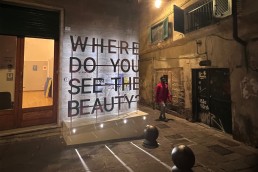
Lighting for Genoa wins big at Luci Cities and Lighting Awards
(International) – The city of Genoa in Italy is the winner of the cities and Lighting Award 2024.
The winning project, called Lighting for Genoa, has revitalised 10 “non-places” in the historic centre of the city through skilful use of light, designed to create gathering spaces and make this particular urban area accessible, overcoming issues related to the type of usage, safety and accessibility.
The project worked with light to create a new sense of security for the people who inhabit it, with a particular focus on women, children the elderly, minorities and vulnerable groups.
Its ten permanent lighting installations are conceived in a joint effort with local associations and residents who live and animate the areas where the project was implemented.
Clarisse Tavin, architect and group manager at City of London corporation and member of the jury, says: “It proves through creative approach of lighting we can support social interaction and sense of belonging and reconnect spaces with their community.”
The 2nd and 3rd prizes go to Eskilstuna, Sweden for the Hamgatan and MDU Plaza; and Bologna, Italy, for project ‘New Light for the Arcades, Gates, and Historic Centre.
All winners receive high international recognition for their work. On top of a number of benefits, awarded projects will be highlighted as case studies with LUCI network’s events and communication channels such as online, print and LUCI’s City and Lighting Magazine, adding to the long-term collective knowledge shared with cities internationally.
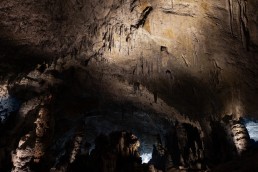
New ‘after-dark’ heritage lighting studio launched
(Europe) - Lighting designer Chiara Carucci has unveiled her new practice, Noctua, a Cultural and Natural Heritage Lighting Design Consultancy.
Carucci launched the firm to act as a bridge between research and practice, aiming to protect heritage by integrating cultural narratives with environmental responsibility, while ensuring conservation and enhancing visitor experiences.
The principle behind the company is that heritage sites are living history, and their stories should continue to be told even when the sun sets. Conservation efforts can often be focused just during daylight hours, and Noctua seeks to make more of these precious natural and built environments.
Carucci will lead Noctua's efforts in addressing heritage sites and diverse urban environments with innovative, tailored solutions. Her adaptive management process, which includes thorough analysis, hands-on testing, and stakeholder input, has already shown success in past projects. This approach will guide Noctua through all project stages, ensuring long-term value while reducing risks in cost, time, environmental impact, and ongoing operational expenses like energy and maintenance.
Noctua is teaming up with Erik Hagström, Lighting Designer, and Dr. Rosangela Addesso, Environmental Scientist, bringing together lighting and environmental expertise to ensure that Noctua can deliver sustainable, innovative solutions, especially in ecologically sensitive projects.
Carucci says: “With two decades of experience in the lighting industry, traveling for work and conferences across the world and meeting the most interesting people (and living beings) I realised that I bring a quite unique perspective to the table that I should fully embrace and take advantage of. I also quickly came to appreciate how much I enjoy collaborating with individuals who possess multiple skill sets.
“Throughout my professional journey, working alongside experts like water and traffic engineers, conservation architects, and scientists has proven invaluable. A memorable instance occurred in 2017 during a discussion about a linear park in Sweden, where the City architect raised concerns about beavers harming trees and consequently disrupting bird nests, including those of two protected species. The guidance of a zoologist and an ornithologist enabled us to devise an optimal solution for the lighting design.
“As my work in Sweden continued to broaden my perspective on the interconnectedness of ecosystems and cascading effects of our design after dark, I found myself increasingly drawn to projects that considered the needs of all living beings. I gained experience working in various environments and harmonizing the coexistence of different species. “Walking the talk” led me to an exciting project: I was offered the opportunity to design the lighting for two tourist caves that are home to protected bats, in a very delicate ecosystem. Since the project was in Italy and we had just transitioned to working remotely, I realized this was the perfect moment to scale down and focus on what truly mattered to me - serving not just people, but all living beings.”
She adds, “Fast forward three years, after moving to Cilento, Italy, while continuing to collaborate with colleagues and clients in Sweden, I found myself longing for a space dedicated to informed design - one that bridges research and practice and fosters interdisciplinary cooperation and storytelling. This vision is a reality with Noctua: I look forward to welcoming forward-thinking, passionate people to co-create new ways of living after dark.
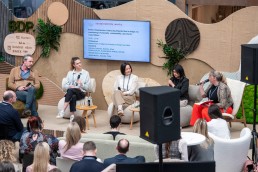
Workspace Design Show announces 2025 theme
(UK) – The UK tradeshow on workspace design has announced the theme of ‘Activate the Senses’ for its return to the Business Design Centre from 26 – 27 February 2025.
The theme invites attendees to embark on a journey of immersive experiences that stimulate the five senses. Guests will step into a space which showcases how each ‘sense’ has a profound impact on the mind, contributing to wellbeing, engagement and productivity.
The show will explore how factors like light, sound, and temperature are crucial in workplace design but can be divisive if not carefully considered, as individuals have varying sensitivities. Elements such as acoustics, lighting, aromas, and textures contribute to a multi-sensory workspace that enhances focus and wellbeing.
Esha Bark-Jones, Co-Founder of the Workspace Design Show, says: “With the industry being at such a pivotal point of change we are looking to gain a deeper understanding of how, through research and knowledge, Technological innovations can benefit the workplace environment. We are all becoming increasingly more in tune with our personal needs and how they differ from one person to the next. Through talks, exhibitors and connections, Workspace Design Show will bring this to life.”

Scot Lim joins LEDFlex as North America Sales Director
LED Flex has expanded into North America with appointment of Scot Lim as Sales Director.
In a strategic step towards global growth, the expansion responds to an increasing demand for LED Flex products across the region, driven by the success of several projects.
Lim will lead the venture, bringing 15 years of experience in sales and business in the healthcare lighting sector. The move enables LED Flex to provide end-to-end support for designers, architects, and distributors across North America, empowering the designer to execute more impactful projects.
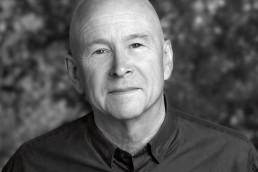
Terence Woodgate
Iconic product and furniture designer Terence Woodgate sits down with darc’s editor Sarah Cullen to chat about his career, design inspirations, and memorable collections that he has created over the last 21 years as an official Royal Designer for Industry.
Terence Woodgate is a well-respected British industrial designer who obtained Royal Designer for Industry (RDI) status in 2003. However, being a furniture and product designer was not on his initial career path.
Speaking with Sarah Cullen, she discovers more about the designer’s past, creative influences, and future endeavors.
Woodgate grew up in the beautiful Parliament Hill area in Highgate, London. Here, he attended the Gospel Oak primary school where he majored in art. At the end of his primary education, he failed his 11+ exams and went on to attend Holloway Comprehensive School, which upon reflection was something he sees as a positive outcome: “It was probably for the best as I would not have enjoyed grammar school”. For context, secondary modern schools were a type of secondary school that existed throughout England, Wales and Northern Ireland from 1944 until the 1970s under the Tripartite System. Secondary modern schools were designed for most pupils between the ages 11 and 15; those who achieved the highest scores in the 11+ were allowed to go to a selective grammar school, which offered education beyond 15. It wasn’t until a little later in life in his 30s that Woodgate was diagnosed with Dyslexia, which could have been a possible influencing factor on his educational direction.
Post secondary school, Woodgate went on to study engineering at Westminster College before beginning work as a petrochemical design engineer in Belgium, creating oil rigs and nuclear power plants. “While in Belgium, I visited an exhibition on The Bauhaus at the Stedelijk Museum in Amsterdam, which had a massive influence on me. The Grand Comfort chair by Charles-Édouard Jeanneret, known as Le Corbusier, blew me away. The idea of having an exterior structure in polished steel tube, holding soft leather cushions was exciting. It was totally different from what I grew up with and I wanted to create work like that myself. Also, the Lights by Walter Gropius were wonderful, stunning and still relevant today.
“Visiting an art gallery continues to have the same effect on me; after a while I want to run back to the studio and create new work!”
Following his stroke of inspiration attending art galleries in Belgium, in the mid-1980s Woodgate retrained as a furniture designer at the London Guildhall University before opening his own studio in East Sussex, UK, 1988.
Since then, blending his technical engineering training with his appreciation for refined aesthetics, Woodgate has established himself as a contemporary designer that describes his aesthetic as “modernist/minimal”. He adds: “I am more interested in subtraction than addition. I don’t add decoration for the sake of decoration, instead preferring to focus on form and texture.
“[When it comes to designing] influences are everywhere for me. When offering advice to design students, I always encourage them to look outside their chosen discipline for inspiration, e.g., architecture, jewellery, racing cars, art. For me, art is probably the most important influence.”
As his studio began to grow, so did the recognition for his designs and his collection of accolades. A mere 15 years after establishing Studio Woodgate, in 2003 he was awarded his RDI as well as the German Red Dot ‘Best of the Best’ Award, IF Ecology Award, and Observer/Elle Decoration Design Award for Furniture. Not long after, in 2008 he also won the Wallpaper* Magazine Design Award.
Over the years, Woodgate’s portfolio of clients has also grown to include brands such as Case, Concord Lighting, Established & Sons, Objekten, Punt Mobles, RVB and SCP. Examples of his work are now held in private and permanent collections such as the Museu d’Arts Decoratives, Barcelona, and the Victoria and Albert Museum, London.
Speaking of some of his most notable moments in his career to date, Woodgate says: “I designed several lights for Concord Lighting that were all speculative, i.e. not commissioned. Notably, Infinite and LED 150 were significant designs. Infinite was a low voltage collection with straight and curved track structures where fittings could be added to the top and bottom. It won various important design awards including the German Red Dot ‘Best of the Best’.”
Ahead of the curve with project circularity, Woodgate’s LED 150 was designed with longevity and flexibility in mind. “LED 150 was a downlight where LED was an acronym for Low Energy Downlight, long before LED light sources were around. It was a holistic design where I focused on benefits for everyone involved be they architects, specifiers, installers, maintenance, or end user. It was flexible in that it could be specified in the knowledge that if the building requirements changed so could the downlight system in terms of optics and aesthetics. The product lit many large projects such as the Petronas Twin Towers and some international airports.
“I would also say my Solid collection for Case is one that I consider notable. The design has now evolved to be portable, which offers wonderful user flexibility.”
When it comes to his approach to designing lighting, Woodgate explains that within all design fields, whether that’s furniture or lighting fixtures, there are particular constraints that need to be considered.
“You need to identify what information you need to start work. When designing an architectural light fitting, you are designing a machine that provides light. Decorative lighting is more about saying ‘look at me’ rather than ‘look at what I do’. And both are valid.
“Lighting can turn a space into something wonderful, be it warm and welcoming like enjoying a whiskey by a log fire, or it can enliven the space and the people within it like a fresh walk in the alps. It can also tell a story and provide a narrative.
“For me, good product design is refinement and engineering beauty either in the design itself or in the effect. It’s the ambiance it produces.”
Looking at the relationship between architectural and decorative lighting, he believes “each has a definitive role to play”. He continues: “Personally, I love the technical challenges of architectural lighting, and I love the freedom/liberty of decorative lighting.”
When it comes to challenges within design, Woodgate is self-proclaimed impatient by nature, stating that the time it takes between design concept to production and finally to reward is the most frustrating part about working in the world of design.
Speaking of one of the best developments in the industry, like many designers who work with lighting, he claims it is the revolutionary introduction of LEDs. “[They] are amazing and have changed the industry. The energy saving aspects and the fact that they are emitting light at such low operating temperatures is excellent. Tuneable white light LEDs are particularly fantastic, but personally, I am not a fan of colour changing LEDs.”
One of Woodgate’s long-standing brand partnerships is with Case, a British furniture, lighting, and home accessories brand established in 2006 by British designer Paul Newman.
“I have known and respected Case for many years and the team has impressed me with their energy and enthusiasm. They have grown and are now a successful international producer with an intention to expand its decorative lighting. Case commissioned me to design a collection of floor and table lights, which is called Soft, due to its soft form of the traditional tapered shade. Made in Poland in mouthblown, three ply opal glass, it provides a beautiful, soft ambient light.”
The Soft collection’s elegant, rounded conic glass shade takes the centre stage, which is acid-etched to produce a diffused, gentle light. With a three-step touch control to dim the light, the collection is versatile and suitable for use in residential, office and commercial environments.
“Working with light is always an exciting experience, because you never really know light and how it will perform.”
What can we expect from the designer next? A new collection of wall lights appears to be on the horizon… “The wall lights are currently a speculative design without a manufacturer in mind; it is one of those designs that has been on my board for a while. As I am now living in Girona, I think I would like to approach a Spanish brand.”
www.studiowoodgate.com