
IALD announces Enlighten Europe Speakers
(Spain) – The speaker lineup for IALD Enlighten Europe has been announced as registration opens.
Architectural lighting design professionals and business leaders across Europe will gather on 26-27 June in Valencia, Spain for the popular conference.
Over two days, attendees will immerse themselves in business-critical issues, obtaining insider knowledge and hands-on advice from leading lighting experts through panel discussions, networking opportunities, and opportunities with peers and industry leaders.
Speakers for this year’s event include:
Alberto Barbera Duelo, Luperscales.Org – Applying a feminist perspective to Urban Lighting
Noemi Barbero, VBNB Lighting – The Eternal Light of the Pharaohs: Illuminating the Three Pyramids of Giza
Erin Denkovska, Delta Lighting Design – Oops I Dropped the Lemon Pie
Willie Duggan, Willie Duggan Lighting – Rethink Light: Embracing Health-Centric Lighting Design
Juan Ferrari, Hoare Lea – Light and Time: Creating Life’s Optical Illusions
Clementine Fletcher-Smith, Speirs Major Light Architecture – The Weight of Light
Sebastian Hepting, Ingo Maurer – Static Sucks! Embracing Colour and Motion in Lighting
Arne Hülsmann, Adres+Partner – Reflections in Architecture: Steering Daylight for Aesthetics
Dr. Shelley James, Royal Art College - Neuroarchitecture Meets Smart Lighting for Inclusive Spaces
Veronika Mayerboeck, ALLES Oder Licht – Corporeality of Light: An Introduction to Sensing Space Methodology
Gavriil Papadiotis, GavriiLux Productions – Lighting projects Properly Exposed: Every Designer Can Make Better Images
Claudio Rojas Wettig, Lichtvision Design – Illuminating Iconic Architecture: The Hyparschale Lighting Story
Katja Schiebler – Reflections in Architecture: Steering Daylight for Aesthetics and Sustainability
Foad Shafighi, Hammel Green & Abrahamson – Illuminate and Innovate: A Workflow Revolution with AI in Lighting Design
Kevan Shaw, KSLD – Are Rainbows Real: A Philosophical Approach to Lighting Design
James Simpson, Copper Candle – Guerillas in the Metaverse
Brian Stacy, Arup – Life-Long Learning: Growth Through Skill Development and Knowledge Management
Registration for the event is now open, with spaces filling up. For more information, visit: https://aimgroup.eventsair.com/iald-2025/iald2025-reg/Site/Register

The Reserve, Singapore
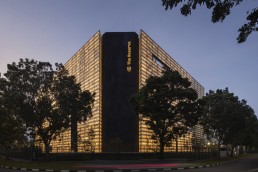
The Reserve is a state-of-the-art asset centre in Singapore that houses a wealth of assets such as gold, silver, art, and more. The building was completed in 2024 for clients Silver Bullion, and can store almost 500 million troy ounces (15,500 metric tonnes) of precious metals, earning it the title of the world’s highest storage capacity. The high storage capacity is made possible via the foundations, which allow the vault’s floors to withstand up to 45 times more weight than a typical car park structure, allowing silver to be stacked as high as 12-metres tall.
The building itself stands as a glistening black monolith, made of transparent onyx panels envisioned by architects Monolab Studio, whose design is a metaphor for the robust precious metals within and the transparency inherent in the distributed financial technologies of the future. Designed as a play on contrasts to captivate, the onyx-clad fortress radiates a luminous elegance both within and beyond, masterfully harnessing light.
Tasked with designing the lighting for The Reserve was Singapore-based lighting consultant Light Collab, which bravely bid for the chance to work on the project despite never designing for vaults before.
After a successful interview with the client, architect, and interior designer, the team was given the go-ahead to join the board and was briefed on Monolab Studio’s vision of a luminous façade.
Light Collab saw great potential in the project’s wow factor and cinematic value, envisioning the venue as a prime location for films. The space offers so much drama as soon as visitors enter the space, experiencing its cave-like feel, high-tech nature, and mysterious labyrinth of corridors, which create a futuristic look contrasted with a hospitality twist.
Lighting designer, founder, and Principal of Light Collab, Yah Li Toh, explains to arc how the team planned to bring this concept to life: “We built upon the strong architectural foundation set by Monolab Studio, enhancing their material palette and spatial composition with carefully curated lighting.
“The challenge was balancing intricate detailing with large-scale spatial considerations, ensuring that every lighting element, from subtle accents to dramatic washes, worked harmoniously. Our approach involved meticulous planning, extensive prototyping, and seamless integration of lighting within the architectural fabric to bring the cinematic vision to life.”
The onyx-clad façade serves as the defining element of this vision, creating a striking contrast between solidity and illumination. By day, the dark, polished exterior exudes a sense of strength and exclusivity, while by night, strategically integrated lighting transforms the surface into a glowing beacon. This design approach not only establishes The Reserve as a landmark, but also reflects a seamless interplay between luxury, modernity, and the natural beauty of its materials.
The façade lighting was one of the greatest challenges that Light Collab had to face, with the architect envisioning the onyx façade to have dual visibility from the outside, and the inside, meaning each onyx panel had no backing. However, behind the façades lies various spaces with numerous functions, such as lobbies, meeting rooms, lounge areas, and a rooftop garden. Ultimately this limited the position of where Light Collab could mount lighting fixtures.
Toh explains: “Due to the nature of the panels and the various spaces situated behind it, we had to conduct studies. This meant testing to understand the interior lighting’s spill of light, the blank walls, or how we conceal the lights while making them easy to maintain, all while keeping the power consumption as low as possible.”
To achieve the desired effect, Light Collab developed a bespoke solution: customised LED modules with integrated optics, carefully engineered to direct light precisely onto the onyx surface. These modules were seamlessly integrated into the façade frames, ensuring all illumination was focused on the panels, while keeping luminaires concealed from view.
Through extensive testing and iterative mock-ups, the team refined the lighting strategy to balance the aesthetics, functionality, and energy efficiency. Early trials included multiple horizontal LED bars per onyx panel, however, the design was gradually optimised to require just a single horizontal LED bar per panel – significantly reducing energy consumption while maintaining a striking visual impact. The reflective nature of the onyx presented a second challenge, which was addressed with customised capping to refine reflections, resulting in a shimmering, jewel-like effect rather than unwanted glare. This meticulous approach allowed The Reserve to transform at dusk, evolving into a radiant illuminated structure – an architectural statement that alludes to the wealth and security housed within.
A key highlight within the building is its 30-metre-tall Silver Vault, where glistening stacked silver is stored on towering 16-metre shelves. The challenge was twofold: creating an immersive, dramatic experience for visitors while ensuring the vault remained fully functional for daily operations and security protocols.
“The racks inside the Silver Vault had a skeletal and industrial look, therefore we decided they needed to be improved by dressing them up with the right lighting. We decided to illuminate the racks vertically and given the narrow space between the aisles, we also needed to consider the mounting options, therefore luminaires were mounted on top of the racks,” comments Toh.
By strategically mounting the luminaires at the top, the towering racks created a vertical wash of light that accentuated the shimmering silver. The result is a breathtaking play of light and reflection, which transforms the vault into a striking symbol of wealth and security that is visible both from the ground floor and the dramatic vantage point of The Silver Cliff, a suspended, glass-floored viewing room on level five. The suspended meeting pod offers an unparalleled perspective on The Reserve’s wealth-protection concept.
Here, the lighting had to complement the sense of grandeur that the vault offers while maintaining an unobtrusive presence. Soft and indirect lighting enhances the sleek, futuristic design of the pod, ensuring that the focus remains on the dramatic view of vast amounts of silver below.
Toh adds: “The team was used to 6000K colour temperature in the vaults previously and thus, it is quite a feat to have warmer colour temperature instead.”
While The Reserve is a high-security facility, it also offers office and lounge spaces, designed to evoke luxurious hospitality. The intention behind this section of the design was to create the right balance between warm and welcoming ambience, and functionality, which could promote ease and productivity among its employees. Carefully integrated layers of lighting, including cove lighting, warm downlights, and subtle accent fixtures, create a refined yet comfortable environment.
Toh adds: “Designing lighting for a workspace that also evokes a hospitality feel can be challenging. The challenge of such spaces primarily will be the client’s and user expectations, as most of the time, the finishes used will be darker and contrasting to create the mood. However, people still expect the space to be bright. The layers of lighting are still similar, a balance of indirect and direct lighting, with careful integration.”
The onyx façade also plays a dynamic role in the interior lighting experience. By day, sunlight filters through the onyx panels, casting a soft yet diffused glow into the space within. This effect, while stunning, also presented its challenges.
“The onyx façade is quite translucent, allowing natural light to filter into the interior when it is sunny. This daylight can be intense, creating a strong contrast between the illuminated façade and the darker interior, where objects appear in silhouette. We were somewhat surprised by the extent of daylight penetration, but rather than trying to compete with it, we embraced its effect as part of the overall lighting design.”
The result creates an interesting perspective on the shift of light from day to night, where lighting ultimately creates an inverse effect, where the light is darker during the day and brighter in the evening. During the day, natural light filtered through the onyx façades casts a dark cave-like effect, while at night, artificial lighting transforms and radiates spaces into luminous environments.
The Reserve stands as a remarkable example of how architectural lighting can truly redefine a structure’s status, and the fusion between architecture, technology, and light stands as a testament to collaboration between design fields. Light Collab’s meticulous approach to illumination ensured every element, from the onyx façade to the silver vault, was both visually striking and functional.
Embracing the interplay of natural and artificial light, Toh and her team established the building’s identity within. Its unique transition from day to night lighting establishes The Reserve apart from other workplaces as a grand and luxurious place however, its hospitality and warmth refuse to alienate its inhabitants. Ultimately, The Reserve is more than just a security unit and workplace, it is a bold architectural statement that balances grandeur with usability for its visitors and employees, thanks to its thoughtful lighting scheme. Through light, the building tells a story of contrast, transformation, and timeless design, cementing its place as a landmark in Singapore’s skyline.
Koert Vermeulen
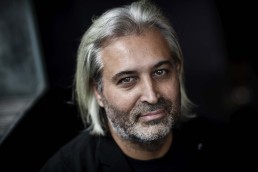
With an eclectic portfolio of stunning projects around the world, from Guinness World Record-breaking installations to Olympic opening ceremonies, Koert Vermeulen has established himself as a great lighting designer. As his company, ACTLD, celebrates its 30th anniversary this year, arc editor Matt Waring talks with Vermeulen about his origin story and his lighting vision.
In Rotterdam, Netherlands, in October 2019, at the final PLDC event’s closing Gala Dinner and Awards Ceremony, proceedings opened with an immersive, dazzling light show. So impressive was this audiovisual performance that the moment it finished, the event organisers called to run it back, much to the delight of the guests in attendance.
This was my first experience of the work of Belgian lighting maestro Koert Vermeulen, and his studio, ACTLD (formerly ACT Lighting Design, now ACT Live Design). As Vermeulen celebrates the 30th anniversary of the studio this year, on reflection, this short, three-minute performance was just the tip of the iceberg when it comes to the incredible, richly diverse works of experiential, entertainment, and architectural lighting design that the studio has made its name crafting.
Over the years, Vermeulen has created projects of all scopes and sizes around the world, from Olympic Games opening ceremonies, to Guinness World Record-breaking art installations, and vast pavilions at World Expos.
With roots in both entertainment and architectural lighting, Vermeulen and ACTLD have built a broad portfolio of projects where, working with forward-thinking clients, they have used technology, multimedia, and narration to design, develop, and deliver dynamic experiences worldwide. As a studio, ACTLD mixes what it calls “Entertecture” and “Architainment” into “Experience Design”.
Speaking to arc magazine as he begins celebrations for ACTLD’s 30th birthday, Vermeulen takes us back to his first fascinations with light, dating back to his childhood in Antwerp, Belgium.
“When I was 11, 12-years-old, two of my older neighbours across the street from me – who were 15 at the time, had what they called a disco bar, with a DJ set up, two turntables, mixing desks, loudspeakers, etc, and they used to play shows for student houses, the Scouts, things like that. They did it to hang out with girls, so while they were doing that, they needed someone to put on the records. As I was younger, they brought me in to help – I had to stand on a beer crate to reach the desk at first, but they introduced me to this world.
“They had a couple of lights already, but over the years, as I started to get a bit of money, I bought some more lighting equipment, and a sound to light modulator, and would start putting on light shows while they were working on the music.
“But when I was 14, one of them got his girlfriend pregnant, the other one was doing bad at school, so they left all of the equipment with me. So, all of a sudden, I had all this sound equipment, my own lighting equipment, and that was the basis of my first, unofficial, business. It was more like a rental place than a design studio, but we did fashion shows, concerts, town fairs, whatever we could find.”
Not long after this though, while Vermeulen was still a teenager, he had an epiphany, which steered him from his DIY, grassroots approach into something more tangibly connected to lighting design.
“We were doing a very small setup for a concert of promo tours in Antwerp, and an English band came in, their tour manager saw my equipment and said ‘what is this? It is like amateur hour’.
“He took all of my disco equipment, put it on stage, and made what I would call a lighting design with the equipment that I was used to seeing just flicker. I was so interested in that part that from then on, putting on records was less and less my thing, and I was doing more of the lighting.”
And so, after Vermeulen finished high school, as well as running his own company, he went to architectural school in Brussels, specifically because it offered a 40-hour lighting course – the only lighting course that he could find at the time.
However, the tenacity and drive of young entrepreneurship meant that, in 1989, Vermeulen cut his studies short and focused full time on his now official company, dubbed Antwerp Stage Productions.
Now under the more official guise of ASP, Vermeulen and his team picked up where they left off, albeit at a much bigger level, working on fashion shows for the higher profile houses, and helping out on larger concerts as they came through town.
“They would need stagehands, roadies, and technicians, and we were able to provide that,” he says.
“I would always try to make friends with the lighting people so that they would give me the good jobs. I was working on one of the Pink Floyd shows, and they saw that I was intelligent and knew what I was doing, so they kept me around, and asked if I wanted to see the concert with them at the front of house, where I could see how they did the show.”
It was through jobs like this, attending various trade shows, and building a library of books and magazines on architecture, light, art, and entertainment (a library that now reaches around 2,300 books) that Vermeulen began to fully understand lighting design in a more formal sense, having previously been self-taught, save for his brief stint at university.
However, after five successful years with ASP, where Vermeulen and his team rented out stagehands and technicians for the likes of Michael Jackson, U2, Genesis, and Tina Turner, he wanted to focus more fully on lighting design as a profession; as such, at the end of 1994, he left ASP, and established Art-Concept-Technology – ACT.
The early incantation of the studio saw Vermeulen continue to work on larger and larger fashion shows, but his big break, he recalls, came on a project called Tour de Cites – a tour of various historical sites across Belgium, where he had to devise a lighting scheme for each location virtually on the spot, as the truck of equipment was being unloaded.
“It could have been anything from a mountain to a fort, to a cathedral, and over two summers we did 50 sites. That was a learning curve where I had to, very quickly, decide what would work from a limited amount of equipment. I would direct where to place fixtures as they were coming out of the truck, and we would have an evening to programme it and create the mood.
“People saw what we were doing and what we were illuminating, and we were asked if we could do something permanent – this is how we got into architectural lighting. Entertainment lighting was always the basis for us, and architectural lighting came after that.”
As Vermeulen looked to move more into the architectural lighting sector, he called on compatriot and fellow lighting designer Bruno Demeester to join him at ACTLD, after the two connected as the only Belgian members of the IALD at the time. Working together, the two were able to fuse Vermeulen’s artistic prowess with Demeester’s technical nous.
“In the beginning, Bruno would take care of the architectural projects, and I was just there for the big ideas. We were asked to come to a site, and within 10 minutes, my design was ready, and I started to explain it to the client, because my background was to always be very quick, you didn’t have time to do designs and think about the process, so I was always very immediate in getting a visual idea in what I wanted. But Bruno was really great at the technical side that I was slightly less interested in.
“Of course, over the years, I learned. Then we got a very big client who was doing shopping centres, and they were interested in made to measure stuff, video, LED tiles, so that was a nice combination of the artistic and technical aspects.”
Vermeulen’s vision, and ability to almost immediately craft a lighting concept in his mind is something that he feels is his “USP”, but he says that he has, over time, learned to slow this process down, and allow his team instead to speak first and come up with their own ideas.
“Some of my clients really love that I can look at something, and in a meeting, I can come up with ideas, which sometimes stick and become the solution, sometimes they don’t. But I think they like the fact that you show you’re interested, that you’re enthusiastic, and that even without a contract, you are willing to share your ideas.
“What I did learn over the years is to keep my mouth shut. When we brainstorm for a project, I learned that the moment I started to explain my ideas, most of the team would nod and say ‘yes, let’s do that’.
“Instead, I told them that I’ve got my ideas, but I’m going to them first, I’ll give them some time, and then we’ll reconvene and discuss.”
As the company continued to grow, Vermeulen explains that around half of the designers on staff were focused on the architectural side, with the other half looking more at entertainment and experiential lighting projects. Although, he says that there have been occasions where the lines became more blurred.
“I was always able to jump in when the projects needed the pazazz and the colour, or the new data,” he says.
“If you look at most of our architectural lighting, there is a trace of entertainment in there. But it has evolved – in the beginning, before video really came in, a lot of people in retail and leisure wanted coloured lighting, so we did a lot of that. As we’ve progressed, the lighting is a bit whiter than we were doing 20 years ago, but it is still dynamic, so it has that entertainment feel to it.
“I don’t think we have ever done a shopping centre without DMX – perhaps that is the cutoff. DALI is much more suited to the architectural field, so maybe our entertainment influence is bringing DMX into the architectural lighting control world.”
However, whatever field Vermeulen and ACTLD is working across, from architectural, to entertainment, experiential and art installations, the notion of storytelling always remains. This, as he explained during his presentation at Light + Intelligent Building Middle East in Dubai this January, can vary from explicit storytelling to more implicit and experiential forms.
“I read a book once that talked about the comprehension of storytelling, and not just in the traditional sense that you would find in a book or a film, and so I brought that into the methodology of our working process here,” he explains. “In most architectural projects or art installations, the story is mostly an existential, experiential kind of story. Sometimes it can be a little bit explicit, for instance, we did a big project for the Zenit Arena in St Petersburg, Russia, where we used storytelling to portray the experience of a father and son going to a football match.
“But when you are an implicit storyteller, what I love about doing technical shows that run three, four times a night, it is a 10-15 minute show on a cathedral with video mapping, etc, and there are no actors. There are no people there for you to have a human connection with, but through implicit storytelling, I see people after the show, and they have inserted their own protagonist into the world you have created. It’s so open to interpretation. Everybody sees something different, and that’s cool. You make that emotional connection with people in that way. If you can bring that, and keep that in your design phases, then I think you will have a successful project.”
Vermeulen is no stranger to successful projects, having curated a vast and diverse portfolio of amazing works across a variety of sectors. Although a few landmark projects are displayed on posters in his studio – OVO, one of his first art installations that has gone on to tour the world, the Tree of Life from Expo 2015, and Light Moves, a one-night-only show created to celebrate his own 50th birthday – he says that to pick a favourite is akin to asking a father to name his favourite child.
“It’s not that you don’t have favourites, but they change over time,” he says. “Almost every five years, I have a change, a big event that changes my perception, or the direction that we are going. But I would definitely say that the Singapore Youth Olympics in 2010, even more so than the Beijing Winter Olympics in 2022, would be a highlight, because it was our first one.
“The Expo 2015 installation was probably my favourite project until 2022; OVO was our very first art installation, which I put together with Star in Motion [the Guinness World Record installation created for Noor Riyadh 2021 and displayed on the city’s Kingdom Tower].
“I would also add Puy du Fou, because it is my favourite client from over the years. We did 10 or 11 shows with Puy du Fou, and all of them are amazing.”
Regardless of which project is a favourite, Vermeulen hopes that in each work, be it a performance, installation, or work of architectural lighting, the lighting can create an emotional response in the viewer.
“It is the best high that you can have,” he says. “I have never taken heroin, but I imagine that it is better than heroin. When you do a light and sound show, and you see people come to watch it, and at the end, they applaud as if you are on stage, that’s a rush.
“Every time we did a Puy du Fou show, I saw 14,000 people stand up and give almost 10 minutes of applause. I know that there are 1,500 people on stage, but it gives me a rush to know that without the lighting, nobody would see them, they would be in the dark.
“I know that there can be a huge emotional response to lighting. I learned very early on, when I was light jockeying in one of the best clubs in Antwerp, I said to the DJ ‘put on the best three songs of the week, and I will work against you, and do bad lighting’. He played the songs, and some people went to the dancefloor, but I said to him half an hour later ‘do the same thing, and I will work with you’ and it really ramped up. So, in that club, in the late 80s, I learned of the power of lighting.
“One of the most important graphical lighting designers of his time, Richard Pilbrow, said to me at a conference, that it is not where you put the light, it is where you don’t put the light. It’s as important. It’s also direction, it’s mood, that’s the emotion that you can bring.
“So, I think that is one of the things that I always try to convey or to obtain, is that people have that emotion when you bring something in front of their eyes.”
Over the course of our conversation, Vermeulen mentions several names that have inspired him in the past – artists and visionaries such as Patrick Woodroffe and Mark Fisher (“he’s the GOAT”). And while there are some artists out there that he would love to collaborate with, he feels he is in a fortunate enough position to be more selective with his clients these days.
“Mark Fisher had the vision, and he was really innovative, which I see now in Es Devlin. She has that same drive for innovation that Mark had. If she were to call me, she wouldn’t have to ask twice. But unless it is Bono, U2, Genesis, etc, I don’t have a wishlist of people I absolutely want to work for. For the most part, I like to work for people who I admire but who are also generally nice and respectful and can work with a team.
“I have had my share of toxic people that I have had to work with. I also now have the luxury of saying no to people that I don’t like – it’s not nice when you’re in a toxic atmosphere, where you feel that you are not adding value, or there’s no synergy.”
When it comes to dream projects though, Vermeulen says that, while ACTLD never had an explicit “mission statement”, he does have a bucket list of projects he hopes to complete – a list that is nearly fully checked off.
“Six or seven years ago, we tried to write a mission statement, but we had real difficulty with it. Essentially, when I started out, I thought that I had a cool logo and a nice name, and that was more than good enough. We never thought about anything else. I think those kinds of phrases didn’t even exist when I started out.
“However, at some point, I made up my mind that, in my life, I wanted to do a big show in Vegas, I wanted to do an Olympic Ceremony, a show on Broadway or the West End, and a big, global tour. Those were the four goals that I had. My mission statement, if you could call it that, was therefore all about the projects.”
As he looks back on his portfolio of projects, Vermeulen tells me that this wish list is nearly complete. “Alongside the two Olympic ceremonies, we did the Vegas show with Le Rêve – I think I was the youngest ever lighting designer doing a $100 million show in Vegas at that time.
“I also worked on a Broadway show in New York, but unfortunately, during that process, the composer died, and the show never saw the light of day. So, the only thing that is still on my list is the big, international touring concert.
“However, we are currently working on some very interesting stuff that we think will create a new paradigm shift for the concert world and live entertainment. It’s a show that will hopefully be at three festivals next year, so if that comes off then I can finally do the fourth element of what I dreamed of 30 years ago.”
As Vermeulen looks to the future, he is also keen to embrace emerging technology to further enhance his design work. While he feels that the likes of drones are “passé”, he is intrigued by the ongoing advancements in AI.
“I think that AI will be a very important tool that will be used. I already use AI in a lot of our processes here, and while I don’t feel that within my generation I will be replaced by AI, I do think that some of our juniors – or at least what they do in the process – will be replaced by AI. But I think that this is a good thing, as those juniors will be free to do more important stuff, more creative work. I am a big believer that curation is becoming the most important part of the creative process.
“When it comes to what we can do, our mind is so limited; if we are creating scenes, we can create maybe three options, and then effectively our mind is blocked by the things that we have already created. But through AI, we can easily create 10 scenes – they may not make a lot of sense, but it can continue to make permutations in which our mind is blocked.
“Our role will therefore develop so that we can curate what AI gives us, and find the solution that works the best, so curation will be a continuing factor of our creative process.”
As for upcoming projects, aside from the touring festival show, Vermeulen is sworn to secrecy on a number of works that will, on completion, be very high profile. Central to ACTLD’s work going forward, will be research and development, through the studio’s in-house Innovation Lab. Here, Vermeulen and his team will look to spearhead research in three key areas – storytelling, design processes, and systems design – with the goal of continuing to further enrich the experiences that it delivers.
In the meantime, Vermeulen is currently mulling over how best to celebrate ACTLD’s 30th birthday.
“I don’t yet know what we will do with it,” he says. “We had a big celebration for the 20th anniversary – the Museum of Contemporary Arts in Brussels gave us a whole floor, and we held a kind of expo, with media displays, Puy du Fou gave us costumes, and we had about 400 visitors from around the world for a party.
“For the 25th, I made three art installations; ACT originally stood for Art, Concept, Technology, so we did an installation on Art, one on Concept, and one on Technology. We also had a big party with around 380 people there.
“So, for the 30th, the only thing I said was that I wanted to push it to the summer, as the previous events were in January. So, this summer I am going to do something. I don’t know what yet, but it is coming.”
If Vermeulen’s staggering portfolio is anything to go by, whatever does come, it will be something special. Watch this space.

Innovators in Healthcare: the business case for circadian lighting
This April, Dr Shelley James is hosting an online event examining the practical applications and cost-effective benefits of implementing circadian lighting in the healthcare sector. Here, she tells us what viewers can expect from the programme.
The residential healthcare sector is under immense pressure. With an ageing population, rising demand for services, and increasingly complex care needs, care homes and healthcare facilities must find ways to improve patient outcomes while working within tight operational budgets.
Many of these buildings are decades old, with outdated lighting systems that were never designed with health and wellbeing in mind. Upgrading to circadian-informed lighting inevitably demands time and attention from a hard-pressed senior management team, an investment that can seem like a distraction in the face of urgent operational demands. For lighting professionals, while ‘human-centric lighting’ has featured in marketing pitches for a decade and most are convinced of the value, few can claim to have successfully delivered a project in the real world, usually citing ‘value engineering’ as the barrier to adoption.
Yet the evidence is clear – lighting that actively supports a healthy body clock can speed recovery from stroke, improve sleep and reduce agitation, and cut down nighttime wandering and falls, all contributing to a healthy balance sheet – and a safer, calmer working environment for staff, especially those working night shifts. This in turn improves retention and reduces sick leave. Combining the physiological effects of circadian-aware lighting with ‘smart’ technologies that track movement, analyse behaviour, and offer clinical insights delivers additional benefits to the bottom line.
But for many healthcare providers, scientific research on circadian lighting can feel distant from the day-to-day realities of running a care home. For lighting professionals, healthcare is often seen as a frustrating sector focused on cost not value.
The online event Innovators in Healthcare, held on 17 April, hosted by Dr Shelley James with John Bullock will bring together scientists and frontline care providers to demonstrate that circadian-aware lighting is not a luxury. It is a practical, cost-effective solution to the pressures faced by the residential healthcare sector, and, critically, when driven by a desire to deliver outstanding care can yield measurable returns on that investment.
Here are some of the topics we’ll cover:
The Impact of Circadian Lighting on Stroke Recovery and Residential Care
Dr. Anders West, a leading neurologist, will present groundbreaking findings on the relationship between stroke, the body’s internal clock, and lighting. Stroke is a leading cause of disability, with survivors facing a heightened risk of cognitive decline. Dr. West’s research is the first randomised clinical trial to demonstrate that circadian lighting can effectively combat depression following a stroke. His work also highlights improvements in sleep, fatigue, and even physiological markers such as bone plasma and temperature regulation.
While his research has focused on stroke recovery, its implications for residential care are profound. Many stroke survivors require long-term support in care homes, where disrupted sleep and fatigue can severely impact their quality of life. Working with ChromaViso, Dr. West has applied his findings in residential settings, showing that targeted lighting interventions can reduce agitation-related behaviours by 71.2%, with some symptoms disappearing entirely.
Lighting, Shift Work, and Staff Retention in Healthcare Settings
Disrupted sleep cycles don’t just affect residents – they are a major issue for the staff who care for them. Many healthcare professionals work night shifts that disrupt their circadian rhythms, leading to chronic fatigue, errors, accidents, and long-term health risks such as cardiovascular disease and diabetes. Poor sleep is also a key factor in staff burnout, contributing to the sector’s ongoing crisis of high turnover rates and staff shortages.
Professor Shadab Rahman is at the forefront of research into how lighting can mitigate these risks. He will share several new studies, including results that suggest the potential for circadian lighting to target the specific issues faced by female shift workers through their hormone cycle.
Revolutionising Dementia Care Through Smart Lighting
Lucy Jobbins, a PhD researcher at Oxford’s Sleep and Circadian Neuroscience Institute, is investigating how light exposure impacts sleep and cognitive health in dementia patients. She will share her research with WCS Care, led by Ed Russell, that includes work to characterise lighting conditions in different rooms and parts of the care home to identify the zones where these investments will deliver the greatest benefits.
Ed Russell, awarded an OBE for his contributions to elder care, will complement Lucy’s presentation to share the real-world challenges of retrofitting a circadian lighting system. WCS Care was an early adopter, installing their first system over eight years ago in a new build. His team saw such dramatic improvements that they decided to invest in a retrofit installation in a 1970s building. However, the original supplier had gone out of business, leading to an ongoing collaboration with John Bullock and Commercial Lighting.
The Future of Smart Lighting in Care Homes
David Poxton is the third generation of his family involved with Ashmere Care Homes. He is passionate about striving for excellence and looking to the future – and is proof that this investment makes sound business sense: Ashmere enjoys record-breaking occupancy rates at premium prices, five-star reviews and wins prizes as an outstanding employer. David has been working with local manufacturer Circadacare to design and install a circadian lighting system in a new building, his only regret being that he didn’t extend the investment to the training areas.
To quote David: “It’s like electric windows in a car. Manual windows work, but once you’ve had the best, you never want to go back.”
AI-Driven Lighting: Transforming Elder Care
At Hartland House in the Lake District, Leanne Scrogham was initially skeptical when offered the chance to trial AI-powered smart lighting. However, the results were remarkable – falls among residents dropped by 86%, confusion at night decreased, and staff response times improved dramatically.
The Nobi Smart Lighting system automatically detects movement and adjusts illumination to prevent falls, alerting staff within minutes that a resident is awake. An integrated intercom system offers the care team the option to speak to the resident, offering reassurance in real-time. Beyond sleep and safety, the system has enabled staff to analyse the cause of falls, identifying underlying medical issues that may otherwise have gone undetected.
Join the Conversation
Please join us on 17 April for this unique opportunity to learn from these experts and add your voice to the conversation.
With thanks to our sponsors: Circadacare, ChromaViso, Commercial Lighting, and Nobi. Also, special thanks to our industry partners: [d]arc media, Designing Lighting, the LIA, the SLL and The Light Review.
David Morgan: LightGraphix LD234
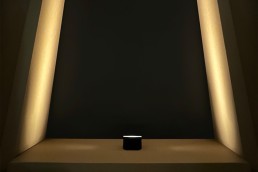
Following its launch at LiGHT 24 last November, David Morgan examines the IP65-rated LD234 window reveal luminaire from LightGraphix.
The motivation to start a lighting company can be many and various. In the case of Ian Boss, who started Tivoli Lighting in the late 1970s, we may never know his reasons; but fortunately the company survived, grew and in 1995 the company was purchased by Richard Hargreaves, who renamed it LightGraphix.
In 2016, the current management team of Robert Buxton and Simon Lyon purchased the company and have pursued a strategy of investment and growth for the company. From a staff of 24 in 2016, the company has grown and now has 96 employees based in Crayford, Kent.
From the early, Tivoli days, marine lighting was one of the key product collections, and this is still an important part of the LightGraphix range, including some luminaire types used for the challenging task of illuminating the exterior of yachts.
With an emphasis on high quality and high performance, the main market sectors for the company are architectural, marine, and display applications with a strong focus on exterior lighting. The company works closely with lighting designers as part of its new product development process for standard products, and has also created a dedicated custom luminaire department to deal with project specific requirements. With more than 30 overseas sales partners, more than 50% of LightGraphix products are exported.
LightGraphix products are manufactured using components produced and assembled in the UK, with 95% of product components sourced locally to the company. Most of the products are constructed using machined aluminium, brass and stainless steel components.
One of the newest products from LightGraphix is the IP65-rated LD234 window reveal luminaire, which was introduced at LiGHT 24 and has received a positive response from lighting designers.
It is understood that the decision to develop a new window-reveal luminaire arose from the company’s close relationship with lighting designers and sales partners around the world. The LightGraphix luminaire design process involves as much interaction with specifiers and sales partners as possible, who helped to identify the key differentiators for a new product in this crowded market sector.
The marketing feedback for this development was that this new luminaire series should complement the existing range of LightGraphix projectors, uplights and linear luminaires, and should provide a low-glare light output, good colour temperature consistency, and a range of beam angles.
Existing products were criticised for their lack of fixing options to cater for different site conditions, along with difficulties in focusing. The LD234 was designed in-house by the LightGraphix development team. The collaborative design process includes contributions from various members of the management and design teams, who work together to determine the best product solutions and configurations. For this product, where the optics play a key part in the product performance, a series of three custom polycarbonate lenses combined with a reflector system were developed and tested by the design team using the company’s in-house photometric testing equipment. The range includes extra-narrow, narrow, and medium beam distributions.
The sample that I was given to test gave an attractive lit effect with a clean distribution, which works well for the window reveal task. The lens is well recessed within the body so there is no visible glare from normal viewing angles.
The minimal design of the neatly machined aluminium LD234 housing includes a flat top, which is included as a useful design feature allowing the electrical contractors to aim all the luminaires on a project consistently using a low-cost digital inclinator. Cut away details on the sides of the body allow rainwater to flow away from the optics. LightGraphix offers a range of powder coat and wet spray finishes for the product, allowing it to integrate with a variety of architectural and landscape settings.
Despite the luminaire’s compact size – 105mm wide x 55mm high x 55mm wide – the lumen output is sufficient for the task in hand although, as is so often the case with very narrow beam optics, the system is not particularly efficient. The LD234 is designed to be run at a range of drive currents from 350mA up to 700mA. When run at 700mA, 9.2W, the high-power Nichia LED light engine delivers 140lm with an efficacy of 15lm per circuit Watt. Light engines are available from 2000K up to 5000K with a CRI of 85 and 2 SCDM colour binning.
One of the most interesting features of the LD234 is the range of mounting options, which satisfy the initial marketing feedback. In its basic form, the luminaire incorporates a tilt adjustment mechanism up to 16°. Four set screws can be individually adjusted to aim and / or level the luminaire on uneven surfaces.
Three add-on adjustable mounting brackets types are also available so that the luminaire can be fixed directly to the window sill, the window frame or into a corner of a window reveal.
The LD234 is compatible with the LightGraphix Repair & Refurbish scheme, whereby luminaires can be returned for repair once their light engines have reached the end of life.
The LD234 is a nicely detailed luminaire with useful mounting accessories, which will overcome many of the installation and aiming issues that are often found with this type of product.

40 Under 40 Awards celebrates 10th Anniversary
(Worldwide) - The 40 Under 40 Awards, an international programme recognising young talent in lighting design, is set to return for its 10th edition in 2025. The nomination window opens in May, inviting industry professionals to put forward outstanding individuals under 40 who have made significant contributions to architectural lighting.
Originally launched in 2016 as part of the now-discontinued Lighting Design Awards, the 40 Under 40 initiative has grown into a globally recognised competition. Since its inception, 320 winners have been honoured for their creativity, technical expertise, and influence in the field. After being briefly discontinued in 2021, the awards were revived by Filix Lighting, a former sponsor committed to keeping the tradition alive. Light Collective has since helped manage the competition, and this year, Selux joins as a new sponsor, further strengthening the program’s reach.
The awards attract hundreds of nominations annually, with an average of 300 entries received each year. While the UK and the U.S. have traditionally had the highest number of submissions, the competition continues to expand globally, reflecting the growing impact of lighting design worldwide.
Submissions are reviewed by an international panel of judges, including experts from Germany, Australia, the U.S., the UK, Spain, and the UAE. The selection process is highly competitive, with judges often noting the difficulty in narrowing down the field to just 40 winners. Organisers encourage past nominees to reapply if they were not selected in previous years.
The 40 Under 40 Judges 2025 will be Carla Wilkins, Lichtvision; Giuseppe Simone, Antumbra Lighting Design; Paola Pietrantoni, Studio Atomic; Jeff Shaw, Arup; Noemi Barbero, VBNB Lighting; Waleed Fakousa, CD+M Lighting Design Group
Nominees must be under 40 and demonstrate passion, talent, and a strong track record in lighting design. Nominations must include reasons why a candidate is exceptional before the nominee is invited to apply. Final selections are made based on talent, innovation, and contributions to the industry.
Winners of the 2025 edition will be announced in winter 2025, and a special celebration marking the 10-year anniversary of the awards is planned for March 2026 at Light + Building in Frankfurt.
The 40 Under 40 website provides further details on past winners, competition rules, and how to apply. Nominations open in May and close in September, giving candidates several months to complete their submissions.
For more information, visit www.40under40.events.
Amerlux - Hornet
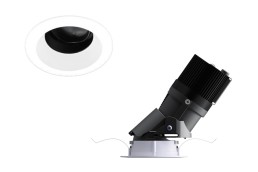
A 2.5” downlight that combines innovation with elegance. Enjoy precision adjustable lighting with a 40° tilt and minimal beam cutoff, Wall washers for smooth coverage without back flash and downlights for quiet ceilings. Perfect for offices, galleries, and upscale retail settings, it delivers up to 2,000 lumens at 90 CRI and 100 LPW, ensuring exceptional output and efficiency.

101 Goswell Road London, UK
When Zaha Hadid Architects sought to renovate its Clerkenwell headquarters, it called on Erco to install a flexible lighting system that would befit the site’s transformation.
Known for radical designs like the MAXXI art museum in Rome and the London Aquatics Centre, Zaha Hadid Architects (ZHA) faced a different type of challenge in overhauling its London headquarters. Instead of a new building, the architecture practice has renovated 101 Goswell Road, a former garment factory. A custom-designed lighting system from Erco played a crucial role in this transformation, allowing the historic building to become a flexible environment for multi-faceted and collaborative forms of work.
ZHA has occupied the seven-storey former factory since 2012, but the team was previously divided between this property and a converted schoolhouse on nearby Bowling Green Lane. A shift in thinking came as a result of the Covid-19 pandemic, when employees were primarily working from home. The ZHA directors saw an opportunity to consolidate to a single location and rethink how the office should function. Rather than trying to pack in as many desks as possible, the idea was to support different types of work style, offering staff greater choice and flexibility in how they work.
“We needed to give them a reason to make the journey into the office,” explains Director Chris Lepine. “We came to the conclusion that space for meetings and collaboration was key.”
With larger floorplates and a more visible street presence than the old schoolhouse, the Goswell Road building was considered the most future-proof option, but it also presented challenges. The building had very low ceilings and a stair and lift core located close to the end wall, so natural light was unable to reach much of the interior.
“We had one very long wall with no daylight coming through,” recalls Lepine. “We realised that, if we were going to do this refurbishment right, we would have to create lighting that did the space justice.”
Enhancing the feeling of spaciousness was the starting point for the human-centric lighting system developed with Erco. Opton wall-washers improve the overall perception of brightness, while Jilly downlights for track create the impression that ceilings are higher than they actually are. Illumination is delivered discreetly to where it is needed, rather than across the entire space, with light fittings that are largely hidden from view. This improves visual comfort without creating obvious patches of light and shadow. “Sometimes I don’t realise the lights are on until I’m right under them and look up,” adds Lepine.
With spotlights that can be easily repositioned in the track without tools, a key advantage of the Jilly system is its flexibility. This was a key goal in the reconfiguration of 101 Goswell Road, which was developed with ZHA’s Analytics + Insights unit (ZHAI), a research group that uses digital data and artificial intelligence to intelligently predict the future of workspace design.
“In the past, there was a one-size-fits-all approach in office design, but that has completely gone out of the window,” says Ulrich Blum, Co-Lead of ZHAI. “Workspaces need to be adaptable to, even on short notice, cater for differences in how teams work together.”
This led to a design that provides fewer desks but offers a wider variety of spaces where people can come together. One example of this is the fourth floor, which has been converted into a social space that can facilitate casual meetings and chance encounters.
Circulation spaces are located towards the centre of the floor plan, anchored by a multi-faceted cork wall that extends through the full height of the building. Track mounted Opton and recessed Starpoint luminaires in 3000k give a warmer colour temperature here, emphasising this as the building’s ‘heart’, in contrast with the cooler tones of lighting within the workspaces. Opton spotlights meanwhile offer dramatic, directional illumination to architectural models and drawings that are dotted throughout the building, as a testament to the impressive scope of architectural projects that ZHA produces.
Casambi Bluetooth wireless control allows lights to be easily switched or dimmed, either individually or in groups, which comes in useful when ZHA wants to change up its displays. But it also makes it easy to create spatial variety, so staff can find a place to work that suits them best.
“When people work from home, they are able to personalise everything,” says Blum. “This autonomy is something they really cherish, so we needed to give them the ability to influence their environment.”
The system is also responsive to fluctuations in occupancy, turning off lights automatically in spaces that are not in use, which improves energy efficiency.
The ground and basement floors combine exhibition galleries with facilities for design research and digital fabrication, allowing ZHA to create varied showcases of architecture innovation. These floors also facilitate other public-facing activities, from intimate dinners and drinks events, to workshops and panel talks. Erco’s Parscan 48V spotlights allow ZHA to highlight different zones, depending on the use.
“We can orient the room in different ways,” says Melodie Leung, Associate Director at ZHA. “Sometimes we want it to be very broad and unified as a space, other times we want it to be more dramatic.”
Leung believes these shopfront-style spaces play a crucial role in helping people understand the process behind ZHA’s architecture. One recent exhibition incorporated dynamic lighting effects that gave a sense of animation to the objects and materials on display. “It’s really important for us to create an environment,” she adds, “so when people enter, they’re entering the world of Zaha Hadid Architects.”
Since moving back into 101 Goswell Road in late 2021, ZHA has been trialing different combinations of remote working with in-office collaboration. The response so far has been positive, with staff noticeably mingling and interacting even more, despite being in the office less. The result is a dynamic environment that feels befitting of an architectural practice with its focus firmly on the future.
Zaha Hadid Architects and Erco are reuniting for this year’s Clerkenwell Design Week, celebrating their continued collaboration. Attendees are invited to join engaging talks and exclusive tours of the remarkable office and gallery project, a stunning example of innovative design and lighting expertise.
Trilux chosen for eco-friendly office campus
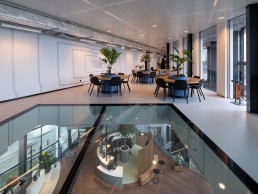
(Netherlands) - Trilux’s latest project at Tripolis Park in Amsterdam, showcases a pioneering office campus that blends heritage-listed buildings with a striking new 11-story structure. Created by Flow Development, the revitalisation focuses on user wellbeing, maximum sustainability and future-proof technology.
Tasked with delivering a smart, energy-efficient lighting solution across indoor and outdoor areas from a single source, Trilux has installed approximately 13,000 light points. Standard luminaires, including 39er G3, Onplana, Lenty and Sonnos, were customised to meet the project’s demands. A standout feature is the foyer’s So-Tube light sculpture, while outdoor spaces and cascading roof terraces are illuminated by ConStela, 8841 bollard luminaires and Skeo Q units. These luminaires seamlessly bridge the historic and modern elements of the campus.
3,000 lights incorporate advanced TRI-Sensors that provide motion detection, daylight control and environmental data via a wireless mesh network, optimising the indoor climate and energy performance through a future-ready Smart Grid.
"At the start of the project, the specification focussed on high-quality, glare-free light – without mentioning Human Centric Lighting (HCL), which dynamically changes the light colour to mimic daylight and is perceived as particularly pleasant," recalls project leader Willem Dammers, CEO of TRILUX Benelux.
A demonstration convinced Flow Development to include Tunable White luminaires with HCL throughout the campus. Employees can even adjust the light intensity or colour to suit their preferences via an app if desired.
Triplos Park has received numerous certifications and awards, supporting its position as a unique and pioneering office project. Its ratings in sustainability, design and user wellbeing include a BREEAM-NL "Outstanding" rating making it one of the most sustainable buildings in the Netherlands. The "Well Platinum" certification attests to the campus’ outstanding work environment, promoting mental, physical and social well-being for users.The site is home to major tenants such as Uber and an international law firm, whose employees benefit from the exceptional design. Visitors and residents alike enjoy the spectacular architecture and the publicly accessible park.
Creative Alternatives to Cat A
https://vimeo.com/1034342305
Speaker: Jonathan Rush, Hoare Lea in collaboration with Recolight
All too frequently, relatively new luminaires from Cat A fit outs can end up in the waste stream. However, recently the design community and developers are beginning to work together on creative alternatives. Here Jonathan Rush of the End Cat A Lighting pressure group looks at some success stories.
Lights in Alingsås announces its 2025 workshop heads
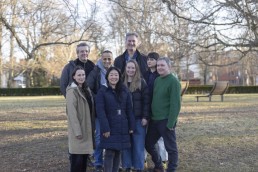
(Sweden) – The workshop heads for the 2025 edition of Lights in Alingsås have been announced.
The eight selected lighting professionals recently gathered for the three-day concept meeting for the 2025 edition. Two out of eight are experiencing Lights in Alingsås for the first time, three are returning for their second time, while three former students return as leaders.
This year’s workshop heads include Phillip Rose, Associate Partner at Speirs Majors Light Architecture; Amardeep Dugar, architect, lighting designer and researcher; Christina Mordeglia, architect and lighting designer at Beersnielsen; Sjoerd van Beers, Co-Founder of Beersnielsen; Meta Romanens, lighting specialist and teacher at Hochschule Luzern; Niken Wulandri Sutanto, freelance architect and lighting designer; Roberto Corradini, independent architect and lighting designer; and Isabel Villar, Senior Lighting Designer at White Arkitekter.
Over the weekend, the lighting designers learned about the organisation behind the event, explored this year’s theme, and selected their preferred lighting locations. They presented their ideas to the event board, which will be developed further during the workshop with participants and students.
A familiar lighting designer for Lights in Alingsås is Roberto Corradini, coming back for the third time. He looks forward to meeting the participants during the workshop this fall.
Philip Rose of Speirs Major Light Architecture, known for his prestigious projects, joins for his first Lights in Alingsås.
Niken Wulandari Sutanto and Meta Romanens first met in 2016 while studying at the same university (Wismar, Germany). They happened to choose the same site in the Lights in Alingsås workshop that year and worked closely together during that week. Since then, Niken and Meta have kept in touch sporadically.
They met for the first time since 2016 at Light + Building 2024, where the seed was planted for applying together as Workshop Heads. This is now their first project together.
Sutanto says: "It’s nice to be back again in Alingsås, working together. So far, we have agreed on many things, like site selection, concept, etc. We are very much alike,”
Frida Almqvist, Workshop Manager says: “Lights in Alingsås is an extraordinary platform for collaboration and creativity. It is an honour to bring together such a talented group of professionals who will inspire and guide this year’s participants.”
Dali Lighting Awards announces 2024/2025 winners
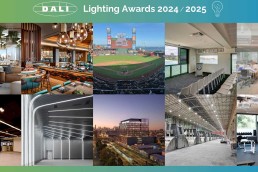
(Worldwide) – The 2024/2025 winners of the DALI Lighting Awards have been announced, recognising excellence in lighting control projects. Organised by the DALI Alliance, the awards highlight applications of lighting control protocols in real-life settings.
Winners:
- Residential – Philips Dynalite – Atlantis the Royal
- Commercial Interior – bluebottle – 480 Swan Street + Australia Post
- Commercial Exterior – Synapse Wireless – Oracle Park, San Francisco
- Industrial & Infrastructure – Beijing Hanmingde Technology Development Co., Ltd.
Innovation Awards:
- Best Use of D4i – Synapse Wireless – Oracle Park, San Francisco
- Best Emergency Lighting Integration – Crown Electrical – Coogee Surf Lifesaving Club
- Best Human Centric Design – KUMUX & Inventronics
- Best Integration into Other Building Systems – Signify – BorgWarner R&D Building
- Innovation in Lighting – Sunricher Co., Ltd. – Zhongguancun International Innovation Center
- Sustainability and Energy Efficiency – bluebottle – 480 Swan Street + Australia Post
- Smart and Connected Lighting – Beijing Hanmingde Technology Development Co., Ltd.
- Emerging Talent Award – Malkit Singh – Heap59
Highly Commended:
- Tridonic – Illuminating the Bibliotheca Alexandrina (Commercial Interior)
- Signify – BorgWarner R&D Building (Commercial Interior)
- Sunricher Co., Ltd. – Zhongguancun International Innovation Center (Best Human Centric Design)
- Lumen Resources – Willowdale Residential Aged Care (Best Integration into Other Building Systems)
- mwConnect – Exploring HVAC and Lighting Controls Integration (Best Integration into Other Building Systems)
- Nilsen Networks Pty Ltd – Health and Medical Research Building (Sustainability and Energy Efficiency)
A panel of expert judges, including lighting designers, media specialists, and global lighting leaders, selected the winners and highly commended entries.
Paul Drosihn, General Manager of the DALI Alliance, says: “Our congratulations go to all the winners and highly commended entries. The quality of submissions was incredibly high, and choosing the standouts was no easy task. These awards truly showcase how DALI technology continues to push the boundaries in lighting design and performance.”
For more information on the 2024/2025 DALI Lighting Awards, visit https://www.dali-alliance.org/awards2024/
