
The Broad, USA
Through a clever and regulated combination of artificial and natural light, darc awards / architectural winner Arup has developed an efficient lighting scheme that is both inviting for The Broad museum's visitors and sensitive to its artworks.
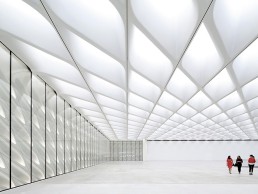
Often called ‘the veil and the vault’, Los Angeles’ The Broad museum merges public exhibition space and archive/storage that will support The Broad Art Foundation's lending activities. The building’s architecture, designed by Diller Scofidio + Renfro (DS+R) in collaboration with Gensler, is characterised by a finely honed geometry derived from the solar path in LA. The entire envelope, including the carefully calibrated veil and skylights, serve as a light filtration device, bringing controlled and diffused natural light into the galleries.
Rather than relegate the archive/storage to secondary status, ‘the vault’ plays a key role in shaping the museum experience from entry to exit. Hovering midway in the building, its heavy opaque mass is always in view. Due to this positioning, its carved underside shapes the lobby below and public circulation routes, while its top surface becomes the floor of the exhibition space. The vault is enveloped on all sides by the so-called ‘veil’ - an airy, cellular exoskeleton structure that spans the entire gallery, allowing filtered natural daylight to penetrate the building's interior space. Moving to the upper level, visitors are drawn upwards via escalator, tunnelling through the archive, arriving onto an acre of column-free exhibition space bathed in diffuse light. This 23ft high space is fully flexible to be shaped into galleries according to the needs of exhibits. Upon leaving the exhibition space, visitors take a return trip through the vault via a winding stair that offers glimpses into the vast holdings of the collection.
Tasked with the museum’s lighting design, Arup has recently been awarded the Best Interior Lighting Scheme at the darc awards / architectural for its work on The Broad museum.
Working with the architects and the Broad to create a sustainable public space, Arup used energy saving strategies including the configuration of the architectural ‘veil’ as an external shading device, harvesting daylight through the gallery spaces, and use of low energy LED light fixtures. The museum was recently awarded a LEED Gold certification, the first major art museum in Los Angeles, and one of only a handful of museums nationwide to achieve this world-recognised status.
Collaborating closely with the architects, Arup’s lighting experts devised a way to utilise daylight while ensuring the artwork was protected. The team’s approach has created an original skylight design that eliminates direct sunlight whilst controlling the amount of diffuse and reflected light that enters the space. Applying a passive daylighting approach means that daylight levels in the galleries will vary with the season, time of day and weather, altering the ambience of the interior on each occasion a visitor comes to the museum.
The top floor gallery is illuminated by expansive north-facing skylights and a fully-shaded glazed south wall. The 300+ skylights are configured to allow filtered daylight through while preventing direct sunlight, creating a uniform ambience across the space. The natural daylight passing through the north canted light slots of the veil’s roof section create a uniform but dynamic light right through the 23ft depth of the upper gallery.
An appreciable amount of daylight occurs outside museum open hours. Daylight in the gallery at these times could be considered unnecessary exposure of art to light. In addition, some exhibitions may require reduced light levels, either for conservation reasons (e.g. works on paper) or for display reasons (e.g. video works). Working closely with The Broad and DS+R, and drawing on previous museum experience, Arup introduced black-out blinds installed on the exterior of the skylights. These can move between full deployment during closed hours to a pre-set position during open hours, giving the museum maximum flexibility to exhibit any medium of art.
For the artificial lighting, Arup assisted with the development of custom track mounted LED wallwashers which are used to uniformly illuminate the 23ft gallery walls. Arup worked with manufacturer Litelab to ensure the lighting complied with California’s Title 24. Several fixture reviews were carried out to evaluate the performance of the custom luminaires in terms of light quality, distribution and levels of illumination. In addition, the ambient lighting that is provided to the ceiling coffers by the skylights during the day is supplemented at night by fluorescent light fixtures carefully positioned within the coffers.
Interior photocells measure the levels of daylight within the space, which trigger the track lights to brighten when daylight levels are insufficient. This means that when daylight levels drop, the artificial lighting slowly brightens so that the combined illuminance is equal to a value set by the museum for that space. An exterior photocell tracks the daylight levels on the roof, and energises the fluorescent lights after dusk.
With all the lighting elements carefully considered, a control system was put in place to ensure all the lights worked together creating a uniformly lit space at all times. With the photocells communicating with the track lighting and fluorescent lighting, an automatic system was installed. An astronomical 365-day timeclock allows the lighting to be automatically controlled, primarily used to turn the lighting off during the museum’s closed hours. This helps to preserve the artwork and reduce the museum’s energy emissions creating a sustainable gallery.
After completion and commissioning of the lighting systems, Arup gave the museum a ‘Lighting Handbook’. This guide sets out how the daylight system can be configured to work with any type of exhibition on a month by month basis. This ensures that museum staff and curators fully understand the lighting strategy and how to work with it so the lighting always complements the artwork.
“Arup has been an amazing partner in the building of The Broad,’’ commented Joanne Heyler, founding director of The Broad. ‘‘They understand the sensitivities of building a space for a collection of contemporary art and helped develop efficient and innovative solutions for the physical and aesthetic needs of the institution.”
A stunning and intelligent project, The Broad museum has received global recognition for its beautiful galleries and critical acclaim from architects and museum professionals for its sophisticated lighting solution.
Pic: Hufton + Crow

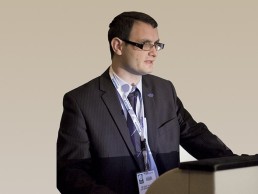
Geoff Archenhold: Will smart buildings be a security risk too far?
Another month and yet another security risk identified with smart lighting systems but what can architects, lighting designers and engineering firms really do to assure their clients their projects are secure and robust? Dr Geoff Archenhold investigates.
Modern smart buildings are embracing technology at a rapid pace and smart lighting is a vanguard for creating a new working environment that embraces the quality of personalised lighting. Indeed, the research firm Gartner predicts that more than 500 million connected devices will be installed in commercial buildings during 2016 to help improve energy efficiency by up to 20 - 50%.
The use of embedded ambient light and occupancy sensors will allow smart buildings to run with optimal conditions using building management systems (BMS) that can be connected to the corporate network and internet. Smart systems can now determine desk, office and building occupancy rates to adjust heating and lighting accordingly in unused areas. However, this increased connectivity also brings about vulnerability to cyber-attacks. With so many entry points to a BMS in a modern smart building, it becomes crucial to build cyber-security into the system architecture from an early stage, in order to reduce the risk of attack. Cyber security has become second nature to IT companies and the same needs to be true for lighting designers, architects and engineering consultants.
In July, security researchers discovered nine vulnerabilities in the Osram Lightify LED light bulbs that could allow attackers access to the local Wi-Fi network to either control the lights without authorisation or to control the network itself.
The vulnerabilities range from poor security management principles such as storing unencrypted Wi-Fi network passwords in the mobile app to more complex Zigbee protocol based issues. The researchers discovered that the lighting systems’ installed management console, which runs on Ethernet ports 80 and 443, was open to a continuous cross-site scripting (XSS) vulnerability that could facilitate the injection of malicious code into the management interface. Third party code could be executed as if it were a command from an authenticated user, which would allow the hacker to alter system configurations, access and modify data, and override the system to launch attacks against other systems.
Although Osram has stated it will attempt to patch the more obvious vulnerabilities with a software release, the real issue is how many of these systems will be updated and will they be secure, especially if the software isn’t pushed to all devices?
Osram isn’t alone as previous security flaws have also been found in LiFX and Philips Hue smart bulb systems.
Unfortunately, the vast majority within the lighting design and engineering consultancy community seem to be ignorant of the importance of system security. Last month I visited two well-known lighting design and engineering consultants in London to discuss security in lighting control systems with significantly different outcomes. The first organisation embraced new technologies and wanted to know more about how to secure control systems whilst the second organisation stated security wasn’t considered or wouldn’t be perceived by them to be an issue for their clients as they believed no one would ever want to hack a lighting control system.
As I tried (and failed) to explain to the latter organisation, security isn’t just about the possibility of the lighting being hacked and controlled, it is also about the corporate risk covering damage to their clients brand and reputation, data protection issues and business continuity.
There are three types of reasons to disrupt a BMS or smart lighting system:
1. The Thrill Seeker – This encompasses anyone who just wants to access a system to see what they can do.
2. The Goal Seeker – This type of disrupter seeks to accomplish a goal such as infiltrating a corporate network via the BMS, and to get past those controls to accomplish a larger goal or seek a more specific target.
3. The Prankster – They don’t want to access a system at all but want to stop the system from working by causing disruption. This could easily be achieved by blocking RF signals or a Dedicated Denial of Service attack.
The following precautions will ensure that basic cyber security in your BMS and lighting control system can be achieved:
• Invite critical personnel, including the CIO and necessary IT staff to talk about cybersecurity.
• Examine the information networks used by facilities staff. Predict and plan how to safeguard vital information and network access points.
• Include BMS cybersecurity in annual operational expenditure budget.
• Remember the value that staff has for security; encourage vigilance, send facility management staff for periodic education, and conduct security audits on control network use.
• Prepare for the possibility of cyber-attacks and train staff how to respond accurately and methodically.
• Encrypt network traffic and secure wireless network access.
• Choose your suppliers carefully, and be aware of exactly what BMS functions are accessible via online portals.
• Look for easy access points.
• Avoid wireless systems within the BMS.
• Include firewalls to protect the network where possible.
• Make a plan to ensure the operating system can be patched for security flaws and updated to latest supported versions.
• Create a straightforward method for adding, removing and suspending user accounts on the BMS system without the need for users to type in username and passwords.
• Ensure all networked devices are secured by minimizing IP and MAC addresses and changing default passwords.
• Attempt to isolate the BMS system from corporate networks.
Who is liable for cyber-security breaches?
• The lighting designer, architect or consultants – If the BMS or lighting control system is defined by the designers and they haven’t undertaken basic cyber security diligence should they be liable?
• The system manufacturer – If the BMS or control system has security vulnerabilities should the manufacturer be liable?
• The installer – If weaknesses, such as not changing default passwords for routers, are not closed down then should the installer be liable?
• The client – If the client doesn’t specify the need for cyber security within the project, should they be liable for any breaches?
In order to simplify your selection criteria for suppliers of smart lighting and BMS systems, I have compiled a list of questions you can ask to gain additional cyber security assurances:
1) What security principles does your BMS or lighting control system employ?
2) Do you employ encryption rather than usernames and passwords and if so what type and how many bits are used to encrypt the data?
3) How quickly can the system repudiate, generate and transfer encryption key-pairs between devices that are on both the open and secure parts of a control network?
4) How do we ensure the operating system and application software can be patched for security flaws and updated to the latest supported versions?
5) How quickly can one add, remove and suspending user accounts within the system?
6) Is the core system reliant on RF based technologies to operate and how does the system perform if RF jamming systems are deployed?
7) What support do you provide once the system has been commissioned?
8) If a system is compromised how does the system know and what contingency plans do you have to repair the system?
9) Does your system connect to the internet and is it physically separated from any corporate network and how can you prove this?
10) Has the system been tested by third party security experts or test laboratories?
Top 500 global companies are being compromised on a daily basis despite spending billions on cyber security activities, so the lighting sector will need to take the threats to smart lighting seriously.
Geoff Archenhold is an active investor in LED driver and fixture manufacturers and a lighting energy consultant. The views expressed in this article are those of the author and do not necessarily represent the views of mondo*arc.
g.archenhold@mondiale.co.uk
David Morgan Review: Simes Ghost
Following its success at the Red Dot and darc awards / architectural, David Morgan takes a look at Simes’ Marc Sadler-designed concrete-cast Ghost luminaire, and its technical inner workings.
Light has become remarkably ‘heavy’ in recent years with the growing use of cast concrete to manufacture luminaires of all types including some seemingly unlikely products such as pendants. The process of casting concrete dates from the Roman era and lamp posts have been made from concrete for many years. However, producing luminaires from this material has been a more recent development. While the mid-20th century brutalist style of architecture based on rough cast concrete with all the shuttering details left on show is still generally unloved, the use of smooth-cast concrete for architectural accessories seems to be on a strong growth path.
Simes Lighting has enthusiastically embraced the use of concrete in recent years and their latest concrete luminaire series – Ghost - designed by Marc Sadler recently won the exterior luminaire section of the darc awards in London after previously receiving a Red Dot award.
Simes is a family run company based in northern Italy with three production facilities covering the complete luminaire engineering, testing, manufacturing and assembly process. Established in 1973, the company is now run by Roberto Botti - son of the founder Egido Botti who had a background in the production of aluminium die castings. Roberto Botti has taken Simes towards a higher level of luminaire design and innovation, introducing a variety of independent designers to the company including Matteo Thun, Klaus Beggati and Marc Sadler.
An early adopter of LED technology, over 80% of the Simes range is now solid state with a clean contemporary aesthetic. Milan based veteran designer Marc Sadler has a long experience in the design of mainly decorative lighting products with a clientele including Flos, Foscarini, Barovier&Toso and Fabbian. The use of novel materials and processes has always formed a central part of his work.
The Simes product range is grouped by material type, termed Material Expressions, and includes separate sections for concrete, aluminium and wood - which is a novel and useful approach for the customer.
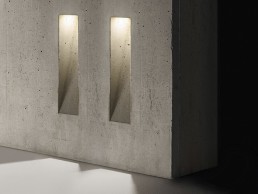
The first Simes concrete series of products was launched at Euroluce in 2014 and was based on design concepts from Roberto Botti. The Ghost collection was developed from this concept with the French born Sadler, who was selected to undertake the design as his first project for the company. The range was launched at Light + Building in March this year and has had a very positive reception. The range takes the ideas of design minimalism and hidden light sources to the logical conclusion, as the luminaire is completely concealed within the concrete housing that is poured on site. Simes describe the range as a lighting void.
One of the most ingenious features of luminaire design is the way it assists with the on-site casting of concrete around the structure. A two-part injection moulded polypropylene housing is fixed to the wooden shuttering with disposable thumb screws prior to pouring the concrete. A template is supplied to ensure the luminaires are correctly positioned and provides a drill guide for the fixing screws. Flexible electrical conduit is run to the housing and sealed with a generous sized compression gland. After the concrete is set, the shuttering is removed and the front moulding can be withdrawn leaving a neatly formed smooth concrete recess. Any trapped air bubbles or imperfections in the surface of the concrete are said to add to the personality of the lit effect.
The light engine is housed in a die cast aluminium heat sink, with the moulded polycarbonate window sealed with resin then installed into the housing, which is now fixed into the concrete.
The LED light engine is available in both dimmable and non-dimmable versions. The non-dimmable type runs direct from 230 VAC with an on-board ic based driver system. The dimmable version runs from a remote dimmable driver for easier servicing. Simes claims a light output of 305 lumens with 3,000K 80 CRI LEDs with an input power of 9W.
The Ghost series currently includes vertical and horizontal rectangular types as well as a square recess. It is understood that a smaller square version is now under development.
Ghost is a type of ‘negative product’ – the result of removing half the product to create a light emitting space. From a luminaire designer’s perspective I would always be concerned about leaving the quality of final finish to the company pouring the concrete but the advantages of completely hiding the luminaire are clearly attractive.
The design is well-considered and executed and the good reaction received so far by the architects and designers bodes well for future sales.
David Morgan runs David Morgan Associates, a London-based international design consultancy specialising in luminaire design and development and is also MD of Radiant Architectural Lighting.
Email: david@dmadesign.co.uk
Web: www.dmadesign.co.uk
Tel: +44 ( 0) 20 8340 4009
© David Morgan Associates 2016
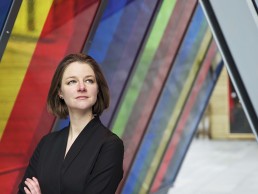
Liz West
To some, it would seem Liz West has experienced overnight success - with her kaleidoscopic installations exploding onto the lighting scene. However, chatting with Helen Fletcher over a green tea in leafy Didsbury, Manchester, mondo*arc learned her success isn’t a story of good fortune, more a story of steely determination.
Call her a visual artist, an installation artist, a light artist even… But whatever you do, don’t call Liz West a lighting designer! “I admire architects and lighting designers immensely but I studied art – it’s completely different. They have spent years studying something so specific and have to answer to strict technical briefs, whereas I can make pieces related to my passions and interests. I don’t have the same knowledge as lighting designers and would never claim to be one.”
Having grown up in the north of England - the old mining town of Barnsley to be exact - perhaps it was West’s gritty northern childhood surroundings that drew her to the vibrant neon colours used in her work today. Surrounded by art from a very early age – her mother an artist with a residency at the Whitworth gallery in Manchester and her father teaching art in Barnsley and with a background from the Royal Academy and the British School in Rome - there was no shortage of opportunities for West to be creative. Whether it was playing with PVA glue, dyes, glitter and acetate in her mother’s attic studio creating gels, or ‘helping’ her father in his studio shed where she would play with lumps of clay - art played an integral role in her upbringing.
“I would pour glue onto an acetate sheet and mix dyes, glitter and sequins then let it dry and peel it off… As you can see, I’ve not really progressed,” laughs West. “I used to love the tactility of picking the glue off and the relationship between how the colours changed when they were flat in pigment form to when they were put up against a window - they came to life when the light shone through! Of course I wasn’t thinking too intellectually about it at that time, but the connection with colour and light was there from an early age.”
Alongside her strong creative streak, West has always loved collecting, whether it was different coloured nail varnishes organised in the spectral order along her windowsill, or her now famous Spice Girls memorabilia collection, which is made up of 5,000 items and has been awarded Guinness World Record status!
“I used to have collections everywhere,” she says, “I loved arranging and rearranging them, it was my way of playing… I would arrange a collection then photograph it - this is still prevalent in me today and evident in my work.”
While for some during teenage years childhood loves are lost, West’s desire to be creative and her love of art grew stronger and stronger, realising which exhibitions she was interested in and who’s work inspired her.
“I first loved a piece by visual artist Jim Lambie at the Tate Britain,” she says. “His work was all about dance, trance, drugs and illusion… I remember stepping onto the floor and feeling sick (in a good way) - there was also one of David Batchelor’s light towers in the middle and I just thought, this is up my street! I loved the relationship between the vivid, chemical, city colours.”
Having studied A Level Art at college and then Foundation Art in Leeds before heading to Glasgow to continue her studies at degree level, when speaking with West you get the sense that a ‘career’ in art has never been something she chose to do, rather art chose her. “It just felt like a very natural progression,” she says. “It was the only subject – along with food technology – I was really any good at. I would skip PE lessons and hide out in the art rooms at school, I didn’t want to do anything else, art was just ‘in me’.
“I lost my way a bit at university though. I was in halls of residence with people I didn’t know, the work I was producing was shit, I didn’t know what I was interested in and I was being pushed and pulled in every direction by my tutors. All I wanted to do was tick boxes and please my tutors and I was really struggling.”
It wasn’t until her third year of university, following a meeting with her old foundation course tutor, that West regained her confidence and direction. She had begun to question what she liked about paint – it was its luminosity when wet - this for West was her ‘eureka moment’, she realised her interest lay more in illumination than it did pigment. This eureka moment later developed into a sensory immersive experience for her end of year show Yellow Chamber, or The Chamber series, as the work is now known. It explored the physicality and illusions of space. Using numerous mirrors and constructs of light, the work multiplies through reflection, giving the impression of an endless expanse.
“It was different to everything else I had produced. My tutor had suggested I make an aperture in a wall that people had to have a very intimate relationship with. I had this collection of yellow objects that I laid on the floor that were then seen infinitely because of a mirrored chamber I had made, in the ceiling there were yellow fluorescent bulbs that created bands of yellow light on the walls.”
Just as things were looking up for West, having made a degree show she was proud of and felt more like ‘her’, it was soon back to reality with a bump. With no money thanks to three years at university, it was back to the family home in Barnsley, where she wouldn’t make any art for the next three years. “I had this huge overdraft and ended up working in the world of events – stewarding at Sheffield Arena and festivals,” she says. “I became really submersed in this world – I loved performance and pop and had some amazing experiences during that time but wasn’t creating any art. I had this idea that I’d be able to sketch away while manning an exit gate but it just didn’t happen and I had some big decisions to make. I knew I was an artist at heart and so I left my job, my partner at the time, packed up and moved to Manchester.”
Once in Manchester, West applied for as many opportunities as she could, using her university work. “I started remaking my degree show and at first it was really small shows and spaces but I got some international exhibitions too. I looked for anywhere I could get my work out, constantly sitting making applications – there was a lot of admin! I just kept pushing it and as I did more I got asked to do more exciting opportunities… I was remaking the Chamber but in different colours, sizes and so on – I did this for about two years! The Chamber series has become such a big part of who I am.”
Having been awarded Arts Council England Funding, West then moved on to produce Vanishing Boundaries, which comprised an array of reflective discs protruding above floor level. The installation emitted intense bursts of light from underneath the discs; the concrete floor transformed into a field of colour, connected by the trailing electrical wires. The same year, she created Tempo, which made use of the fluorescent stick light but modified with a particular colour.
“The art world had started to pay me a bit more attention at this stage, but all of the work I was putting out there was sculptural and something still didn’t feel right,” says West. “I was really struggling with artist’s block and became quite clinically depressed. My mum suggested doing project work, so I would go to my studio every day and make something using the materials around me. I’d take a photo and then put it all back, then repeat the process as many times as I could.”
West was relying heavily on working tax credits at this stage, living on a profit of just £2-3,000 a year and was questioning whether she should continue or should start handing her CV out for a more ‘sensible’ job. “I would get paid a block of Arts Council money and slowly see it chip away,” she says. “This is when the panic would set in and it propelled me to look at the opportunities listings again – all the time applying for stuff.
“I then spent some time at Kurt Schwitter’s Merz Barn, this is where the shit really hit the fan and I began to question everything! I was supposed to be working on a project for a light festival but it just didn’t look right – it wasn’t working! It was my (now) husband that helped me realise what I wanted to do. He came to the Merz Barn and we looked at what had been successful about my best work so far and why. We figured out that the sculptural work just wasn’t working – it was the experience of colour, whether emotional or physical, that worked for me. A lot of contemporary art can make you think, but how much of it makes you feel? That was what I wanted to do.
“This was a big moment for me,” West continues. “It was one of the hardest moments in my life – there were tears, doubts about who I was as a person, I questioned whether I was even an artist. I came out of it thinking, well I can’t do anything else so I’ve got to make it work!”
The work that came next truly announced West; perhaps it came from a fear that she might not succeed, perhaps it came from a deep interrogation of herself, whatever the reason it would set the tone for the next two years.
“By this time I had become really interested in how colour changed people’s perceptions rather than it being about coloured objects as a sculpture or form,” she says. “Mark (my husband) was curating an exhibition at Federation House in Manchester. Castlefield Gallery had brokered the building from the Coop and there were eight floors for artists to create work that they couldn’t in their studios. The fourth floor was a 10,000sqft exhibition space and I felt I could really do something great with it. I approached Castlefield Gallery and they said I could have it for just one week.”
West’s first idea was to put LED tape down the columns in the room – she had just made Shifting Luminosity, a piece that used black pipes and LEDs propped against a wall. “I made that piece because I’d just moved studios and wanted to explore the space - find its restraints and attributes and make something really spatial. So I was just going to use them in this new space but realised I needed something that was going to have more of an impact.”
After rummaging in her studio West found a bin bag of Lee and Rosco filters left over from her Tempo installation. “I taped lengths of filters together to create an area big enough to fit over the square panel of the pre existing office lights in the exhibition space. It wasn’t refined enough for me though, it didn’t look professional enough. Mark suggested I take down one of the metal grates to reveal the four T8 lamps then cut strips of the filter and wrap the physical bulbs, to see what it looked like once I put the metal grate back up. So I did and it was better but there were four lights in each of the panels and there were 400 panels in the space… this meant covering 1,600 bulbs!”
West had just five days to install it and to cover all 1,600 bulbs in time was going to be a big task. “I started to panic. I had to really think about whether it was do-able but I could see it would work and it was worth a shot. So I got on with it…”
West’s first task was to organise the filters into colour order, then decide which to start with. “It was dusk by the time I’d started thinking about it – that beautiful time of day when it’s not quite light or dark yet – and I thought wouldn’t it be beautiful if the space went through the spectrum of red to blue which would then meet the windows and continue into the sky. By the Thursday evening I knew it was going to work… I knew I’d made a piece that felt right and felt like me as an artist. It was spatial, it was site responsive and it was about the architecture and people noticing elements they’d never seen before. It was about changing and challenging people’s perception.”
Your Colour Perception was open for two days. West admits the opening was mainly made up of mates and a few people from the arts crowd but by the Sunday the piece was all over social media with people sharing pictures of themselves in the space.
“I’d never experienced anything like that before, I was happy but absolutely knackered! Every muscle in my body was aching and I was there every moment of the exhibition, watching people’s reactions – researching for future works.
“Your Colour Perception represents a lot about pop – the colours, the look of it… people were running through the space, sitting and lying and absorbing the space – people were taking real ownership of it.”
From this moment, things really took off for West, she had made something she was truly proud of and set to work promoting it in any way she could, writing press releases, contacting different magazines and organisations and so on, which is where her relationship with the IALD begins. “I’ve definitely found a kindred spirit in Emma Cogswell from the UK division,” says West. “And working with the IALD is opening up opportunities for me. Being selected to go to the Enlighten conference in Mexico and talk about my perspective of colour, as an artist is nerve wracking but amazing. Hopefully it will open doors to work with architects and lighting designers on projects.”
And what of her relationship with light? “It’s about interrogating what each thing does,” she says. “How can I best control it through coloured filters, through apertures or through structures, how can I make it into something people are going to enjoy. It’s about the space and asking myself what it needs, what’s going to complement it, add to it.”
Since Your Colour Perception, West has had numerous works launch including An Additive Mix at the National Media Museum in Bradford; Through No.3 in Manchester; Our Colour Reflection at 20-21 Visual Arts Centre in Scunthorpe; and Our Spectral Vision at the National History Museum in London, to name just a few. While all individual pieces, responding to their surroundings, they have a unified voice. “I’ve still got this vivacious energy and I’m so appreciative of everything that has come my way. Every time I make a new piece of work I understand a bit more about myself and what I want. I’m serious about this; I’m not a one-hit-wonder or a joke. I never want to dictate through my work and I very much feel that while each piece is personal to me, I want people to have their own experiences – it’s about people questioning perception, their spatial awareness and their relationship with colour and light.
“It’s been a weird journey and I still feel very lucky. Why should people keep coming to my exhibitions? Because it’s coming from the heart, I want people to look closer at the beautiful world around them. I want to increase people’s awareness of where we are, it’s ever questioning.
“Light changes the way I see the world, it’s integral to my well being and I find it interesting to observe how it affects other people’s well being. But I also think the relationship between colour and light is really interesting and integral – you can’t have one without the other.”
Pic: MDP Photography
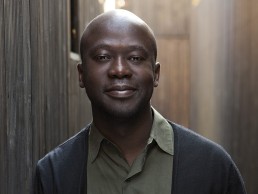
David Adjaye
Ghanaian British architect David Adjaye’s ability to communicate with people is second only to his appreciation for history. mondo*arc caught up with Adjaye to talk light, the hybridity of architectural types in the urban landscape and cultural significance.
In the summer of 2015, iGuzzini and MAXXI Architecture – Italy’s museum of contemporary art – embarked upon a new collaborative project entitled Light On. In a similar format to last year’s project, Light On 2016 has so far consisted of talks from four major international architectural firms, including discussions of their work and the topics, themes and contexts defining their professional careers. In doing so, each designer offered a contemporary point of view regarding the relationship between form, technology and light.
Taking place in July, the fourth 2016 Light On talk saw Ghanaian British architect David Adjaye OBE, founder and principal architect of Adjaye Associates, share his viewpoint on the identity of architecture in cities and the role light plays in forming said identity.
With offices in London, New York and Accra and having completed work in Europe, North America, the Middle East, Asia, and Africa, storytelling is a recurring theme for the architecture of Adjaye. Through six of his projects, different in purpose, scale and materials used, he graced the auditorium with tales of his process. Adjaye’s ability to communicate with people is second only to his meticulous attention to history and his ability to intertwine culture and structure. These, his very own tools of his trade, are apparent in all of his works, giving rise to an unmistakably ‘Adjaye’ style.
Take, for example, Shoreditch’s ‘dirty house’ - a project that got him a lot of attention in London. Previously an old piano factory in the ’50s, this industrial space wore the scars of its wartime existence in plain sight. This allowed the area, and buildings like this, to become popular in the late 20th century due to cheap price tags and attractive large spaces – two important prerequisites for the development of modern architecture. Now a studio home for two artists, this project saw Adjaye design with an alternative approach: “It was very much a hybrid, generic building,’’ he explains. “When we were given this building, the city said: ‘why don’t you tear this down’. However we were interested in not destroying this generic hybridity but instead celebrating it.’’
In a then controversial exploration, the team took interest in the fabric of the city and how they could layer and add to it. ‘‘We wanted to try something new, not just to create a studio with light but to make a space for experimentation for the two artists in relation to the civic world,’’ explains Adjaye. ‘‘Not just a place to make art but a scale to see how their art worked in institutional space.’’
During this exploration, and in order to achieve the desired result, light played a crucial role: “Light, for me, is a primary material,’’ explains Adjaye. “The way in which it augments and supports life is critical to the way I work. Ultimately, my architecture is really framing light all the time and addressing how it enhances the everyday experience.’’
In this instance, the top of the house has been lit by strip-lights, with most of its light being delivered by indirect floor lighting, illuminating its white surface to create a beacon at night. This beacon became very famous in the neighbourhood, as in the evening its roof would glow, paving a new way of looking at the city and its “apparently terrible architecture’’.
As much as Adjaye’s ‘Dirty House’ is unique, his skill in conducting light to elevate the emotional prowess of his architecture is ever-present throughout his portfolio. In conjunction with this, a man well-traveled, he has developed a global sensitivity towards light. “I’m a creature that first notices the light when I arrive in a new country,’’ he adds. “Whether it’s cool, warm, the intensity of it, the clarity of it; these are things that really fascinate me.’’
This sensitivity and appreciation for the inevitability of light is apparent in a number of Adjaye’s international projects. For example his ‘River Reading Room’, a public library found on the banks of South Korea’s River Gwangju, forms a gateway, a moment to reflect and look. Framed by four archways, notches cut into the pavilion’s timber structure house books, which catch light in its most organic state and create an atmospheric environment for visitors to the water’s edge.
Moving on to a project in New York’s Harlem - his first big project there - ‘Sugar Hill’, a housing start-up centre for homeless people, was started by a group who believe that housing is the best way to move people out of poverty. Within its multi-purpose interior, the museum section uses shafts to bring natural light down into its 40ft space. At the bottom, the light floods the floor to create a corridor that divides the main art space.
Once countryside, Harlem was first a ghetto and now a community for African American immigrants. This saw an incredible explosion in music and culture, which Adjaye encapsulated to make a building with a new type of skin, featuring Harlem’s most prevalent flower - the rose - embossed in concrete. “As it indents negatively, you don’t see it in the sun, you see it in oblique light,’’ he outlines.
The building is strong and quite brutal but when you come close, “the light starts to reveal something else,’’ explains Adjaye. “Depending on the angle, you get these flowers appearing and disappearing in a monolithic block. Children often say: ‘oh my god I can see something, or not!’ It becomes a way in which you see ornaments in a new way. A soft game.’’
Now to Beirut, one of the Mediterranean’s many beautiful peninsulas. Positioned in close proximity to Syria and next to a six-lane highway, the Aïshti Foundation project symbolises hope in a time of war-stricken instability. A retail environment but also an exhibition space for digital art, a wellness centre and a public plaza for the community, the building takes the form of a box wrapped in a skin. Taking inspiration from a traditional Middle-Eastern idea for creating shade, the skin creates shadow but is perforated to allow natural light through. In this, the façade becomes a way of talking about light and shadow, permanence or not. “We have used reflection, natural light and artificial light to create a kaleidoscope, which brings you from other spaces into the retail area,’’ explains Adjaye. “From the top, you start to see the light emerge and you come out of it. You realise from looking at the top that it is really a mixing of natural and artificial light that creates the reflections.’’
More recently came the grand opening of perhaps Adjaye’s most famous project to date - Washington DC’s Smithsonian National Museum of African American History and Culture (NMAAHC). At the end of September, Obama, Clinton and the Bushs officially opened the building - the last to be built on the Washington mall, which was designed 200 years ago.
Eight years in the making, Adjaye’s museum is dedicated to the African American community and its contribution to the identity of America. “It isn’t a museum full of beautiful objects, but about stories and how people contribute to nations and how nations are made stronger through the diversity of their groups,’’ he summarises.
Beginning with the Nigerian Yoruba tribe’s motifs and crowns, which became systems to hold up buildings, Adjaye’s contemporary design is a layered structure that tells tales of the past. Forming a monumental cross with other great buildings of Washington, the structure creates a three-layered filtering system through positioning of a glass building inside a skin, with an opaque building inside that.
Further enforcing consistency of theme, the skin is a triple tiered reference to the Yoruba crown made from Charleston cast iron and created by a computer-generated matrix, which has been densified or thinned to respond to light.
Upon entering, visitors are presented with a dark ceiling that accentuates the four lights infiltrating each side of the building, like the points of a compass. Natural light penetrates the cladding and is fractured into dynamic patterns. When asked about the role of light in its ability to pattern and texturise, Adjaye responds: “It’s about, in a way, bringing people closer to the power and effect of our natural environment but also letting them understand that’s part of our ritual and our pattern. And somehow, architecture can harness this to enhance the experience of being inside or outside.’’
The ‘Oculus’, a circular raised platform at the west entrance where the slave market once stood, displays a reverse waterfall, acknowledging a moment of significance on the site. Initially, visitors can look down the waterfall, allowing it to become a lens or beacon for the northern side of the site.
The top view gives visitors a panorama over the entire mall, with the roof terrace providing a vista to Maryland, Virginia. “Looking at different lighting effects, it becomes graphic at times; in the evening it becomes a lantern,’’ Adjaye adds.
Just like all of Adjaye’s works, the NMAAHC speaks for something much bigger than construction, materials and technology, “it really talks about how we grow as large cities or large super countries, the narratives of people are very important. In the 21st Century, maybe this mixing of people and institutions has a new role; not just to talk about beautiful objects but also how our lives are, how we come together and how we form new places’’.
In the context of light, it seems as if Adjaye isn’t someone who floods a space with the artificial but instead acknowledges its natural ubiquity, using his architecture to frame the wonder of its properties and the ways it can influence social experience. He concludes: “I have become much more conscious of light. I was very inspired and informed by light in my work, right from my student days. I just wasn’t very conscious about what was guiding it. But as I matured it has become much clearer what the inspiration is.’’
Pic: Courtesy of Adjaye Associates
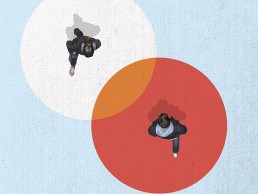
CLUE launches One for Light, Light for All competition
(Canada) - CLUE's third edition invites emerging lighting industry members to reflect on extending personalisation of private spaces to personalisation of public spaces, through lighting.
The CLUE competition, an annual celebration of the best in lighting, launches its third edition under the theme: One for Light, Light for All.
CLUE invites new and emerging members of the industry to reflect on the possibilities for extending the personalisation of private spaces to the personalisation of public spaces. Candidates are given carte blanche to propose innovative lighting solutions relating to this theme by 31 January 31 2017, the deadline for submissions.
Winners will be selected by a jury of professionals representing various positions within the international lighting and design community. In addition to a global platform, winners will receive one of three grants totalling $8,500, as well as a trip to Philadelphia for LIGHTFAIR International 2017.
More details on the theme can be found below:
CLUE 03: ONE FOR LIGHT, LIGHT FOR ALL
CONSIDER
Even as technology keeps advancing, in lighting as in other fields, the world we live in becomes ever more homogenised. The techniques at our disposal (LED lighting, control over intensity or colour, preprogrammed lighting schemes, etc.) give us the feeling of a personalised environment, but only within the limits of our own private space. Everyone can live this experience at home but when we cross the threshold of our front door, what happens then?
IMAGINE
With this in mind, how can we extend the personalisation of our private space to our public spaces? One of many examples: it’s now easy to translate, in an instant, any web page into our own language, while others can translate the exact same page into theirs—without affecting anyone else’s reading. How can this personalisation of the virtual world be implemented in the physical world, through lighting? Short of having a drone following our every move, how can personalised lighting help us to live side by side, or improve the society in which we must live together? In what ways could individuals control this lighting, and how can we each live our own experience without disrupting others or creating social chaos?
PROPOSE
For this third edition of the CLUE competition, candidates are invited to reflect on these questions. Proposals should suit the context of a public space—interior or exterior—and should answer a social need while improving quality of life and having a positive impact on the community, all through the personalization of lighting. There are no budgetary or technological limitations, and candidates are given carte blanche to present inventive lighting solutions. Proposals will be evaluated on the relevance and the originality of their approach.
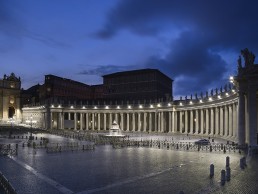
Osram illuminates St Peter's Square
(Italy) - Following the Vatican's Sistine Chapel lighting project, Osram provides 132-luminaire lighting experience on St Peter's Square as part of large scale refurbishment.
Osram has lent St. Peter's Square in Rome a new sense of radiance. Following refurbishment, some of its modern and energy-efficient outdoor LED luminaires now provide a unique lighting experience and also save energy of approximately 70%.
St Peter's Square ('Piazza San Pietro' in Italian), located directly in front of St Peter's Basilica in Rome, consists of a trapezoid section and the actual elliptical forecourt with a total area of 48,000-m2, and up to 400,000 people gather on the extensive square for celebrations and special occasions, for example the election of a new Pope or at Easter time. Extensive renovation work of St Peter's Square began in 2011, and at the beginning of the current year Osram, together with Direzione dei Servizi Tecnici del Governatorato SCV, created a new lighting concept based on modern LED technology that was installed and inaugurated in the evening on October 20, 2016.
The project concept by Direzione dei Servizi Tecnici del Governatorato dello Stato della Città del Vaticano was realised with support from Osram, the reference partner for global lighting expertise. The same level of cooperation with Servizi Tecnici del Governatorato was also fundamental for the success of the Sistine Chapel project, carried out in 2014. The new lighting system for the Sistine Chapel featured higher lumen-output and artwork-conserving LED lighting to protect and enhance Michelangelo's renowned frescoes. It also served as a benchmark with regard to artistic, historical and preservative aspects.
‘‘We have gained recognition worldwide since October 2014 for our state-of-the-art LED lighting of the Sistine Chapel, and we're exceedingly pleased once again to have demonstrated in Rome our strengths as a provider of complex lighting solutions with the illumination of St. Peter's Square,’’ said Olaf Berlien, CEO of OSRAM Licht AG.
As with the Sistine Chapel project, the lighting solution for St Peter's Square was planned and put into operation in close cooperation between Osram and the Direzione dei Servizi Tecnici del Governatorato SCV. ‘‘In addition to ideal lighting results the task also included visual aspects such as the discreet integration of luminaires into the architectural setting and incorporating a simple, unobtrusive electrical installation; saving energy and ecological sustainability was also important,’’ stated Eladia Pulido, CEO of the Osram Lighting Solutions (LS) business unit.
The Vatican specified an illuminance level of up to 120 lux at night to provide safety for visitors and to enable reading on the square during events and celebrations. 132 LED floodlights were installed, providing sufficient brightness and homogeneous illumination for the square. The new lighting lends the existing architecture and materials a visual upgrade – the light underlines the impressive columnar architecture and emphasises the innate colour of the marble. Ecological sustainability is simultaneously addressed, and for this reason the lighting concept focused on cutting power consumption and avoiding unwanted light immission. ‘‘Thanks to modern LED technology in combination with a DALI light management system, we achieve energy savings of around 70%,’’ added Carlo Bogani, Executive Project Director at Osram Italy.
The 132 LED luminaires installed are a customer-specific version of the Floodlight 20 LED with through-wiring and special plug connections that enable simple installation and easy interwiring of the luminaires. The luminaires are equipped with a DALI Professional control system and feature a 4,000K light colour (neutral white).
2016 Codega Prize winners announced
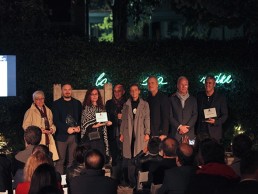
(Italy) - Fourth edition of Codega Prize welcomes 110 people to Peggy Guggenheim Collection in Venice.
The fourth edition of the Codega Prize, the international recognition of LED solutions and lighting design excellences, was successfully attended by over 110 people from the academic and professional world.
Gathered together in the wonderful setting of the Peggy Guggenheim Collection in Venice, Friday 7th October saw the announcement of some names of excellence in the world of lighting design.
Now in its fourth edition, the Codega Prize is an international recognition of lighting design excellence, which is awarded to professionals for their creativity and know-how in the application of transforming LED technologies in new ideas. Promoted by Assodel (Italian Federation of Electronics Clusters) in partnership with IDEA (International Distribution of Electronics Association), under the patronage of APIL (Italian Association of Lighting Professionals), the prize aims at disseminating the importance of the quality and versatility of LED lighting and of an intelligent and integrated use of light.
Great satisfaction from the jury was expressed for the presence of very high quality projects and for the presence, among the finalists of the prize, of outstanding installations and projects created by famous names of the international lighting design industry, such as Pfarré Lighting Design (Germany), ÅF lighting (Sweden), Aureolighting (Spain), James Poore Lighting Design (UK), Brian Orter LD (USA), Licht 01 (Germany), Molindris + Associates (Greece), and Michael Grubb (UK). Among Italian finalists, other important names, like Simone Micheli Architectural Hero, Romano Baratta Lighting Studio and Pasetti Lighting were also of note.
The winners of the fourth edition:
LIGHTING DESIGN CATEGORY
The first prize of the Lighting Design category went to the lighting project of the Museum of the Duomo of Florence by Massimo Iarussi Studio: “In the museum, the light is used to engage visitors rather than just to highlight the exhibits. It is a highly technical and well executed project showing the best elements presents in the exhibition with the best technical solution and taking care of maintenance.”
Second place for the Bolon Eyewear project realised in Shanghai by Gerd Pfarrè - Pfarrè Lighting: “A simple yet stunning solution for retail display. Interesting integration of lighting in new materials and furniture and the use of the light to create a complex wall for exhibiting the products. Lighting seems to be on the glasses. Materials and lighting interplay cared.”
Third place for the wonderful project of the Dreamy SPA by Simone Micheli Architectural Hero: “An emotional lighting system, thought to involve visitors, which is very well executed and perfectly integrated in the environment. The light is used to highlight the various elements of the SPA and to create relaxing and comfortable atmospheres. Light and water are melt together creating a unique beautiful and elegant environment.”
Special mention for another lighting design project, the Avila Nightscape, realised by Rafael Gallego of Aureolighting: “An incredibly wide project which, for its technical details and its relation to Avila’s urban landscape, is something unique, which is difficult to compare to other projects. Everything has been studied in the detail, with the purpose of emphasising the cultural heritage aspects of the city.”
LED SOLUTIONS CATEGORY
For the LED solutions category, the first prize went to Moonflower by Linea Light: “A very innovative solution with an appealing design, thanks to the use of RGB LEDs. Moonflower can create different scenarios with selectable programs. A dynamic decorating wall which can influence mood and emotions.”
A special mention went to Acqua by Cini&Nils: “Lightness and elegance make this design product a special piece of furniture. With different configurations, it is a versatile and functional solution, based on a masterly use of LEDs.”
Information on the prize
The Codega Prize has been held contemporary to ILLUMINOTRONICA – the Italian fair on LED lighting and smart solutions organised in Padua (www.illuminotronica.it) from the 6th to the 8th of October.
The Jury of the Codega Prize is composed by qualified experts of the lighting and electronics sectors:
Domenico Caserta – President of Assodel
Stefano Catucci – Director of Lighting Design Master at La Sapienza University of Roma
Paul James – mondo*arc Editor-in-chief
Gary Kibblewhite – Past president of IDEA
Francesco Iannone – Lighting designer
Massimo Malaguti – Past Director of Univeneto
Fabio Peron – Teacher at IUAV University of Venice
Maurizio Rossi – Director of Lighting Design & LED Technology Master at Politecnico of Milan
Paola Urbano – Lighting Designer, Co-founder of APIL and Member of its Board
Philips Lighting helps create world's first 'crowdsourced smart city'
(Netherlands) - City of Eindhoven enlists support of Philips Lighting to realise vision of a smart city where people's views shape change.
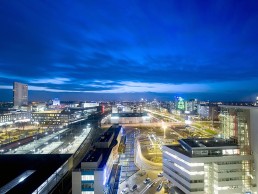
Philips Lighting has been chosen as a key partner to provide the urban lighting infrastructure required to bring Eindhoven's vision of a smart and sustainable city to life. The Dutch city of Eindhoven will draw on the expertise of the government, academia and businesses to address the city's needs and has formed a partnership with the Technical University of Eindhoven (TU/e), Philips Lighting and Heijmans, a Dutch company that specialises in developing roads infrastructure, civil engineering and non-residential buildings. This so-called "Quadruple Helix" of partners will work together for a period of fifteen years to develop innovations that respond to the residents' aspirations.
The city of Eindhoven is introducing participatory planning that allows its residents to be part of every step of the smart city project to improve the quality of life in their community. The project 'Roadmap Urban Lighting Eindhoven 2030' includes the development of innovative lighting applications in public spaces, such as connected LED street lighting, and the maintenance and management of public lighting in the municipality. The consortium starts work in the autumn of 2016 in five selected pilot areas across the city.
City officials believe many of the issues raised by voters can be addressed through lighting itself or via smart technology delivered through the lighting infrastructure. Technology like connected street lighting in combination with other smart systems, sensors and intelligence will turn the lighting infrastructure into an information highway that will enable numerous other benefits and services for residents. For example, the city may opt for piloting technologies that enable lighting to guide emergency services accurately to incidents or within meters of individuals in need. Alternatively, smart sensors in each LED luminaire may be utilised to adapt the lighting to weather conditions or provide light on demand when people are on the streets at night to improve safety.
‘‘We see Eindhoven as a true pioneer in what we see as an evolutionary path towards transformation into a smart city. Public lighting is closely interwoven with a city's infrastructure. In addition to light it represents a ready digital platform for acquiring and sharing information and services that provide real value to the citizens," said Frank van der Vloed, Market Leader Philips Lighting Benelux. ‘‘Citizens want a say in the smart city services provided to them and the city of Eindhoven plans to involve them, so that the smart city is built from the ground up.’’
The scheme in Eindhoven launched this week, echoes the findings of a fresh study by the Economist Intelligence Unit on 'Empowering Cities'[1] that finds that there is more demand for further citizen engagement. Although digital technologies facilitate the "crowdsourced city," the study reveals that more than six in ten people think governments are not investing enough in digital technologies to create smart cities. The opportunity for policymakers is to explore how to adapt to a new culture in which residents are no longer passive consumers of services but active participants in efforts to improve the planning and operation of their cities. Citizens feel they can guide the improvement of infrastructure and services in three top areas: social services, such as healthcare and education; pollution reduction and environmental sustainability; and waste collection, treatment and recycling.

Philips Lighting appoints David Nicholl as CEO for UK & Ireland
(UK) - Following a stint as Rockwell Automation Country Director, Nicholl succeeds Peter Maskell, who retires at the end of this year.
Philips Lighting has announced the appointment of David Nicholl as its CEO for the United Kingdom & Ireland. Nicholl succeeds Peter Maskell, who will be retiring at of the end of this year.
Nicholl joins Philips Lighting this month from Rockwell Automation where he was Country Director for the United Kingdom & Ireland. He was instrumental in accelerating the adoption of the connected enterprise approach; harnessing the Internet of Things in the industrial and manufacturing space to enable customers to benefit from greater connectivity and information sharing. Prior to Rockwell Automation, Nicholl spent thirteen years with Schneider Electric where he held senior leadership roles in the UK, Romania and Sweden, driving energy management and the transformation to systems and services.
Commenting on his appointment Maria Letizia Mariani, Market Group Leader Europe for Philips Lighting said: “David joins us with a strong track record for delivering results. His experience and customer centric approach will drive new areas of opportunity and growth within the UK and Ireland, accelerating our connected lighting journey and our leadership in lighting for the Internet of Things.”
Nicholl added: ”I am truly excited to be joining Philips Lighting and look forward to delivering real value for our customers by unlocking the potential of greater connectivity and light beyond illumination.”
Ready Steady Light competition to make regional debut at Light Middle East 2016
(UAE) - Organised by SLL and Light Middle East 2016, seven teams of professional designers, students, and manufacturers will be tasked with lighting a site in its natural state with equipment provided.
One of Britain’s most popular lighting design competitions is about to make its Middle East debut in Dubai, offering regional lighting design professionals, students, and manufacturers a platform to showcase their creative talents and network among industry peers.
Ready Steady Light, jointly organised by the Society for Light and Lighting (SLL) and the Light Middle East 2016 exhibition, will host up to seven teams who will compete against each other as they overcome challenges without a budget and within a chosen time-frame.
Every team, limited to five members each, will be allocated a site, and returning to basic engineering and design, will be given 90 minutes to design and install a lighting scheme with a range of provided equipment.
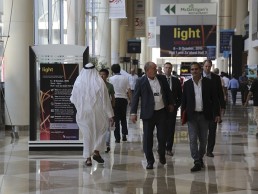
Held annually in the UK for the last fourteen years, Ready Steady Light’s Middle East version has already attracted five teams from the UAE, with the competition taking place on the second day of Light Middle East 2016, which runs from 31 October – 2 November at the Dubai International Convention and Exhibition Centre.
“Ready Steady Light is a unique opportunity for the Middle East lighting community to take part in a fun and educational event,” said Ahmed Pauwels, CEO of Messe Frankfurt Middle East, the organiser of Light Middle East, the region’s dedicated trade show for lighting design and technology.
“The competition is open to lighting designers, manufacturers, and students from throughout the region, and we’re sure everyone involved will enjoy the competitive aspect and camaraderie.”
“As Light Middle East continues to grow in both size and scope, interactive and talent-promoting events such as Ready Steady Light have an important role to play in the regional lighting design industry’s continued development,” added Pauwels.
Ready Steady Light will be contested among three categories, two of which will be judged by an expert panel; the Most Creative Effect, based on natural features of the site and theme; and the Best Technical Solution, taking into account energy use, light pollution and health & safety.
The final category, the Peer Prize, will be judged by other contestants, with all winners to be announced and celebrated at the fourth annual Light Middle East Awards, which takes place on the last day of Light Middle East 2016. The winners will also be mentioned on the SLL and Light Middle East website.
“Anyone with an interest in light and lighting should take part in Ready Steady Light,” said Brendan Keely, the SLL’s Secretary. “It’s an opportunity to get hands on experience of lighting the night time environment, to handle luminaires and see the distribution and effect that they will create.
“There’s also the competitive aspect of the event and each team will be vying to be crowned winners, while they’ll also have the opportunity to network with their peers.
“The SLL is very excited about delivering Ready Steady Light with Light Middle East 2016,” added Keely. “It’s one of our most enjoyable annual events in the UK and to take this to the region and have a whole new set of teams and challenges is very exciting. We’re very much looking forward to reaching out to the lighting community in the Middle East.”
The SLL created Ready Steady Light in 2001 as a celebration of the basics of lighting as an art and science, and have run the competition annually ever since. Returning to basic engineering and design, teams are tasked with lighting their site in its natural state with the equipment provided. They each have to overcome challenges without a budget and within the time constraints.
Now in its eleventh edition, Light Middle East 2016 will feature more than 400 exhibitors from 30 countries, and returns with regular headline features including the Light Middle East Conference, bringing together key leaders to analyse innovative technologies, changing global trends and evolving regulations impacting the lighting industry.
The Light Middle East Awards on 2 November will also celebrate the most outstanding lighting projects and designers from throughout the region.
IALD Enlighten Americas registration to end 5 October
(Mexico) - IALD conference to feature global panel of 41 speakers from ten countries - its most diverse body of presenters yet.
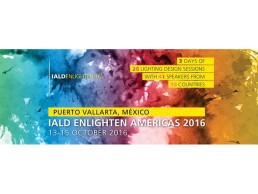
If you’ve been putting off registering for IALD Enlighten Americas 2016 in Puerto Vallarta, Mexico, now is the time. Registration for Enlighten Americas 2016 ends in just two weeks.
Registration ends Wednesday, 5 October at 11:59 P.M. CST, but don't wait until the last minute... register now
This year's IALD Enlighten Americas conference is 13-15 October 2016 and with a stellar line up of experts, topics, amazing parties and receptions, it's shaping up to be an exciting conference that you won't want to miss. Some of the highlights for this year’s conference include:
A keynote address by Danielle Feinberg from Pixar Animation Studios, one of its highest rated speakers ever.
Global panel of 41 speakers from ten countries - its most most diverse body of presenters yet.
The Sky Library, a collaborative, artistic closing session from Martin Lupton and Sharon Stammers of Light Collective.
Full simultaneous interpretation into Spanish for all educational sessions
Exciting nightly parties and receptions sponsored by LIRC member companies
Non-stop networking opportunities with people in the lighting community
For full conference information, visit the IALD Enlighten Americas homepage, or for an advanced look at what's on at the conference, view the program in an online flipbook format today.
To register, visit iald.me/enam16pv
