

Soraa hires Todd Antes as Senior Vice President of Marketing
(USA) - Former Qualcomm executive joins Soraa to drive go-to-market activities.
Soraa, a specialist in GaN on GaN™ LED technology, has announced the appointment of marketing veteran Todd Antes to the role of Senior Vice President of Marketing. Antes will report directly to CEO Jeff Parker and work closely with the sales and product development teams.
“Todd brings extensive marketing experience to Soraa and will play a key role in driving the company’s next phase of growth into full spectrum, smart and connected lighting,” said Parker.
Most recently, Antes was Vice President at Qualcomm, where he was responsible for the strategy, product roadmap and go-to-market activities for the company’s networking, and connected home/office/IoT products.
Prior to Qualcomm, Antes was the Vice President of Marketing at Atheros Communications, which grew to become the world’s largest supplier of Wi-Fi technology and chipsets prior to its acquisition by Qualcomm in 2011. Additionally, he has held several executive marketing leadership positions at small startups through large, public technology companies—including Philips and AirPrime (acquired by Sierra Wireless).
“I’m excited to join Soraa and have the chance to work with such a brilliant team and technologies,” said Antes. “I look forward to applying my marketing experiences in IoT and connected products to help the company deliver truly innovative LED lighting to more customers around the world.’’


Harvard Engineering rebrands to Harvard Technology
(UK) - Wireless lighting control specialist evolves brand to embrace Smart City and Internet of Things technological advancements.
Harvard, a leader in design, development and manufacture of energy saving wireless lighting control solutions, has unveiled its exciting new brand – Harvard Technology.
For more than 20 years Harvard Technology has been consistently bringing new, innovative, products to market. The company plans to remain in the vanguard and has undertaken a review, resulting in the launch of a new brand that not only represents the company’s intentions, but will also allow it to move forward and embrace the opportunities that present themselves in a world of technological advancements, including Smart Cities and the Internet of Things (IoT).
Paul Hussey, Chief Executive Officer at Harvard Technology, said: “Our brand evolution from Harvard to Harvard Technology is a positive and exciting step forward for us. During the last six months the management team has evaluated our core values to strengthen our position within the marketplace. The new brand epitomises everything we represent; a forward thinking, technology focused manufacturing company, that continues to be at the forefront of an advancing wirelessly connected world.”
Combining R&D, software, firmware and electronics, Harvard Technology has been manufacturing cutting-edge solutions in the UK for over 20 years.
Harvard remains a pioneer in the wireless controls solutions market, having been one of the first companies in the world to launch a wireless control and monitoring solution for street and outdoor lighting. Launched in 2007, LeafNut has been deployed by over 100 local authorities across the world. More recently the company launched EyeNut, one of the world’s first wireless controls and monitoring management systems for interior lighting.
Installed in 50 locations worldwide, EyeNut is helping realise substantial monetary and energy savings. This is exemplified by the world’s largest installation of the innovation system in New Zealand, where the client is achieving savings of £9,500 per calendar month.
The company also has an LED Solutions range, which consists of CoolLED high performance LED drivers, LEDeng modular light engines and the Custom LED design and placement service.
Harvard prides itself on providing the highest levels of service and is currently into the second year of a five-year transformational plan entitled, Harvard Lean Enterprise Deployment (HLED). The strategy has seen the company implement a number of new processes throughout the product lifecycle, from design, development, pre-production and production. This has resulted in Harvard setting market leading benchmark standards that far exceed the current industry levels.
For example, the introduction of solder bath profiling and training, has led to an approximate 80% improvement in the quality of all products as well as standardising production methods. A New Product Introduction Team has also been introduced to monitor the development of new products. The team has implemented a strict gated review process and Design for Manufacture guidelines, which has led to an improvement of nearly 50% in the time taken to deliver new products with the added benefit of increased design efficiency.
The HLED process has also resulted in Harvard establishing an After-sales Department to manage the complete customer experience, from planning through to product delivery, ensuring all aspects of the relationship with customers are delivered as effectively and efficiently as possible.
Hussey added: “Customer satisfaction is key to our future success. We are recognised internationally for developing innovative, cutting edge products and as we continue to introduce new solutions, our new forward thinking processes will allow us to meet all our customers’ expectations.”

Anno Tropico, Italy
A marriage between light, sculpture and movement, the Anno Tropico exhibition at Peep-Hole Contemporary Art Centre in Milan, Italy, by Amsterdam-based design duo Formafantasma, transformed the functioning of the exhibition space.
On view from 17 February to 19 March 2016, Peep-Hole Contemporary Art Centre in Milan, Italy presented Anno Tropico - the first solo show of Andrea Trimarchi and Simone Farresin - a duo of Italian designers based in Amsterdam, collectively known as Formafantasma - in an Italian institution.
The duo's work reflects on the historical, political and social implications of design, and a critical approach to materials and their use in production. Their research represents a fusion between two schools of design with strong identities: Italian, connected to an idea of craftsmanship and tradition, and Dutch, viewing design as an artistic discipline based on research and innovation.
The exhibition reflects the designers’ interest in the functional and expressive qualities of light, presenting a series of works made with different techniques and materials, together with a site-specific installation that shifts their experimentation onto an architectural scale.
The project is inserted in an environment, which, through the construction of wall-diaphragms corresponding to several windows, screens and modulates the intensity of daylight. The nature of this work transforms not just the architecture but also the functioning of the exhibition space, in which the opening hours vary depending on seasonal changes of the lighting.
Seen as a material, light is at the centre of a research process that investigates the relationship between natural and artificial illumination, shifting from reference to traditional unplugged systems to contemporary innovations in LED lighting and optics.
The exhibition is organised on different levels. Drawings, models and a video establish a dialogue with a selection of finished objects, all created over the last year. These objects mark an important passage in the designers’ practice, now closer to the industrial sphere than to crafts.
The models narrate the path that comes prior to the invention of the finished objects: dichroic glass, optical lenses and a parabolic mirror, assembled with industrial materials like bricks and iron rods, shape the light, generating reflections and shadows in the space.
On the walls, 3D renderings printed on millimetre paper reproduce details of the objects on display, superimposed on graphics and numerical data drawn with a pencil. The details of the lamps are isolated and described from close vantage points, while the lines that define their forms seem to extend, becoming hypothetical axes of diagrams that allude to an exponential consumption of energy.
Certainly in their results, if not in their intention, the exhibition's objects hover in a liminal dimension between work and object. To the extent that they come to grips with the specificities of sculptural language: the abstraction and geometry of absolute forms, with a nod to such works as those of Romanian artist Brancusi, who was an advocate of one of the most traditional materials of sculpture – bronze – applied for its intrinsic characteristics of weight and reflection.
In formal terms, most of the objects have been designed starting with circles and circular structures, reminiscent of astronomical rings and the armillary sphere used in the past to monitor the transformations of the cosmos. This relates to the accompanying video, installed at the end of the exhibition route, conveying its theoretical premises.
In Anno Tropico, abstract lights and shadows alternate with the presence of more familiar elements, like the gesture of a hand moving objects. The experiments conducted in the designer's studio, to become acquainted with this new material, are accompanied by an off-screen voice that describes luminous phenomena on a cosmological level. The soundtrack, based on a text written together with Edoardo Tescari, an astronomer at the University of Melbourne, shifts the subject matter onto a more philosophical, existential plane.
Formafantasma's works have been shown and published at an international level and are part of prestigious public collections like those of MoMA New York, Stedelijk Museum’s-Hertogenbosch, Metropolitan Museum New York, MAK Museum Vienna, Victoria and Albert Museum London, MUDAC Lausanne, Mint Museum of Craft and Design in North Carolina, Chicago Art Institute, and the Textiel Museum in Tilburg. Formafantasma teach in the “Man and Well-Being” department at Design Academy Eindhoven.
Pic: ©2016 Laura Fantacuzzi – Maxime Galati-Fourcade

Green light, Austria
Consisting of a workshop and learning platform surrounding the making of lamp modules, Olafur Eliasson's Green light endeavour combines light, art and community to challenge the current state of uncertainty amongst refugees and the European societies that welcome them.
Following the success of the exhibition OLAFUR ELIASSON: BAROQUE BAROQUE, organised by Thyssen-Bornemisza Art Contemporary (TBA21) and the Belvedere at the Winter Palace of Prince Eugene of Savoy in Vienna, TBA21 announced Green light - a new socially conscious endeavor by Danish-Icelandic artist Olafur Eliasson at TBA21–Augarten in Vienna, Austria, running from 12 March - 15 June 2016.
Conceived by Eliasson as a metaphorical green light for refugees and migrants in Austria and beyond, the project testifies to the agency of contemporary art and its potential to initiate processes of civic transformation. Green light consists of an artistic workshop and learning platform surrounding the making of lamp modules designed by Eliasson. The lamps are assembled on-site from materials and components that are made available at TBA21–Augarten. In addition to Augarten’s regular audience, young refugees, migrants, and university students were invited to take part in this process of collaborative artistic practice and learning, giving rise to a space of exchange and encounter for contributors from a range of linguistic, social, geographic, and educational backgrounds.
The Green light project responds to a situation of great uncertainty, both for refugees, who are often caught up in legal and political limbo, and for the European societies that welcome them. Through its communal fabrication, Green light constitutes a dynamic space that elicits various forms of participation to migrate to other locations and contexts to initiate different specific engagements. By collapsing the categories of production and reception, performer and audience, art and social action, the project aims to open up the contested terrain between art and society, probing the question of what constitutes the 'public' and negotiating a field of difference and similarity.
Eliasson commented: “It is my hope that Green light will shine light on some of the challenges and responsibilities arising from the current refugee crisis in Europe and throughout the world. The project is an act of welcoming, addressed both to those who have fled hardship and instability in their home countries and to the residents of Vienna. It invites them to take part in the construction of something of value through a playful, creative process. Working together in an artistic context, in dialogue with the regular visitors of the Augarten, participants build both a modular light and a communal environment, in which difference is not only accepted but embraced. Green light attempts to question the values of similarity and otherness in our society and to help shape our feelings of identity and togetherness.”
The crystalline Green light lamps are polyhedral units fitted with small, green-tinted light fixtures. Made predominantly from recycled and sustainable materials and designed to be stackable, the modules can function either as single objects or be assembled into a variety of architectural configurations. At TBA21–Augarten, the lamps form a steadily expanding environment in the exhibition space that carries the narratives of its making.
The Green light lamps are for sale on-site at Augarten, online, and through selected partners, allowing everyone to shine a light of inclusion and openness at home. Proceeds from the sales support the Green light project, TBA21’s partner organisations Red Cross Vienna, Caritas, and Georg Danzer Haus, as well as other initiatives helping refugees in Austria.
Over the course of the three-month Green light project, the participants and students will partake in a multifaceted curriculum of shared learning initiated by TBA21.
An evolving sculptural environment made from hundreds of modular Green light lamps will accommodate a multidirectional weekly program. Within the framework of this program, artists, thinkers, students, refugees, migrants, and collaborating organisations are invited to host and to be part of a series of workshops, seminars, performances, screenings, lectures, and artistic interventions responding to socio- and geopolitical, cultural, and personal issues and narratives of migration and arrival through collaborative creative activities and critical discourse.
This participatory platform engages with practitioners from diverse educational and professional backgrounds and tests ways in which artists and organisations can be deeply invested in political and social models of transformation, and thus the production of kinship, civic engagement, and sharing. Creating a space of exchange and encounter, this integral part of Green light tackles issues that matter to each of us.
The weekly program at Augarten is composed of a variety of initiatives and activities within a flexible educational structure that fosters engagement from all participants, those enrolled in the program, university students from Vienna, as well as visitors.
The program features films by artists such as Marine Hugonnier, Omer Fast, Walid Raad, Christof Schlingensief, Sean Snyder and many others. Workshops, interventions, and lectures by Olafur Eliasson and Displaced (the project of Department of Social Design of University of Applied Arts Vienna with Department of Architecture and Urban Planning of Technical University Vienna), Johannes Porsch, David Rych, Mario García-Torres, as well as lectures and discussion rounds with Matti Bunzl, Raimund Haindorfer, Oliver Rathkolb, and many others.
Pic: María del Pilar García Ayensa / Studio Olafur Eliasson
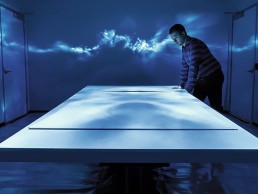
A Panorama of the Skies, USA
Through collaboration with Hrvoje Benko, a human-computer interaction researcher at Microsoft, artist Maja Petric has transformed a standard, every day conference room at the Microsoft 99 Building in the US, into a truly interactive audiovisual installation aimed at creating a truly emotional experience.
A Panorama of the Skies is an interactive audiovisual installation created in collaboration between artist Maja Petric and Hrvoje Benko, a human-computer interaction researcher at Microsoft Research.
Maha Petric is an artist working at the interface of science, technology and art. She holds the Docorate in Digital Art and Experimental Media from the University of Washington and a Masters degree in new media art from New York University, Tisch School of the Arts, Interactive Telecommunications Program.
Together, the duo have been researching the possibilities of immersive technologies through which a space can be experienced emotionally. Their focus has been on the innovative application of audiovisual experience that engages perception, emotion and imagination and morphs experience of space.
For this project, the duo transformed the experience of an otherwise normal conference room at Microsoft’s Building 99, through the use of audiovisual content, with a multi-projector and multi-depth-camera framework called RoomAlive Toolkit. The system uses five projectors and eight Kinect cameras to acquire a detailed map of the room, register the projectors and cameras into a single coordinate system, and enable real-time projection mapping in the immersive scene.
The sound was created by Daniel Peterson, a doctoral student at the University of Washington’s Center for Digital Art and Experimental Media with an emphasis on composition, spatial sound, ambisonics and spectral analysis.
Pic: Arturi Ortiz
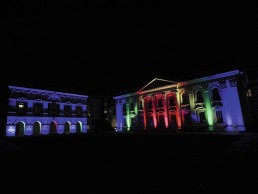
e-luminate Cambridge, UK
Now in its fourth year, the e-Luminate Cambridge festival in the UK was once again met with enthusiasm by the general public and the lighting world, with contributions from key players in the industry.
An internationally recognised multi-arts event that animates the city of Cambridge each year in February, e-Luminate is supported by some heavy weights in the sector and consists of six days and nights of displays, talks and workshops all around light.
Stunning architectural lighting projects bathed famous Cambridge buildings and provided great entertainment for the thousands of visitors in the cold February nights. This year's gold sponsors included returning sponsors Pulsar and Philips, which worked respectively on the Senate House and the University Library buildings. The latter was commissioned to celebrate the 600th anniversary of the University Library during the acclaimed festival.
SGM was involved as Silver sponsor for the third time running creating beautiful choreography for both the inside and outside of Great St Mary's Church; along with two new sponsors, who joined at top tier level: Lumenpulse, as Gold sponsor, and Paviom, as Bronze Sponsor.
The team at Lumenpulse collaborated with artist Gabby Shawcross to create a beautiful pastel coloured moving light installation on the Fitzwilliam Museum also celebrating an important anniversary this year - its 200th. For this piece the artist selected and sampled 200 colours from objects in the museum to create the colour palette for the lighting. Eve Gaut from Lumenpulse commented: “e-Luminate offered Lumenpulse a wonderful platform in which to engage with the lighting community and beyond. We were delighted to be gold sponsors and support the festival by hosting various events around the city and lighting the impressive Fitzwilliam façade. We are already looking forward to supporting e-luminate 2017!”
Paviom put its expert team led by Simon White to work on a lighting scheme for the Cambridge Judge Business School, which at the same time, housed art work using The Technology Partnership’s Mirage display technology. Created by Zero Kb and Visual Poke, the sculptural artwork exploited the unique ability of a Mirage display to appear transparent while able to display a static or video image. Comprising 23 small-scale Mirage display panels, suspended as rotating pieces of glass form the multiple facets of the sculpture, each Mirage display showed specially created images.
Over at the historic Guildhall, a richly coloured lighting display was created with a collection of Iluminarc fixtures from Chauvet. A Victorian style, natural stone building located in the centre of historic Cambridge and owned by the city, it provided an ideal backdrop for the interplay of vivid hues produced by the Colorist Pod 7Qa and Colorist Panel 8Q. Strategically positioned on the building’s balcony by lighting designer Simon Cox, the RGBA fixtures accented the distinctive architectural features of the popular Cambridge landmark. To illuminate the window bays across the façade, Cox placed a further six Colorist Panel 8Qa fixtures on the first floor balcony to work in unison with the Colorist Panel 7Qa fixtures.
The organisers were thrilled by the positive response received with Alessandra Caggiano, Festival Director and Curator, commenting: "It is great to see that so many people in lighting have taken an interest in showcasing their products and designs on the e-Luminate Cambridge platform. The festival is growing from strength to strength and we are already looking for more companies to join us in 2017."
Simon Fisher, Vice President of SLL, joined the organisation's Advisory Board for this year’s event and commented: "It has been a pleasure to work with the e-Luminate team to deliver the festival in its fourth year. Cambridge offers an amazing backdrop of history and architecture to showcase lighting, light art and lighting design. The buzz on social media this year compared to previous years definitely highlighted the continued and growing interest in the festival and it was great that a regional event could attract national and international interest. Something that we hope to increase next year.”
Senate House - pic credit David Johnson at Cambridge News
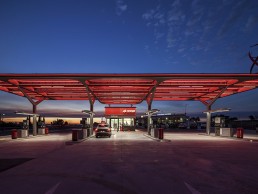
CEPSA, Spain
Forming part of a vibrant rebrand, Aureolighting's scheme for the new CEPSA petrol station in Adanero, Ávila, Spain balances natural and artificial light to maximise customer experience, while reflecting the brand through strong visual impact.
With a view to form a point of connection between itself and society, the design of the new CEPSA petrol station Adanero, Ávila, Spain, looks to communicate the following objectives: improve customer service experience; reduce the cost of maintenance using the latest technology; and create strong visual impact, representing CEPSA in a vanguard, technological and ecological manner.
In late 2013, CEPSA commissioned Saffron Brand Consultants within the program of redefining its brand, including an exercise in strategy, design and brand experience and redesign of its petrol stations.
Tasked with this role, concept creators Saffron selected a prestigious professional team. This was made up of strategic design consultants Tangerine, who redefined the experience of refueling; Malka + Portús Architects, who realised the architectural design of the new station; and Rafael Gallego - Principal of architectural lighting design practice Aureolighting - who designed the lighting.
“Malka + Portús Architects are my neighbours – we share a studio,’’ explained Gallego. “They hired me after being tasked with CEPSA's new petrol station design. This is how we entered into the project.’’
The architects and Aureolighting share a large office space, which allowed the collaborative design process to develop in real time.
“This project was different - I was working in real time because it was done with neighbours and colleagues in a real moment,’’ continued Gallego. “When the architects were drawing the structure, I was close to them. When they had problems, I would move from my table to their table and we solved it in the moment.’’
Light played an important role in the project, placed at the forefront of design decisions, with all parts of the structure and the architectural aspects paying attention to how lighting can be incorporated or adapted to suit.
In order to transmit the values of the company through the architecture of the new station, the choice of materials and shapes became essential, as well as the core idea of creating a light, nearly invisible structure that would come alive at night, and use it to signal the station’s presence.
The use of a new material similar to ethylene tetrafluoroethylene (EFTE) - a fluorine-based plastic - on the canopy over the forecourt helped to convey the idea of lightness, and to accomplish one of the main objectives of the canopy - to allow the passage of natural light through.
“In this case, natural light can penetrate directly to the customer and cars while pumping petrol. This is something that is completely new, even in Spain where there is a lot of sunlight. It is a much better experience to be in a station that is illuminated with natural light,’’ said Gallego.
This allowed the use of artificial lighting during the day to be minimised. Resulting in a significant reduction in energy consumption, given that sunlight is spread over more than ten hours a day in Spain during half of the year, thus rendering the use of artificial light unnecessary before 22:00hrs in the summer. The ETFE-like material permitted a very light steel structure with a profile of 40cm instead of 100cm standard canopies, turning the marquee into a line in the landscape.
The rounded corners on the canopy directly relate to the design used in the logo and brand signage, while lending a technological aspect and greater lightness to the structure.
Finally, the Y shape columns elegantly support the entire canopy, maintaining the same engineering design used on the marquee.
Efficiency and sustainability are ever-present in the lighting design values: all luminaires used are LEDs with very low energy consumption and maintenance, high visual effect and full integration into the metal structure.
The lighting has been regarded as one of the canopy's main components, which illuminates itself at night with the company's corporate red colour, allowing the station to create a strong visual impact in its environment.
Using a sample of the marquee material, Aureolighting worked with mock ups to find the correct balance point between transparency and non-transparency. After a challenging process, the optimum level was set at around 80%. The difference in transparency is achieved through varying numbers of small silver dots that are printed within the material, which absorb the red colour, giving the sensation that the material is completely lit.
“We carried out a lot of tests to find the right proportion, trialing different percentages of transparency in relation to the number of dots,’’ explained Gallego.
Lines of white LEDs integrated in the structure, provide functional lighting to the entire area, which is complemented by sub-canopies with integrated lighting, located over the pumps islands. These provide the required illumination level in the area, creating a more localised experience for the customer and reducing energy consumption as no light floods the space. Furthermore, sensors identify when the station is absent of customers and reduce the luminous flux accordingly.
Becoming a new beacon itself, the C-store building signals the presence of the station by its red polycarbonate skin, shining bright both day and night.
Aureolighting's scheme is both unique and thoughtful, using an innovative material that maximises daylight penetration as well as artificial light absorption to great effect.
Pic: Montse Zamorano
Dalia Energy Plant, Israel
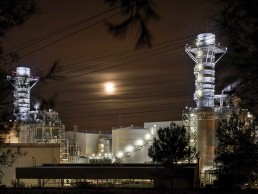
The first of its kind in Israel to employ the services of an architectural lighting design studio, Dalia Energy plant enlisted the help of Studio Twilight to develop a scheme that would create a landmark with minimum damage to nature and maximum visibility from surrounding areas.
Constructed by French multinational Alstom at an overall cost of NIS3.5 billion, Dalia Energy is Israel’s first independent power station. The station runs on natural gas and generates 900MW of electricity through two turbines, each producing 450MW. It uses integrated recycling technology, which enables energy efficiency of 58% - the highest available in Israel’s power market.
Unlike other power stations, the Dalia Energy management sees the station as integral to the landscape and environment in which it was constructed. Sustainability, environmental quality, and aesthetics were therefore matters in which major resources were invested and, directly following that approach, in the sphere of lighting too.
In 2013, Ailon Gavish, founder and CEO of architectural lighting design Studio Twilight, who was teaching at the time in several academic design schools, organised the first Guerrilla Lighting in Israel - a collaboration between the studio, the students and Tel Aviv city hall. One of the locations was right next to the residence of Eitan Meir – CEO of the Dalia power plant. After he saw the light show in action, he contacted the studio and enlisted its help with lighting the power plant.
Twilight has been involved in various and varied projects, from private to hospitality, public and commercial spaces, urban master plans and landscape.
“The Dalia power plant is the most technical mega project we have participated in,’’ said Gavish. “It's amazing how an industrial, functional structure in such a technical project is so detailed and that the lighting concept is being treated with serious consideration like you would expect in a hotel or urban master plan project. In fact, it’s the first power plant in Israel that has employed the services of an architectural lighting design studio. We feel privileged to be part of this project for many reasons but mainly because we can actually envision how it would have looked and felt without lighting design as an integral part of the plan like in all other power plants in Israel where lighting design wasn't a planned part of the project, light pollution abounds with no regard to the surroundings.’’
Working in close collaboration with architects Carlos Prus, Avner Drori and Uri Shitrit, the project’s planning began in the preliminary stages, and engaged with every part of the station: safety and security lighting, road lighting, operational lighting in various areas, landscape lighting, office lighting, and general lighting of the entire facility – chimneys, turbines, and other parts of the station.
The brief was very clear: create a landmark and monochromatic hue with minimum damage to nature and maximum visibility from specific areas within a radius of 3km.
The planning and design choices were derived from management’s approach to energy efficiency and respecting the environment, allied with the desire to create branding for the station.
With this in mind, Twilight placed a strong emphasis on the themes of reducing light pollution, energy efficiency and choosing top-quality fixtures.
“We don't work in every project with clients who are aware of the environmental aspect, or lighting’s role in branding and defining the site; here, though, there was a harmonious combination of those two aspects,’’ said Gavish. “And since the project concerned a power station – an industrial, functional structure where usually only the operational aspect of lighting is considered – this adds to a highly successful result.’’
To enhance energy efficiency and cut light pollution, the facility’s lighting is operated by sensors and switches that turn on only when needed. When choosing fixtures for the project, Twilight took into account precise photometric qualities – full cut-off, tilting fixtures, light sources with high light efficiency, use of LED technology, and specifying fixtures with advanced photometric lenses.
“Our lighting concept was informed by several aspects; one was to differentiate the Dalia power station from the station adjacent to it, which produces high levels of light pollution and light sources – sodium lamps - that are not environmentally friendly,’’ continued Gavish.
Since Dalia Energy produces electricity from natural gas, the studio tried to imbue in it the subtle blue colour of burning gas, and used W.W.B.W. LED technology - that produces a high colour temperature as well as uniform wash and fade – lighting that grows weaker as the distance from the light source grows.
In order to create a landmark, the vitality of the lighting was cardinal to both the customer and to Twilight.
“It was important to create a unified language between the power station, the context of the natural environment and light performance,’’ said Gavish.
Light temperature and intensity were carefully selected according to the distance from which the studio intended people to view the project, taking into consideration two vital viewing points. One from the nearby forest and the second from the urban area west of the project, both approximately 3km away.
In order to achieve these results, the studio made a large number of mock-ups, where each time it circled the power plant at a different radius. At various remote viewing points Twilight checked that the light performance was consistent with the specifications of the brief, emphasising reduction of light pollution and glare.
As a unique project with a specific brief, Twilight faced many challenges during the process. For example, installing the lighting fixtures for mock-ups and in the final stages of the project, working at extreme heights (30-60-metres), using a combination of several crane lifts and a skilled labour force.
“We think, in architectural lighting design, there is a dimension that is invisible to the eye but definitely felt: the dimension of time. In another time, perhaps another client, possibly other requirements and a different worldview, all would lead us to a completely different design perception of light. If we had to change something in this project, we would give greater expression to random safety and security lighting as well as operational lighting in various areas, to maximise it and create hidden depths and layers of light that would reveal themselves from different spots around the power plant,’’ concluded Gavish.
Twilight has carefully selected and positioned luminaires to impressive effect. In doing so, it has provided an industrial project with a strong identity defined by light that is both sensitive to its environment, while remaining true to its function.
Pic: Omri Amsalem
Lit Brothers, USA
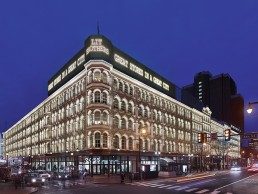
Paying respect to its Victorian architecture and contributing to the revitalisation of the city, The Lighting Practice's illumination of the Lit Brothers building in Philadelphia, USA uses the latest in LED technology to bathe the grand façade in a variety of vibrant hues.
Composed of approximately 33 buildings, the Lit Brothers building is the only complete block of commercial Victorian architecture in Philadelphia, USA and as a consequence was added to the National Register of Historic Places in 1979. Philadelphia-based lighting design studio The Lighting Practice (TLP) was tasked with highlighting the façade and other historical features, specifically the classical arch windows.
TLP’s design embraces the elegance of the architecture and uses an LED lighting system with colour-changing capability to highlight the fine details in the façade.
“Approximately four years ago we were approached by the architect, an existing client of ours, who was leading the digital media and public improvement design effort, to photograph the building and assist in the development of façade lighting renderings,’’ said Michael Barber, Principal, TLP.
“That work never happened. For nearly two years we were left wondering what had come of the project before we were we asked to interview with the owner in 2014. We were competing for the project this time around, and after waiting all this time, were determined to win the commission. Our drive and passion to light the Lits Building was evident to the owner and we were awarded the project.’’
Following an approval process conducted by the City of Philadelphia’s Historical Commission, TLP's design incorporates low profile adjustable brackets, strategically placed beneath each sill with additional LED uplights mounted to existing brackets, creating vertical columns of light along the façade. Leading the re-birth of the East Market corridor, Brickstone Realty sought to enliven the building’s glorious renaissance revival style façade.
Barber added: “While the building appears to be one cohesive mass it’s actually a number of buildings, constructed of various materials, stitched together. The seemingly repetitious details have subtle differences that required acute attention; this was further complicated as there was limited documentation available.’’
In total, 504 window openings are illuminated with linear RGBW LED luminaires mounted at each sill, painting the façade canvas in light. Custom enclosures painted to match the building façade shield the fixtures from view and allow them to appear as part of the window sills.
Each window and pilaster is individually addressed through controls that are provided by a Pharos LPC DMX control system with secure remote access from anywhere in the world. This allows the client to adjust the lighting at a moment's notice for holidays as well as major events. For example, after the attacks in Paris, the building was able to quickly display the French Tricolour to show support and solidarity with Paris.
During the design process, a full-scale mockup was performed to study beam angles, intensity, fixture lengths and locations. In addition, TLP worked in close cooperation with the City’s Historic Committee, ensuring the building’s fabric remained true. With this in mind, power feed penetrations through the building were only allowed at the second level windows, so cables needed to run along the outside of the building. Furthermore, custom white cables were used and runs were coordinated extensively with the project architect and reviewed by the Historic Committee during construction.
As the façade materials between each building consist of cast iron, stone, sheet metal, and wood, the project required unique mounting hardware and installation techniques. Taking this into account, select pilasters along the façade, illuminated with an RGBW accent luminaire painted to match the supporting bracket arm, add a layer of dimension and balance the illumination. Also, new 3,000K LED lanterns replaced the existing bracket-mounted luminaires.
With proportion, scale and style being studied at length to reinforce the human element at the base of the building, lens materials and finishes were reviewed with the selected manufacturer to ensure even diffusion of the LED source.
While envisioned in incandescent white, the RGBW system provides a myriad of colours and hues. Therefore, the dynamic nature of the specified luminaires supports the client’s vision and potential retail clients’ branding and marketing needs.
Catering for potential marketing needs and with the implementation of the new rooftop signage, attention was drawn away from the building’s ornate façade. TLP addressed this so that, “the new lighting wasn’t just vital in helping balance the building, it was vital in creating a resurgence in the surrounding neighbourhood,’’ explained Emad Hasan, Associate, TLP.
“The East Market Street area was once a thriving part of Philadelphia but eventually went out of style. Only in the past year has the city seen development proposals come to fruition. The Lit Brothers Building is the first of many projects that are helping to create a resurgence in the area.’’
Throughout the project, TLP's intent was to provide a lighting solution that would balance the building with the signage, accentuate architectural features, and become a beacon of the neighborhood, all while respecting the historic fabric of the building. “I know this might sound cliché, but to achieve this we worked closely with the design team and owner to think through each nuance of the design, and kept the Philadelphia Historic Commission updated as the design developed,’’ commented Hasan.
“The Historic Commission was invited to attend mockups and review the construction so that we could address any concerns they had. This collaborative approach allowed us to achieve the design intent.’’
Working to incorporate lighting into such a historically significant building was a significant challenge for the TLP team.They worked closely with the design and construction team to develop details for mounting luminaires to the various window sill materials. Additionally, due to the fact that it was only possible to have power penetrations through the second level, the luminaire manufacturer was able to provide custom cabling, which was then mounted along architectural features.
“This method allowed the cabling to appear as shadow lines in the daytime and become virtually non-existent,’’ continued Hasan. “Lastly, we needed to ensure that the exterior illumination did not impact the tenants. Through mock ups, we were able to determine the appropriate beam angles and fixture aiming to ensure there was minimal spill light into the occupied spaces.’’
Having completed this project during a time in which LEDs are so prevalent, TLP has provided a solution that is both flexible and technologically advanced. When asked if he would have approached the project in a different way, Hasan responded: “I walked by this building for years on my commute to work and often wondered how to light it. Maybe, if we could have used tiny luminaires powered wirelessly we would have gone that route, but unfortunately that’s just a dream. In the end, we are extremely pleased, as is our client. You can’t ask for more than that.’’
Barber concluded: “Our client was truly remarkable; his support of the design vision was unwavering. He was engaged in all aspects of the project from design, participating in meetings with the Historic Commission, through construction, climbing scaffolding to review paint finishes and cable runs. It was a real pleasure working with him and his team. Our office looks down on the Lits Building, so when you can experience your work every day and know that it enlivens the urban experience and contributes to the revitalisation of the city, it’s a great feeling.’’
TLP has provided a considerate and inspiring solution for the historic Lit Brothers building, highlights the beauty of Victorian archictecture.
Pic: © Jeffrey Totaro, 2015
West Keira Centre, Australia
Working in close collaboration with architects HDR Rice Daubney, Electrolight's lighting scheme utilises strategically placed luminaires within architectural details to illiuminate form and enhance volume at the West Keira shopping centre at Wollongong Central, Australia.
After being awarded the AIA 2015 IALD Lighting Prize for best architectural lighting NSW and the IES Lighting Design Award of Excellence 2015 NSW Chapter, GPT Group’s Wollongong Central West Keira project in Wollongong, Australia has gained international recognition.
Its interpretive architecture combined with integrated lighting to create an immersive shopping experience. Each element of the project is unique and bespoke, drawing strong parallels to the surrounding landscape that make the local region distinctive.
The lighting design looked to enhance the architectural form of the new-age shopping centre in a timeless and integrated fashion, providing a base for the retail tenants to connect themselves organically.
With a budget half that of similar projects, the Electrolight design team worked in close collaboration with the architects HDR Rice Daubney to achieve the desired result.
This concept was achieved by minimising a reliance on conventional downlighting, and strategically selecting and locating luminaires within architectural details to illuminate form and enhance volume.
The success of this strategy is owing to a collective vision, attention to detail and meticulous co-ordination with the HDR Rice Daubney architectural team throughout the entire design process.
The architecture evolved into a vibrant and colourful interior space encompassing a diverse range of visual experiences. This presented the challenge of illuminating each area to enhance these themes, whilst still maintaining a consistent language throughout without appearing as a patchquilt of lighting applications.
The lighting scheme looks to nurture the form and materials of the architecture, providing a natural rhythmic flow of light and relief.
Electrolight took an organic approach to the lighting strategy, working from within the identity of the architecture. The theory that luminance creates illuminance where light appears to flow inherently with a deepseated connection to the built form. This approach would prove to rely heavily on balanced intensities and strategic direction of light to bring every part of the built fabric to life.
Lighting is seamlessly integrated amongst the sculptured architectural elements, demonstrating the potential of modern lighting tools to successfully force light where it is wanted, and to restrict light where it isn't necessary.
By day, sunlight pours in through the central mall void and perimeter glazing. With this in mind, artificial light has been thoughtfully placed to fill the remaining pockets, strengthening a natural flow of luminance.
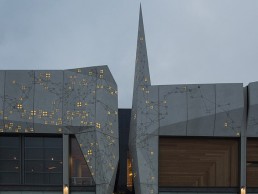
Moving to the exterior, the striking façade, dotted with sparks of light, creates a fresh and iconic vista for Wollongong that emulates the native flame trees of the Illawarra region.
These luminous cavities perforate through the precast concrete paneling in an organic pattern, in contrast to the facetted, monolithic structure.
Over 2,200 customised 0.5W LED sources have been strategically placed to provide just the right balance of intensity, but remain hidden from view. In the larger cavities, two 0.5W LED are used to balance the effect.
The initial costing design was based on a compact fluorescent and metal halide downlighting solution. Due to these budget restrictions, luminaire selection and controls required a strategic approach. Thoughtful switching arrangements controlled by daylight sensors were determined to maximise the use of natural light. Select luminaires provide low-level security lighting triggered by motion sensors after hours.
“One of the significant concerns for the client was the ongoing operation and maintenance costs for the centre,’’ said Donn Salisbury, Director, Electrolight. “Conducting a thorough analysis into ongoing costs versus capital investment to utilise LED sources throughout, we were able to determine a clear comparison, allowing the client to make an informed decision. We were also able to negotiate extended warranties with suppliers as an added incentive for the client to minimise ongoing expenditure.”
GPT Group agreed the payback period for the initial outlay of costs was beneficial, resulting in the positive outcome of a 100% LED lighting solution. The project utilises 100% LED sources, all selected specifically for their technical performance to enable a successful result within integrated details. Custom modifications were made to many luminaires without compromising the manufacturers warranty requirements.
Achieved through particular luminaire selection and in perfect harmony with architect HDR Rice Daubney's interpretive design, Electrolight's integrated lighting scheme creates an organic experience for shoppers, allowing them to connect with the retail environment.
Pic: Rohan Venn Photography and Brett Boardman
Suntec, Singapore
Bo Steiber Lighting Design took on the mammoth task of lighting Suntec Singapore as part of bigger redevelopment plans, creating an impressive, stand out design.
Suntec Singapore - a renowned institution in meetings, incentives, convention and exhibition (MICE) and retail industries – recently revitalised its brand by embarking on a five-year redevelopment of its property starting in 2010. Having gone through a series of partial openings in the last couple of years, Suntec finally completed the last phase of renovations in October last year and fully opened its doors once again - revealing more than 200,000sqm of ultra-modern MICE facilities and fresh, up-to-date retail premises.
Along with a major revamp in architecture and interior design, lighting design was an integral part in breathing new life in to the Suntec development. Bo Steiber Lighting Design (BSLD) - an international lighting design consultancy based in Singapore - was commissioned to undertake the overall lighting design for the US$290m redevelopment project.
Suntec’s building façade and external spaces, originally designed by US architect I. M. Pei and Partners, underwent a dose of facelifts from architects Aedas, starting off with the acclaimed ‘cube’ structure - shelter to Suntec Singapore Convention and Exhibition Centre - all the way to the familiar roundabout plaza - foreground to the company’s retail arm, Suntec City, and address to the world’s largest fountain, Fountain of Wealth.
To inject a formidable nighttime presence to the convention centre, the lighting designers focused on common façade elements – the existing roof and the new vertical glass fins – to form a ‘solid’ coordinated lighting scheme through the varied façade planes. The roof sails were dramatically uplit with ‘wash’ projectors and the roof pediments accentuated with continuous linear uplights maximising the overall roof lighting effect. Continuous vertical covelights were integrated into the nine-metre glass fins creating a rather striking and consistent nighttime feature across the façades.
The convention centre’s western façade called for a much-needed lighting intervention to camouflage the unsightly views seeping through the perforated wall panels at night - generated by the multi-level loading bays and staging areas located directly behind the façade. This presented a good opportunity to introduce an array of LED nodes - capable of animated effects and low-resolution media displays - to the perforated walls onto effectively disguise the back-of-house views.
Once a lacklustre outdoor space, Suntec’s expansive roundabout plaza went through a major lighting design revamp to give it a livelier and more coordinated visual impact.
At the heart of the plaza, Fountain of Wealth was upgraded with synchronised water and light shows and served as the focal point of the nighttime scenario. Overlooking the grand water feature, the Fountain Terrace at Level One was rendered with a complementary yet unobtrusive ambiance focusing on wash lighting of key surfaces such as railings, seating and foliage.
On the other side of the roundabout, the old nondescript street light poles were replaced with signature pieces adding a touch of exclusivity to the streets. The grand canopy fronting the new multi-level shopfronts was made even more impressive with dynamic uplights integrated into its column details. New food and beverage outlets abutting the retail entrance promenades injected their own interesting variations and added to the overall nighttime appeal.
Suntec’s retail development also saw the addition of the new Sky Garden, an intimate outdoor food and beverage destination occupying the retail roof deck and directly accessible from the roundabout plaza via a pair of three-storey-span outdoor escalators. Housing a collection of restaurants and bars amidst the landscaped environment, Sky Garden was designed to project an elegant lighting ambience prioritising the enhancement of the natural settings and the appreciation of surrounding views.
Suntec’s façade and external lighting installation predominantly used LED luminaires capable of colour-changing and animated effects. A central lighting control system was incorporated into the design for full programming and synchronisation of the entire lighting installation. This gives the development the ability to create endless nighttime transformations that would keep it visually interesting and adaptable to various occasions and seasons.
The Lighting design for MICE facilities is in itself a big challenge due to the highly technical requirements that come with lighting multi-functional and specialised event spaces. In Suntec’s case, this was paired with yet another set of lighting design considerations - the cutting-edge interior design and the clients’ wish for maximum design flexibility and advanced technology integration.
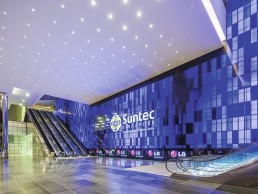
Lighting for triple-volume lobby spaces – the entrance lobby in Level 1 and the concourse lobby in Level Three - were designed to cater to different lighting moods and varied lighting levels that could either stand on their own or be adapted to the requirements of major events being held in the exhibition and meeting halls. Architectural lighting, effects lighting, video walls and other multimedia amenities were synchronised to achieve maximum visual impact within the lobby spaces.
Level Three was dedicated to meeting room facilities that posed some major lighting design challenges: first, the movable partitioning of the meeting rooms; second, a generally low ceiling height across the interior spaces; and last, the use of very dark colour palette throughout the interior design.
Level Three’s partitioned spaces were designed to be fully configurable and needed lighting control that would address that kind of flexibility. A lighting control system with a partitioning feature integrated - enabling all lighting circuits to be grouped, dimmed and controlled based on the required configurations of the meeting rooms.
Diffused linear downlight extrusions were chosen for general lighting of most interior spaces not only for their contemporary look that perfectly matched Level Three’s interior design intent; but for the main reason that diffused linear lights would typically have much better direct glare control – most crucial for low ceiling heights - as opposed to most point-source downlights. Covelight features were also introduced to various ceiling planes to give them a softer appearance and to camouflage their low height. To mitigate the perception of dark interior ambiance, the lighting designers introduced ‘wallwash’ lighting techniques to all major wall surfaces in the meeting rooms and within the circulation areas as well.
Exhibition halls in Level Four were refurbished to become state-of-the-art venues for a vast variety of functions - from travel fairs to professional exhibitions; from weddings to boxing events. The halls required extremely varied spatial transformations to be executed in a matter of hours in order to maximize the potential returns from the spaces. All eyes were on lighting design to provide the quickest yet highly effective solutions in altering the general ambiance of the spaces according to the requirements of events.
Bo Steiber, Founder and Design Director at BSLD, recalls: “Our team had to make sure that the lighting design would not fall short of the expectations for each and every event – that a wedding celebration would be given the same romantic ambiance as that of a grand hotel ballroom; that a company D&D would get the exciting vibe of a top disco venue; that a product launch would be provided with the maximum attention that it required; and so on. Since walls, ceilings and other interior design elements could only remain relatively static, it was mostly up to lighting to wave a magic wand.”
The lighting design solution for the exhibition halls involved several layers of lighting elements – new LED high-bay lights to replaceme the old high-bay lights using conventional lamps - were introduced to address the high illuminance requirement for exhibition, tradeshow and similar set-ups.
For big-volume seminars, lectures and similar events, LED cylinder downlights with wide-beam distribution were provided to render pleasant uniform illumination. Track-mounted LED wallwashers complemented the lighting scenario by increasing the perceived brightness within the spaces.
For social events such as weddings and parties, track-mounted narrow-beam LED spotlights were used to focus on tables adding drama and visual contrast in the spaces. These spotlights were specified for individual remote control - via integrated IR receivers - for quick individual aiming and focussing of the luminaires without the need for any scaffolding or boom lift.
The main lighting feature of the exhibition halls came in the form of a blanket of stars - made up of more than 48,000 LED nodes spanning across the entire ceiling space. Every LED node was painstakingly integrated with clear acrylic casing to optimise the sparkling effect of the entire installation. With the use of a sophisticated lighting control system, the individually-addressable LED nodes produced fantastic compositions of dynamic lighting effects ranging from sophisticated starry-sky effect to vivid displays of colourful graphic patterns.
With reference to the retail spaces, the clients’ brief was made very clear right from design inception – the tenant spaces would be the focal point of the shopping experience and everything else in the design should complement this objective.
In response to this, the lighting designers prioritised visual comfort and pleasant ambiance - setting aside over-the-top technology - in the lighting design of the mall interiors. As Josephine Dimalibot, Team Leader for the project and Director at BSLD, puts it: “While it was rather easy for us to inject colour-changing ceilings and maximum effects as widely seen in retail lighting nowadays, this was not the case for Suntec City.”
General downlights for mall corridors were carefully selected to ensure optimum glare control and minimum interference to the tenants’ shopfronts. Linear light extrusions were also introduced as contemporary yet unobtrusive accentuation to the trellis-like ceiling design of the corridors. Ceiling covelights were used to emphasise the graceful lines of the atrium spaces and interior design features.
Lighting levels for corridors and other interior common areas were purposely designed to the minimum lux value allowed by the local authority in order to provide differentiation from typically much brighter tenant spaces.
In terms of sustainability, the lighting designers pushed for energy efficiency and sustainable design within the practical bounds of the project. The selection of light fittings, lighting components, lamp types and lighting control systems were taken into account throughout the design process so as to meet optimum energy efficiency. Lighting design and layouts were thoroughly reviewed and coordinated with stringent power load requirements.
The redevelopment project garnered Singapore Building & Construction Authority’s Green Mark GoldPlus award for its sustainable design on various trades - lighting design included.
As a result BSLD has created a carefully considered and flexible lighting design that enables Suntec Singapore to make the most of the various spaces.

Jean Sundin and Enrique Peiniger
Office of Visual Interaction principals Jean Sundin and Enrique Peiniger use lighting to tell the story of architecture. Vilma Barr caught up with them in their NYC office to get behind the narrative.
Jean Sundin and Enrique Peiniger may be lighting designers by trade, but they are storytellers at heart. Like a team of dedicated journalists, the principals of Office for Visual Interaction (OVI) approach their projects with an investigative line of inquiry, asking questions whose answers reveal the project’s underlying narrative. They then use their novelist-like powers of creative expression to flesh out the story with the details of their design. The team even creates what they call “lighting workbooks” or visual narratives, that capture their exploratory process - research, idea creation, development and testing - for each project.
“This process allows us to explore highly integrated design solutions,” Peiniger explains. “Our philosophy is to set up a dialogue early on with the architect that enables us to understand the project and then create a lighting program tailored to their specific project needs.”
Sundin adds: “The inspiration for our solutions comes from the project itself…the architecture, cultural context and the excitement it is meant to create. The final results should look like a natural extension of the architectural story already being told, as if the architect did the lighting design themselves.”
Fittingly, Peiniger and Sundin relate the story of OVI, the New York City firm that they founded in 1997, as a joint narrative written by both and then explained orally in a smooth outflow of thought. They met when both worked in a lighting design studio in Washington, D.C. Prior to that, Sundin had been a designer for Claude and Danielle Engle after earning her degree in interior design from Virginia Commonwealth University. She was involved in the planning and design of their domestic and international projects.
Peiniger completed his studies in architectural engineering and social sciences at the Technical University, Berlin. After developing custom luminaires for a German manufacturer, he joined the US lighting design office where he met Sundin. During their work together, they came to the joint conclusion that lighting needed to be brought in earlier in the planning process to establish more holistic lighting design solutions. “We wanted to do something special and find another way to bring lighting into the overall design equation,” Peiniger relates.
They launched their own lighting design practice as Office for Visual Interaction, nineteen years ago. “We felt that a name-based firm wasn’t a fit for us,” Sundin says. “Design is a team effort, so we decided to give our studio a name that resonated with both of us: the way light interacts with surfaces and materials. In any project, you can’t have one without the other. The name is holistic and leaves us open to create lighting for all types of projects and demonstrates the diverse thinking process of our practice.”
The studio-sized office allows the personal attention of principals on every project. OVI specialises in significant one-of-a kind projects for which they create individually tailored lighting solutions using their characteristic approach to design. Though the final design for each project is totally unique, most begin the same way: a conversation with the architect that gives the designers an understanding of the project’s scope and challenges.
This dialogue-based methodology makes OVI well suited to dynamic, challenging projects like the United States Air Force Memorial in Arlington, Virginia, the New York Times Building, or the Scottish and Canadian Parliaments. It’s also allowed the firm to build strong relationships with its clients, who represent some of today’s best-known names in international architecture: Zaha Hadid, Renzo Piano, Foster + Partners, Smith+Gill, Bjarke Ingels, Grimshaw and Morphosis, among others. OVI’s dedication to establishing a dialogue between architect and lighting designer is ever present… even when the architect is not.
“When we designed the exterior lighting for The Rookery in Chicago, which was built in 1888, we had to envision the dialogue with Burnham and Root and what they would have told us about how they would like to see their building in the evening. We hope they would be pleased with the result,” Sundin says.
By having such early input in the design process, OVI is often able to impact how lighting is integrated with architecture in a way that most lighting design firms can’t. When direct sunlight from the large windows at the Scottish Parliament threatened to interfere with televising the parliamentary sessions, OVI intervened. “At the master planning stage, we took a look at the big picture and all buildings were rotated to provide ideal daylighting conditions in the Chamber,” says Sundin. “The result is a very sustainable solution that utilises the surrounding buildings to shield the Chamber from direct sunlight without the need for shading devices.”
Early communication with the architect also enables OVI to get a head start on analysing and testing concepts that often involve complex, dynamic lighting strategies and ever-changing technologies. The firm’s recent work on another Parliament complex - the West Block of Canada’s Parliament Hill in Ottowa - is one example. “The design of the new Chamber of Commons needed to respond to a variety of uses, from public visits to HDTV broadcasts of parliamentary sessions,” explains Peiniger. “At an early stage, we conducted exploratory lighting studies to define the precise locations and aiming angles necessary for TV broadcast lighting. Working from these setting out points, we coordinated strategic positioning of the branching columns with structural requirements to optimise the tilt angles needed and avoid the use of the traditional, suspended gantry system. The result is that the TV lighting is fully integrated into the columns.
“We also researched and tested different optical materials and identified a diffuse, white material that blocks the LED light source from view, like white lenses, but does not reduce the efficiency of the light beam as they do. We’re now working closely with lighting manufacturers to developing luminaires that will be powerful enough to meet the light levels required for TV broadcasting and compact enough to be integrated within the architectural and interior design elements.”
The Canadian Parliament isn’t the firm’s first time working with manufacturers to customise LED technology for its projects. As early adopters of solid-state technology, OVI won a worldwide competition over ten years ago to design a new streetlight for the City of New York, which is now being installed in the five boroughs, and the light source they proposed was LED.
“LEDs are now commonplace, but ten years ago we had to explain this technology and we needed independent labs to test the brightness and intensity,” Sundin observes. “There was no data available to base our calculations. Now the data provided by manufacturers is far more available and reliable.”
Their concept was vertical application of applying daytime automobile running lights as an industry crossover to the streetlights. “We adopted this technology since we understood the auto industry has the same challenges as street lighting - heat, vibration, needing a long throw of light and minimising glare,” she says. “Conceptually, there was only one big difference between these applications: vertical and horizontal. The use of LEDs made sense for many other reasons including size, better colour rendition compared to traditional light sources, and a more even and controlled distribution of light.”
Even as early and enthusiastic adopters of solid-state technology, OVI avoids using them as a one-size-fits-all solution. “As designers of illuminated environments, our concern is how and where LEDs are best used, and for us to select and edit the use of LED as an applied technology that enhances the beauty of the architecture or the landscape,” Peiniger says.
Indeed, OVI rejects the idea of a one-size-fits-all solution on principle. “We don’t recycle designs,” continues Peiniger. “No two OVI designs are the same because they are always based on changing factors like the architecture and the context.” It’s an attitude that has resulted in designs as varied as the formal, elegant and stately lighting of the United States Air Force Memorial and the asymmetrical, avant-garde illumination for the forthcoming King Abdullah Petroleum Studies and Research Center (KAPSARC) by Zaha Hadid currently under construction in Riyadh, Saudi Arabia, which Sundin describes as “a series of interlocking, cellular structures—dune-like forms rising from the desert landscape.” The lighting tells the story of the architecture by using the same geometric vocabulary. “It has an array of adaptation and variations, including compact, adjustable track luminaires that are cleanly detailed around the perimeter of the skylights, with additional lighting strategically concealed within the handrails, coves and reception desks to provide ambient illumination and intuitive wayfinding,” she adds.
Not surprisingly, OVI prefers to showcase its projects through narrative, both of the visual and verbal varieties. In 2009, the firm was the first to have a solo lighting exhibition at the prestigious Aedes Architecture Forum in Berlin. Their show entitled Lighting Powers of 10, inspired by Charles and Ray Eames, was the first time the ‘powers of 10’ were applied in a logic relating to lighting, architecture and interiors. The exhibit presented OVI’s approach to creating illumination for the built and natural environments through a close examination of four of their projects: The New York Times Building; New York City’s LED streetlight; the Scottish Parliament complex and grounds; and illumination of the United States Air Force Memorial.
On display were a mix of photos, working drawings and full-scale models that traced the development of each project through various scales of the design process. OVI organised the exhibit to explain the creative and technical aspects of a lighting design in a way that could be comprehended by both a design practitioner and an interested layperson. The design and content of the exhibition (and show catalogue) was done by OVI in their unique way, to communicate how a project passes through a range of scales - from regional considerations spanning hundreds of miles (master plans and city blocks) to interior surfaces, detailing and nano-scale wave-length manipulations. “For the opening, over 200 people attended. Everyone seemed fascinated to see the scale and range that is involved with the lighting design process that emerges as a finished project,” says Peiniger.
Then in 2013, OVI released Lighting Design & Process, a monograph of their work published by Jovis Verlag. The 200-plus-page title offers an in-depth look at the firm’s design process and philosophy through more than 400 images, sketches, illustrations and graphics. “The book communicates our process of lighting design and tells the stories of how some of our most seminal projects came about,” says Sundin. “It was important to us that it was more than a glossy picture book. We wanted it to demonstrate the craft of lighting and show how it is a parallel process to architecture. It reveals the behind-the-scenes details that have shaped our projects.”
Beyond developing design narratives, Sundin and Peiniger are also pragmatic believers in on-the-ground education and professional development. Both principals are active in professional lighting organisations, frequent lecturers and invited jurors for awards competitions. Both are among the first to achieve Certified Lighting Designer status and are members of the Illuminating Engineering Society, International Association of Lighting Designers and the U.S. Green Building Council. Sundin also teaches lighting at the New York School of Interior Design and Peiniger is an associate member of the American Institute of Architects.
Both are also committed to advancing lighting, both in their individual practice and the profession at large, which they note is still in its infancy compared with architecture. “In reality, we are just heading into the fourth generation of being recognised as lighting design professionals,” says Peiniger. “Designers with the talents of Richard Kelly, Edison Price and Claude Engle broke the ice to gain acceptance of the lighting designer as a valuable member of the design and construction team,” he points out. “Now, with intelligent lighting being integrated with other communications devices, there’s no reason why the process of awareness, comfort and usage won’t be advanced, step by step. We are all working towards that. It’s a matter of time.”
Pic: Adam Tetzloff
