
Luminale previews 2016 programme
(Germany) - Urban light laboratory accompanies Light+Building for eighth time with programme of projections, installations, talks and parties.
The eighth Luminale is set to accompany Light+Building with around 200 light events in Frankfurt am Main and Offenbach this year. Whilst on the exhibition grounds, the exhibition will present novelties to more than 200,000 experts, light planners, architects, designers, artists and students who can experiment with the medium of light in the urban laboratory in Frankfurt and Offenbach. Projections, installations, tours and talks, performances, catwalks and parties invite both trade fair visitors and citizens to discover the city on the trail of light. This year, a Luminale bus connects the events and the evenings are decidedly longer due to moving the dates of Light+Building to before summertime.
At Rossmarkt, a 'Zukunftspavillon' (future pavilion) has been erected and the Karmeliter Cloister has been taken over by the Bundesverband der Innenarchitekten (Federal Association of Interior Designers), showcasing the role light plays in our wellbeing. Tobias Grau will open his showroom for the Luminale, while museums, exhibitions and galleries present artistic items.
In the city centre at Hauptwache, the artist duo Hartung & Trenz will transform the Katharinenkirche church into a light and meditation space, creating an immersive space to fascinate its guests. Just around the corner, Tom Groll plays with symbols, signs and bank notes on the facade of the Deutsche Bank building.
Churches as public spaces play a big role at this Luminale. The RaumZeitPiraten present their light installation in the Weißfrauenkirche church in the middle of the red light district. Eberhard Bosslet hosts a lightning storm in the Haus am Dom. Hfg Offenbach professors Rosalie and Holzbach will activate a 'Traumraum' (dream space) with their students in the Nikolaikirche church at Römer. On the Sachsenhausen side of the river the Dreikönigkirche church will draw the crowds (Betty Rieckmann) just as the Bonifatius church will, where Herbert Cybulska will show his scenographic ideas.
Another highlight will include the light kinetic space art performance by Christopher Bauder 'Berliner Lichtgrenze', who has composed his own piece together with the composer Robert Henke, specially for Luminale. This will take place at Mousonturm and tickets for the performances (5 x 45 minute performances every evening) can be booked in advance of Luminale. Opposite the Mousonturm, the Naxoshalle will present viewpoints by young light designers, hosted by the Willy Praml Theatre, which will also offer a culinary service for Luminale visitors.
Light designer Robin Uber from Cologne won the Mainova competition in 2016 and will plunge a central transformer station of the Frankfurt utilities company into Piet Mondrian's colour scheme for Luminale and beyond. Nearby, Reiner Plum will stage his laser light in the Deutsche Nationalbibliothek. Among the technical highlights are Germany's largest OLED light wave (hatec) in the lobby of Neue Mainzer Str. 80.
Exhibitors at Light+Building will be supporting Luminale projects, for example Zumtobel with artist Miriam Prantl and Osram with Sigi Bußinger. iGuzzini will carry on working with Christian Uitz on the lighting concept for the main station, while Tjark Ihmels from the Institut für zeitbasierte Medien and his students will be active in the lobby of the main station.
Building sites will be transformed into exhibition sites, in locations such as at the Historical Museum at the Römer. At the main station students from the Mainzer Hochschule will present their projects. The new car park (schneider + schumacher) at the coach station adjacent to the main station will be interactively illuminated by MESO, and the Deutsche Bahn invites us to the S-Bahn station Taunusanlage where student projects will be taking place.
The longterm lighting project along the banks of the Main has now reached Höchst. For Luminale 2016 the completed illumination concept by the city planning office will be presented to the public.
The European Central Bank will take part in Luminale for the first time after its construction phase. Both in the city centre at Willy-Brandt-Platz and on the facade of its new building at Osthafen, the bank signalises that Frankfurt is the city of the Euro. Alongside this, Helaba permits a look at the Bill Viola installation and the DZ Bank invites us to a tour of the Sky Lobby by James Turrell.
Connected by a dedicated bus line, in the neighbouring town of Offenbach - the creative venue in the Rhein Main area - a growing range of projects will attract visitors, including: The harbour entrance of the town development area - harbour Offenbach - will become a shining landmark; the Heyne factory will be the stage for a group of Dutch light artists from iLo in Amsterdam; and the Deutsche Ledermuseum will make its Luminale debut.
Those who wish to concentrate on individual events will find a wide selection. For example, the opening is the Science Slam in the AudiMax at the Goethe University. Here, young scientists present complicated light physics in an understandable and entertaining manner. In the Deutsche Architekturmuseum, media architecture specialists will meet, while at the Frankfurt University of Applied Sciences urban lighting and masterplan experts for symposia will come together. In the Baseler Oval, international light designers will speak at a fast PechaKucha tempo about their ideas and concepts. This will include speakers: Peter Weibel (ZKM Karlsruhe), Kaoru Mende (Tokyo), Jean-Francois Zurawic (Lyon), Mark Major and Moritz Waldemeyer (London) and Michael Badics (Ars Electronica Linz). Finally, the saasfee pavillion invites guests to a happening every evening as well as a party and Light Fashion Catwalk in the Gibson Club at the Zeil.
Luminale will be banking on the visitors' love of discovery again as well as the professional curiosity of trade fair guests and the next generation's love of experimentation.
A Selection of Participating Artists:
Christopher Bauder, Merlin Baum, Franz Betz, Friedrich Biedermann (A), Adrian Bischoff, Katrin Bethge, Eberhard Bosslet, Marco Brianza (I), Willi Bucher, Sigi Bußinger, Jeongmoon Choi (RUO), Titia Ex (NL), Anitia Doornheim (NL), Cerith Wyn Evans (UK), Laura J Gerlach, Paul Göschel, Tom Groll, Andrea T. Hannig, Detlef Hartung, Robert Henke, Jan Jacob Hofmann, Tjark Ihmels, Johannes Kriesche, Mischa Kuball, Thomas Lüer, Matinka Marac (NL), Robert Meyer, Johannes Pfeifer (I), Rainer Plum, Miriam Prantl (A), Anton Quiring, RaumZeitPiraten, Betty Rieckmann, rosalie, Julia Schäfer, Valerie Schaller, Peter Schlör, Lidy Six (NL), Georg Trenz, James Turrell (USA), Roos van Haaften (NL), Bill Viola (USA), Silke Wagner, Ulrich Wagner, Peter Weibel, Franziskus Wendels, Alfred Wolski.
Important Dates:
Saturday 12.3. | 20.00 h Science Slam Luminale Special, AudiMax, Goethe University, Campus Westend
Saturday 12.3. | 20.00 h Luminale Opening Offenbach / Fluorescent Catwalk, Hafen 2, Nordring 129, Offenbach
Sunday 13.3. | Luminale Opening with numerous vernissages
Monday 14.3. | 20.00 h PechaKucha Luminale Night, Baseler Oval, Baseler Str. 10, admission 19.00 h international list of speakers: Mark Major (Speirs & Major), Kaoru Mende (LPA,Tokyo), Rogier van der Heide (Zumtobel, Amsterdam), Moritz Waldemeyer (London), Peter Weibel (ZKM-Intendant, Karlsruhe), Michael Badics (Ars Electronica, Linz), Mischa Kuball (Düsseldorf), Jean-Francois Zurawik (Lyon Festival), Titia Ex (Amsterdam), Klaus Teltenkötter (Mainz), Antonius Quodt (Lightlife, Köln), Jean-Michel Quesne (Skertzò, Paris), Aleksandra Stratimirovic (Stockholm, Belgrade), Jürgen Meier (Lichtfest Leipzig)
Tuesday/Wednesday 15.3./16.3. Media Architecture Summit by the Media Architecture Institute, Vienna in the Deutsche Architekturmuseum, Schaumainkai 43, 10.00 – 17.00 h with Susanne Seitinger (Philips) and others
Thursday 17.3. | Stadtlicht – CityLight, Symposium Frankfurt University of Applied Sciences, Kleiststr., building 1: 15.00 – 20.00 h with Roger Narboni, Uwe Knappschneider, Michael Batz and others
Friday 18.3. INNENarchitekturOFFEN 2016, BDIA Hessen, extensive presentation programme from 15.30 till 22.00 h
Friday 18.3. | Luminale Closing Party, MTW, Nordring 131, Offenbach
Guided Tours:
world-architects, Luminale Bus Tours with Thomas Geuder
Advance booking required. Start: Paulsplatz
Architecture in Dialogue: Greencity / Osthafen with Susanne Petry, Pier F
Skyline Tour on a Primus Line Main (from Eiserner Steg)
Historical Tram (round trip)
Kulturothek, Tours and round trips (Exclusive bus tours also available for groups)
Frankfurter Stadtevents, focus night time photography
Every Day:
GRID – Light and sound kinetic performance by Christopher Bauder and Robert Henke (composer) in the Mousonturm, Waldschmidtstr. 4: every day on the hour from 7 pm – midnight. Tickets available at the door and in advance: http://www.mousonturm.de/web/de/veranstaltung/grid
Central Locations:
Naxoshalle, Theater Willy Praml, Waldschmidtstraße (U-Bahn: Merianplatz)
Karmeliterkloster, Braubachstraße, Frankfurt (U-Bahn: Willy-Brandt-Platz)
Kunstverein Montez, Honsellbrücke (S-Bahn: Osthafen)
Taunus-/Gallusanlage (S-Bahnhof Taunusanlage)
Römer, Frankfurter Innenstadt (U-Bahn: Dom/Römer)
Hauptbahnhof, all around the main station (S/U-Bahn: Hauptbahnhof)
Heyne Fabrik, Offenbach (S-Bahn: Ledermuseum)
Participating Museums:
Institut für Stadtgeschichte (Karmeliterkloster), historisches museum frankfurt, Deutsches Architekturmuseum, Deutsches Filmmuseum, Museum für Kommunikation, Senckenberg Naturmuseum, Experimenta, Klingspor-Museum, Deutsches Ledermuseum
Transport:
Luminale bus line, departs from Messe Frankfurt/Eingang City from 18.00 every 15 minutes. In the core time between 20.00 and 21.00 very high demand. A total of 17 stops throughout the city. Free of charge.
Public Transport:
With your Light+Building ticket all buses, S- and U-Bahns in Frankfurt/Offenbach can be used free of charge.
Luminale Express Bus between Frankfurt and Offenbach. In Offenbach a tour along the Offenbach Luminale parcour every hour.


BDP and Nippon Koei join forces
(UK) - Japanese engineering practice acquires entire shareholding of BDP for sum of £102.2 million to form integrated design group.
BDP combines forces with Japan’s leading engineering practice Nippon Koei to form an integrated design group of genuine international reach. Sharing a philosophy which places an emphasis on design integration and community impact, the new group offers a unique combination of deep technical skills in engineering, architecture and the full range of design disciplines.
The boards of BDP Holdings Ltd. (BDP) and Nippon Koei Co. Ltd. (Nippon Koei) have announced that the two companies have exchanged contracts on a deal in which Nippon Koei has acquired the entire shareholding of BDP for the sum of £102.2 million. While both companies will retain their existing operations and their own brand identity, their complementary geographical footprints and technical skills mean that they will be able to work collaboratively to deliver integrated design solutions across international markets.
BDP is a UK-based international practice of architects, designers, engineers and lighting designers with six UK studios as well as offices in Ireland, the Netherlands, the Middle East, China and India. The firm employs 950 people and had a turnover of over £81 million in 2015.
Originally established in 1946 as Japan’s first independent engineering consultancy, Nippon Koei’s primary strength is in civil engineering although it offers a range of services to both Japanese and international clients. A significant proportion of Nippon Koei’s work is associated with infrastructure development funded by the Japanese Government and the World Bank in developing economies across Asia, South America and Africa. In coming together with BDP, the company would like to expand its current international offer in the rapidly expanding Asian commercial markets. Nippon Koei employs around 3,200 people and had a turnover of £430 million in 2015. The company has been listed on the First Section of the Tokyo Stock Exchange since 1954.
The two companies have a vision to be the world’s leading integrated architecture, design and engineering firm delivering world class design solutions which enhance the communities they serve.
John McManus, Chief Executive of BDP said: “The alliance with Nippon Koei heralds an exciting new era in BDP’s evolution. Although separated geographically, our two firms share common values and have highly complementary strengths in terms of professional offer and sector expertise. By uniting the two firms, we are creating an organisation which genuinely has the potential to be greater than the sum of its parts. We believe that this strategic international alignment will deliver huge benefits to our clients and will offer exceptional prospects for our people to develop both professionally and personally”.
Ryuichi Arimoto, President of Nippon Koei said: “As an architecture and design firm in the UK, BDP’s participation in the NK group will mark a great turning point in both of our histories. We will join forces on a global basis and provide solutions together to the many urban development problems from both an engineering and an architectural perspective. The combination of NK’s 70 years of experience in social development and infrastructure together with BDP’s 55 years of experience in the education, health and commercial sectors, will create significant opportunity to add value for our clients and, I am confident, will lead the group to become the world’s leading integrated architecture, engineering and design company for the next generation. I also believe that the synergies between us will not only advantage our projects but will be of enormous benefit to our staff from a human resources perspective.’’
LIA laboratories ready for testing
(UK) - Largest of its type in Europe, new facilities will provide lighting industry with cutting edge testing and certification service.
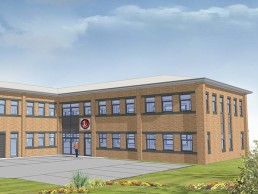
The Lighting Industry Association (The LIA) will officially opened its new laboratories facility on 8 March 2016. The facility is the culmination of many years of planning with lighting manufacturers, suppliers, retailers and wholesalers and will provide the industry with a cutting edge testing and certification service helping grow exports and improve product compliance.
Based in Telford, UK, at 12,500sqft this purpose-built facility is the largest facility of its type in Europe and houses the latest state-of-the-art testing equipment creating a UK wide, national testing asset for the whole lighting industry. Already employing over 20 staff and technicians, it is envisaged that the Laboratory will employ over 60 highly skilled personnel within the next two years.
This substantial investment was funded in part by the Government’s Regional Growth Fund. Along with the financial investment and that of the new technology the LIA will also be investing in key experts to ensure the industry continues to receive outstanding service, whilst encouraging those new to the industry to grow and develop.
The LIA Laboratories are the UK's largest independent ISO 17025 test laboratory dedicated to lighting and an ISO 17065 (product certification) National Certification Body. With the lighting industry changing dramatically and new advances in technology coming to the fore it seems almost daily. The LIA’s new Laboratories facility is built for the future and can provide the testing services the industry expect and require to ensure their products are compliant both in the UK and abroad. The Laboratories are also equipped with a variety of certification schemes to help strengthen the products, out there in the market.
LIA President Alasdair McRury (Holophane) and Councillor Leon Murray MBE, Mayor for Telford and Wrekin will join LIA CEO, Steve K Davies in officially opening the LIA Laboratories facility.
Zumtobel Group receives iF gold award
(Austria) - Designed by artist James Turrell, Zumtobel Group's 2014/15 annual report impresses jury in Communications category.
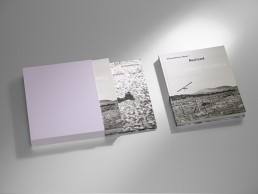
Zumtobel Group's 2014/15 annual report, designed by the artist James Turrell, has been awarded the iF gold award 2016 in the Communications category. From over 5,000 submissions, the Zumtobel Group's annual report has, together with 75 other entries, thus made it into the TOP selection of a high-class, international jury of experts and has therefore received the iF gold award 2016. The awards were presented last Friday at a ceremony at BMW Welt in Munich.
The annual report by the light artist James Turrell joins Zumtobel Group's 24-year series of artistically designed books, which have been collectors' items for many years already. The annual reports are created in collaboration with high-profile artists, architects and designers.
Zumtobel Group grants the artists great freedom, and they are released from all CI requirements. The connecting element between the artist and the company is however always the fascination and the complexity of the subject "light" and the rootedness of the designers with regard to Zumtobel Group's business environment.
“In this annual report, Zumtobel decides to present the data sets in a short, concise and objective way, printed on pink paper. Apart from that, the company leaves the field to artist James Turell, who has created an excellent book on his light-and-colour projects, subjects that match, of course, the company’s focus. However, the degree of freedom with which the subjects are treated is absolutely fantastic, as is how authentic they are, and this again reflects well on the company," was how the 58-member jury explained its decision.
The James Turrell's decorated annual report is entitled "Extraordinary Ideas – Realized". The work depicts important installations by the artist from all periods of his work, accompanied by essays by – and interviews with – some of Turrell's colleagues and friends. The graphic concept is by Lorraine Wild of Green Dragon Office, Los Angeles. The Munich photographer Florian Holzherr – with whom James Turrell has had a longstanding collaborative relationship – is responsible for the photos. Many of Turrell's light installations were photographed for the first time by Holzherr for the purpose of this annual report.
"We are especially pleased about being honoured with the iF gold award, and it acknowledges the uniqueness of our annual reports. The report by James Turrell, with whom the company has been closely linked for years, is a very special one for us too. Turrell's artistic work explores the individual's perception of light in a fascinating way," explained Astrid Kühn, VP Global Communications Zumtobel Group.
Zumtobel Group's annual reports are no strangers to renowned awards and international prizes, including Anish Kapoor's report and "Brighten the Corners", which won the 2014 iF communication design award, and received the gold award at the ADC Art Directors Club New York in 2013, and gold at the German Art Directors Club Awards, besides other prizes for design. SANAA's Kazuyo Sejima and Ryue Nishizawa received the red dot award – communication design 2012 for their 2010/11 annual report, as well as first place in chromolux's "more with less" challenge. Snøhetta – the book by Kjetil Thorsen – was named "most beautiful book of 2015", in Norway. Christian Boros, Berlin, was awarded the Red Dot Grand Prix Annual Report for his 2009/10 annual report. The list of renowned artists continues: for example, David Chipperfield Architects, Olafur Eliasson, Hani Rashid, Appelt, Studio Achermann and Stefan Sagmeister.

Acolyte and Lucibel open Hong Kong office
(China) - American and European LED lighting manufacturers join forces to offer full line of LED products to Asia market.
Acolyte and Lucibel, two LED lighting manufacturers, are joining forces in a new Hong Kong office to offer Acolyte’s American brand of linear lighting and Lucibel’s European brand of Panel Lyte, track lights and down lights to the Asia market. These two brands combined can now offer a full line of LED lighting products to the specification and distribution markets.
For existing customers it is business as usual, but now the new exciting product offering is much broader and the selections more colourful. Acolyte brings RGB, RGBA and RGBW along with variable warm and cool white lighting LED technology. Acolyte manufactures the complete solution from LED lighting to power supplies and controls. These products now allow both Acolyte and Lucibel LED lighting to be controlled by one system, creating the total LED lighting solution.
By joining forces, the full range of products will be sold through one local sales team providing better service and a much broader range of products.
www.acolyteled.com
www.lucibel.asia
Tridonic and Panasonic reach patent agreement
(Austria) - License agreement strengthens IP position and provides extended freedom-to-operate for future growth of product portfolios.
Panasonic Corporation, Japan, Panasonic Lighting Europe, Germany and Tridonic & Co - a manufacturer of lighting components and part of the Zumtobel Group - have announced that they have entered into a patent license agreement. With this agreement the parties grant each other a license to use certain patents in the field of lighting electronics, mainly in the field of control and operation of LED light sources. The specific terms of the settlement will remain confidential.
This agreement will help the parties to accelerate R&D activities for creating new innovation and to push further growth of the LED lighting market. It gives both companies the freedom and opportunity to develop products and solutions in order to better service their customer needs in the fast changing lighting world.
"We are delighted with this important license agreement with Panasonic. It enables us to bring new products and technologies even faster to the market and further to provide a higher IP protection. This patent license agreement is one of the most wide-ranging in the history of Tridonic and strengthens the IP-position of the brand Tridonic and thus as well of the whole Zumtobel Group," said Alfred Felder, CEO Tridonic.
"Intellectual property rights are gaining increasing importance in the lighting industry. Together with our mother company Panasonic, we are very happy about this patent license agreement with Tridonic, which provides extended freedom-to-operate for the future extension of our product portfolio,” said Klaus Breisch, Managing Director of Panasonic Lighting Europe.

Fulham expands into Europe
(USA) - To spearhead expansion, global supplier of lighting components and electronics appoints Mark Needham as new Vice President, European Sales.
Based in the UK, Mark Needham will oversee Fulham’s growing European presence, focusing on its intelligent LED drivers, modules and emergency LED solutions along with UV and other specialist lighting gear. Needham will have the full backing of Fulham’s global operation, which engages in product innovation and manufacturing, employing 800 people in North America, the Middle East, Europe, and Asia.
Commenting on Needham’s appointment, Mike Bauer, Vice President of Global Sales for Fulham said: “We are delighted that Mark Needham has joined our company with his long and deep experience in the lighting industry. His position is key to our company growth as we expand our presence in European countries and he will be instrumental in introducing some exciting new products that we are about to launch worldwide.”
Needham has over 25 years experience in the lighting industry and an extensive background in sales, having most recently spent seven years as sales director for Venture Lighting Europe. As a result, he has much knowledge of doing business in European countries and an understanding of their different needs. Needham commented: “This is an exciting new challenge with the Fulham Company to establish and grow their position in Europe with such a high quality and advanced product range for ‘tier one’ lighting manufacturers. I look forward to strengthening existing relationships, introducing Fulham to more of the mainstream lighting manufacturers, and appointing key agents in each country.”
Examples of Fulham’s technology are reflected in two recently introduced products. The HotSpot Plus is an all-in-one unit combining a dimmable LED driver, an emergency LED driver and a replaceable battery. Fulham’s WorkHorse LED driver is a fully programmable driver that replaces numerous variations of fixed output drivers and is a smart solution for greater LED efficiency.

Kerem Asfuroglu
Having recently been awarded the PLDR Best Newcomer award Kerem Asfuroglu talks to mondo*arc about his inspiration and his work as both a lighting designer and graphic novelist.
How did you get into lighting design?
Curiosity. Anyone who is keen on understanding the ways of altering perception will eventually find themselves exploring the alchemy of light and shadow.
Why did you join Speirs + Major?
Passion. I became familiar with Speirs + Major’s work while studying my masters course at Wismar University. I was only a student when I first saw my future directors Mark, Keith and Jonathan present together at PLDC, Berlin. Clearly the quality of their work was outstanding but that was not what got to me – it was their explosive energy and passion. I said to myself, “I want to work with these guys.” It’s been five years and I’m still a happy member of this family.
What do you enjoy most about your job?
Storytelling and creative freedom. I love stories - who doesn’t? If you think about it, we have massive film and music industries that are built on this. From way back in the distant past when we gathered around the fire to shelter from the dark of the unknown, stories have spoken to us, cutting across social and cultural differences. As lighting designers we get to tell stories of people and places using brightness and darkness. Playing with such an ethereal medium while creating a physical manifestation and a visceral effect is something that still blows my mind sometimes. You may have the courage and talent to tell a good story yet lack the freedom to speak. That comes with working with the right people and for the right people. That said we must also be mindful that there are limits to what we can convey with light, just like light itself has a limit in its speed. After all, what does a rainbow mean to a blind person?
What’s a favourite project you’ve worked on up to now?
Light Echoes. I have been lucky enough to work on many fantastic projects of varying scales while I have been at Speirs + Major - from Covent Garden’s site-wide lighting improvement through to Shakespeare’s New Place in Stratford Upon Avon. Often though, I find that the real champions are the tiny projects - the ones that no one has ever heard of. In 2013, a group from Speirs + Major worked on a temporary light installation for Canning Town’s Light Night. It was an interactive sound and light piece composed of a ring of nine tom-tom drums. We located these drums under the A13 flyover where we had the luxury of finding a pocket of well-preserved urban darkness to play with. Light was projected through the water filled drums. When they were played, the water in each drum was agitated, producing pulsating patterns of light on the underside of the flyover.
You were recently awarded the PLDR Best Newcomer award. How pleased were you about this?
Over the moon. It is great to be recognised for something I consider to be a compulsive disorder that I am wired with. The list of people to thank for getting me there is far too long. There is a sense of overwhelming contentment when people appreciate you for being you.
You are also a very talented graphic artist. How did this develop?
Comics and films. I read a shit load of comics when I was a kid. They took me to an alternative reality where things were less lucid. This is what happens when you are brought to see The Terminator at the age of three by your Grandma, who is the craziest artist I’ve ever known. I still get inspired by her flaming passion for creativity.
Your artwork has been published in mondo*arc and it was used for the 2015 darc awards. How good is it to see your work published?
Fantastic. Comics are like a type of meditation for me, they provide a place for my imagination to run riot. I’ve been amazed at how supportive people have been about the crazy decision of mondo*arc to include two pages of comics in the magazine. Boldness of the magazine has given me a chance to communicate my influences to people. Good or bad, people have an opinion about it. This is what I love about art. It’s approachable but viral.
So lighting designer or graphic novelist? What’s the future?
Unknown. I really enjoy my job but I also get most of my inspiration from things outside of the lighting world - from science, art and literature, to music and comics. I can’t help but think that the moment you put a title on yourself, you potentially close off interesting and exciting new avenues. Regardless of how I express my view, I hope that I’ll constantly be exploring the issues that move me.
Paule Constable
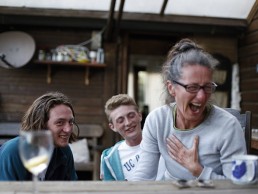
Winner of four Olivier awards and two Tonys, Paule Constable is a lighting designer who needs no introduction. With work spanning a broad catalogue of opera and theatre productions, her stripped back approach to lighting design has earned global recognition. mondo*arc caught up with Constable, after a showing of The Curious Incident of the Dog in the Night-Time, to talk about light and its ability to adapt.
Growing up in a military family, lighting designer Paule Constable has moved around all of her life. The need to make friends quickly and the peripatetic nature of this lifestyle made theatre attractive to her. Although it may seem like a somewhat unlikely correlation, Constable explains: “It’s amazing how many military kids gravitate towards theatre.”
Like many young and brilliant minds, Constable studied an eclectic mix of arts and science subjects through school, culminating in A-levels in Maths, Physics, English and History of Art. “I didn’t know what to do next. Originally I was considering architecture, then I thought about engineering but in the end I decided to do an English degree,” says Constable. The English degree in question she pursued at Goldsmiths College in London, which at the time - in the mid 80s - was a hub of creativity, producing the likes of Damian Hirst, under the guidance of Dean Richard Hoggart. Invigorated by the artistic essence of the institution, Constable changed after a year to a combined English and Drama course because “...it was just a better course for me,” she explains.
During her studies Constable went through the motions of wanting to become an academic or a director. However, during a real-life piece of theatre, her flatmate - a stage manager at the time - fell madly in love and ran away to Spain. Seizing the opportunity, Constable pretended to be her, took her job as a follow spot operator and turned up at the Hackney Empire to announce “I’ve no idea what I’m doing”.
After doing a lot of climbing when she was younger and having never been frightened of heights, she was immediately happy amongst theatre’s stage rigging and equipment. Constable explained: “Because of A-level Physics I could rewire stuff and I loved the creative aspects of lighting. It discovered me really. I worked in the music industry for a few years, then experimental theatre and devised theatre. I simply followed my nose.”
In that time, academic study of lighting was rare and the route into the industry came from people who were working as electricians. Learning on the job, Constable followed the advice of a couple of key designers who mentored her. After being in the industry for a short time, she realised that it wasn’t just the technology that interested her but also the storytelling of lighting. “I already had an academic strand to my life with an English degree and a love for literature, as well as a very practical strand and I didn’t want to do something that was purely one or the other.” It was at this point that she realised design was the missing piece to her puzzle.
When asked about her influences along her journey to success as a lighting designer, Constable responds: “Through learning, there have been people who have been very influential to me. Through looking at other people’s work and realising it was different, particular and special.” More specifically, she cites Germany’s Wolfgang Goebbel, who created a very different aesthetic to anybody on the UK stage, as well as Jean Kalman from France. These people, along with many others, made Constable realise that light could be more; it didn’t have to be purely functional.
In her own projects, she worked with a lighting designer in the UK called Stevie Whitson who was very experimental after coming from La Mama theatre in New York. “I worked with him and helped him out a lot. He was completely anarchic and brilliant. He made you believe that light could do anything,” she explains.
In addition, Constable draws inspiration from cross-discipline sources, finding reference material that unlocks her creative vision in sources such as American photographer Gregory Crewdson. “He uses light in a very particular way, it is so resonant.”
Lighting is a very diverse medium, from theatre to architecture it can be manipulated to impressive effect. Constable attributes its creative value to the feeling that “there is something about working in a landscape that is not necessarily understood, seen or overt. Something about the subversive nature of it. It’s not concrete and not right or wrong; it is incredibly lyrical but also literal. It’s so many contrasting things”.
As a great lover of the outdoors and, more specifically, an obsessive fell runner, Constable’s appreciation for light and the way it interacts with landscape, people and space runs deep. “Even if you’re working in a tiny space, you have to find a sense of why light is there; working in a medium that is never entirely finished, it is entirely illusive,” she adds.
This philosophy runs through into her lighting of theatre. For example, shows such as The Curious Incident of the Dog in the Night-Time doesn’t use traditional scenery to tell the story, but instead uses gesture and lighting to create the impression of a room with nothing. Based on long collaborative relationships between the team behind the show, the result is a spectacular display of light, sound and interaction. “We began with a floor of LED pixels in a grid. We wanted to make it an experience for the audience, a journey they went on with Christopher – the lead character,” explains Constable. With the focus on stimulating the audience and to reflect Christopher’s state of mind, the team looked at how the space would respond. Therefore, allowing the stage to become the inside of his head. Based on the protagonist’s immaculate attention to detail and fascination with his surroundings, the team thought he would love technical theatre, lights and equipment. With this in mind, they came up with the idea of a square and then Constable created the idea of having a pixel grid of LEDs and RGB light boxes, which are used to represent objects throughout the performance. “I wanted to reflect the same above him, to create Christopher’s world, his machine. You feel as if you are creating the show with him, creating an immersive experience for the audience.”
As a member of the audience you understand the rules of the space within the first ten minutes. There is a collective sense that you are going to share something with the actors. This is achieved, in the most part, by a stage brought to life through intelligent lighting and the diversity of LEDs. “When we first started making Curious Incident, LEDs would flash on and the story would get lost as it felt as if the lights were doing something to him rather than with him. We had to make sure that it felt like he was making it happen - a brilliant conversation between mediums,” comments Constable.
Her commercially successful shows such as The Curious Incident, War horse and Wonder.land, which travel the world or appear on Broadway, obviously attract the most media attention. However, Constable’s favourite show of last year was a production of Wozzeck – the opera – in Chicago. “It was a piece I’d never done before; based on an 18th century German play by Buchner, written by Berg as a response to the First World War. Incredibly modern, short and episodic, it’s really angry. We did a stripped back version of it designed by Vicki Mortimer – a close friend and colleague of mine – and directed by Sir David McVicar - someone I have worked with for 20 years. The coming together of the piece, the creative team, the cast and the space made for a great production. All in white, it was hard, brutal and really stripped back. At first I never thought it was going to work but in the end we got close to something that really landed with the music,” says Constable.
When comparing theatrical lighting and architectural lighting, the link may seem unrelated. However, Constable believes that the understanding of light and its application is universal. Citing the work of Speirs + Major, she says: “I’ve always really loved their work because it’s story driven. I love their relationship to landscape and talking to them, I was fascinated to see how similar their thinking was to mine. I look at architectural lighting design, particularly in interiors - it can be quite functional or it can be quite transcendent. Their work for me feels like it wants to do both things. You go into their spaces and you feel different – your senses wake up.
“The area that people such as Olafur Eliasson and James Turrell are exploring is absolutely the area that concerns me. Then there are people who objectify light like Dan Flavin – even though his work is still about colour balance. I think this is true with architectural work, you can see there are places where people are really telling a story with a space or places that are rudimentary and functional. Similarly in theatre, say with musicals, the lighting often has to create rhythm and shift the space in a very overt way - not working from the inside but imposing an agenda on a moment. This to me is objectified lighting - it has a strong external hand. As in offices, when it needs to be functional, compared with places that need to be stimulating.”
The road to success is often described as a bumpy one and Constable’s has been no different. “Being female and having children has been tough. The weird thing about lighting is that people can use the idea of technology as a weapon against you. Being an electrician, my technical knowledge was quite good. But now things change very quickly. I use the technology to be creative but I can’t talk to you about the technical minutiae of how we manage data in say Curious Incident. It is about learning that you don’t have to be able to do everything. Originally, I would hang my own lights and do my own programming. That can be a problem for young people to come into the business,” she explains.
Constable went on to describe a brief encounter with the V&A museum that opened her eyes to how light can be interpreted in space. “One thing I think is interesting about architectural lighting design, I discovered during a brief encounter with the museum. They were scared by the way I think about light. I wasn’t thinking about lumens, functions, labels and walls. I was thinking about light as a dynamic, story-telling thing. I realised that I was the wrong person for them to be talking to. With my work, I can start with nothing but I don’t think in architectural work anyone can really do that. I don’t think of myself as much of lighting designer, as someone who works with darkness. That is a very different discipline.”
Aside from ups and downs, Constable has received four Olivier and two Tony awards for her work in lighting. Within an industry that is male dominated, achieving this level of public recognition has been a highlight in her professional career. “I am the only female senior lighting designer in this country who has global recognition - partly because I do a lot of opera. In a world where role models are really important, winning awards is great to prove to people that it is possible. In terms of gender balance within my own teams, most of my favourite programmers are women. They tend to have a very level head in that particular role. Being in a position to champion them is really important,” she explains.
Constable pinpoints the beginning of her journey to success to a pivotal moment when she became the first woman to light a show at The National Theatre in 1993. “That is pretty shameful but I suppose that was the start of a big journey for me as I’m an associate director there now,” she says.
Another significant moment in her career has a very heart-warming story behind it. When working at the English National Opera, after just winning an Olivier award, the stage manager told her that she must bring it in the following week. On Monday, much to the manager’s surprise, the award was nowhere to be seen. “Where is it?” they said. “It went to show and tell with my kids,’’ says Constable. “They are nineteen and seventeen now but back then they must not have known what the bust of Olivier even meant.”
Her success and recognition within the industry is often attributed to her unique process, which tends to be simple and stripped back. “It’s kind of Amish,” explains Constable. With a simple, clear and honest approach, the focus remains on the right idea, light, the right moment to not feel obliged to do everything and the right moment to release a particular story. “My work doesn’t use a lot of saturated colour but I’m really interested in height and naturalism – ideas that come from a reality. I like stripping back to a truth and then heightening that,” states Constable.
What is apparent through lighting, whether it is theatrical or architectural, is that lighting designers share the same foundation of skills. These shape how people experience, perceive, feel and immerse themselves in space. There are so many ways to experience space and that becomes the common ground between all lighting designers. “Learning to look is the secret we share. The public don’t obviously always notice or perceive light. I was recently in terminal five at Heathrow, when my plane was delayed. I walked through the subway and the way the LEDs are used is really beautifully put together. You walk through the tunnel and you feel like you’re in a Sci-Fi movie - it is alive. It has been done thoughtfully without feeling suppressive. Even a small detail like that, you do it properly and it can make people’s travelling more enjoyable.”
Whether it is in theatre, architecture or any other environment, this anecdote encapsulates what designing with light can create. Just like in Heathrow’s terminal five, with thoughtful design, even simplistic lighting can deliver a grand impact.
Pic: Lulu Ladd
Yoshi Tsukamoto
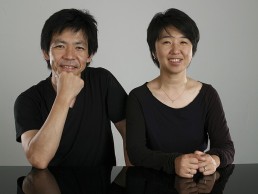
Last summer, as part of the iGuzzini and MAXXI Architecture collaborative project Light On, Yoshi Tsukamoto, founding partner of Tokyo-based architecture studio Atelier Bow Wow, discussed his design principles in the context of light. mondo*arc caught up with Tsukamoto to discover the inner workings of his process, applications of behaviourology and the beauty of vernacular architecture.
In the summer of 2015, iGuzzini and MAXXI Architecture - Italy’s museum of contemporary art - collaborated on a new project entitled Light On. The project consisted of talks from four major international architectural firms, including discussions of their work and the topics, themes and contexts defining their professional careers. Each designer offered a contemporary point of view on the relationship between form, technology and light.
The second event saw the exhibition of Yoshiharu Tsukamoto, founding partner of Japanese studio Atelier Bow Wow. In a conversation with Adolfo Guzzini, President of iGuzzini illuminazione, and Pippo Ciorra, Senior curator MAXXI Architettura, Tsukamoto presented the studio’s projects and explained the inspirations behind each in the context of light.
Atelier Bow-Wow is a Tokyo-based architecture firm, founded in 1992 by Tsukamoto and Momoyo Kajima. Born in 1965, Tsukamoto studied architecture at Tokyo Institute of Technology and then on to Paris, at L’Ecole d’Architecture de Belleville. Following this, in 2000, Tsukamoto became an Associate Professor at the Tokyo Institute of Technology. Born in Tokyo in 1969, Kaijima studied at Faculty of Domestic Science at Japan Women’s University and at Tokyo Institute of Technology. She also studied at Eidgenössische Technische Hochschule Zürich (ETH). By 2009 she became an Associate Professor at the Art and Design School of the University of Tsukuba.
Atelier Bow Wow distinguishes itself from the most prestigious Japanese studies thanks to the duo’s investigative work of behaviourology. It is Tokyo’s environment and architectural landscape that characterises its research - an investigation of micro-architectures that tries to give logical rules to the urban complexity of modern cities. Having published Tsukamoto’s investigations in Made in Tokyo and Pet Architecture, the studio focuses on the role of architecture in the 21st century, attempting to apply principles of its research drawn from existing examples and altering them to create a new reality.
Faced with the evergrowing population of Japan’s core metropolis, the main focus of its priniciples is centred around the use of space, its sharing and employment. For example in residential buildings such as the studio’s office / living space, partitions are often removed to create a continuous but organised space, where stairs and landings are used to emphasise the continuity.
“Instead of making a strong partition between rooms we use the sense of occupancy to give a subtle articulation in the continuous space,’’ explains Tsukamoto. ‘‘So as you walk around you encounter different types of occupancy. This is interesting because it means we need the help of the users to achieve our intentions.”
The studio’s anthropological approach looks to create architecture without architect but with people, known as vernacular architecture. In the context of lighting, the studio’s work makes reference to Junichiro Tanizaki’s revered book In praise of Shadows, which describes the western world in favour of dazzling lights, and the east traditionally in favour of shade and shadow in interiors.
Using this, its work looks to find the balance between the traditional and the ultra modern based on how people, material and weather behave. After studying these behaviours, all considerations are integrated into one physical entity, creating architecture that reflects the people it is designed for.
Tsukamoto attributes what he calls a “failure of Twentieth century architecture’’ to viewing groups of people as mass numbers rather than individuals. “Twentieth century architecture became a very visual art when it should be both very beautiful and have delightful behaviour,” says Tsukamoto. With this in mind, he has reintroduced vernacular architecture in his home city. Tokyo is a metropolis of houses so it speaks to its surroundings, acting as a point of contact between inhabitant and environment – an ideal setting for vernacular architecture and the implementation of behaviourology.
He believes that all skills and behaviours are important to observe in order to give identity to particular groups of people. It is within the study of human behaviours that the power of light becomes apparent. “Light is a very important agent based on its natural discipline,” states Tsukamoto. His idea of space interrelates the behaviours of both humans and objects. Therefore light is investigated as one act of behaviour, as our behaviour is influenced by lighting conditions.
During an interview with mondo*arc, Tsukamoto told us first hand about his experiences and inspirations, discussing the importance, impact and use of light in architecture. He considers light as “the central natural element that behaves in and around architecture. From this behaviourial point of view, lighting can become other natural elements in architectural design, even if it is artificially created.’’
His approach to lighting is appreciative of the way it behaves as well as its practical function. Tsukamoto explains: “Of course it’s important to light the space and its objects with an appropriate amount of light, but beside these functional concerns, the behaviours of light, such as reflection, creating shadow, projection and so on, are very interesting to my design process in architecture.’’
He argues that light has its own behaviour based on the physical principle itself. More importantly, it is the fact that you can’t change the physical principle that makes it exciting to play with the behaviour of light through architecture. From this, Tsukamoto explains: “you can make light tangible through architectural design”.
As with many things in architecture, light and shadow are two sides of the same coin, with the latter being another element that behaves in and around architecture. Produced by the interaction between light and architecture, shadow and darkness “are the powerful means that create a heterogeneous condition in the space; also providing a means to give depth to facade’’.
When asked about Tokyo and the role of light in cities in general, Tsukamoto passionately described light as “something that moves. Sometimes it appears and sometimes it disappears. It gives the sense of movement and rhythm of a city’’.
Atelier Bow Wow’s work is incredibly diverse, ranging from an outdoor canal swimmer’s club in Bruges, Belgium to the Izu Book Café in Shizuoka, Japan and the Four Boxes Gallery in Skive, Denmark. Two very different but very interesting examples of its work – the BMW Guggenheim Lab and the Kitamoto Station Plaza – showcase how lighting complements architecture to produce social environments that understand human behaviour.
When asked to explain the lighting of the BMW Guggenheim lab in Mumbai, Tsukamoto says: “The lighting was incorporated in a theatrical manner.” The part urban think tank, part community centre and public gathering space, travelled globally to inspire new ways of thinking about urban life. During the six weeks of its Mumbai presentation, the third stop on the project’s global tour, organised in collaboration with the Dr Bhau Daji Lad Museum, the Lab offered 165 free programs over 29 days, including design projects, surveys, tours, talks, workshops, and film screenings. The central location of the Lab was on the grounds of the museum in Mumbai’s Byculla neighbourhood, making it available to a wide range of audiences and communities. This is a perfect example of how Atelier Bow Wow’s principles can apply universally, even to external, semi-permanent architecture, creating an interactive space where lighting plays a crucial role.
At the Kitamoto Station Plaza in Saitama, Japan, the lighting was limited as much as possible to make pedestrians as visible as possible for drivers. With this in mind, “very small but powerful downlights were set in the ceiling, lining along the edge of the pavement,’’ says Tsukamoto. “Combined with uplights set into the pavement, illuminating the ceiling that is finished by locally sourced wooden planks. In doing this, reflection from the ceiling is coloured by the light, taking on the wooden colour.” In summary, for Tsukamoto light “is very important since it is the central element investigated in behaviourology”. This is apparent in all of his work, which plays on the diverse condition of light - sometimes bright, sometimes dark - to create conditions for people that suit different behaviours, creating a collision between the shadows of traditional Japanese interiors and the artificial light of the modern age.
Noticing that human behaviour can be influenced by natural behaviour - for example, when shadow in the summer gathers people together – Tsukamoto believes the same influence can be implemented with light in architecture. His designs look to create spaces that become a more complex place of experience, with an interest in light and its interactions with other agents.
Although, traditionally, Tsukamoto’s cultural background doesn’t pay much attention to lighting buildings at night, (until neon light arrived from USA, when places like Tokyo became flooded by neon) people are now beginning to light rooms the western way with spotlights, for example. However, he still argues that there isn’t enough atmospheric light and that strong lighting isn’t necessary everywhere. For example in Norway, they have abolished the subject of lighting streets, highlighting the importance of shadow.
Yoshi Tsukamoto and Atelier Bow Wow offer an approach that creates a meaningful environment to live in – a place to share that creates social interaction between its inhabitants. The studio’s philosophy appreciates the fact that behaviours and their natural discipline can’t be changed. With this, it prioritises the shareable aspect of behaviour as a very important resource in architectural design, creating a synthesis between the behaviour of such things as light and the behaviour of people to result in un-institutionalised space. Put simply: “The idea of behaviourology can apply everywhere, it isn’t specific to any culture or country but is a universal principle / school of thought that can be utilised in all areas of architecture,’’ concludes Tsukamoto.
Pic: Courtesy of Atelier Bow Wow
Levity, Netherlands
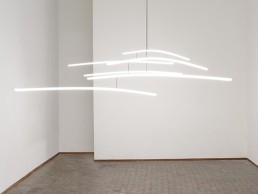
Combining light, sound and movement, Henk Stallinga's Levity exhibition at Gerhard Hofland Gallery in The Netherlands transforms product design into sculptural works of art.
Dutch visual artist and designer Henk Stallinga lives and works in Amsterdam. In 1993 he graduated from the Rietveld Academy, after which he opened his own studio that is co-owned by management partner Annemarie Galani.
Although he doesn't consider his product designs to be fine art, parts are often transformed into conceptual multimedia installations and sculptures, which exhibit recurring themes such as a minimalistic visual language, light, sound and movement. For example, the Levity exhibition at Gerhard Hofland Gallery in The Netherlands, consisting of the light installation Lumen Balance, the series Breathe In Breathe Out - wherein paintings are combined with tube lights - and the installation A Couch to Match the Painting.
The concepts behind Stallinga's works are often based on our awareness of the everyday world around us, like sense of time, sonorous and visual perception and experience of energy in the form of light, heat or movement.
In the light installation Lumen Balance, lamp tubes float in the gallery space as naturally moving mobiles. These tubes create various hues of white light, in which visitors can recognise the hourly and seasonal changes in daylight. Stallinga plays with the perception of light by making the viewer aware of the influence that light has on our perception of time and our sense of warmth, simultaneously showing light as an energy that moves.
Light also plays an important role in the series Breathe In Breathe Out. By hanging circular lamp tubes that are strung together in front of a canvas, Stallinga literally frames light. Like a painter he attempts to direct light and dark to achieve a visual illusion. By varying the light's intensity or by partially covering the lamp tubes, forms and depth optically emerge. The subtle brightening and dimming of the light creates associations with the rhythm of breathing. It is this visual game with physical and optical patterns, realised through ingenious programming and production, that makes the artist's work intriguing.
Stallinga's installations are part of several permanent collections, including the Museum of Modern Art in New York, Fonds National d'Art Contemporain in Paris and the Stedelijk Museum in Amsterdam. He is currently working on a major solo exhibition in Japan that opens in 2017.
Timeless Elegance, UK
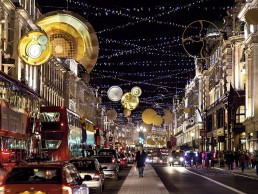
A London Christmas premiere for 2015, 'Timeless Elegance' is an immersive light art installation designed by ACT Lighting Design illustrating the concept of the suspension of time.
The first edition of Timeless Elegance, a light art installation signed by ACT Lighting Design's creative team, marked the beginning of the 2015 Christmas season on the prestigious Regent Street in London.The Philharmonic Orchestra, conducted by Nicholas Dodd, played a musical piece by Pierre Mussche from Musicom, which was composed specially for the occasion.
Koert Vermeulen, Principal Designer and Julie Boniche, Artistic Director at ACT Lighting Design created the Christmas lights - programming the lighting, video animations, and projections to accompany the musical composition.
On the hour, every hour, visitors were treated to an exclusive compilation of video projections and programmed lights that brought the sculpture to life. This ambitious dynamic installation was designed to evolve in time to reflect the brand values of Regent Street and convey its atmosphere of glamour during the festive period.
ACT Lighting Design's concept was a sculpture of time – nowadays a genuine luxury. The lighting team illustrated the concept of ‘suspension of time;’ by showing each element of an enchanting innovative clockwork mechanism, which paved a suspended ‘golden way’ for the visitors. The proposal was to rediscover the festive season of Christmas with a new artistic perspective and a touch of avant-garde.
For the first time in London's festive illuminations, ACT Lighting Design imagined a challenging lighting scheme with a custom created combination of video projections, dynamic pixels, tinsels of light and LED screens integrated into the decoration. The installation consisted of five distinctive decorative compositions placed at 9-10m high on the straight crossovers and repeated randomly all along Regent Street (800m x 25m) in intervals of approximately 50m.
Each composition included a series of 24 elements as an interpretation of the clockwork pieces. These elements, made of metal, were scattered along the street with a systematic application of basic and special elements together with connection pieces. In order to obtain the most appealing look during the day and various visual effects by night, each of those elements differed in style, surfaces and specific colour codes (yellow, rose gold and lead metal).
In addition to the compositions, and especially in the diagonal crossovers, tinsels of light with small glitter diamond shapes (approximately 100mm x 200mm spaced every half metre) filled the atmosphere moving freely in the breeze and reflecting the light rays, further creating a golden immersion.
The lighting scheme was based on a combination of video projections, dynamic pixels, tinsels of light and LED screens integrated into the decoration. The largest elements of the composition served as the projection surface for the scenography and unique video content.
Custom-created video animations were projected in a loop during the evening hours, featuring crystallised textures and engraved textures of the watches and gift boxes with Christmas greetings. Each hour, visitors could discover the main attraction of a tailored spectacle featuring an exclusive compilation of video projections and programmed lights. Five different video storyboards enhanced the structure with visual and lighting effects.
All visual elements (video projections, LED RGB lines, LED pixels and the custom LED screens) were controlled by DMX and Artnet. A fibre optic gigabit ring network was implemented to program, control and monitor all the lighting and video elements. The light art installation and its main spectacle was on show until 4 January.
Pic: ©2015 ACT LIGHTING DESIGN - photo by Tomasz Kozak - all rights reserved
