
Less is More with David Morgan
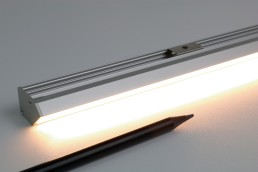
The latest discreet architectural lighting fixture from KKDC, produced earlier this year, is the TANA Asymmetric. David Morgan puts the angled linear luminaire under the microscope.
KKDC has always focused on the ‘less is more‘ approach to luminaire design, with the development of miniature linear LED lighting systems for installation into discreet architectural details for high end projects.
The company was founded in 2005 by Jack Choo, who first encountered LEDs in the early 2000s while working for Toyoda Gosei in technical sales. He was able to persuade Samsung to use blue LEDs for mobile phone keypad back lights. In 2003, Jack and his brother Konkuk started a company to produce their own innovative LED arrays from scratch. Moving to Sydney, Australia in 2005, he founded KKDC to focus on the architectural lighting market. The company has since grown significantly with worldwide sales and a staff of around 100 people.
Research, development, and manufacturing take place at the KKDC R&D Centre in Seoul, South Korea. The company has 19 branch offices in major markets including a marketing and design office in the UK.
The first three KKDC systems, launched in 2005 and 2006: TIMI, MIMI and MOMO established the market niche for the company with small, well-engineered products for both interior and exterior applications. The 6mm wide Groove system was developed more recently based on a request from Philippe Starck as part of a hotel project to illuminate whisky shelving with the smallest dot free output luminaires.
The latest system introduced by KKDC earlier this year is the TANA Asymmetric.
The product name derives from the Japanese word for shelf and the original TANA system was an angled linear luminaire, designed by Tim Young from the KKDC Design House in the UK, for shelf illumination.
Apparently research with architects early in the life of KKDC had identified linear shelf lighting as a good potential market application that seems to have been an accurate prediction.
The TANA Asymmetric range incorporates a faceted extruded housing design with useful internal space for through wiring and connectors, an asymmetric linear optic and a new high output LED light engine.
KKDC design and development is undertaken as a collaborative in-house effort, with engineering design at the R&D Centre in Seoul and design input from KKDC Design House in the UK, plus global market feedback from KKDC sales branches. Jack Choo oversees the whole process and makes final decisions about timing and project priorities.
For them, the most challenging part of the luminaire development was the custom asymmetric lens design. This was designed in-house by the KKDC optical engineering team in Korea. Based on the test sample I was given to review, they have been able to produce a good quality textured extruded lens that produces an asymmetric beam without any significant striations in the beam or any colour over angle distortions or colour shifts. The beam does seem to split slightly between the major asymmetric beam and a secondary more vertical one.
The complete product development process took around two years, with much of the time devoted to the linear lens design and development.
The KKDC A Line LED light engine incorporates mid power 94 CRI LEDs on a 4.8mm pitch and the luminaire produces up to 2,970lm with 3000K LEDs and a power consumption of 30W/m. The range includes 2700K, 3000K and 4000K LED options with three-step MacAdam’s colour binning. The system works with a remote 24 VDC power supply and dimming options include 1-10V, 1-10V, DALI and DMX. The cutting module for the light engine is 38.46mm.
The TANA luminaires are produced with a nicely finished anodised satin silver aluminium extrusion, with the matching end caps fixed with neat machine screws. Available lengths range from 90mm up to 1,013mm. Concealed stainless steel spring clips fix the system to the mounting surface invisibly.
The company manufactures most of its components in-house either in Korea or in the UK. Aluminium extrusions are made with recycled aluminium and KKDC is aiming to move towards a circular economy approach.
The KKDC A Line light engine are constructed with FR4 PCB material, which is bonded to the extruded aluminium heat sink. As the company is moving towards a circular economy approach, the PCB material may need to change to aluminium, which can be recycled and the fixing method changed to allow easier on-site replacement.
The TANA range is a good quality system with an impressive light output for its small size. The asymmetric distribution provides a useful punch for use in applications including retail and display where high ambient lighting levels are required.

What exactly is “good quality” commercial lighting?
Natalia Duffy, Lighting Associate at Cundall, shares her thoughts on the best, most responsible, lighting for workspace environments.
Good lighting is not something people often notice immediately; our attention generally gravitates to architecture and interior design – unless, of course, you are a lighting designer.
Indoor lighting is a subtle yet pertinent element that complements interior design. Like a person in a nice outfit, we notice the person first and the outfit’s ability to enhance their beauty second. The effect of lighting goes beyond creating aesthetic spaces and allowing us to see. Light has been integral in shaping the trajectory of evolution and acts as a cue for activity and rest.
In contemporary life, the average office worker spends 60-70% of their lives in the office, thereby creating a responsibility for developers and employers to create workspaces that are healthy and encourage productivity. Light is proven to have a huge influence on our health and wellbeing, and as a result, lighting design cannot be left behind amongst the plethora of design considerations for a healthy office.
Gone are the days when offices were fitted with energy-guzzling, lacklustre tube lights that stayed at the same intensity for hours on end. They are not sustainable, nor healthy. Yes, our surroundings should be well lit, however, lighting should take advantage of the benefits of natural daylight and adapt itself accordingly. Such daylight design strategies involve relying on the available natural light alongside electric lighting. The trend is intuitive: when light is available externally, the reliance on electric lighting should decrease and in the darker hours of the day we shift to artificial lighting. This ensures spaces are well lit throughout the workday in a sustainable fashion as there is a lower energy need when natural light is available.
It might seem unlikely that such a minor design choice could have a significant influence on sustainability. Cundall’s Manchester and London offices conducted a study as part of the Building Energy Exchange’s Daylight Hour 2023 campaign, which calculated the energy saved when the lights were turned off for an hour. Turning off the lights for an hour in the Manchester office saved 9.19kWh, and in London it saved 28.32kWh. This equates to 2,307kWh and 7,108kWh per year respectively. Clearly, reducing the intensity of light for a few hours when it’s bright outside can have a considerable influence in reducing energy.
Employers may often be under the perception that keeping an environment bright throughout the day allows people to stay ‘awake’ and hence productive. However, how ethical is it to keep someone’s environment ‘well-lit’ for eight hours continually during each day of the working week?
Natural light, and its colour and intensity, varies throughout the day, and helps in the alignment of circadian rhythms. Cooler light colour temperatures are produced when the sun is shining at its brightest around noon, while warmer colour temperatures are emitted during sunrise and sunset. This influences energy levels through the day – with unconscious cues for staying active and resting.
In a workplace environment, where lighting is bright and constant, a lack of variation can negatively impact wellbeing, for example through burnout. To combat this, circadian lighting design strategies, where light intensity and colour temperature changes according to the time of day, are better for occupiers’ wellbeing. A lighting design strategy that alternates between cooler and warmer light colour temperatures can essentially imitate daylight by creating an outdoor light environment indoors.
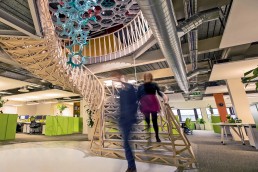
Cundall’s Birmingham office was designed to centre around a spiral helical timber staircase that is fitted with twelve spotlights, which follow the path of the sun through the course of the day. The result is a subtle change of shadows cast by the staircase around the office throughout the day – a good example of artificial lighting being used to imitate daylight.
The International WELL Building Institute has devised guidelines for lighting design to meet standards of comfort and wellbeing for occupants. The guidelines address the initial necessities of office lighting such as light that allows people to read and see clearly. Alongside that are considerations for ensuring people remain healthy, such as circadian lighting design strategies. When it comes to office lighting, striking the balance between productivity, wellbeing and sustainability is an important consideration. Ultimately, ensuring daylight is utilised to its maximum ability whilst simultaneously imitating patterns of daylight indoors seems a reasonable ideology for lighting designers. Using light colour temperature variations is a valuable tool to achieve this.
In terms of putting sustainability at the heart of lighting design, the best advice we can give as lighting designers is to do it right the first time and you won’t have to do it again. Once the occupants’ needs are satisfied and their wellbeing has been improved by a good lighting system, they are less likely to need replacing continually. The objective of investing in ‘good quality’ lighting is to ensure that we are designing sustainably, saving energy, and saving money as well.
Moreover, good lighting schemes must account for future proofing. In recent times, we have seen massive changes in how office spaces have been adapted to staff needs. The acceleration of hybrid working has created a new realm of opportunities for office spaces, with the introduction of breakout spaces, wellness rooms and collaborative workspaces amongst other things. When it comes to lighting, flexible or modular lighting systems that can be easily configured to adjust to changes in office areas or layouts can be a sustainable alternative.
With workspaces increasingly focused on staff wellbeing, elements such as indoor air quality and the creation of greener environments for mental wellbeing have been in the spotlight. However, lighting design must not be forgotten in the much-required push towards a healthy and sustainable office. Wellbeing and sustainability in lighting design need to work in tandem to create a holistic lighting system. Lighting designers have a responsibility to adapt and put people and their wellbeing at the heart of our design decisions, because ultimately, we are creating these spaces for people.
Landscape Forms - Northport
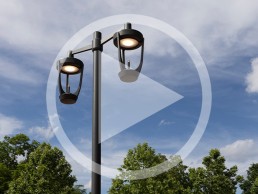
Northport, by Landscape Forms, pays homage to traditional street lighting, offering a warm and emotional connection to the past while also performing, looking and feeling at home in the present. Including a path light and multiple area light configurations, Northport luminaires combined with the collection's partner street furnishings offer designers a full suite of resources to program outdoor spaces ranging from charming streetscapes, to historic downtown districts, to parks and pedestrian promenades. Designed in collaboration with Robert A.M. Stern Architects.
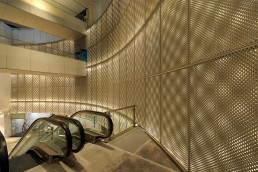
Singapore Land Tower, Singapore
In the heart of Singapore's bustling financial district stands the Singapore Land Tower, a 47-storey landmark poised for a remarkable transformation. This Asset Enhancement Initiative Project is poised to elevate the tower's prominence through a fusion of eco-conscious features, verdant public spaces, energy-efficient systems, and cutting-edge lighting solutions. Leading this project is Pritzker Architecture Laureate winner, Fumihiko Maki of Maki & Associates. The vision is steadfastly committed to reshaping the tower's identity, prioritising both environmental and social sustainability.
Despite the ongoing renewal of the Singapore Land Tower, part of the main lobby has recently been completed, unveiling the new design. Luxconex's SR Blaze Linear Wall Washer is at the heart of this the tower's regeneration, proving to be a testament to Luxconex's commitment to illuminating excellence. The lighting design for this ambitious endeavour was entrusted to Lighting Planners Associates.
The tower's grand lobby, a focal point of the transformation, boasts a captivating design concept. Curved and ensconced within two layers of perforated metal panels, it exudes an aura of sophistication. The magic, however, lies behind the perforated metal panels, a layer of mirror panels adds depth and intrigue. Within this intricate space, the SR Blaze Linear Wall Washer takes centre stage, creating an enchanting moiré effect – an optical illusion that dances with light.
The moiré effect conjured by SR Blaze Linear Wall Washer imparts an inviting entrance to the office lobby that seeps in grandeur appearance. As occupants and visitors step into this space, they are greeted not merely by light but by an immersive experience. The mirror panel, with its matte finish near the linear light, ensures the source of illumination remains hidden, casting a gentle glow.
One of the key features of Linear Wall Washer is its flexibility. It can be tailored to match the length of the panel module, seamlessly adapting to the unique architectural demands of the space. The product offers deep recessed LEDs mounting with a special honeycomb that does not need to attach any louvre, a practical solution that prevents glare from the LED light source, to enhanne the visual comfort of the space. Furthermore, the Linear Wall Washer also aligns with the tower's commitment to sustainability. It meets the stringent criteria of Green Mark Platinum certification, affirming its energy efficiency and eco-friendliness.
In the luminous journey of the Singapore Land Tower's renewal, SR Blaze Linear Wall Washer emerges as a shining star. It embodies the spirit of transformation, casting a brilliant light on the tower's promising future – a future where architectural prowess and innovative lighting solutions converge to create spaces that inspire and captivate.
www.luxconex.com
www.maki-and-associates.co.jp
www.lighting.co.jp

Light Collective announce Disruptia event in Mexico City
(Mexico) - Curated by Light Collective, Disruptia is a two-day event focusing on the lighting community’s place in the new era of technology in design. Disruptia will be held on 30 November, coinciding with Light Collective’s expansion to the city.
Held in Mexico City on the 30 November, where the group is opening a new LATAM branch with former collaborator Magali Mendez. Disruptia will be the first official Light Collective LATAM event and Mendez, who has worked globally as an architect and lighting designer with her own company, Saas Lighting in Mexico.
The programme includes keynote presentations from key disruptors in and out of the lighting industry, creating opportunities to learn and develop with expert think tank session. The aim is to bring industry and designers together to discuss ideas, problems, solutions, and ambitions in the technology focused event.
Disruptia will include international contributors of lighting design, product design, visual arts, architecture, neuro-architecture, theatre, material innovation, immersive experiences, AI, web 3.0, blockchain, metaverse and manufacturing.
The program includes the following: James Simpson from Copper Candle; Christopher Bauder from WhiteVoid; Juan Ferrari from Hoare Lea; and Tapio Rosenius from LDCOL, who will be contributing virtual presentations. Juan Carlos Baumgartner from Space; Kai Diederichsen from Luz en Arquitectura; Karina Lozano from Arquitectura, Entorno, Energía; Miguel Corella from Korela Innovación; Juan Rodriguez García, Independent Artist; Julie Conway from Illuminata; Dinorah Martinez from Manufactura; and Luis Ignacio Santibañez Wood from Cocolab will also be presenting in person.
Workshops will also be available for practical demonstrations alongside think tank session featuring Victor Palacio, Liliana Gonzalez, Cristina Escofet, Bianca Gonzalez, Lorenzo Marla, Juan Carlos Yurrit and Gabriel Esquivel.
For tickets go to www.subscribepage.io/disruptia
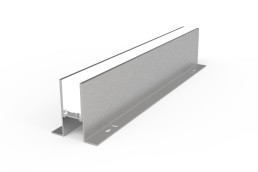
Licllab - ACQUA Linear
Designed to enhance outdoor landscapes, the AISI 316L Architectural Linear Recessed Inground fixture is crafted from linear AISI 316L stainless steel. The product seamlessly blends aesthetics and utility, featuring advanced LED technology and a built-in 24Volt converter. Boasting of IP68 and IK10 ratings, it ensures robustness and durability. This Italian-crafted lighting solution showcases the fusion of form and function, exemplifying artistry and innovation. Illuminate outdoor spaces with PERFIL AISI masterpiece, creating a harmonious balance between aesthetics and performance.
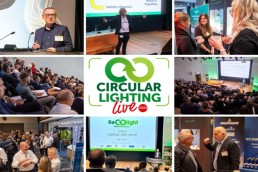
Circular Lighting Live 2023: Reuse of luminaires goes mainstream
(UK) - One of the key messages to come from the Circular Lighting Live 2023 conference in London last week was that the reuse of luminaires is becoming more normalised.
Circular Lighting Live 2023 included an exhibition by major lighting remanufacturers and sustainable lighting suppliers as well as presentations by clients who had reused luminaires. Such clients included Rolls Royce, Cambridge University, The Holburne Museum, Dublin Port Tunnel and Building Craft College.
The event, held in the main auditorium of the Royal College of Physicians in London, brought together 290 registered delegates for the most comprehensive review of circular economy progress in the lighting industry.
35 speakers and panellists provided a comprehensive review of the legislation, and actions that companies in the UK and elsewhere are taking to drive forward the circular economy. Presentations presented a clear message that remanufactured lighting products are no longer the preserve of just a few companies.
The conference was chaired and curated by Ray Molony, Editor of the Circular Lighting Report, and hosted by Recolight, the UK’s leading lighting WEEE compliance and circular economy scheme.
Recolight CEO Nigel Harvey said: “It was truly inspirational to see so many examples of organisations that are putting the circular economy into practice. The vital significance of the conference was thrown into sharp focus by the deeply disappointing announcement that the Government is watering down key climate action policies. It is clear given this lack of ambition; it is the corporate sector that must now rise to the challenge.”
www.recolight.co.uk
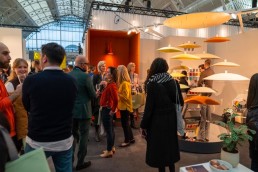
Workspace Design Show returns for 2024
(UK) - Workspace Design Show, the trade show that brings together the UK workplace design community, returns to London’s Business Design Centre for its third UK edition from 27-28 February 2024.
At the 2023 event, visitor number increased by an impressive 75% year on year with exhibitors from over 20 countries showcasing innovative and transformational workplace interiors products. Due to this success, 75% of stand space is already booked for 2024.
The organisers of the Workspace Design Show have unveiled exciting plans for the upcoming February event. This year, the show will revolve around the theme of Bloom: Exploring the thriving ecosystem of work life. One of the standout features will undoubtedly be the raft of collaborations with renowned architects’ practices, promising an unforgettable experience for attendees.
Workspace Design Show allows an opportunity for architects, designers, occupiers, developers, consultants, coworking companies and fit-out companies to explore the latest industry trends, see the latest products as well as find inspiration in the talks programmes.
Gurvinder Khurana, Director of M Moser Associates said: “I would highly recommend attending the show next year, it is a brilliant chance to learn and to meet many people through a shared interest in the design sector.”
Natalie Smith, Principal of Planning and Strategies for Perkins and Will added, “Highly recommend - a show that brings the entire industry together; a great place to network.”

The 40 under 40 Awards nominations are open
(UK) – The 40 under 40, an annual competition where young and talented individuals in lighting in architecture are recognised for their achievements, the submission for nominations are officially live.
The submission deadline will be closing 17 November, and to be eligible for participation nominees must be under the age of 40 on 15 September 2023. Nominations must also be a part of lighting in architecture in some capacity whether it be as a lighting designer, technician, engineer, artist, or architect.
Winners will be announced in January 2024 at Light Building Middle East in Dubai.
To find out more on how to enter go to www.40under40.com.
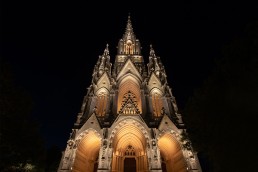
Winners Announced for 40th Annual International Lighting Design Awards
(Worldwide) - The finest examples of lighting design in the world have been celebrated and awarded through the presentation of the 40th annual IALD International Lighting Design Awards.
This year’s awards were presented by Acuity Brands and showcased a total of 27 projects from 15 countries. Each nomination was recognised for their demonstration of exceptional lighting design and contribution to the professional design community.
The project with the highest score received an Award of Excellence as well as the highest honour of the ceremony, the IALD Radiance Award for Excellence in Lighting Design. This accolade was given to The Church of Our Lady of Laeken in Brussels, Belgium with lighting design by LIGHT-TO-LIGHT.
The following projects received an IALD Award of Excellence:
- 550 Madison Avenue Lobby | New York, NY USA | KGM Architectural Lighting
- Central Library of Estefan Municipality | Esfahan, Iran | Behin Lighting Company
- The Church of Our Lady of Laeken | Brussels, Belgium | LIGHT-TO-LIGHT
- Espenes Rest Stop | Sørfjorden, Hardanger, Norway | Light Bureau
- IINC Boutique | Hangzhou, China | YAANK Lighting Design
- Indoor Lighting for the Mausoleum of Theodoric | Ravenna, Italy | I-DEA
- New Perelada Winery | Girona, Spain | Artec Studio
- Polish Army Soldiers' Cemetery at Westerplatte | Gdańsk, Poland | QLAB Laboratory of Light
- Rochester Cathedral | Kent, United Kingdom | CES Lighting & Electrical Specialists
- Suzanne and Walter Scott Aquarium | Omaha, Nebraska, USA | Morrissey Engineering
- Zero-Energy Media Façade | Basel, Switzerland | iart
The following projects earned an IALD Award of Merit:
- American Museum of Natural History: Allison and Roberto Mignone Halls of Gems and Minerals | New York, New York, USA | Renfro Design Group
- Athens Olympic Museum | Marousi, Athens, Greece | Loisos + Ubbelohde in collaboration with KLAB Architecture
- Biograph Pilot Clinic | San Mateo, California, USA | PritchardPeck Lighting
- The Elizabeth Line: Line-Wide Design | London, United Kingdom | Equation Lighting Design
- Greenhills Beach Residence | Sydney, New South Wales, Australia | Electrolight
- GRNDCNTRL Night Club | Shanghai, China | YAANK Lighting Design
- Hallgrímskirkja | Reykjavík, Iceland | LISKA
- Ishikawa Prefectural Library | Ishikawa, Japan | Lighting Planners Associates
- The Schwarzman Center Renovation at Yale University | New Haven, Connecticut, USA | L'Observatoire International
- Senate House Steps, University of London | London, United Kingdom | BDP Lighting
- SETSU Niseko - a Seven Palms Resort (Reception, Lobby Lounge & Wine Bar) | Hokkaido, Japan | Nipek
- Steinmetz Hall - Dr. Phillips Center for the Performing Arts | Orlando, Florida, USA | Ann Kale Associates
- Queen Miami Beach (Theatre Restaurant Night Club) | Miami, Florida, USA | Lux Populi
- Verizon at the Hub on Causeway | Boston, Massachusetts, USA | HLB Lighting Design + Michael Stiller Design
Chair Yah Li Toh hosted the online broadcast. Yah Li Toh commented: “These exceptional projects are diverse in application and scale, but each one elevates and inspires our professional community.”
She continued: “The large number of entries submitted for this year was a clear indication of the vitality of professional lighting design. Our judges worked tirelessly to evaluate them all thoroughly and with strict adherence to our blind scoring criteria, and these 27 winners are the absolute best of an already incredible array of talented work.”
This year’s esteemed judges included Ee Mun Chan, Roberto Corradini, Kim Daley, Julia Hartmann, Fang Hu, Andrew McCormack, and Jackson Stigwood.
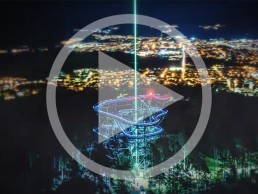
Kvant Architect - Extremely bright single-beam architectonic and sky lasers
The new Architect range of high-power static-beam lasers, sometimes called sky lasers or landmark lasers, is the reaction to globally increasing demand for super bright lasers. These are used for highlighting significant landmarks, structures and buildings.
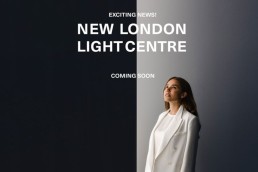
Zumtobel Group opening new London Light Centre
(UK) – Zumtobel Group has announced the opening of a new Light Centre at the Business Design Centre in Islington, London.
Coinciding with LiGHT 23, the London Light Centre will open its doors for the first time on November 21, 2023.
The Light Centre will be used to showcase the company’s latest and most innovative products and solutions. This will allow customers to experience the Thorn and Zumtobel brands first-hand.
The London Light Centre will feature a curated selection of Zumtobel's luminaires, covering a broad range of applications, including the Ambitus, Tramo and Artlea to name a few. Additionally Thorn will showcase its new outdoor architectural range of luminaires for building surrounds and façade lighting applications.
CEO at Zumtobel Group, Alfred Felder says: “The Zumtobel Group has always been synonymous with high quality, innovative, unique and sustainable lighting products and solutions. The new Light Centre will give us a fantastic opportunity and base to showcase our lighting solutions and expertise to our clients.”
UK and Ireland Managing Director at Zumtobel Group, Paul Kilburn, adds: "We are delighted to be opening our brand-new London Light Centre. This will help bring us closer to our valued customers and partners, offering them an immersive space to experience our cutting-edge lighting products and solutions. We believe this new venture will further establish us as the leading lighting supplier in the UK and Ireland.”
