
Pixel Flow, Peru
Claudia Paz Studio's latest light art installation challenges the general public to feel the freedom of expressing themselves while exploring their senses in a surrounding space generated by light and sound.
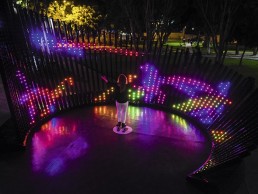
Pixel Flow is an immersive interactive light and sound installation created by Claudia Paz Studio for the general public to explore emotive experiences.
The concept was to integrate the installation within a public space, giving people a magical moment in an urban area where they can interact with the installation and surroundings to create a social environment.
The idea behind the installation was to explore the visitors' senses in a surrounding space generated by light and sound that allows them to express themselves freely.
The aim was that people should feel wrapped in a spiral of light pixels and sounds that are activated by the natural flow of the body, creating a unique and magical experience. A number of highly detailed immersive scenes allow the exploration of unforgettable scenarios within the installation. There are ten different scenarios in total, each one designed to have a different experience. Particles of light gently encompass the participants, immersing them in an audiovisual landscape in which even the slightest movement generates light and sound across the space. With each gesture the patterns of colour evolve and move, while the generative audio system responds accordingly through a dynamic soundtrack to the user’s experience.
The 2,235 pixels are distributed in the structure facing inwards to create a wall of colour, but also on the exterior to create an echo of light that mimics what is happening inside.
Every time a new person enters the installation, the intensity of white light gets brighter to dazzle and transport them into a new scene. Sometimes the visitors will be taken into a world of sound and coloured lights and other times will be part of the natural surroundings of the park.
So how does it work? A combination of hardware and software allowed the realisation of this installation. With the use of a Kinect camera, detailed movements of the user were detected as inputs to drive organic particles of light across the structure. Highly responsive light particles were handled by algorithms that managed the complex real-time movement of the user, ensuring a natural and fluid reaction from the 2,235 pixels; every movement or gesture of the body can trigger a light pattern and custom sound.
Standing at four-metres high, each rectangular pole integrates small RGB node of CK Flex LM clear dome, individually controlled and separated 10cm from one another. The dots cover the front face and part of the back to create the perception of pixels floating in the space. The metal studs were distributed radially around a circular platform of five-metres in diameter with a mirror effect finish, generating an infinity space that goes beyond the floor.
The base of the structure is where all the power sources are kept, while a centralised control system and interactive control cabinet are located at the back, along with a wireless connection to control the installation from anywhere. The installation also includes four loudspeakers hidden in the back of the structure to generate a surround system for each scenario.
Pixel Flow has an incredible responsiveness that captures the participants by surprise. The installation is a playful development of physically interactive concepts previously explored by the studio in the interactive aquarium for La Rambla shopping mall, Aurora and Light Garden for Plaza Norte Mall and BCP Affinity.

Loomings, UK
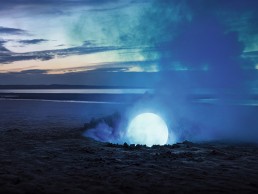
Raising questions about nature and landscape, David Ogle's Loomings encapsulates the artist's desire to escape the built-up world we live in through the perception of objects and light in space.
David Ogle graduated from Lancaster University in Fine Art History and Practice (2009) and an MA in Contemporary Arts Research (2012). Currently undertaking an AHRC funded doctoral research project at The University of Liverpool, Ogle maintains his studio (based at The Royal Standard, Liverpool) alongside ongoing academic study. Having exhibited work internationally, he has shown in a number of group and solo exhibitions, undertaken gallery residencies and has been awarded several art prizes. Recent exhibitions include: In Another Light, Croft Castle (The National Trust) (2014), Regenerate 14, Berlin/Copenhagen (2014), The Royal British Society of Sculptors Sculpture Shock (Subterranean), London (2013) and The Catlin Art Prize, London (2013).
His latest work, Loomings, is a project that harnesses the drama of remote landscapes through artworks that call attention to their own environments. With deep routed associations in the history of painting and in particular, the Romantic movement, Ogle considers his place within the natural landscape.
Developed from Ogle’s previous indoor site-responsive light works and drawings, Loomings encapsulates the artist’s ambition to escape the built environment and the confines of walls, floors and ceilings. Exploring notions of materiality, permanence and the perception of objects in space, Ogle uses light and space as a sculptural medium, as the location shapes the work but also becomes manipulated by it.
Taken from the title of the first chapter in Moby Dick, Loomings references the narrator’s (Ishmael) feeling of being pulled towards the wilderness and wanting to leave behind the constraints and domesticity of the city. Ishmael is travelling through a barren landscape in search of a rare natural anomaly - the white whale.
David Ogle is represented by Mark Devereux Projects and Kinetica Museum, London.
Pic: Andrew Brooks
LewesLight, UK
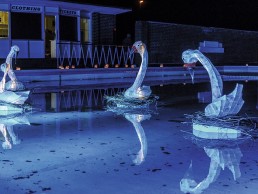
LewesLight is a new light festival launched in October 2015. Taking over the small town of Lewes in South-East England, it aims to promote the town's history and beautiful architecture, while showcasing the creativity that lives within it.
LewesLight festival took place for the very first time in October last year. A small town in the south east of England, Lewes sits on the South Downs in an area designated as a National Park with an aspiration to become a Dark Skies Reserve.
The organisers of the event had discussed the possibility of staging a festival in the town for a number of years and with 2015 being the UNESCO International Year of Light, it seemed to be the perfect time to realise these aspirations. Festival Director Graham Festenstein is an independent lighting designer with a consultancy based in the town, and as a designer with specialisms in lighting strategy and masterplanning he was able to see the potential and opportunities LewesLight would have for the community. Discussing his ideas for the lighting event with environmentalist, author, journalist and Lewes resident John May who, inspired by images from Lights in Alingsas festival in Sweden, convinced Festenstein to persevere with his plans.
The aspiration was to showcase what is possible, with a view to developing the event as an annual festival of light promoting the town, its history, its beautiful architecture and its creativity. Taking place over a two-day period, the festival included lighting installations, an exhibition, talks and discussion. In the spirit of International Year of Light 2015 the intention was to include as diverse a programme as possible including science, astronomy, sustainability, health and, given its special location, environment, wildlife and the impact of lighting in such a sensitive area.
Another aspiration for the event, was that it should be community based. Whilst the organisers wanted to draw visitors to the town, they felt it must be firmly routed in the community and engage with local people, businesses and have a strong educational component.
Educational input was provided by the Sussex Downs College (SDC) located in the town; head of the Production Arts course Philip Rose embraced the event involving his students as a formal part of their course in all aspects, from design through planning to delivery. He also enlisted the help of his colleagues and the students in the Digital Arts and Photography departments. The festival was also publicised to local schools through STEM (Science, Technology, Engineering and Maths), a network that engages with professionals to encourage children to consider education and careers in these fields. It is hoped that in future STEM events with local schools can also be included. Whilst the community was core, it was essential that what was delivered was of the highest quality. With this in mind, Festenstein was keen to draw on whatever professional resource was available. Keeping the local theme very much in mind, he approached fellow Lewes resident, theatre and opera lighting designer Paul Pyant, and lighting designers Karen Van Creveld and Paul Nulty, both with Lewes connections - all were enthusiastic and keen to support the festival. Paul Nulty also enlisted his co-director Ellie Coombes, who coincidentally grew up in Lewes, to coordinate input from the Nulty team.
The final place was filled by projection artist Alex May; having grown up in Lewes, May returned to the town with one of his pieces Shadows of Light previously shown at the Kinetica Art Show and Tate Modern. An interactive digital artwork, Shadows of Light, explores the concept of ‘slow interaction’: rather than responding to quick movement, it requires viewers to slow down and stand still, it slowly takes the viewer’s silhouette and uses it as a digital stencil, ‘spraying’ paint that starts to drip and spread into the silhouettes of others.
The festival itself was based in the Linklater Pavilion, an eco building that plays a community role as home to the Railway Land Wildlife Trust – a nature reserve at the edge of the town. Within the building was a small exhibition with displays on Dark Skies by the South Downs National Park; work on the impact of artificial light on wildlife by Dr Alan Stewart from Sussex University; sustainable light sources by Sustainables4U; Brighton and Lewes Downs Biosphere – a UNESCO project; photography from the Lewes Camera Club and SDC; and an educational display for younger children by the Herstmonceaux Observatory Science Centre.
The venue was also host to a short programme of speakers who talked on a range of subjects: Paul Nulty on lighting design; Graham Festenstein on lighting as part of sustainable urban design; Dan Oakley from the South Downs National Park on dark skies; and Dr Richard Hobday on light and health. The discussions were chaired by Professor Emeritus Peter Mobbs, former Dean of Life Sciences and neuroscience researcher at UCL.
There were fourteen installations around Lewes itself, with buildings and spaces lit by conventional architectural schemes, torches, or digital projection. Visitors could navigate these by joining a guided walk or by themselves using a map of the route. At the end of the night they could reflect on the evening while enjoying the final installation to an atmospheric soundtrack prepared for the event by Starfish, a local youth music project.
The entire event was delivered on a shoestring budget with limited funding and many of the resources delivered by the organisers and designers. Significant support came from within the industry, as the event was affiliated with, and supported by, The Institution of Lighting Professionals; The Society of Light and Lighting; the International Association of Lighting Designers; and IYOL 2015. Equipment was provided by Commercial Lighting; Meyer; iGuzzini; Light Projects; Architainment; Malham Lighting; SORAA and Osram with additional support provided by Russell Beck Studio and Creative Light and Power.
The organisers were said to be delighted with the final result and feel the first year’s event demonstrated the tremendous potential the festival offers the town; successfully combining community participation with high quality artwork and design, providing something for everyone - residents and visitors alike and across all ages.
Pic: James McCauley
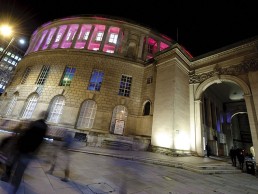
Enlighten Manchester, UK
Enlighten Manchester festival of light and sound art transformed public spaces across the city centre into an immersive and inspiring cultural celebration. More than fifteen installations and performances brought together an ambitious programme of light works.
Enlighten Manchester festival of light and sound art brought a stellar programme of world premieres, award-winning installations and international artists to the north-west city. Across three-days from 10-12 December last year, contemporary artists transformed public spaces inside Manchester Central Library, Vincent Harris' neoclassical treasure and The Bridgewater Hall, offering visitors an immersive and inspiring cultural celebration.
With more than fifteen installations and performances - the festival was a vibrant hot bed of light, sound and literature.
Following a successful pilot in 2014, the festival launched a new relationship with Manchester Central Library as the main venue to bring together exciting local and international talent, skills and energy with an ambitious programme after dark. Light works were also on show at The Bridgewater Hall from leading audio visual artist Kathy Hinde and Liverpool-based contemporary composer Matthew Fairclough.
Organiser of the event - 'Curated Place' is a Manchester-based creative production company specialising in developing, delivering, managing and marketing major projects across international borders and with numerous partners. It commissions and presents new music and visual art across Europe and beyond, and has successfully developed major city-wide projects for major institutions and establishments, taking projects from concept through to delivery in the UK, the Netherlands, Iceland, The Faroe Islands, Norway and Egypt.
Andy Brydon of Curated Place and festival director said: “Being able to deliver the first full outing of a light festival in Manchester is the best way we could launch a relationship with these brilliant venues. "We’re all looking towards developing the light festival as an annual event to inject some high quality public arts into Manchester’s Christmas celebrations. This year we had some of the UK’s leading sound and light artists collaborating at the boundaries of their disciplines helping us develop the festival from a pilot to a major family event. Next year we’re hoping for more.”
Festival highlights included:
Relay (2015) – Kaj Duncan David
Techno-logical music for amplified electromagnetic relay and three light bulbs. A relay is used to individually turn the lights on and off. The acoustic sound of the relay's switches is filtered and transformed. Performed live, Relay is sound and light combined in a rhythmic, trance-inducing play of echoey clicks and dancing shadows.
Light Wave Power - Paul Friedlander
Light Wave Power is a light sculpture and professional development project developed by Manchester Central Library in collaboration with Curated Place and kinetic artist Paul Friedlander. This site specific, kinetic light sculpture was presented in the library’s main entrance hall during the festival and consisted of an overhead kinetic wave light display, which allowed visitors to walk underneath. A rotating rope was hung between the obelisks, illuminated by chromastrobic light, creating an impressive display of changing colours in double helixes stemming from the rope’s shape.
Visible Words by Invisible People – Richard William Wheater with RECLAIM
Neon artist Richard William Wheater has been working with the RECLAIM project to produce a series of new neon works for Manchester Central Library and around the city centre. Focusing on the silenced voices of youth in society the project created a series of neon statements from participants placed around the city with a centrepiece in the library.
The Chandelier of Lost Earrings – Lauren Sagar and Sharon Campbell
Initially stimulated by a collaboration with staff at St Mary’s Maternity Unit at Central Manchester University hospitals, where staff were asked to donate lone earrings, which had formerly been a pair, and which had some emotional resonance or significance for the wearer. A successful press and social media campaign followed, gathering in many thousands of earrings over twelve months. The act of individuals contributing something of personal value, towards a communal project to form something new, found strong resonance among hundreds of people locally, nationally and internationally. Dripping with glittering jewels, delicate threads of fine chain cascade down the curvaceous structure and close-up the individual earrings form a detailed textured surface made out of the myriad of small forms in every colour.
Entropy – Carlos Bernal
Entropy is an audio-visual installation based on video mapping projections and sound reactive LED strips. It creates a new dimension, a space-time tunnel where the energy of light is transferred and transformed through the art installation; eight consecutive screens, one projector and mesmerising visuals guided the viewer through the immersive audio-visual experience.
HadroScan – Toby Heys, Anke Eckart and Ulf Pedersen
This multi-sensory installation uses the Large Hadron Collider as a reference, where sound and light circulated around the 360º walkway scanning the space for its particles – in the case of the library these are fragments of language. Bespoke infrasonic loudspeakers, along with hypersonic sound systems (directional ultrasound) and regular loudspeakers, circulated three ranges of frequencies. Visitors experienced stimuli that caused the body to enter a flux of affect – sound becoming something felt as well as heard. The light work was synched according to presence and motion so that they eventually travelled together mimicking the scanner effect.
Emotional Fish – Jorgen Callesen and Jacob Tekiela
Emotional Fish is a moving light sculpture of the performance figure Miss Fish. It emerges from the darkness and comes forward to bypassing audiences in five different shapes.
In a flux between realistic and fictional characters – man, woman, fish, goddess and demon – visitors experienced the many faces and expressions of the apparently living figure. Unlike any other sculpture of a historical person, politician, poet or artist this generative video piece dealt with the question of fragility, indeterminacy and variability. Emotional Fish reflected new possible constructions and ideas about the human mind and gender – a bundle of selves and a fluid gender identity.
The Stories Under Our Feet – Elisa Artesero
The Stories Under Our Feet are ephemeral light and text artworks trimming the edges of the Manchester City Library benches. Short observational poems drawing on changing weather and seasons to create moments of contemplation for people walking by or sitting on the benches.
Lost and Found – Elisa Artesero
Lost and Found are understated light and reflection pieces activated by the viewer. Passers by interrupt the reflection to become either ‘lost’, ‘found’ or sometimes both to highlight the search for sense of self and connection between people.
One Thousand Birds – Kathy Hinde and Matthew Fairclough
One Thousand Birds is an installation by Kathy Hinde with surround sound by Matthew Fairclough. Each time the installation was shown, the paper birds were re-made by people from the local community. A statue of Sadako holding a golden crane was built at the Hiroshima Peace Park in memory of her. On the statue is a plaque: “This is our cry. This is our prayer. Peace on Earth.” Every year on World Peace Day (August 6th), people from all over the world fold paper cranes and send them to Sadako’s statue in memory of the innocent victims of war.
Video images of origami birds being folded, strung together and hung in trees were projected onto one side of a hanging of 1,000 paper birds. Images of the same paper birds floating down a river, through reflections of trees were projected onto the other side of the paper mass. Using the paper birds as a projection surface caused the imagery to distort and fragment, spilling onto the walls.
Luminous Birds – Kathy Hinde
Kathy Hinde’s interdisciplinary approach combines different art forms frequently through collaborations with other practitioners, partnerships with scientists, and input from the audience. She has made work for concert halls, theatres and galleries alongside site specific work for outdoor locations and unusual indoor spaces.
She has shown work across Europe, Scandinavia, China, Pakistan, USA, Colombia and Brazil. A new piece seeking to bring more of the natural environment into the city centre saw a flock of 64 origami birds with LED lighting suspended overhead in The Bridgewater Hall Piazza. As night fell the lighting created the effect of birds flying along the street. The birds were arranged in rows, and each bird had its wings positioned at the next stage of flight within the row – aiming to create the impression of stop motion animation, using individually illuminated, hand folded paper birds.
Pic: Joel Fildes
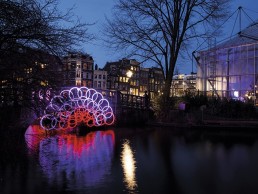
Amsterdam Light Festival, Netherlands
This edition of the 55-day Amsterdam Light Festival was dedicated to the theme ‘Friendship’ and took place from 28 November 2015 until 17 January 2016. mondo*arc editor Paul James was delighted to be on the judging panel to choose the installations and visited the Dutch capital to see the results.
Now in its fourth year, the Amsterdam Light Festival ran from 28th November to 17th January for a 55 day extravaganza of lighting creativity. The 38 lighting and multimedia installations attracted an amazing 850,000 visitors (100,000 more than last year).
I was honoured to be part of the judging process alongside such luminaries as American light artist Janet Echelman; Rogier van der Heide, artistic leader of Amsterdam Light Festival; and Jeroen Junte, a freelance editor who writes about design and architecture; to choose the magnificent installations for this year’s event. The festival has grown year on year in terms of popularity both with artists and visitors.
Amsterdam Light Festival consists of two main routes. The boat route, Water Colors, offers a unique view of the city from the perspective of Amsterdam’s famous waterways. The walking route, Illuminade, winds its way through the culturally rich neighbourhoods Weesper and Plantage in Amsterdam East. During the festival, light played a central role in the city as museums and institutions organised light-related activities introducing visitors to innovations in light art.
The fifth edition of the Amsterdam Light Festival will take place from the end of November 2016 till January 2017. The deadline for submissions is March 11 2016, 10am CET.
Pic: Janus van den Eijnden
www.amsterdamlightfestival.com
FRIENDALA
ARTIST: Oh my Light! Studio
To the Chilean artists Macarena Meza and Daniela Orallana of Oh my Light! Studio light art is a way to generate emotions by transforming light into a sensory experience. Their Friendala is a good example of this. Half of the work consists of a big mandala, an Indian symbol for unity and integration between peoples. The reflection of the light in the water constitutes the other half of the circle and makes the work complete. The artists hope that in turn the work will infuence the visitors: “We hope that the Friendala will subconsciously touch the people who observed it so that they will take along some of the harmony and the peace it stands for.”
PATHS CROSSING
ARTIST: Ralf Westerhof
Those who visited the festival two years ago, would recognise Ralf Westerhof’s style. In the 2013-2014 edition he created Drawn in Light, but with this new project, Paths Crossing, he manifests himself even more lavishly.
The work constists of colourful, 160 metre long lines of light that stretch out over the canal from bridge to bridge. While you are tranquailly sailing along in your boat, the work comes alive. Suddenly you feel as though you’re inside an animated cartoon and your eyes are the camera. All around you a story about friendship begins to unfold. The abstract lines are like a colourful linear diagram – every one of them has its own colour and represents a person. Lines moving towards each other are friendships growing. The lines also form figures that make up sculpture groups, representing certain stages of life. Paths Crossing is a universal story about paths that may cross, or run parallel to each other, sometimes for a short time, sometimes for life.
INFINITE SUPPORT
ARTIST: Lightform
Infinite Support is a project created by the Dutch collective Lightform, which is made up by the young creatives Dorus van Lieshout, Ivar Posthumus, Daniël Thomassen and Raoul van der Ploeg. The collective, four sworn friends, focuses on finding exciting applications of new technologies. With Infinite Support they translated their ideas about friendship into a beautiful light object. “To us friendship means supporting one another through thick and thin. As far as we’re concerned, friendship is never ending.” What we see are two drop-shaped objects, visible from afar beause of the subtle changes of different colours of light, enticing the public to come closer. The two shapes turn out to need each other to stay upright. If we come even closer, the sculpture, that can be touched, turns out to contain mirrors, suggesting an unfathomable depth. According to Lightform, the mirrors symbolise real friendship: a bond without limits.
THE UNITING LIGHTSTAR
ARTIST: Venividimultiplex
The theme of the project The Uniting Lightstar by Venividimultiplex is clearly friendship. To begin with we see from afar a multangular, luminous object. More precisely a dodecahedron, which, in its turn, consists of twelve pentagonal surfaces. That number corresponds with the number of stars in the European flag. Getting closer, you see numerous strings of blue light which connect all the points of this artificial star and which represent the continual relationships between the European countries and their inhabitants. The Uniting Lightstar contains another characteristic of friendship, namely the human capacity to boost friendships and let them grow. The sculpture has been positioned in such a way that it is a part of both the boat route and the walking route and the festival’s visitors collectively control the intensity of the radiance of this diamant. With The Uniting Lightstar, Venividimultiplex wants to convey the essence of friendship in an iconic manner.
WINGED MIGRATION
ARTISTS: Judith Hofland and Tessel Schmidt
Winged Migration is an interactive video installation created by theatre maker Judith Hofland and filmmaker Tessel Schmidt. In the Wertheimpark there is a larger than life-size birdbox that looks out on to an old tree. As soon as you enter the little house, a bird starts to fly. The more people come in, the more birds start to fly around freely. To people freedom is not always as self-evident as it is to birds. In the theatre Hofland and Schmidt often use video, trying to confront the audience interactively with the current situation in Europe. In this work, as in many others they have created, the artists combine reality and fiction. In this case they use video mapping on an existing, old tree, and add the projection of birds. Visitors of the birdbox are invited to take a stranger inside with them in order to let more birds fly and make the tree glow, which constitutes the interactivity of the piece.
RUN BEYOND
ARTIST: Angelo Bonello
Run Beyond is a work about the jump we all have to take in our lives: the jump to freedom. Artist Angelo Bonello does not tell us what kind of freedom, the spectator has to make up their own mind about that. The figures flash in sequence to give the impression of the movement of the jump before all figures shine together.
As Bonello explains: “To me this work is about the power of imagination, a power so strong that it makes individuals conquer their fears and limitations and causes them to open up to other cultures, new friendships and unknown worlds.”
TALKING HEADS
ARTIST: Viktor Vicsek
The two spectacular heads created by the Hungarian light artist Viktor Vicsek show countless emotions and react to each other across the canal. Each head has 4,000 individually controllable LEDs to provide different facial expressions in various colours. As they are connected by WiFi, they react to each other, but also to the interference of visitors. They conduct conversations by means of light. Only when a new boat passes, these talks are cut short, whereupon a new conversation between the heads commences. What is it exactly they’re saying to each other and to the visitors?
HOLON LIGHT
ARTISTS: Michiel Martens & Jetske Visser
In science a holon is something that is simultaneously a whole and a part. This looks like a brainteaser, but it is applicable much more frequently than you would imagine. Think for example of the cells that together make up you body, or of atoms that exist on their own, but also make up a molecule. Holon Light, created by the designers Michiel Martens and Jetske Visser, also consists of various parts that form one whole. Holon Light will give you as a spectator an unforgettable experience: a swarm of spinning, hypnotising light spheres is formed directly above the water. They become more fluorescent as they turn and seem to fuse the loose strips.
POLYGONUM
ARTIST: Them Sculptures
Polygonum is an artwork that investigates the differences (and similarities) between organic and geometric forms and between natural and artificial forms. Them Sculptures, the studio of Belgian artist, sculptor and designer Tom Dekyvere, made the work. Dekyvere has participated in two previous editions of Amsterdam Light Festival.
According to Dekyver: “Today, we live in a world that manipulates the natural environment. Digital devices and microchips are intertwined with the human body. In art, we also see a lot of nature-based forms.”
BIRDS FLY AROUND WITH YOU
ARTIST: Masamichi Shimada
Birds Fly Around with You, created by the Japanese light artist Masamichi Shimada, is an interactive licht sculpture based on the zoetrope, a pre-film animation device, consisting of a cylinder that is spun at a certain speed. Looking through the slits in the cylinder, you see a figure moving. Shimada has taken this simple principle out of its casing and put it here as a larger than life-size object. A visitor who enters the garden will activate the magical machine. The birds illuminate one by one, giving the illusion that they are flying. The more visitors that come into the garden, the more birds will fly around.
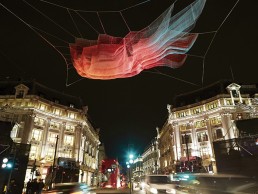
Lumiere, UK
Beginning in Durham and then moving on to London, Creative event company Artichoke pushed themselves to the limit by organising two Lumiere festivals within two months of each other.
Producers of extraordinary live events, Artichoke is one of the country’s leading creative companies and is a registered charity, funded by Arts Council England. Its previous projects include: Royal de Luxe’s The Sultan’s Elephant, which brought an estimated one million people onto the streets of London in 2006; La Machine’s 50- foot high mechanical spider for Liverpool’s Capital of Culture celebrations in 2008; Antony Gormley’s One & Other 100-day long invasion of the Fourth Plinth in Trafalgar Square, London in 2009; and Deborah Warner’s commission for the London 2012 Festival, Peace Camp, a nationwide celebration of landscape and poetry, which took place across eight separate sites around the UK.
Artichoke creates and produces Lumiere, the UK’s largest light festival, which has been staged in the medieval English city of Durham every two years since 2009; and in Derry~Londonderry in Northern Ireland as part of the celebrations for City of Culture 2013, commissioned by Culture Company 2013.
The Lumiere festival, first commissioned from Artichoke by Durham County Council, completed its fourth edition in the city last November 12-15. Featuring some of the world’s most eminent artists working with light in all its forms, in 2015 the Durham festival attracted 200,000 whilst it is estimated that the 2013 festival brought economic benefits to the area worth £5.8m.
Helen Marriage, Director of Artichoke said: “I was so excited to put this new Lumiere programme in front of Durham’s discerning audiences. This was the fourth time that we’ve brought Lumiere to Durham, and each time we've tried to innovate and bring new parts of this glorious city into the festival. Artists both local and international delight in the opportunities of working with such extraordinary architecture and landscape.”
Council Leader, Cllr Simon Henig said: “We enjoyed welcoming everyone to our beautiful city and seeing it in a whole new light. Only Artichoke could arrange a whale in the Wear and bring the history of the universe to life at Durham's spectacular Cathedral.”
But that was nothing compared to the monumental task of organising London Lumiere a mere two months after the Durham event had taken place.
Taking place 14-17 January 2016, London’s first Lumiere light festival transformed the city’s streets and buildings with spectacular artworks. First estimates put the numbers of visitors at over 1 million attending the festival.
“The sheer size and scale of London made this a different proposition, as did the multiple agencies involved. But the ambition was the same. Leading international artists working with light engaged with the urban landscape and architecture to create a place where strange and wonderful things happen,’’ said Marriage.
Supported by the Mayor of London, Lumiere London turned King’s Cross and London’s West End, including Leicester Square, Piccadilly, Regent Street, St James’s and Carnaby into a magical pedestrian playground, encouraging Londoners and tourists to explore the heart of the capital and view it in a new light.
With founding support from Atom Bank, Bloomberg Philanthropies, Heart of London Business Alliance, London & Partners and King’s Cross, plus additional support from a host of partners and sponsors, including Westminster City Council, Lumiere London presented installations by 30 international artists, at some of the city’s most iconic locations.
The Mayor of London Boris Johnson said: “I am thrilled by the success of Lumiere London, which has brought a wonderful burst of imagination, colour and creativity to our city’s streets in the middle of cold, dark January. It could not have happened without the input and support of the many businesses and agencies who helped to make it happen. We have been astounded by the crowds, which exceeded all our expectations and brought a boost to the West End and King’s Cross and are delighted by the response, not just from Londoners, but visitors from around the world.’’
Marriage, concluded: “It’s been an unprecedented four nights for London and the turnout has been extraordinary. Thank you to all our partners who helped make this event possible. Over a million people came to experience something truly magical and unusual: this great world city turned into a temporary pedestrian playground. While the success of the festival did mean that contingency measures had to be put into place occasionally to help keep the crowds moving, the atmosphere has always been amazing. This festival has been about more than seeing the art. It’s about people sharing public space and re-discovering the city.’’
Over 200 volunteers from across the capital were recruited to support the festival through Team London, the Mayor’s volunteering programme for London, and whose local expertise and knowledge of the artworks helped make the festival a success.
Pic: Matthew Andrews
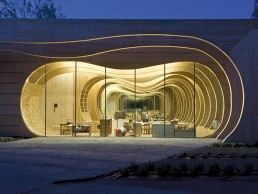
Guastalla Kindergarten, Italy
Mario Cucinella Architects created a unique space for children to learn and discover at a new kindergarten in the Reggio Emilia region of Italy. A delicate lighting design that achieves a high level of environmental standards was achieved through a considered approach.
Replacing two previously existing schools damaged by an earthquake in the region of Reggio Emilia, Italy in 2012, Mario Cucinella Architects (MCA) won the architectural competition for the design and build of a new school in the area. Having been given just fifteen months to complete the project, Kindergarten Guastalla can accommodate 120 children up to the age of three and aims to stimulate the children’s interaction with the surrounding space.
Nothing was left to chance when considering the new building; from the distribution of educational areas to the choice of materials used, the integration between indoor and outdoor spaces and more. The architectural elements of the new kindergarten were carefully considered by MCA – such as the shape of the interior, the organisation of the space, sensory perceptions of light, colour and sounds, all taking into account the pedagogical and education of the children.
In terms of the lighting system at the kindergarten, MCA used high luminous efficiacy fluorescent lighting fixtures from IDEALLUX. In the classrooms, they can be set according to motion and brightness, while scenarios can be activated via remote control. In the relaxation rooms the light intensity can be manually adjusted, while in the service areas and passage areas the lights turn on and off through motion detectors and timings. These were carefully positioned so that they can work in an optimal manner providing complete coverage, with disturbances avoided.
As the building features large amounts of glass surfaces, special attention was given to the lighting control; the sensors constantly measure brightness by taking into account both natural and artificial light.
Lighting was such an important consideration for MCA that at times it becomes a prevailing element of the decoration, while remaining an extremely important part of the behind the scenes technology.
“This was one of the reasons we chose to work with the lighting brands specified,” said Architect Mario Cucinella. “IDEALLUX's Fluo range produces clear and simple lines which can guarantee light quality and quantity necessary for this particular environment.
“Artificial light in our opinion should imitate - as closely as possible - natural light,” continued Cucinella. “The mental and physical balance of people – especially children, is highly influenced by light. We therefore included a specific technology with a dimming system, which guarantees the necessary quantity of light depending on the levels of external sunlight. This allowed us to reach another important target within energy saving. Environmental compliance of the whole project was also guaranteed by the choice of lighting fixtures.”
Commenting with what made the kindergarten stand out as a project, Cucinella told mondo*arc: “The structure involves the use of natural materials with low environmental impact. In particular, the supporting structure is made up of a wooden frame: a safe and ideal material to keep the thermal insulation of the building. The high insulation, optimal distribution of transparent surfaces, the use of advanced systems for rainwater harvesting and insertion of a photovoltaic system on the roof allows the building to minimise the use of mechanical equipment to meet the energy needs of the school.”
MCA has created an environment where children are driven to discover places that are complex and at the same time familiar, where they can develop abilities through special features of each.
“Even the areas between the classrooms and laboratories are designed to be used by the children,” said Cucinella. “Along the route there are play and relationship areas, niches where they can stop and discover transparent elements to peek out of.
“Starting from the internal signs, the sensory journey is continued and articulated outside, integrating the trees and encompassing the structure,” Cucinella concluded. “Protected areas for the activities of the children, educators and parents have been created.”
Pic: Moreno Maggi
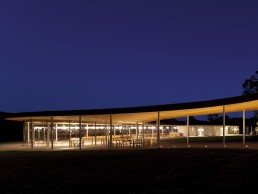
Grace Farms, USA
BuroHappold Engineering's lighting team worked alongside SANAA and Handel Architects to create a unique space for the arts and community of New Canaan, Conneticut, that embraces and welcomes its natural surroundings yet utilises intelligent lighting solutions at night to bring the building alive.
Grace Farms, designed by architectural practice SANAA, is in the northeast of New Canaan, Connecticut, USA. Envisioned as a new type of space to house a new kind of programme where the foundation’s initiatives of nature, arts, faith and community could interact with each other, it is also known as the River building. SANAA's goal was to make the architecture become part of the landscape without drawing attention to itself, or even feeling like a building and the hope was that people would have a greater enjoyment of the beautiful environment and changing seasons. Under the continuous roof are five transparent glass-enclosed volumes that can host a variety of activities and events, while maintaining a constant sense of the surrounding environment.
Chosen by the ownership team as the executive architect on the project, Handel Architects based in New York, worked with SANAA's vision to develop the porous membrane, which includes a 700-person sanctuary / indoor amphitheatre; a library that includes an enclosed glass conference room; commons - a dining room and living room with capacity for 300 and a lower level that accommodates a lecture hall and ancillary spaces; a staffed welcome centre; and a partially below-grade gymnasium / multipurpose space with adjoining media lab and game room. The original barn on Grace Farms' land has been renovated to serve as a welcome centre with a greeting space in each of its two wings and houses many of the day-to-day programmes.
The evolution of the design was a process that lasted for over five years, with the project going through several iterations throughout the schematic and design development. The formation of the architecture went hand-in-hand with the evolution of the foundation’s vision of how it would be used, meaning the team at Handel needed to be flexible even through the construction phase in order to make significant changes to the project so that the vision and architecture remained in harmony.
In terms of lighting, according to Handel’s Peter Miller, artificial light was to be at a minimum during daylight hours given the large expanses of glass used on the project – meaning little additional light was actually needed. “However, artificial light was integral to the night experience,” he tells mondo*arc. “It was important that the building walls were as invisible as possible during the day and night. Use of artificial lighting was critical to highlight interior and exterior elements so that the walls became immaterial.”
Working alongside SANAA and Handel Architects on the project was BuroHappold’s US lighting team, led by Associate Principal Gabe Guilliams. “The initial brief included little in terms of preconceived lighting ideas, other than maintaining a delicate touch on both the building and the landscape,” he tells mondo*arc, “if it had been an option to have no electric lights they would have accepted it.
“SANAA referenced their Rolex Learning Center project and how happy they were with the lighting there, so we studied the project and through dialogue with SANAA, began to understand what it was about the Rolex centre that they liked.”
“It’s always important to work with skilled lighting professionals when working on projects of this nature,” picks up Miller. “A truly gifted set of lighting designers such as BuroHappold could immediately understand the concept of what we were trying to build and offer solutions to enhance the experience. They were able to work within our parameters, while expanded our vision for what was possible.”
The main challenge of this project for Handel Architects was to accentuate the invisibility of the building in daylight and at night. Maximum transparency of the glass was achieved through careful selection of lighting including colour temperatures and beam angles.
“In the end, each light needed to be carefully adjusted so that they would properly highlight the opaque surfaces we wanted to see, while not creating reflections in the glass,” said Miller. “This allowed the building walls to disappear at night and during the day.”
But before the project even got to this stage, the planning and zoning commission hearings were a big challenge – with neighbours confronting the development, concerned that it wouldn’t fit in to the context of their existing rural neighbourhood, particularly given its 1,400ft length and transparency.
“For six months we travelled to New Canaan and gave testimony at monthly hearings defending the subtlety of our proposed project," says Guilliams. “We did a photographic essay on the existing nightscape in and around New Canaan to contrast the norms of the neighbourhood with our design at Grace Farms. Central to discussion was how the revered Glass House by Philip Johnson functioned at night. We demonstrated that the significant transparency was a benefit because there were few opaque surfaces to become light reflectors.
"Johnson recognised the need for landscape lighting at the Glass House so that he could see through the glass at night instead of only reading himself and his housewares in reflection," continues Guilliams.
“We ceded that we needed light outside of our volumes for this very reason. The trees in the landscape would receive uplight to serve this function and to minimise the visual impact for the neighbours we only illuminated trees from the river building’s side.”
The covered walkway that extends the full length of the building was also a perfect receiver because it follows the slope of the hillside and is not visible from neighbours’ vantage points across the valley. According to Guilliams, uplighting the ceiling enhanced the sense of wayfinding at night and appealed to SANAA in a very similar way to the Rolex Center; the purity of the surface material was maintained by removing light fixtures from it.
Structurally, the building was a lot kinder to BuroHappold largely because the team avoided locating lights in the ceiling. The big exception to this is the sunken gymnasium, where they chose to tuck lights in to the ceiling. “We did this to minimise visual obstructions as seen from the landscape,” says Guilliams. “The roof has a slight bow to it and doesn’t offer much view to the ceiling surface from outside – so we managed to limit light spill to the landscape.
As discussed, natural daylight is the dominant light throughout the day at Grace Farms with not much electric light required. As the day comes to an end, the wood ceiling throughout becomes activated, transitioning the warmth of the sunset glow to the interiors. “We’re really pleased with the way lighting works at Grace Farms,” says Guilliams. “We did 15-20 mock-ups during the design process, eliminating the risk involved for a number of our more aggressive design ideas. We struck a delicate balance between the need for the interiors to be functional; the exteriors to enhance that function; and for the two together to create a singular experience.”
For BuroHappold, light in this project is an activator; a wayfinder through the site, it is playful and promotes socialising in the commons. It is focused, with light on task in the library and it is calm – imbuing a sense of serenity in the sanctuary. From higher density landscape lighting outside the commons, to largely moonlight glow outside the sanctuary, the gradient density of landscape lighting supports the human transition upon ascent from social spaces to the place of prayer.
One of the stand out lighting features in this project is the beautiful ceiling detail devised by BuroHappold using Flos Glo Ball fixtures in the commons and custom pendants in the sanctuary. In their standard form, the Glo Ball fixtures have a massive canopy mounted to the ceiling that holds the ballast. The custom pendants in the sanctuary have a 120cm canopy at the ceiling to make the wiring splices accessible, as is required per the US National Electric Code.
“We preferred that all of this be concealed and accessible from above the tongue-and-groove ceiling,” says Guilliams. “We worked with the contractor where several slats from the ceiling would become a removable panel at each fixture. The panel would extend from glulam to glulam. The stems for each fixture now appear to pass straight though the ceiling, without a hint of their supporting canopies.”
In considering elements of the project that could have been approached differently, from an architectural point of view Miller tells mondo*arc: “A lot of effort was spent to make the exterior spaces and the glass enclosed spaces work perfectly. The care spent in those spaces is evident such that it makes the opaque interior spaces feel more enclosed than they could be. If we had more time, I think we would have made more examinations on how to treat the opaque interior spaces.”
Summing up, Guilliams notes that the biggest distinguisher at Grace Farms for him, was the singular focus from everyone on the team, from the client, to the designers, to the builders, telling mondo*arc: “In large, I credit this to our client Sharon Prince (Grace Farms Foundation President). It has been her mission to see Grace Farms come to fruition – and she was relentless. From the lighting side alone, she was at nearly every mockup we did, mockups that often lasted until the early hours of the next morning. I can only imagine how that permeated to the other 30 plus consultants on the project, and the final result speaks volumes. The sense of camaraderie on this team is one that I can only wish to have on future projects.”
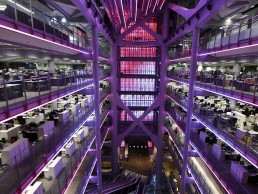
HSBC Atrium, China
With clean lines of light used to emphasise and support the striking Foster + Partners architecture as well as adding spectacle and drama to the space, the main banking hall of HSBC's headquarters in Hong Kong is the recipient of considered architectural illumination by MindsEye Lighting Consultants.
The main banking hall of HSBC’s headquarters is referred to as ‘The Cathedral’ thanks to its modern resemblance to a grand abbey. The vast space soars above the glass floor of the main banking hall and is accessed via escalators from the plaza below. The vaulted ceiling is crowned with the sparkle of an immense mirror. The office floors are the galleries and the bridges the cloisters. The eastern elevation contains a grand symbolic gesture, a vast unstained glass window complete with its tracery of mullions and transoms, which extends the full height of the vault.
The idea of lighting the atrium had been proposed more than a year ago by UK-based Mindseye Lighting Consultants. The impetus to develop and implement the concept came from the 150th anniversary of the bank, which fell on the 3 March 2015.
As covered in mondo*arc issue 87 (October/November), Illumination Physics was already engaged on a major project for the HSBC headquarters - the design replacement of all external lighting and the creation of three large media walls, all of which would be used during the nine month long 150th celebrations and beyond, and was again asked to be involved in the Cathedral project.
With no internal core structure, the building is suspended from the steel exoskeleton and the services are hung from this using bridge building techniques. Thus, architects Foster and Partners were able to create a spectacular atrium that soars 55-metres upward from the glass floor of the main banking hall; itself suspended ten-metres above the ground so that an open public plaza can exist at street level. The bank’s customers ride up through the transparent belly of the building via the world’s longest free-standing escalators.
The atrium is eleven stories high. Mounted at the top are a bank of giant mirrors designed to reflect natural light being captured by the computer controlled ‘sunscoop’, a massive articulated reflector mounted on the exterior of the south façade.
At the centre of the eastern façade is the ‘cathedral wall’. This 50-metre high double layer glass wall is transparent on the outside but opaque on the inside allowing natural diffused light to enter, which exposes the remarkable metal structure. The concept was decorative and conceived of a mix of direct-view lighting and back-lit panels. The areas to be treated included the chamfered edges of the floors that surround the atrium, the 'sunscoop' mirrors and the cathedral wall.
Creating an internally illuminated light box on the chamfered floor edges proved problematic for structural reasons. Indirect grazing light produced obvious aberrations because of the slight differences between the metal panels. Mock-ups and testing found that a direct view LED strip with a 100% diffused lens would produce the best result. The clean lines emphasise and support the architecture and add spectacle and drama to the space. Previously the upper levels of the atrium were regarded as too dark and the addition of the line of light on each of the five floors which bound the atrium corrected that impression.
Illumination Physics developed a custom version of the IP Bar rectilinear - an architectural light strip with a unique rectangular profile. The light strip is in keeping with the rectangular profile of the chamfers where a round profile would be discordant.
The installation process called for a new product to be created – the IP Bar Rail - as a mounting rail was required to hold the IP Bar as the soffit cladding needed to be removable for access to the fire extinguisher system. It was necessary to attach the rail to the stanchions of the balustrade to provide both structural integrity and a method for concealing the power and data cables.
The 'sunscoop' mirrors were the subject of several tests using both indirect and direct view lighting techniques. It was not the client’s intention to reactivate the mirrors as a light source per se but to celebrate the design and add drama to a feature that had been left in darkness for decades. An aesthetic choice was made, an IP Bar Rail gave the cleanest and most pleasing result and was also the most practical to install.
The Cathedral Wall was the most challenging of the three features to illuminate. The wall is composed of two vertical layers of glass forming a cavity approximately one metre apart. Between the two layers and the supporting structure are layers of louvered working platforms and a cat ladder system to connect them. All of this has been designed in the finest detail as is visible from outside the building in Bank Street. The aim was to illuminate the inner glass layer from within the cavity whilst keeping the light fixtures and cables invisible.
Illumination Physics' objective was to illuminate each 1,200mm pane of glass individually, creating a pixel. Content was then created for a variety of dynamic displays that are synchronised with the 'sunscoop' and atrium edges.
Mock-ups with both high powered and low powered LED were performed. Since it was not the client’s intention to activate the Cathedral Wall lighting until late afternoon, lower power LED was sufficient and required only 20% of the power. Illumination Physics Linear Graze was chosen, a very slim and compact fixture using the 5050 RGB chip. Its modest dimensions also made it easier to conceal behind a custom designed reflector/glare shield, carefully finished to match the existing metal work.
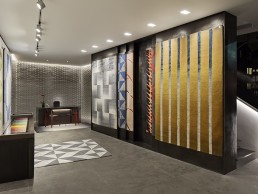
Deirdre Dyson Showroom, UK
Treating the London space more like a gallery than a showroom, Lighting Design International has created a strong lighting design that works within the minimalist and refined architectural space, while working to reinforce Deirdre Dyson's reputation as a contemporary and stylish artist and designer.
In the era of online shopping, creating a retail environment that people will want to visit is key. More importantly, the space needs to reinforce the brand and create an experience, not just a shopping opportunity.
As a renowned artist and designer, Deirdre Dyson’s move into the luxurious carpet market has challenged the way consumers think of this traditional flooring. With her contemporary aesthetic and vision of carpet as art, Lighting Design International’s (LDI)approach to conceptualising the lighting was not along the traditional route.
The concept was to treat the showroom like a contemporary gallery as opposed to a traditional carpet showroom. Working with the clean lines of the Timothy Hatton designed interior, LDI integrated the lighting where possible to provide a subtle backdrop against which the carpets could shine.
With a corner location on Chelsea’s vibrant King’s Road, it was important to create a strong presence that reinforced the client’s contemporary and stylish design aesthetic. While by day the windows allow glimpses into the gallery spaces, it was important that by night the showroom gave a strong unified presence. When the gallery closes, the automated system drops the blinds on the upper floors and activates the linear LEDs that are integrated into the window sills. This provides a soft wash light to the blinds, giving the showroom a strong understated presence, which is clearly visible from a distance. To reinforce this further, the brand logo is captured in silhouette, backlit with linear LED to highlight the fluid forms of the client’s signature.
With a deep floorplate, a unique glass-block wall was designed to allow natural light to filter into the main client consultation area to the rear of the ground floor gallery. To enhance this effect the glass blocks were softly washed with light from a ceiling slot bordering the space, silhouetting the desk and creating a backdrop to the gallery. In addition, the lighting from the basement skylight below washes the lower part of the wall, giving a magical floating effect.
The client consultation area is accented with ceiling recessed spotlights providing good task lighting for clients to review colour samples and designs. To add additional definition to this space, a linear LED was integrated into the front of the desk, highlighting the monolithic black steel structure.
The minimalist interior and defined display areas lent themselves to the contemporary gallery feel that LDI wanted to create. The lighting was used to enhance this feeling further, treating each rug like a work of art, reinforcing the client’s vision of carpet as art.
The gallery spaces were treated in two halves with one side illuminated with a discreet recessed track system, which focuses light on the carpet ‘artworks’ on display. The track system allows the flexibility to change the lighting dependent on the pieces being displayed. Fitting locations can be easily adjusted and a range of optics can be fitted to the luminaires to achieve the desired effect for each rug.
The other side of the gallery was wash lit with plaster-in custom RAL finished wall washers to illuminate the sliding rug displays. In each case, the white light colour temperature and colour rendering were carefully considered to ensure continuity throughout the space and to ensure that the carpets are rendered in their true colours.
The spine of the building comes in the form of a sculptural black steel staircase, which winds its way up the building, linking the floors and becoming the central transitional space on a customer’s journey through the building. The staircase is key to the experience of the showroom and was deliberately illuminated with only minimal functional light, allowing for navigation through the space. This provides a brilliant contrast to the vibrantly lit gallery spaces displaying the bespoke carpets and rugs.
The lighting to feature the architectural staircase has two elements, each being integrated into the handrail. The first element is a linear LED which washes light over the stair treads, while the second lights the handrail itself, giving definition and visual strength to the spine. The open treads allow light to gently filter through, illuminating the spaces beyond and casting interesting shadows. To address the functional requirements, the integrated lighting has been converted to emergency, eliminating the need for separate emergency lighting.
As an extension of the main staircase, the black steel finned balustrades on the first and second floors visually link the spaces. The subtle integration of custom mini recessed spotlights between the fins uplights the balustrade, defining this feature while casting dynamic shadows on the soffit above; this also provides an ambient indirect light to the galleries without taking the focus off the main feature - the rugs.
The basement area is home to the design studio and meeting room. With limited natural daylight from the skylight, providing a high colour rendering light source was key. A combination of infill ambient lighting, task lighting and focused display lighting was used to illuminate the area. To help with eliminating the basement feel, additional lighting was discreetly integrated into the skylight to supplement the natural light on darker days. Even the storage spaces have been carefully considered with high colour rendering luminaires integrated into the joinery to allow for the best colour rendition of fabrics and samples. The cupboard lighting is controlled by door contact switches to allow for functionality and energy efficiency.
The experience extends to the toilets, which have been treated like a luxurious home, with light carefully integrated and layered into the space to create a warm welcoming environment. On ascending to the top of the staircase visitors are welcomed onto the roof space, tucked away at the top of the building. Creating a flexible space suitable for both relaxing and entertaining was important. To stay in keeping with the minimal interiors, the lighting has been integrated into the back of the bench, providing a soft low level wash light below the seating while low glare spiked uplights add to the foliage to create some focal points onto the borders of the terrace.
To achieve such a detailed and integrated scheme required a client willing to push the boundaries in defining what a retail space can be, along with a design team dedicated to creating a space that is exceptional in design and that speaks directly with the contemporary stylish design of the client’s product.
Pic: Andrew Beasley
www.lightingdesigninternational.com
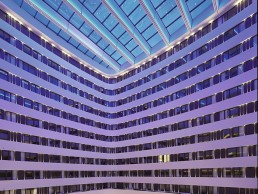
Hilton Amsterdam Airport Schipol, Netherlands
Schiphol Airport has grown to such a size that it now offers direct flights to 319 destinations and in 2014, the number of travellers it served grew to almost 55 million. Conveniently located at the airport, Hilton Amsterdam Airport Schiphol aims to offer travellers a home-from-home experience. dpa lighting consultants developed an advanced LED lighting system that works to create a variety of atmospheres within the hotel.
The new Hilton Amsterdam Airport Schiphol hotel, with its 433 bedrooms and 1,700sqm of meeting and event space, is designed to be the airport’s leading conference hotel. Designed by acclaimed Dutch architectural practice Mecanoo, the impressive landmark with its iconic cubic mould, diamond-shaped windows and large atrium and 42-metre high glazed roof aims to challenge expectations of airport hotels.
With a breath-taking interior featuring quirky details, bringing contemporary design, innovation and Dutch inspiration to life, the quiet and spacious guest rooms, first-class amenities, conceptual axis lobby and cocktail bar, Bowery restaurant, and eforea spa, make the brand new Hilton Amsterdam a welcome retreat for business and leisure travellers alike. What’s more, the hotel is linked to the airport via a covered walkway, bringing travellers directly from the terminals to the meeting centre and hotel. By gradually descending to ground level at the hotel entrance, the walkway creates a physical link between the plinth and upper level, while improving connections to new development The Base and the office park along the Evert van der Beekstraat.
The diagonal pattern of the hotel exterior serves to emphasise the iconic appearance of the building - by grouping the glass and composite panels in white and grey, a large scale diamond pattern is created making the building recognisable from a substantial distance. At the same time the pattern strengthens the unity of the different building volumes, blurring clear boundaries between the individual rooms and floors.
Inside, the design is as unique as the façade and building form. The thinking was to create a ‘Dutch touch’, taking recognisable Dutch design icons, history and traditions as well as the characteristics of the land and its people today, and translating them into a contemporary world-class hotel.
Creating a home-from-home for travellers - furniture, lighting, fabrics and floor coverings were carefully selected to evoke a sense of home and the narrative of lace embroidery and crochet (traditional art forms in Dutch life) threads through the design.
The large and light atrium is at the heart of the hotel, from which guests and visitors experience the inspiring feel of the open space. Making use of the 42-metre high glazed roof, is the main meeting area. Mecanoo designed the atrium to have a strong identity – with the size, surrounding gardens and light horizontal lines of the balustrades and white elements that reflect daylight deep into the building, providing an air of grandeur. From the smooth winding galleries guests have a spectacular view of the atrium, while the incorporated advanced LED lighting system - developed by UK-based dpa lighting consultants - allows for the creation of a variety of atmospheres. The atrium also plays a role in energy saving with outside air filtered before it is introduced into the space, where it is then preconditioned for the rooms, resulting in a reduction of energy consumption.
Speaking exclusively with mondo*arc, Michael Curry of dpa lighting consultants explained the idea behind the lighting design: “Our brief was fairly open and because it was such a vast site we approached it in a master plan way while responding to the architecture, which is very strong and bold and then enhancing the interior space, which brings in softer components.
“We had a blank canvas from the beginning and it really was a collaborative process with Mecanoo and The Gallery HBA (responsible for the interior design), which is great as you can progress with ideas as you go along. We’ve worked with both companies on many occasions previously and they’re definitely the sort of designers that will have an idea but don’t try and force the lighting design. Quite rightly, they want to get the best solution and is achieved through working with a lighting designer.”
Commenting on the atrium lighting specifically, Curry explained how he was keen to avoid the overuse of downlighting within the space, as for him it results in the feeling of guests being under the spotlight; it is better to use integrated lighting in a clever way.
“Providing an overall ambience was the success of the space here,” said Curry, “and the transition from day to night is really very different.”
During the daytime the atrium is really bright and flooded with natural light and on a dull day it’s different again, so certain lighting elements needed to be on full to provide accent and noticeable contrast. According to Curry, daylight was a really important starting point for the lighting design because of the sheer volume of light entering the building, which informed the team where to position the lighting.
“The lighting is very reactive to daylight levels and we used an architectural lighting control system with an astronomical time clock featuring overrides for the staff to control,” he said. “Each of the components and groupings are controlled separately so that we can have certain lights dimmed down or turned off during the day. At night the space has a really comfortable ambience where all the activity is at the low level on the ground floor. We created different atmospheres and focal points creating contrast with light and dark and areas of interest such as the bar, the reception and so on - it seems natural to provide focus so people know where to go.”
Ellen van der Wal, Partner at Mecanoo and responsible for the Hilton, also notes the importance of appropriate lighting levels in a project, telling mondo*arc: “The use of natural light in the atrium was essential - as it is for all of our architecture projects – so this was included in the designs from the beginning. There were lots of changes in the early stages and there was a time when the Hilton Group wasn't so keen on the idea of the atrium but thankfully this changed.
“Lighting is so important to consider in architecture because it’s part of the well being of people – it’s healthy,” continued van der Wal. “Your whole system of day and night and your biological clock is based on it – it’s very important. Hotels should have outstanding lighting levels in my opinion, because every space needs a good lighting concept, I always advise our clients to work with lighting design experts to achieve the highest quality level. Lighting is a small part of a project, but in some ways it is the most important part.”
In order to achieve a level of comfort in the atrium, The Gallery HBA created ‘islands’, each of which support a distinct function: reception, lounge, library, gathering and the bar. Inbetween the ‘islands’ the sand-coloured limestone of the floor becomes the pathways. The wall, which charts the course of the entire ground floor, is variously functional and a piece of art; weaving through quiet and busy areas, helping to define spaces and providing degrees of privacy.
“The decoration within the screen around the perimeter of the ground floor is like a ribbon that runs around the whole space,” said Curry. “We responded to this by back lighting it and then floating it around the whole perimeter, tying everything together.”
The elongated restaurant located on the ground floor, along the façade aims to draw passers-by at Schiphol Boulevard inside. Featuring a playful and upbeat design with quirky furniture features, floor-to-ceiling black metal and textured glass panels break up the space, designed to screen parts of the restaurant during quieter times in the day. The restaurant is another area where Mecanoo insisted on a lot of natural light and an important element was that diners should be able to see the outside world.
Moving through the rest of the building, for dpa lighting consultants, key lighting considerations included the corridors, which each feature a line of light running around the skirting detail – again wrapping like a ribbon from the ground floor all the way up to the twelfth floor; on the guest floor levels the linear light continues up to the ceiling and wraps around.
The bedrooms are divided between the exterior side of the hotel looking to the outside world and airport, and rooms facing the interior, which overlook the atrium and interior garden, dabbled in indirect daylight through the glass atrium ceiling. The rooms facing out to the airport feature at least two diamond-shaped windows, which frame the spectacular picture over the Dutch landscape.
In order to achieve the ideal levels of lighting in the bedrooms, something which can sometimes be tricky to achieve, Curry explained how working with a good client was key: “The operators have a design focused team as well as a technical team to check standards, which are there to set a precedent of light levels,” he said.
“We made sure we ticked all of the boxes and so in the bedrooms you can sit at the desk and read a book and the light’s in the right position; there is adequate lighting in the bathroom without being too stark or bright and each of the rooms feature areas of focus.”
Also working as a conference hotel, it was essential that all of the 23 meeting rooms, business centre and ballroom, which has a capacity for up to 640 delegates, had a functional layer of lighting.
The meeting rooms are flooded with daylight, softened by sheer curtains and benefit from movable partitions that allow for flexible layout, while the boardrooms are distinguished by full-length windows that enable users to feel connected with the buzz of the lobby below.
In terms of challenges with lighting the hotel, for Curry when it came to restricting natural light, while in the architect’s remit, it can effect the space for lighting designers as he explained: “If there are areas where there’s decorative lighting or features, it can effect how we work with it. For example, on this particular project with the backlit wall, if the space is too bright then you don't appreciate some of the architectural features that have been enhanced with lighting.
“What’s worked well in this instance is that the panels on the backlit wall aren’t in direct sunlight as there’s a bulkhead in front or above it, so it’s shielded from direct sunlight – so then the lighting helps to lift that space. It’s about striking the right balance at all times.”
Key elements of the project for Curry included the scale of the atrium and level of detailing together with both architect and interior designer – both were totally open in allowing dpa lighting consultants to improve on the interiors using lighting.
“An example of this is where we’ve integrated into the guest room skin of the atrium, there are 500 uplights around each little strip of copper detailing. Without a lighting designer the space would have looked completely different, the lighting aims to evoke an emotion.”
van der Wal added to this with: “There were lots of challenges along the way with this project. In terms of lighting we wanted to make use of the beams above the atrium space and this was a big challenge as we wanted them to be lit but didn't know how to make this happen. dpa lighting consultants came up with the idea that they should put a transparent panel on top of the structural beams that holds colour changing LEDs behind it. This took a lot of changes and tweaks along the way to get it right but I was very happy with the end result.”
Concluding, with the Dutch panorama as design inspiration, the hotel introduces its guests to the Netherlands with views out onto the polder landscape. Located at the main access road to the arrival and departure terminals, the design maintains the rhythm of the building volumes along Schiphol Boulevard. From its plinth, the hotel is rotated by 45º giving the building not only momentum, but creating a visual connection to both Schiphol Boulevard and the Ceintuurbaan.
Pic: Courtesy of Hufton+Crow
German Gymnasium Restaurant, UK
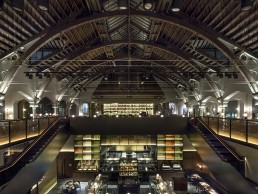
Paying special attention to the Grade II listed building's spectacular architecture, Into Lighting's illumination of London's German Gymnasium is sympathetic to its history, while remaining contemporary and comfortable for the restaurant's guests.
Located between King’s Cross and St Pancras railway stations, German Gymnasium was originally constructed in 1864 for the German Gymnastic Society. It was the first of its type in England and the first venue to host the National Olympic Games.
To complement the newly invigorated King’s Cross masterplan, London-based lighting design consultancy Into Lighting was appointed by D&D London to help realise architects Conran and Partners' vision for a glamorous and contemporary European Grand Café, transforming the Grade II listed building into a unique destination. Conran and Partners' concept sits as a refined modern insertion within the existing building; a Bauhaus version of a European Grand Café.
The team worked closely with landlord Argent’s base build team and its architects Allies and Morrison to preserve the building’s core structure, whilst making necessary interventions to prepare it for its new life as a hospitality venue.
The main spatial concept was to reinstate the first floor viewing gallery (previously in-filled in the 90’s for office space) to allow for impressive views of all dining areas and, most importantly, the breath-taking roof structure.
Many of the building’s unique historic details, such as the climbing hooks in the ceiling and cast steel columns, have been retained, setting the tone for the choice of materials, colours and textures for interior detailing. Warm, walnut timber panelling and black and grey distressed leather upholstery have been juxtaposed with fresh, contemporary insertions such as the occasional pink and red tone to add depth and visual interest.
Into Lighting was briefed by D&D and Conran and Partners to provide a theatrical and layered lighting scheme within the venue, which comprises the ground floor restaurant and bar, first floor restaurant area and bar, including the private dining area along with the external seating and bar areas. The lighting scheme was designed to enhance the space, both throughout the day and into the night, to complement the function of each space whilst creating an intimate warmth in the cavernous venue.
A key factor in the scheme was to highlight the magnificent architecture of the space as well as integrating the lighting to highlight the plush and sleek finishes of the various materials used for the interior design.
As with any Grade II listed building, attention had to be paid to mounting positions and cable routing for light fixtures. The control of the lighting was also a careful consideration within the design to ensure smooth and low-level dimming within the various scenes from day to night.
Darren Orrow, Director of Into Lighting commented: “We always relish the opportunity to work with listed buildings and take on the challenges involved. As lighting designers we have a responsibility to respect the fabric of the building and be sure to help visually communicate the history of the building to those who are to experience it.”
On entering the venue, the reception desk is the first element to greet the customer. This has been integrally illuminated using LED in a profile with diffuser to provide subtle illumination to the front of the desk. In addition, a low level lighting detail softens the monolithic form, while an uplit metallic screen behind the desk gently obscures the view through into the venue.
Positioned high above the main section of the venue, the focal point is the timber ceiling, which is viewed via the new expansive cut-out on the first floor slab. This is highlighted by an integrated LED lighting detail, uplighting the metal mesh balustrade running around the perimeter of the cut-out.
The main dining space on the ground floor is illuminated by high-level track-mounted halogen AR111 adjustable spotlights, mounted to the existing tie rods which span the building. The client specifically requested lighting to the tables from above. Also, the fixtures and light source chosen were selected by the client after numerous on-site mock ups where a range of different light fixtures were demonstrated from LED projectors, remote controlled LED projectors to halogen spotlights, hard-wired table lights and table-top candles. This particular light source was chosen due to the extremely narrow 4° beam angle, high colour rendering properties and the warm colour shift when dimming. A fitting with a deep set lamp and honeycomb louvre was specified to prevent glare for the diners and anyone looking up at the beautiful ceiling.
Upkeep was always going to be an issue with a halogen light source so Into Lighting highlighted to the client that a maintenance programme was essential. With this in mind, Into considered the use of lux lifts to raise and lower the lighting track for cleaning and relamping, however the client adopted for the services of an abseil company to maintain and clean all equipment not just lighting. Under the service contract, abseil equipment is left on site to enable next day high level lamp changes along with any other maintenance issues at high level.
Following on from the main dining space, the bar on the ground floor is situated in front of the open kitchen with large bottle displays located on either side. These are illuminated with linear LED under each of the glass shelves with a separate LED to highlight the metallic surface on the back walls of the displays, complementing the underlit bottle display within the centre of the bar.
The main architectural elements within the venue are two grand staircases sweeping up either side of the ground floor café to take guests up into the higher level. The staircases have been highlighted via an integral LED handrail detail to subtly illuminate the stair treads whilst not detracting from the views up into the venue.
Feature wine displays sit underneath both stairs and are illuminated using integral LED details to provide both functional and feature lighting.
On the first floor, guests are greeted by the main bar, which has an expansive LED backlit bottle display like the ground floor bar, along with integral LED lighting to the front of the shelving, providing illumination to the front face of the bottles on show.
In addition to this, the bar lounge is illuminated using decorative floor, table and wall lights to help create a relaxed ambience. The booths running down either side of the venue are illuminated using miniature LED spotlights, discretely mounted on high-level beams to provide specific table illumination. A concealed LED profile, mounted on top of the beams, highlights the timber ceiling within each booth.
Alongside this, statement decorative wall and floor-mounted feature lights, selected by Conran and Partners, provide a relaxed ambient and visual feature.
The main architectural details are the listed ornate columns and vast timber arches spanning the venue. Out of respect for such structural elements,the columns are up-lit by floor recessed LED ingrounds with a colour correction filter to ensure warmth of colour temperature along with a deep baffle and glare shield to avoid dazzling diners nearby.
The timber arches are sympathetically lit using surface-mounted LED projectors with a very controlled optic and cowl to avoid any glare. The bespoke artwork either side of the first floor bar is illuminated with bespoke LED picture lights designed specifically for each piece.
The lighting to the external ground floor seating areas consists of LED profiles and LED spike lights concealed within the bespoke seating, planter and bar, providing functional and key focal point illumination, whilst also being fully IP rated as these fittings are open to the elements.
All LED lighting throughout the project is controlled using a DMX protocol to allow for smooth dimming to an extreme low level.
Tina Norden of Conran and Partners said: “Every D&D restaurant is a unique destination and treated with a particular and distinct design approach. Our brief for German Gymnasium was to create a modern interpretation of a classic brasserie, with German undertones – which led to much research, exploration and analysis.As someone with a German background myself, I was particularly conscious of our responsibility to honour and celebrate the building’s past as well as take it forward to an exciting future as a destination restaurant and bar. I hope we have achieved this.”
The external lighting was designed by Hoare Lea Lighting from a site-wide concept by Speirs + Major. The design was developed in collaboration with Allies and Morrison, Conran and Partners, Into Lighting, D&D and Argent to achieve the subtle yet effective lighting of this important building.
Into and Conran and Partners have achieved a dramatic lighting scheme that is theatrical whilst being sympathetic to the magnificent architecture. Lighting has been successfully integrated where possible, so as not to detract from the architectural elements of the venue itself. The layered and integrated lighting throughout the cavernous venue ensures intimacy and warmth of ambience wherever guests sit within the space.
Pic: Marcus Peel Photography
