
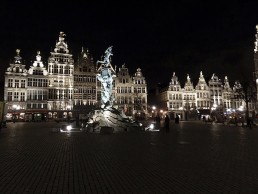
Grote Markt, Belgium
Having won an international competition launched by the city of Antwerp, Belgium, Studio Susanna Antico from Milan, Italy - in collaboration with Giladi Architectural Lighting from Brussels - developed the lighting master plan for the entire city of Antwerp and its neighbourhoods.
Following the decision of the city of Antwerp to adopt the lighting master plan and apply it to any new lighting project in the city, the College of Aldermen decided to renew the lighting of the Grote Markt - the historical market square and centre of the city. Studio Susanna Antico was commissioned to design the lighting for this public space, which was to be executed according to the master plan guidelines. The project was carried-out in collaboration with Giladi Architectural Lighting with the support of Stramien Architects and Urban Planners, Antwerpen.
The area to be treated in the framework of the project, included the square itself; the City Hall building that occupies the entire western side of the square; the three main streets leading to the square; and the important building façades - most of which are historical and listed in the square and along the streets leading to it. With the exception of emergency vehicles and delivery vehicles at limited hours of the day, the whole area had also recently been declared a pedestrian only zone.
At the beginning of the project, the Grote Markt was lit by pole-mounted historical decorative street lanterns fitted with 150 HIT sources. One of the streets leading to the square was lit with the same luminaires mounted on the walls with historical decorative brackets. The other two had recently been re-lit with wall mounted state-of-the-art 150 HST road lighting fixtures (at heights of eight to 10m), out of character with the historical middle-ages Flemish environment, and the wider of the two had also been fitted with different decorative poles and lanterns than those in the square.
The main façade of the City Hall was flooded from two clusters of 400 HST floodlights mounted on the roofs of the historical buildings around the square. Other façades around the square were flooded with 70 HIT luminaires mounted on both sides of the pedestrian poles. Finally, the sculpture and fountain of the Brabo (a mythological character who slayed a giant that had terrorised the people of the area, cut off his hand and threw it into the river Schelde) a focal point in the square, was lit by six in-ground directional luminaires fitted with 70 HITs.
A number of façades, some of which are listed, were privately lit by the owners or tenants, some with saturated colour changers. Many private installations were out of order as were a few of the street lights.
The pervading ambience of the square at night time was dictated by the orange soup of sodium reflected from the main façade of the City Hall. Some gaudy bursts of coloured light attempted a Las Vegas type of visual attraction. Glare was a major feature in the square; colours, materials, finishes and architectural details were distorted or disappeared; the total lighting power amounted to 30KW and the annual consumption amounted to 115MWh.
By day, light fixtures and uncontrolled wiring destroyed the appearance and perception of this historical public space. The project went through the master plan required motions, which consisted of an in-depth historical, urban, architectural and functional analysis; conceptual design; design development; detailed design and documentation; establishing technical specifications and bills of quantities; assisting client in the tender and bidding process; approval / rejection of offered equipment; on-site direction / supervision; final focusing and commissioning.
The design suggested the creation of a comfortable and inviting nocturnal space for city residents and visitors; to highlight the Town Hall, the Brabo sculpture and the rest of the abundant architectural heritage in the Grote Markt as well as the surrounding streets, according to a city-decided visual hierarchy (the master plan developed a tool allowing the city to determine the night-time visual hierarchies in any project). The elimination of all glare, light trespass and light pollution, while cleaning the façades of unwanted luminaires and wiring, respecting the architecture and details were also considerations while ensuring an overall sustainable lighting system; installing an intelligent programmable management system that would control both street lighting and architectural lighting, relating to both as integral components of public lighting (this would allow further energy savings by shutting-down and / or dimming systems according to a pre-set calendar controlled by an astronomical clock).
LED systems were adopted throughout the project as well as a generalised approach of lighting all surfaces from very short distances mainly resulting in grazing illumination of façades. This approach would initially imply a large number of luminaires and complex wiring (including wiring for controls) however these would be offset by the very low power and reduced consumption of the systems, the elimination of glare, trespass and pollution, the minimal visual impact of the systems and the final visual effects and perception of the space and its elements at night-time.
Besides answering master plan requirements for the systems’ longevity, the adoption of LEDs allowed the programming of different scenes according to the time of night, season and any special holidays or events. It also enabled carefully planned and controlled additional power consumption savings at night when pedestrian presence is scarce. Also, architectural and functional (pedestrian) lighting being fully integrated and simultaneously controlled, thus never in conflict, allowed for a continuous level of low and diffuse illumination throughout the project, providing a sense of security and comfort, regardless of the programmed scene. Finally, the LEDs, being close to the architecture - the emphasis of the architectural detail works like a magnifying glass for the aesthetical qualities of the middle-ages Flemish architecture.
The approach was to light the many historical façades in the main square and surrounding streets, while creating a balanced perception of the spaces, giving the four façades of the City Hall a lighting treatment that would highlight the architectural details; reduce the luminance in public spaces and in the streets leading to it while creating a soft, warm atmosphere, in harmony with the old stone façades.
In agreement with the city, the posts of the square would remain on site and the lanterns would be replaced by new fixtures with a quasi-identical appearance but equipped with LED sources and opaline glass diffusing the light and preventing glare. The same luminaires would be adopted in the surrounding streets thus making them an integral part of this public space as per the brief of the city. The height of the pedestrian luminaires would be limited to 4.5 – 5m (as per master plan guidelines and in order to create the more intimate ambience wanted in the project).
The dominant correlated colour temperature adopted was 3,000K, highlighting the old stone façades and creating an inviting atmosphere. In some cases, for the sake of visual interest, 4,000K were specified (such as on the Brabo sculpture or the roof of the City Hall).
Installation of luminaires on historic façades was done in coordination with the department of historical monuments, dissimulating the fixtures wherever possible while avoiding any damage to historic materials. Routing of all required cabling and installation methods were carefully designed within the same parameters.
The installation work took almost three months as every luminaire had to be individually focused and locked in its position, sometimes at extreme heights (luminaires at the top of the city hall were installed with installers reverting to Alpinism techniques because no elevator could reach the location of the luminaires). In order to avoid extensive digging in the historical paving of the square and the streets and high costs of heavy cabling, the management system adopted was a hybrid wired system (DMX) for the City Hall (in which the system was installed) and a wireless DALI system for the rest of the project.

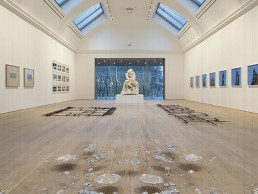
The Whitworth, UK
It’s won several RIBA awards this year including the National Award, the North West Award, the North West Conservation Award and the North West Building of the Year Award; was this year's Art Fund Museum of the Year winner; and most recently co-commissioned and produced the Richter / Pärt project as part of this year’s Manchester International Festival… ‘It’, is one of Manchester’s most notable buildings and galleries… The Whitworth.
Making up part of the University of Manchester, the Whitworth was founded in 1889 as the first English gallery in a park. Originally designed by J.W. Beaumont, it is home to an internationally important collection of works on paper, wallpapers and textiles as well as a contemporary collection institution, acquiring works by emerging and established artists.
Having undergone various development stages over the past 126 years, the gallery is now an amalgamation of numerous alterations and reconfigurations, which often resulted in inappropriate, compromised and inefficient use of space. For example, in 1908, the external frontage was resolved, however the west end of the building presented an unresolved, blind mass to the park. Then in the 1970s, the original Grand Hall on the first floor was altered to contain collection storage as well as study and office space. More recently, with a growing national and international profile, an increasing audience, an ambitious exhibition and education programme, and a growing arts collection, the Whitworth found a new need to expand.
The gallery’s RIBA architectural competition, which was won by MUMA architects in 2009, wanted to make its internationally important collection accessible to a wider range of visitors; make better use of the existing gallery spaces; and establish a relationship with the surrounding grounds and park.
The brief included the following quote from previous Whitworth Director Margaret Pilkington following a visit to Oslo in 1932: “I have come to the conclusion that a good museum or gallery should be a place where people feel comfortable. If it stands in a garden or park, the visitors should be able to enjoy the beauty of the outdoors as a counterpart to what is within.”
This quote struck somewhat of a chord with MUMA and underpins the architectural firm’s design approach to the Whitworth, with new visual connections to the park created and celebrated. Equally important to the architectural firm was the opportunity to establish a new transparency. MUMA’s design aimed to respond to the existing characteristics of the site and building.
For MUMA's Stuart McKnight, it wasn’t just the Whitworth’s wants and desires that were the main focus of the project, it was their vision also, as he explained: “We all wanted to better connect with the park as the competition brief had outlined and so we took both horizontal views of the park and opened up the original Victorian roof lights to bring in light from above."
The new gallery extension encapsulates the unresolved west end, creating a new frontage to the park, while the architectural hierarchy and scale has been carefully considered to ensure that the clarity of the principal entrance is not undermined. McKnight spoke with mondo*arc about some of the improvements made through the project: “One of the issues with the existing building was that it was quite dark, only 16% of the ground floor galleries had daylight and we felt that had to change. Now, 56% of the ground floor galleries have daylight but there is also the café and promenade, so the majority of the ground floor has daylight streaming through it, as well as views connecting to the park.”
Working with the lighting group at BuroHappold Engineering and company Partner Stephen Jolly, two new wings of contrasting character extend into the park containing a garden courtyard and new entrance. Placed at main gallery level, the transparent, slender wing of the café and its south-facing terrace celebrate the park context and the avenue of trees. DAL Cool Ambience X100 recessed ceiling downlights with Xicato LED light engines feature in the café's dining area, while pendants from Delta Light’s Ultra C range illuminate the server area. With its transparent linear form positioned above a sloping site, as the ground falls away, diners find themselves within the tree canopy of the park.
To the north, we find the more solid form of the Landscape Gallery, featuring Zumtobel’s ZE batten luminaires - overlapped by 100mm to ensure a continuous linear lighting effect and concealed in the Landscape Gallery lantern. The new study centre is also featured in the north wing extension and makes use of recessed downlights from DAL, surface mounted XAL Mino 60 fixtures, while louis poulsen AJ table lamps feature in the workspace. Both areas provide an urban edge as well as a visual and acoustic buffer that contains the garden.
New openings have been created in the existing building at significant locations, connecting the new extension and providing the heart of the building with a range of long views. A promenade gallery - lit by DAL Ambience 100 downlights using Xicato light engines - wraps the existing exhibition galleries and provides a vantage point to view the garden and park beyond. This glazed link maximises the visual connections to and from the park and connects the central exhibition gallery to the garden, meaning artwork inside and out can connect. Gallery lighting throughout the Whitworth sees ERCO track mounted LED gallery Lightboard spotlights used.
The promenade is repeated on the lower ground floor, turning the former windowless basement into a generous space that engages with the Art Garden, which comes alive at night with various Bega luminaires and creates a welcoming informal park entrance at the west of the Whitworth. The lower promenade is lit through Modular Lighting Nude Par 30 surface mounted downlights semi-recessed in the ceiling. As well as this, Bega LED surface mounted downlights with deep lamp recess for maximum glare control, are featured within the brick arch soffits and plastered arch soffits. The creation of this courtyard and promenade allows light and park views into the heart of the existing building.
MUMA’s strategy was to work with the inherent characteristics of the building and the high daylit volume of the Grand Hall has now been recovered as a place of gathering.
“We knew that as soon as light was brought in we would need to think about how to control it. We worked with Stephen and the lighting group at BuroHappold, who developed a system of daylight control that’s automated to work in tandem with the track mounted LED gallery spotlights. It was about maximising daylight but balancing artificial light to highlight the art… How did we do this without overexposing the pieces?”
As the sun moves around the building the louvres open and close on the roof lights - as the evening approaches and the daylight diminishes the artificial light recognises this and lifts light levels.
“We agreed with the Whitworth that a more dynamic approach to conservation of objects and lux exposure was needed and we agreed to year round lux hours for certain objects,” said McKnight. “This was very helpful because with our daylight control mechanisms the galleries can put themselves to sleep at night so that when the building closes, the louvres all close and the remaining quantities of daylight get cut out. As the lux exposure is cut out at night, the visitor hour lux level for an object can be lifted during the day.”
Stephen Jolly adds to this telling <strong>mondo*arc</strong>: “The brief was for a 21st Century gallery in the park to drive community engagement, so daylight and views were key - without creating glare, energy or conservation issues. We agreed with the client very early on that the exhibition galleries should be daylit and not black boxes. This allowed us to restore and reuse the original rooflights that had been covered up. Restoring the roof lights also restored character and dynamics to the daylighting of the galleries.
“We had to provide flexible space that could work at different light levels for exhibits with different sensitivities to light exposure. We agreed a series of different set points with the curatorial team that would form the basis of the user control interface: 50 lux, 100 lux, 500 lux, 1,000 lux and so on.
“Diffuse glass was used to provide the background daylight level moderated by internal louvres to achieve the different set points. The control system balances the amount of daylight and artificial light to achieve the overall agreed lux-hour exposure defined by each set point. At each design stage modelling and visualisations were carried out to confirm the design assumptions and communicate the brief back to the curatorial team.”
As a listed building there were naturally key considerations that had to be worked to during the project, including carefully positioned lighting tracks in the vaulted ceilings that would suit light angles but also the building’s fabric. Working within an existing building also predefined the amount of glazing in the roof lights and the source daylight level for each gallery. BuroHappold assisted with performance requirements for the glazing to provide the right amount of daylight, which could be moderated by the louvres as required.
Integrating new with old is something of a skill and at the Whitworth the two blend seamlessly - bringing new life to an out-of-date space. According to McKnight to make this work there are a lot of subtleties within the space - contrasting colour rendering for when looking at art and eating food, considered use of materials and careful consideration of how the old space flows through to new. As part of this, the lighting throughout the gallery has been carefully constructed. Bespoke LED wall scoops with hidden fixings from Mike Stoane Lighting are recessed into the internal stair treads, while Fagerhult Diva II surface mounted LED linear fixtures were concealed throughout the new Learning Studio, and in the Conservation Studio, Whitecroft Glide luminaires are fixed in the soffits.
“Similar materials repeat or reference themselves, while views out needed to work from one space to another,” McKnight noted. “As you move through the lighting, where the central gallery opens onto the west promenade there could have been the danger of optical strain as there is so much glass, however a delicate steel structure casts a shadow on the west elevation to help adjust the light level of the west promenade. The contrast isn’t too radical from inside to out - the equivalent of wearing a baseball cap or shading your eyes.
“The glass itself has solar controlled coatings," continued McKnight. "Also built into the design of the west promenade are translucent blinds which help control a medium light level for the central gallery. You can still see through them but they cut the optical strain, unifying the two. We were thinking about the visitor experience in less tangible circumstances.”
Commenting further, Jolly adds: “Each lighting set up is an integral part of the exhibition design for each show. We have provided the gallery with a daylight and artificial lighting infrastructure that can be adapted to suit the exact requirements of each exhibition. The needs of the artwork come first but it is important to provide daylight for comfort. The circulation promenade that wraps the galleries provides views to outside without exposing the artwork to uncontrolled daylight.”
This reinvention of space by MUMA and the lighting group at BuroHappold Engineering has set the Whitworth on the right track to continue growing Manchester’s position as a cultural hub. Concluding, McKnight said: “The Whitworth has been described as a breath of fresh air and I think this is a reaction to light and the way we’ve changed the existing building. It feels light and airy due to the quality of light and views. These galleries have been made possible through an approach to controlled light and views.”

Szczecin Philharmonic Hall, Poland
Influenced by the steeply pitched roofs and the verticality of the city’s residential buildings, Szczecin Philharmonic Hall is identified by the monumentality of the upright ornaments of its neo-Gothic churches and the heavy volumes of its Classicist buildings.
Designed by Barcelona-based Estudio Barozzi Veiga with an expressionist mindset, the architectural practice aimed to use geometry to give shape to a new rhythmic composition that conveys feelings by balancing massiveness and verticality. The use of glass as the exterior cladding material highlights how the building contrasts with the conditions of its surrounding environment. It creates a bright, transparent and upstanding object that has been the perfect canvas for architectural lighting design practice Anoche, again from Barcelona.
The design of the Philharmonic Hall goes hand-in-hand with attempts to revitalise the city and restart it as a lively hub with cultural attractions of reference. It is a new interpretation of what were the main attractions of the city, harshly treated by a history of crises and world wars.
The interior of the building showcases the main hall, with everything focused on its needs and on facilitating the movement of spectators and the work of music professionals.
Its overall intention is to reproduce a traditional Baroque music hall, maintaining the typically warm atmosphere inside but with the architects' own vision and a new reading of the form.
All this is brought together in a single building, designed and intended only for music, cloaking the interior neutrality with an expressive façade inspired by the profile of the city itself, whilst transmitting the necessary personality to mirror the city’s identity.
With this achieved by the distinguishable shapes and colours, the music hall has become a new city landmark. The façade is translucent to allow its night-time expression by lighting its white glass with marked vertical profiles. The backlighting of the façade adapts to different moments prior to concerts, heralding their proximity with staggered phases of intensity, in a nod to the ringing of the bells in ancient temples. The start of the concert is announced with maximum intensity of white light. This announcement, silent and stylish, is part of a broader communication repertoire that the building and the façade provide to music and the city. In fact, the LED lighting system allows for all kinds of configurations, sequences and colours, even though the project specified and required only an expression in white.
The dynamic LED lighting solution contains over 25,000 customised Traxon Dot XL-3 RGB fixtures which replaced the originally planned linear fluorescent lamp arrangement. Mounted on flexible strings between the walls of the building and its glass covering, the reflected light emerges from the empty space. e:cue’s control systems manage the installation, with a combination of the Lighting Control Engine 2 fx, Butler XT, and Video Micro Converter delivering pre-programmed content.
There are dynamic and static scenes available for festive days like Independence Day, Anniversary of the Constitution, and Christmas, as well as scenes for special events, concerts, and regular days. The façade illumination starts at the end of the day via the sunrise trigger and stops at midnight, and manual operation is also available via a Glass Touch terminal. By entering a special combination, the Glass Touch is deactivated and the system returns to the sunrise trigger operation. Functionality is monitored by a temperature sensor which automatically switches off the illumination if necessary.
Inside, the uniformity of its white walls, floors and ceilings meant that cluttering the space with visible luminaires was out of the question. Therefore light appears not as a lead actor but as a messenger for the main medium: architecture. It is maximum result with minimal intervention.
The largest area in the building is the Space Hall - giant, transcendent, expressive, neutral and empty. The entire message is offered and communicated there, opening up as a vast meeting point including a cafeteria, where human coming-and-going flows towards the points of attention - the box office, cloakroom, stairs to the main hall, spiral staircase and the cafeteria itself. These spaces, lit as small and open alcoves, express their human concentration by giving off a more welcoming atmosphere and warm lighting that identifies and showcases them.
The lighting fulfils its original function: to show, to lead and to disappear. A major technological challenge, which was achieved by using ERCO 4,000K LED technology for general lighting, was to concentrate overhead lighting with very intensive narrow spots (NSP) from a height of over 25-metres, managing to avoid illuminating the walls surrounding the space.
The use of technology accompanies visitors on the journey to the movement areas of the hall, where the use of metal-halide downlights (also in neutral light, 4,000K) of between 20W and 35W with very extensive WW optics, helps the feeling of volume in these spaces to reach the walls. This becomes visible to help the user detect the change in scale and prepare them to enter the rooms.
Having crossed the gigantic lobby, long staircases close in, changing the scale and preparing the visitor to reach the main hall. A prior area is used to acclimatise the eyes, which is achieved with a transitional space in which pupils can dilate and grow, a black space with very low lighting. This dilation of pupils allows the visitor to arrive in perfect conditions for the surprise to be even greater upon discovering the golden heart of the building.
The main concert hall is lit from above, with 3,000K halogen projectors with intensive narrow spots to gain height and ensure that light reaches the stalls. This overhead lighting helps the visitor better understand the space by showing its brightness and textures. 3,000K LED spotlights, integrated into the geometry of the walls in such a way that they are not seen by users and appear to be reflections of light, are also used to reinforce this luminous discourse of brightness and texture.
The concert hall is also equipped with controls at each point of light, so that the different scenes can be programmed according to needs (welcome, concert, accompaniment, maintenance, for example).
The small concert hall, all black, stands out for the use of neutral 4,000K lighting to showcase the space. The integration of points of light on the ceiling is absolute, and this regulation makes its versatility total at all times. Circulation areas in the room are resolved with more intensive NSP lights so as not to cast light on the walls, which in turn are lit by 4,000K LED points near the floor to provide a sense of security during periods of low light intensity.
The remaining areas of the building harmonise naturally with the main lighting concept, adapting to the tighter budget that these areas receive. The dressing rooms, rehearsal rooms and public bathrooms strive towards practical and integrated lighting, in this case with linear or compact fluorescents, always with warm 3,000K light as they are areas of use, drawing from the architecture to prove integrated and functional.
Szczecin Philharmonic is the new icon of the city and darling of the architectural world thanks to its form and it's spectacular lighting. Following it's inauguration in September 2014 it has won a plethora of architecture awards including the coveted European Union Prize for Contemporary Architecture – Mies van der Rohe Award 2015 in May.

HOME, UK
As one of the host venues for this year’s Manchester International Festival (MIF) and co-producer of festival performance Neck of the Woods, HOME is the latest cultural destination to hit the streets of one of the UK’s most vibrant cities.
Featuring international contemporary art, theatre and film, HOME is a bold new centre that commissions, produces and presents a provocative year-round artistic programme and is a space in which artists can create work that interrogates and illuminates our existence and experiences today. Having received a cool £25m investment - with contributions coming from Manchester City Council, the Arts Council England Lottery funding and fundraising including £250,000 from Garfield Weston Foundation and £150,000 from The Granada Foundation - the new space forms the cultural heart of the First Street Redevelopment project in Manchester and it is anticipated that the venue will attract half a million visits a year, making significant economic and social impact to the local and regional economy.
The overall design for HOME was led by Dutch architectural practice Mecanoo, while Wates Construction led the design team, which included Buro Happold Engineering, Concrete Amsterdam, Space Group and Charcoalblue.HOME features a 500-seat theatre; a 150-seat flexible theatre; a 500m², four-metre high gallery space; five cinema screens; digital production and broadcast facilities; as well as a café bar and restaurant. With its roots in two of Manchester’s best-loved cultural organisations, Cornerhouse and the Library Theatre Company, HOME will inherit and build upon these artistic legacies, with artistic directors Sarah Perks, Walter Meierjohann and Jason Wood leading a dynamic in-house team, while working with international networks, curators, designers, playwrights, directors and artists to commission, guide and produce the year-round programme.
Commenting on the direction of this new cultural hub, Dave Moutrey, Chief Executive, said: “We’ll be a 'home' for everyone, staging challenging and critically engaged art, yet connected with our city. We exist to produce outstanding art, create unforgettable experiences, develop skills and make a difference to people’s lives.”
The ‘home for all’ ethos is reflected in the building’s characteristics. Its striking exterior acting as a beacon, while welcoming public spaces and social areas designed in such a way that HOME is inviting to all - a place for making, meeting and socialising. For Mecanoo, working alongside BuroHappold Engineering, identity was key. From the outside, the building’s triangular shape and rounded corners create a strong visual identity. The building, which connects the First Street zone with the city centre, is carefully positioned in its surroundings while visually distinct from the adjacent, commercial developments.
The glazed façade, adorned with irregularly spaced fins, opens up where public areas are located, giving the building a varied and dynamic appearance. The iridescent façade reflects the surrounding city and skies, its colour changing from black to blue to green depending on the weather.
Mecanoo partner Francesco Veenstra commented: “We tried to perforate the façade as much as possible to let daylight into the building, especially in the main entrance.” At night, the building comes alive with help from 65, five-metre Aurora LED strips, neatly tucked in all the way around, illuminating the building’s exterior. At the same time, from inside the lighting acts very much as an attractor at night - the building viewed as a lantern - creating a warm and inviting quality throughout.
Putting the visitor at the heart of the project, BuroHappold provided multi-disciplinary engineering solutions from the ground up. Partner Mark Phillip explained why it was so exciting to be part of the project: “HOME provides a fantastic new cultural hub for Manchester’s community and through the building’s design, this vision has really been brought to life.”
“HOME is quite a demanding space where a lot happens in a small area,” added Laura Phillips, Head of Lighting at BuroHappold. “The material palette adds a lot of drama to the space and from a lighting perspective provides challenges in terms of sufficient visual brightness and bringing out the inherent qualities of the materials used. With the use of the building always in mind, we played with the idea of light and dark. Different lighting languages help to define the different uses and assist with visually organising the space.”
The relationship between natural and artificial light at HOME was, of course, a key consideration as Phillips went on to explain: “Sunlight is allowed into the building in a controlled way and adds drama and visual interest to the various spaces. The lighting was mindful of the transmission from inside to out, where people would be leaving the theatre environment to move outside and so, to help with this, the lighting is at a slightly higher level at the entrance spaces.”
A series of sensors have been fitted at HOME to respond to daylight levels - increasing and decreasing the artificial lighting accordingly. Veenstra commented on the use of daylight in the space: “We deliberately opened up the southern corner to let as much daylight through as possible. The brief was to create an open appearance when you’re looking out from the building, but also when looking into it. It’s not pretentious… The quality of daylight comes from a large window format, four-metre high pieces of glass, at 1.5-metre intervals. The daylight then falls into the deepest part of the floor, reducing the amount of artificial light needed.”
Inside, intimacy is key with the triangular floor plan allowing for a series of unique rooms inhabited within the three corners, including one of the five cinemas. On entering HOME, a combination of suspended and recessed Whitecroft fixtures; suspended Illuma Concepta fixtures; Chelsom decorative glass black pendants; and Inspired By Design bespoke decorative lamps, work within the urban living room layout to instil a sense of warmth.
Very raw materials have been used as much as possible at HOME. Wood and steel are the main ingredients and part of this is a large central wooden stairwell, which acts as the main circulation route through the building - helping to create a strong sense of identity, as Veenstra explained: “For such a dense building, inside we introduced this big staircase bringing people from the ground floor, through the first and up to the second. Covered in wood, which will colour in time through exposure to daylight, it becomes the heart of the building.”
The stairwell makes use of suspended Whitecroft Mirage SX and Illuma Concepta fixtures all the way up - connecting the different aspects of the venue: gallery (also on the ground floor and featuring ERCO Optec fixtures), theatres one and two (featuring GDS Blue Dome and Pro 1, 4 & 8 Cell fixtures) and cinema. According to Veenstra, The decision to use suspended lighting fixtures, rather than hiding everything away, came from the idea of using the building as a machine. Mecanoo’s Ernst ter Horst explained further: “It’s an honest approach that keeps costs down while achieving so many goals. The concrete is exposed and celebrated and the lighting really helps with this.”
The bars and restaurant are located in the areas in between, some of them cleverly integrated into the characteristic stairwell; the restaurant is an essential part of the integrated art and culture concept, with high floor-to-ceiling windows - Chelsom glass black pendant lights and custom made fixtures from Inspired By Design, again create an airy and inviting space. As you move up to the second floor, the roof terrace offers a view onto the square - the rugged concrete floors and part of the walls contrast with the warm oak of the bar.
With the lighting more or less replicated on each floor of HOME, Phillips told mondo*arc of HOME's lighting brief: “The space was to feel pared back, yet warm and comfortable so lighting was important to create warmth and to direct visitors on the use of different spaces. Early on in the process we established the importance of vertical illumination to key surfaces in order to create a sense of enclosure and comfort to the bar lounge areas.”
Horst adds to this: “The Cornerhouse wasn’t about having fancy lighting features, it was about being honest and appropriate lighting - we didn’t want HOME to be glaring – but still get warm lighting, a nice downwash on the timbers. The fixtures point to the plywood to celebrate the material and shiny concrete floor - celebrating the palette of materials and elements we have in the building. It has been kept very simple from an architectural point of view, but also from a light point of view.”
Summing up the experience of HOME and the challenges the BuroHappold team faced, Phillips concluded: “Brainstorming ideas with Mecanoo was really great fun and then seeing those ideas come together on site was very satisfying. It was important to consider the technical requirements, especially for darker spaces such as the cinema and theatre where there are changes of level, but this did not drive the design. We looked to create the right quality of lighting for how people will use each space, then looked at how the spaces could be stitched together with down lighting and wall washing to provide continuity and assist with orientation.”
As remarked by Councillor Rosa Battle, Executive Member Culture and Leisure Manchester City Council: “The opening of HOME marks the newest high-profile addition to Manchester’s renowned cultural scene - a scene that brings with it huge economic benefits and is a big part of what makes the city a place that people want to live, work and invest in."
Britannia Cruise Ship, UK
The Britannia P&O cruise liner began its journey in mid-2011 when the MBLD team joined interior designers Richmond International to change the face of cruise ship design. P&0 presented a brief which challenged us to develop a completely fresh and contemporary approach, which would, at the date of launching in March 2015, be introduced on Britain’s largest cruise ship.
As well as a new aesthetic, energy consumption was at the top of P&O’s priorities. With this in mind, the use of LEDs to reduce energy connsumption compared with traditionally used halogen sources was, from the outset, a goal which we worked hard to achieve, given the added issues of vibration and unstable power when using LEDs on a ship.
From the outset, we were required to meet targets for each of the public areas, in terms of loading and dimming circuits. Based on experiences from other ships' use of halogen downlights, we felt confident it could reduce the ships loading. By turning the ship into a fully LED lit scheme the energy consumption was reduced to a third or less of its normal running requirements. This, along with our approach to luxury hospitality lighting - whereby lighting is selective and sensitive to each area - has seen significant improvements to the energy demand on the ship.
While ship specification and stringent space-by-space requirements provided benefits in some aspects, it took away from others in terms of the limited number of circuits allowed within each space. This meant that we had to work hard to achieve the balance of lighting within each space; a task that proved challenging in areas such as large scale restaurants or zones that consisted of mixed use spaces, yet shared limited circuitry.
Working closely with the lighting manufacturers, we selected products and LED chips that ensured consistency in the quality of light and colour temperatures across the range of 130 lighting products installed. Public area lighting was supplied by Ensto Italia and Cabins by iVela, Italian manufacturers that have had many years experience working with the Italian shipyard Fincantieri.
The aim was to develop a range of products that would allow the least amount of variations for difficulties faced in maintaining lighting whilst at sea and provide the best design pallet to cover all aspects of the wide range of spaces across the ship. Catering for 3,600 passengers, across fifteen passenger decks, the 1,082ft ships consists of thirteen bars, thirteen restaurants and cafes, a spa, theatre, TV studio, dance hall, specialist cookery school and pool decks. At the heart of it all is the atrium - comprised of celebrity bars, delis and the focal lighting installation called the Starburst - the concept of Richmond International, developed by Jona Hoad Design. The Starburst, made up of 300 illuminated shards and 200 hand finished triangular facets, creates a spectacular centrepiece that elegantly explodes and drops seven metres from the ceiling, floating above the lower deck.
Working together with Jona Hoad Design, we developed a lighting narrative that created a dynamic and adaptable lighting sculpture. The piece is programmed with eight lighting scenes that utilise the 580 individual 2W LEDs within each of the acrylic shards over 72 DMX channels and eighteen Lumenbeam RGBW floodlights focused onto the Starburst.
The welcoming scene is of gently pulsing shards combined with floodlighting of red, white and blue, creating a ceremonious Union Jack like arrival onto the Britannia. The day-to-day scene works with the ship's clock, displaying a warm golden colour in the morning through to a darker moody aubergine colour in the evening, with an on-the-hour light explosion, when the shards chase up the Starburst and sparkle across the ceiling.
With the Starburst providing a statement attraction, the lighting within the rest of the three-storey high space was carefully balanced to provide the ground floor seating area with a vibrant and comfortable setting. The surrounding levels include four individual bars across two floors, a retail floor and another central feature at a spiral staircase with individually lit acrylic balustrade rods. Other striking areas include Olly Smith's The Glasshouse on deck seven, sparkling with four glass chandeliers and backlit bar counter.
Lighting played an important role in continuing the experience through transitional spaces. Scene-setting between night club venue to signature restaurant, retail units and spa required the balance of light which one would expect.
The Lime Light Lounge - where entertainers such as Jaki Graham and Kiki Dee performed in a laidback jazz club atmosphere - features a central lighting feature providing an adaptable and attractive detail within the otherwise low key lighting. The 150 programmable LEDs, with four different coloured handmade amber glass diffusers linked to a DMX system, were set to slowly ripple across the ceiling during dining followed by a more dynamic effect during the late evening setting. All of which links back to the entertainment AMX control system to adapt to the flexible performance space.
The rest of the lighting is muted with selective gimbal downlighting to tables, highlights from golden pendants and pin spots to provide sparkle from the feature wall glass beading details creating an opulent and atmospheric dining and entertainment space.
At the other end of the scale, a large theatre, one of P&Os largest and advanced venues to date, features full video wall mapping. With a contemporary take on traditional theatre design, specially developed adjustable high power LED downlights ranging from wide to narrow beams were integrated within ceiling trough details, splaying out in a radial arrangement across the ceiling rafts to provide the house lighting.
On the other hand, wall panelling details lended themselves to a linear framing detail completed with uplighting to a central copper panel, creating the perfect low level ambiance for show settings.
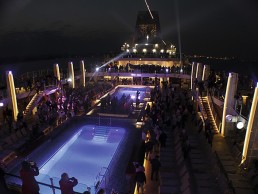
Special areas for the cruise liner include the Open Decks and the new James Martin cookery school. The Open Decks were considered as a place for entertainment lighting to take control during the hours of darkness. We were briefed to develop this, working in harmony with the entertainment lighting to create an extra special night time venue. Lighting control for the first time was seen as a vital part of this area although limitations were to be considered within the ship specification. With this in mind, we set about selectively integrating feature lighting within architectural elements, such as the pool edge, planters and large scale pylons which house entertainment speakers and moving head projectors.
The scenes set for the different areas include: a brighter and radiant surrounding for the terrace pool, more intimate and relaxing setting for the serenity pool and bar and a golden and vivid lighting scheme to highlight the entire perimeter of the lido pool. One of our lighting designers, Arianna Ghezzi, commented: “Our intention was to bring a Miami Beach pool party feeling to the Britannia poolside, creating a glamorous experience for the guests, supporting with our different lighting settings the various events the entertainment has scheduled.”
The cookery school, which was to be offered as a working professional kitchen for small classes of people learning from chefs, had the function of a private dining space open to the kitchen added. Lighting within the kitchen area had to meet lighting requirements of a working kitchen whilst forming the backdrop when not in use for the dining area, with the head chef table set as a part of theatre for the on-looking diners.
After four intensive years the day came for the MBLD team - Laura Mackay and Arianna Ghezzi, along with support from Rebecca Hines, Rob Honeywill and two Helvar technicians - to prepare for the final commissioning. After spending one week in the shipyard and one week at sea from Monfalcone to Southampton the ship was launched by Her Royal Highness the Queen at a grand ceremony in Southampton dock where the Britannia was successfully named in full glory of red, white and blue, christened with Wiston Estate English Sparking wine specially selected for the occasion.
Pics courtesy of P&O
New Age Clinic, Turkey
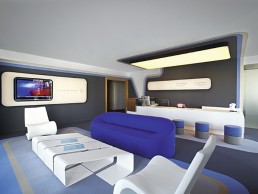
New Age Clinic is a plastic surgery, known for its hair transplantation procedures, located on the twelfth floor of the Fulya Terrace building in Istanbul, Turkey. UÄŸur Ä°mamoÄŸlu and Iglo Architects have created an affordable and impressive design through rational solutions. An impressive interior space was achieved by colouring on the walls, graphic arrangements on the carpet and the design of several furniture and illumination elements.
The founders of the clinic, Dr Ä°lker Apaydın and Dr Özge Ergün, requested a style that would reflect their personality and the job that they do. The existing 250sqm layout, having four rooms and a lobby, was suitable to function as a plastic surgery without any changes.
The clinic has an original, modern and smart design that serves a clientele who value aesthetics. A deliberate avoidance of standard surgery colours - white and blue - was expressed by the decision to use dark grey as the main colour from ceiling to floor. On the ceiling and wall crossings a fluid form was used to mimic a heartbeat. These graphic details help to define the style of furniture, such as the five-metre long desk in the lobby which was designed by Iglo especially for the project.
As no structural elements were desired, ceiling details were enhanced by using specially designed stretch lighting elements. The designer's brief was to create an aesthetic space that makes clients walk in and feel comfortable with the surgeon's work.
Most of the lighting fixtures were designed by Iglo Architects specifically for this project. All illumination in the corridors and lobby is provided by stretch ceiling fixtures, which were made to measure on the spot. On the ceiling and walls, electronically controlled Osram LEDs were fixed to a Barissol PVC stretch ceiling in a metal case.
The fixtures designed by Iglo and produced by Tekno Yapi provided the illumination level needed in the space without the need for additional fixtures. In the office spaces and consultation rooms, Philips wall fixtures, desk lamps and pendants were used for illumination. LED spots, provided by local manufacturers, create a sophisticated effect in the reception via a concealed positioning behind the steel plate on which the New Age Clinic logo was engraved.
A simple, clean approach to the interior and lighting design reflects New Age Clinic's desire for precision and aestheticism.
Pics: Fethi Izan
New Parliament Building, Oman
Oman’s recent civilisation is very visually present in the architecture of the landmark buildings that are spread throughout the country. It is the vision of Sultan Qaboos, the Sultan of Oman, to build a modern civilisation that has its roots in the Islamic arts and culture and this can be best seen in the modern Omani architecture of the low rise buildings in the capital city, Muscat.
The architecture of modern day Oman is unique in the Arab world combining Arab and Islamic culture and heritage with a classic contemporary style. Most of the buildings utilise the simple lines and arches found in the traditional forts and castles together with the precise cutting and carving technologies of the modern day to create some of the most magnificent Islamic architectural sculptures found around the world today. The Royal Opera House, the Grand Mosque and the Allam Palace are examples of this architectural style.
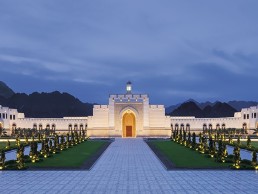
Majlis Oman, the new parliament building, is the latest of these landmark buildings in Muscat. The building comes as a testimony to the Sultan's vision of establishing a modern democratic state built on grounded Islamic routes where the people of the land are an integral part of the decision-making authorities in the country.
The symbolic significance of this project cannot be overstated. The Majlis is at the very heart of Oman's constitutional power and is the only legislative body in Oman where all members are democratically elected.
The building is located in the prestigious Al Bustan area of Oman close to the Ceremonial Palace and Ministerial buildings. The new Majlis overlooks the Gulf of Oman and is surrounded by a mountainous background and primary dual carriageways.
The building's design has a number of elements that are based upon elements from the numerous early forts located throughout Oman. This building both respects the origins and takes from it, and also adapts into a modern Omani style showing the forward looking intents of the government.
Scale is the key to the design of the external spaces. The architectural scale of the Majlis Oman built form is truly grand and monumental and drives the design. This grand and monumental scale is preserved in the landscape. Broad and flexible spaces open views to the architectural façades. These spaces are also designed to accommodate the grandeur and spectacle of ceremonial functions.
The grandeur establishes the Majlis Oman as the symbol of the highest order of national governance. The design of external spaces also provides human scaled spaces within the campus. Trees and palms planted relatively close to the facades transition the scale from monumental to human. Social scaled spaces are created in areas close to buildings. Examples are the two enclosed courtyards, the Clock Tower Courtyard and the Mosque Plaza that are more detailed and intimate spaces for smaller groups or solitary enjoyment of the outdoor environment.
The actual construction of the main building started on 29 July 2009 and was completed on 13 October 2014. The 101,931sq.m site featured a new building to the upper and lower houses of parliament (Majlis Oman, Majlis A’shura and Majlis A’ddowla), VIP areas, an information centre, library and associated offices/facilities to support the buildings.
The concept design of this iconic building started as a design competition that Australian architectural practice Moller Architects won. Detail design was carried out by Oman’s Royal Court of Affairs’ in-house team of architects, designers and engineers with Ammar H. Mohamed (Senior Lighting Engineer) and Anthony Coyle (Coordinating Architect).
The preliminary site enabling works took six months as the site had a hill which was removed and a number of Wadis (water channels) that were diverted away from the project site. Lighting design practice Visual Energy was commissioned by the Royal Court of Affairs to design the façade and landscape lighting for the entire project. The brief was to bring the Majlis alive at night time with the help of artificial lighting to enhance the style and identity of the building.
With over 2km of façade to illuminate, it was by far the largest and most visible element of the project. A number of challenges had to be tackled including finding a solution that was unique, sustainably and economically viable, and would enhance the architectural lines and contours of the highly engineered façade stone work.
During the concept design, two approaches for illuminating the building were studied simultaneously, the first relied on conventional inground metal halide uplights and floodlights and the second was a more revolutionary (at the time) linear in-ground high power LED system that would evenly illuminate the façade. A number of computer models and physical mock-ups at site were made to compare the two systems and to communicate the idea to the architects and the client.
The selected solution had to successfully illuminate the façade so that it could be seen from a minimum distance of 250m away for the public and close-up for the VIP guests and dignitaries visiting the building. From the mock-ups it was very clear that the traditional system of uplights and floodlights (spaced at 6m apart) would not achieve this goal as it resulted in the following adverse effects:
• The carved details in the façade of the building will be flattened out if floodlit from a distance. These details can only be seen when layers of light and shadows are present to emphasise the depth of the grooves in the façade.
• The shadows created by the architectural elements such as arches will not be evenly seen on the building.
• A single burned out lamp will create a gap of 12m of darkness which would be very visible from the viewing platforms created alongside the main roads.
• The VIPs and dignitaries would be affected by the glare from the floodlights as they walk out of the building at night time.
• Due to the low lumen output of LEDs at the time, metal halide floodlighting was not considered viable due to the large amount of power it would consume.
Therefore the selected solution was to project a linear beam of light at a precise distance away from the façade so that the shadows could be controlled. The location of the light fitting had to be closely coordinated with the landscape architects as it would run around the entire building, and coordinated with the architects on the floors above.
The scale of the Majlis dictated that the lighting had to be plentiful, varied in its form and function but beautiful to behold. There was no room for standard products in such grand surroundings. One of the principle terms in the lighting contract as per the Royal Court of Affairs criteria was that lighting manufacturers had to provide a five year limited warranty (due to the extreme heat and dusty conditions) and the qualifying companies must have been running for a minimum of ten years. Working closely with specialist lighting manufacturer Linea Light, Visual Energy designed a custom linear LED recessed in-ground solution that allowed for a small offset from the wall of only 900mm while still maintaining a uniform vertical illumination and minimal glare to the users of the space. The length of the fitting was also customised to be exactly 1,200mm so it could fit into the 4.8m grid used around the building.
Furthermore, the inground casing of the fitting allowed for running the three-phase cables and DMX within the body of the fitting, minimising the number of tapping points from the building, and the depth of the fitting was restricted to 100mm so it fits within the screed and top finish of the flooring. The fittings in the upper terraces were dimmed down to give a continuity effect to the light from the fittings in the ground. Finally a number of metal halide inground uplights were added around the main entrances of the building to emphasise the importance of these entrances when compared to the rest of the building.
Another important decision that was taken during the mock-up stage was the selection of the exact colour temperature of the inground light fittings to best illuminate the two-shade stone cladding of the building. 2,800K was finally selected as the most appropriate colour temperature and was used for all the LED fittings illuminating the façade of the building with the metal halides being 3,000K.
When the building was fully illuminated, the shadow lines were clearly visible as sharp lines seen from the 250m away roundabout and viewing platforms. The building now has a striking night-time façade and landscape set on a backdrop of the rocky Al-Hajar Mountains that can be enjoyed by the local population and visitors to the region alike.
Pics: Adam Parker - www.buildingimages.co.uk
Clay Paky welcomes Alfonso Zarate Takano
(Italy) - Alfonso Zarate Takano appointed as new Clay Paky Area Manager for Asia Pacific region.
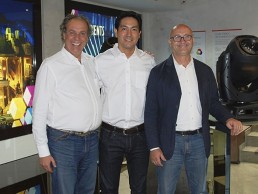
Alfonso Zarate Takano is the new Clay Paky Area Manager for the Asia Pacific region (APAC), comprising all countries in the Far East, South Asia and Oceania. Takano will report operationally to Sales Manager Alberico D'Amato, and is based at the OSRAM offices in Singapore.
"The markets in Asia and Oceania are growing fast and the appointment of Alfonso Zarate Takano is a strategic move to ensure a constant fixed local presence," said D'Amato. "It will now be easier for Clay Paky to visit customers in the region and provide top-class timely technical and commercial support."
Takano was born in Peru, but has lived for many years in Japan and Singapore and speaks English, Spanish and Japanese. He has excellent technical experience in the industry, having worked for important manufacturers of stage and architecture lighting, as well as detailed knowledge of customers in the region.
"Clay Paky has the support of a professional with an ideal profile for our business, on a market that will be a primary outlet for our offer," said Clay Paky CEO Pio Nahum.
Takano has already been to Clay Paky for a training course, where he had the opportunity to study the corporate guidelines and all the company products. He has been operational in the region since July 2015, where he has already visited all the main local Clay Paky distributors, with whom he will be working closely to optimise product promotion and marketing.
At his main international appointments, Takano will always be accompanied by a Clay Paky Sales Support Engineer.
IALD launches new website
(USA) - IALD.org is easier to navigate, mobile-friendly and offers reimagined user interface.
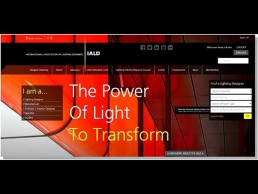
The International Association of Lighting Designers (IALD) launched its new online home at IALD.org this month. Redesigned with the lighting community in mind, IALD.org is easier to navigate, with a mobile-friendly design and a reimagined user interface.
UPGRADED LIGHTING DESIGNER PROFILES
The Find a Lighting Designer feature on IALD.org gives you access to redesigned profiles of more than 750 of the world's leading architectural lighting designers.
GLOBAL EVENT CALENDAR
IALD's worldwide network of regions and chapters host some of the industry's most vibrant and unique events. See what IALD is doing near you.
ONLINE MEMBERSHIP APPLICATION
The IALD Membership Committee is pleased to begin accepting applications online. Learn more.
REFRESHED NEWS FEED
Visit the IALD News page for a real-time feed of information about what the IALD and its members are up to; or get a digest of the information by perusing past issues of Reflections or Member Spotlight.

Targetti USA appoints O'Blaney Rinker Associates as NYC representative
(USA) - Manhattan-based boutique design agency will represent both Targetti and DuraLamp lines for New York and surrounding metropolitan areas.
O'Blaney Rinker Associates (ORA) is a boutique design alternative lighting agency that provides services from schematic development through the project completion and after-market service for their clients and manufacturers. The Manhattan-based agency provides lighting and control system specifications and sales, a vast range of experience and knowledge across the complete spectrum of New York's lighting design, engineering, architectural and distribution communities.
Marie Paris, US Business Development Manager said:"The NYC and New Jersey area is a primary specification influence for the global lighting industry, as well as a dynamic market for both our brands. As a premier sales representative in the area, O'Blaney Rinker Associates is uniquely positioned to help us communicate our message and manage our continued growth in the US market."
"We are pleased to be represented by such a top-notch organisation that truly understands the specification community."
Caroline Rinker an ORA Principal said: "We are very excited about our new partnership with such an iconic brand as Targetti. Their history in the international market and focus on quality and innovative solutions provides a perfect mix for our U.S. specification customer base."
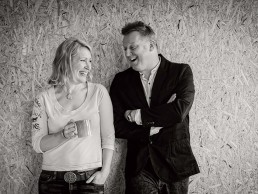
Kate Wilkins and Sam Neuman join forces
(UK) - London based lighting designers bring together years of collaboration to create portfolio of varied projects and launch new website.
Lighting designers Kate Wilkins and Sam Neuman have joined forces after years of collaboration. Their new web-site KateandSam.co.uk is now live showing a portfolio of projects of different scales using both well-established and cutting-edge lighting techniques and often together.
Much of their work is about lighting as a way to effectively bring out the materiality and details of both architectural interiors and exteriors. Another of their objectives is based around exploring the narrative role of lighting in a space and a physical and psychological feel-good factor that can be achieved through tactical lighting.
Wilkins and Neuman's interests follow lighting as an essential part of a business' identity. Their work for Wahaca restaurant group has explored the notion of brand in this way. Most recently, Wilkins and Neuman completed the lighting scheme for Wahaca Cardiff. This involved the installation of Booo soft rubber pendants each supplied with a 2,700k 650 lumen LED with mains dimming down to 10%. To work with the colour palette and react to the warmer tone light waves, the pendants were fitted with custom yellow and orange flexes. The Booos help bring the room down to a more friendly scale for dining whilst keeping the impressive size.
The studio has also recently completed the lighting scheme for Llanelly House in Wales (pictured right). The building is Wales' finest Georgian house and has been painstakingly restored for public use, incorporating retail, function rooms, exhibition space and a restaurant.
The studio used a lighting scheme in the grand room that highlights important works of art and architectural details, including the original cornices. The role of lighting in conservation and historic buildings is something that they are looking to explore further in the future.
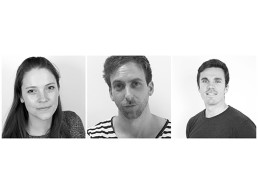
PNLD announces promotions
(UK) - London based architectural lighting practice promotes senior team members Daniel Blaker, Ellie Coombs and Emilio Hernandez to continue growth.
London based architectural lighting design specialists Paul Nulty Lighting Design (PNLD), have announced the promotion of senior members of the team within the award winning practice.
Daniel Blaker has been promoted to Creative Director, Ellie Coombs takes up the role of Director and Emilio Hernandez takes up the position of Associate. Blaker, Coombs and Hernandez oversee a team of lighting designers and are currently heading up projects including Keflavik airport in Iceland, a roof top park and 5* hotel in central London.
Phil Copland, Anna Clara Sandgren and Christina Hebert have also been promoted to senior designers within the practice.
Paul Nulty, Head of Practice said: "Promotions are a proud time for us as a business. These promotions are well deserved and it signals our maturing as a practice whilst continuing to highlight our intent to employ, nurture and develop the best talent within the industry.''
PNLD is now in its fifth year and has a reputation for high quality and creative design work across the commercial, residential and retail sectors. The team has grown rapidly in the four years since it was founded in 2011 and has tripled in size to 26 employees.
