
LEDucation 2023 celebrates record-breaking attendance
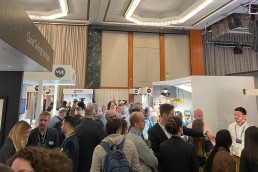
(USA) – LEDucation Trade Show and Conference celebrated its 17th year at the New York Hilton Midtown on 7-8 with a record-breaking year in terms of attendance figures; more than 8,000 attendees from all aspects of the lighting industry visited the show over the two days.
LEDucation Co-Chairperson Caroline Rinker said: “We are pleased to see how this show is growing. The explosive energy and enthusiasm of attendees only confirmed that the lighting industry is still going strong.”
Noting an increase in the number of attendees and exhibitors from outside of the US, Co-Chairperson Burt Grant added: “The show is noticeably gaining more recognition internationally. Attendance at our virtual educational sessions have proved there is worldwide interest and these sessions have contributed to the expansion of the LEDucation name. In addition, interested European companies have recognised closer access to top lighting design firms here in New York City. Their projects can be seen around the globe. We are exploring ways to better serve not only the local and national industry, but the international lighting market as well.”
Alongside the tradeshow, 36 LEDucation seminars explored a variety of topics, and both utilitarian and more thought-provoking seminars were all well attended. The LEDucation Presentation Committee, comprising Wendy Kaplan, Craig Fox, and Shaun Fillion, acknowledged the presenters for sharing their knowledge at the educational seminars: “Your collective information reached well over 3,800 attendees via virtual and in-person sessions. We look forward to our slate of speakers for 2024 LEDucation presentations.”
The LEDucation Conference is known for engaging a large cross-section of the lighting industry and those in related fields. Also a seminar panellist, Fillion added: “We began our panel discussion on the topic of glare with a survey of the attendees. Of the 150+ attendees, we had representation from designers, manufacturers, and reps, but also architects, contractors, distributors, educators, and facility managers.”
After such a successful event, plans are already underway for LEDucation 2024, with more than 325 exhibitors already reserving their booth space for next year’s event, which will take place at the New York Hilton Midtown on 19-20 March.


Nuckolls Fund distributes $140,000 in Grants and Awards for 2023
(USA) – Four grants of $30,000 each and four awards of $5,000 have been distributed by the Nuckolls Fund for Lighting Education for 2023, totalling $140,000. This year’s grants and awards brought the Fund’s total distribution to more than $1.85million.
Founded in 1988 to recognise the achievements of the late lighting designer and educator James L. Nuckolls, the Nuckolls Fund supports the development of innovative college-level lighting programmes for the technology and aesthetics of lighting design with grants, and assists deserving students with awards to further their lighting design education. Submittals by educators for grants and nominations for student recognition are judged annually by the Fund’s Board of Directors.
Nuckolls Fund President Lee Waldron, in announcing this year’s award and grant recipients, recognised the breadth of the proposals for lighting-related instruction, from incorporating Building Information Modelling across inter-department programmes to techniques for integrating daylighting into interior spaces. “Each grant principal investigator emphasised the importance of their revised curricula to the students who would be taking the knowledge gained with them into the lighting industry, which will ultimately benefit the end-user,” he said.
Recipients of the $30,000 Nuckolls Grants to Expand Lighting Curriculum were Texas Christian University, and Oregon State University. At Texas Christian University, Alyssa Humphries Steward, Associate Professor and Director of the Center for Lighting Education was recognised for the programme “Integration of CAD to BIM: the Design Process and Technology Paradigm Shift in Architectural Lighting Design Education & Practice”, which will extend throughout the existing lighting curricula.
At Oregon State University, Clotilde Pierson, Assistant Professor of Architectural Engineering received a grant to improve learning modules with its “Daylighting Design through Experiential Learning Pedagogy”.
The $30,000 Lesley Wheel Grants to Develop and Deliver New Courses were awarded to Lauren Dandridge, Adjunct Assistant Professor, School of Architecture at the University of Southern California, who received a grant for “Exploring Exterior Lighting Design and its Effect on Health, Community, and Nature”. Robert Davis, Affiliate Faculty, Civil, and Architectural Engineering Department at Tennessee State University was also recognised with a grant for “Expanding Lighting Education: A step towards a more diverse academic pipeline into the lighting professions”.
The Nuckolls Fund also distributed four $5,000 Awards to students across the United States. The Jonas Bellovin Scholar Achievement Award when to S M Ashik Rahman, University of Colorado; The Jules Horton International Student Achievement Award was given to Nayoun Ryu, Parsons School of Design; and Bentley Tonniges, University of Nebraska, and Aaron Zimmerman, Pennsylvania State Univeristy, were both recognised with the Designers Lighting Forum of New York Student Achievement Award.

IALD Chase the Dark to take place this Thursday
(Worldwide) – The 10th edition of the IALD’s Chase the Dark community event will take place around the world this Thursday, 23 March.
The programme’s name comes from the global nature of its premise: designers from the start of the International Date Line follow the rising sun as it “chases” the darkness, from Australia to the Pacific coast of the US. Encouraging participants to join in the activity, either individually or in localised gatherings, each year’s event has a theme that is the basis for individual expression, that is then shared on social media using the #IALDChaseDark hashtag.
For 2023, the programme’s theme is entitled “Shadow Play”, allowing participants to use the balance of light and dark to create displays that might involve casting unique shadow shapes, backlighting silhouettes, creating optical illusions, or anything else personally inspired.
Emma Cogswell, the lead coordinator for the Chase the Dark programme and project manager for the IALD UK region, is pleased to see the event so widely embraced for its 10th year. “Shadow is a valuable asset in a lighting designer’s toolbox,” she said. “With the ability to be projected forward or silhouetted when backlit, it’s a commonplace technique in storytelling and puppetry in a range of South Asian cultures.
“We have numerous regions and chapters coordinating in-person gatherings; form Melbourne to Mumbai, to Toronto, to San Francisco, not to mention the individual participants trying their hand at Shadow Play and joining the fun from all over the world. We can’t wait to see the results.”
The Chase the Dark event is specifically developed to encourage participating by IALD members and non-members alike, promoting the awareness and value of professional lighting design on a global scale.
Complete details of the event can be found on the IALD website here.
Christopher Bauder to deliver keynote at IALD Enlighten Europe
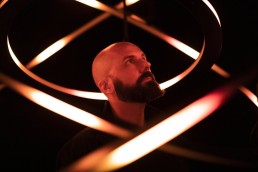
(Europe) – The IALD has announced that Christopher Bauder, founder of art studio WHITEvoid, will deliver a keynote session at IALD Enlighten Europe.
A multiple [d]arc award winner, Bauder is an artist that works in the fields of light and installation art, media art, and live AV performance. He focuses on the translation of bits and bytes into objects and environments, and vice versa. Space, object, sound, light, and interaction are the key elements of his work.
Enlighten Europe will be held in June, in Bauder’s native Berlin, bringing together hundreds of lighting professionals to attend sessions and discuss topics of high importance to the industry.
Christopher Knowlton, IALD CEO, is delighted to have Bauder as the headlining speaker for this year’s event. He said: “Having seen first-hand the incredible artistry that Christopher Bauder has shared with the world, and the city of Berlin in particular, it is nothing short of perfect to have him attend Enlighten and share his insight on the design, interactivity, and engineering that he demonstrates in his work.
“Designers of all tenure and scale could benefit from his understanding of the intersection between architectural illumination and the human experience, to say nothing of his groundbreaking use of media and technology.”
Christopher Bauder has brought his installations and performances to events and spaces around the world, including Centre Pompidou Paris, MUTEK Montreal, Fete des Lumieres Lyon, The National Museum of Fine Arts Taiwan, the National Centre for the Performing Arts in Beijing, and many more.
He is best known for his city-wide light art installation “LICHTGRENZE”, created in 2014 with his brother Marc Bauder, for the 25th anniversary of the Fall of the Berlin Wall.
Bauder’s keynote will be the headlining session of the event which runs from 30 June through 1 July at the Café Moskau in the heart of Berlin. The conference schedule spans two days of thought-provoking discussions among the profession’s foremost experts to inspire and motivate, moving architectural lighting design into the future.
Returning to the continent for the first time since 2018, the IALD Enlighten Europe 2023 conference is eagerly anticipated and expected to mark the triumphant return of in-person networking and continuing education opportunities for the professional lighting design community across Europe and beyond.
arc spoke with Bauder about his studio’s design approach, its immersive artwork and its fascination with light, inside issue #122. Read the full interview online here.

WIL launches global equity survey
(Worldwide) – In a change from previous years, Women in Lighting (WIL) has celebrated International Women’s Day with the launch of an online survey.
The theme for this year’s International Women’s Day was #EmbraceEquity, and as such, the survey looks to examine equity in regards to working practice in all aspects of the lighting industry.
“This year, the WIL project isn’t bringing you an event. Instead, we call upon you to help us to create a global gathering of information by completing our survey,” the group said.
“In order to embrace equity, we need to investigate it. Our hope is that this global gathering of data will not only highlight where equity is problematic, but also where it is positively thriving.
“The survey may originate from the Women in Lighting project, but it is for everyone. We want everyone to join in because we only get better together.”
The expansive survey is entirely anonymous, and all questions are optional. Results will be shared as aggregated data only with more responses leading to better end data. However, WIL stresses that if answering a particular question “acts as an identifier or makes you uncomfortable in any way, please move on to the next question”.
“Questions came from women and men around the world, and we thank everyone that responded with suggestions. Some questions may be irrelevant, but we want to cross reference many different things. For example, job fulfilment, digital equity and wellbeing can all be cross-referenced through the lens of gender equity.”
The full survey can be found online here.
Glamox switches to recycled aluminium
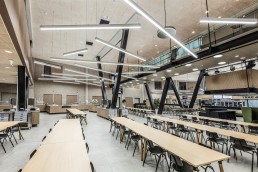
(Norway) – As part of its goals to reach Net Zero operations by 2030, Glamox has announced that it has started to switch from using virgin aluminium to recycled aluminium in the manufacture of its LED luminaires.
The company has already made the switch for one of its most popular luminaires, and is preparing to extend this to other families. The move will lower the carbon footprint of the company, and also of customers who purchase the energy-efficient luminaires for use in professional buildings.
Recycled aluminium is created by re-melting scrap metal. The process is less expensive and energy-intensive than creating new aluminium, which is made by the electrolysis of aluminium oxide, which must first be mined from bauxite ore and then fired.
Birger Holo, Technical Director, Professional Business Solutions, Glamox, said: “We’ve already implemented the plan to shift over to recycled aluminium in the manufacture of a popular luminaire, which will result in a 63% reduction in the emissions of CO2 equivalents over using new aluminium in these profiles.
“By adding two new product lines, we estimate that we will eliminate a total of 1,000 tonnes of CO2 equivalents each year, which equals the amount of carbon sequestered by nearly 1,200 acres of forest a year.”
The company is also looking to eliminate plastic in its packaging, replacing bubble wrap and Styrofoam with materials that are easier to recycle. It also recently launched an Environmental Product Declarations (EPD) generator. Based on international standards, this tool documents the environmental footprint of products taking into account their lifestyle.
“We still have a lot of work ahead of us, but we are committed to helping our customers to reduce their carbon footprint and for us to achieve Net Zero operations by 2030,” said Viktor Söderberg, Business Development Director, who heads up Glamox’s sustainability programme. “It’s not enough providing energy-efficient LED lighting, we must ensure that every facet of our operations and supply chain minimises our environmental impact.”
Light Symposium comes to Stockholm
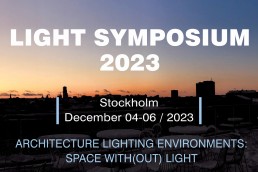
(Sweden) – Light Symposium – a yearly collaboration between four universities and their partners across Europe – will this year be held in Sweden during Nobel Week from 4-6 December.
The 9th edition of the event will have the title Architecture Lighting Environments: Space With(Out) Light, and will be hosted by the Architectural Lighting Design Division of KTH Royal Institute of Technology, in collaboration with the Perception Studio at Konstfack, the University of Arts, Crafts, and Design.
KTH is one of the four partner universities, alongside Hochschule Wismar, Germany; AAU Copenhagen, Denmark; and USN Kongsberg, Norway. The event coordination and location alternates among the four partners, which each being involved in steering and advising each year’s event and programme.
The conference programme will be structured around a published call for papers (talks and poster presentations), with proposals to be submitted online. Suggested topics include daylight and electric light in architecture, art, and urban design, including interpretations on: Variability and Rhythmicity; Designing for Darkness; Sensory and Spatial Perceptions; Light and Health for all Species.
Daylight and electric light are an integral part of our built environment, and the sustainable design of lighting in this context, its presence, absence, and variability over time, requires trans- and interdisciplinary research and practice.
Although the presence of light is intimately linked to the life of humans, flora, and fauna, research and practice have not yet fully explored how light and dark (lightness and darkness) can shape the built environment in a sustainable and holistic way. Research and practice into the affects and effects of light combine lighting design with other fields. LS2023 will facilitate a spectral interchange in which individuals working in research, design, and industry will discuss the process of integrating the many shades of light into various scales of projects, large and small.
The three-day international conference will be organised as an in-person event to bring together lighting-related communities and discuss the latest insights from design, research, theory, technology, art, and applications.
Alongside these talks, related panel discussions, and posters, the programme will also include several keynote speakers, networking events, and walking tours of light-related installations throughout Stockholm, for example, as part of the Nobel Week Lights programme.
Following the three Light Symposium days, lighting-related talks and gatherings will continue in Stockholm 6-8 December in connection with the Light Week of the Swedish Energy Agency.
For more information about the event, and to submit to the call for papers, visit the Light Symposium website.

Silhouette Awards reveal winners for 2023
(Worldwide) - The international Silhouette Awards has announced the winners of its 2023 programme in a virtual celebration, which took place on 1 March.
The whole international lighting community was invited to join this momentous occasion, with many taking part in celebrating the winning Mentees and their Mentors.
For the second year running, the popularity of the awards was demonstrated by the vast number of entries received from candidates located in 26 countries across the globe.
The renowned judging panel have independently reviewed the entries, and all aligned with a final selection showcasing the very best of the industry’s rising talent.
The 2023 winners and mentor partnerships are as follows:
- Ines Bartl - Mentor: Amardeep M. Dugar
- Jessica Keates – Mentor: Arianna Ghezzi
- Anastasia Angeli – Mentor: Barbara Horton
- Jessica Smith – Mentor: Beata Denton
- Danai Lytra – Mentor: Claudia Paz
- Consuelo Emiliana Miranda Barroso – Mentor: Diana Galic
- Annabelle Hill – Mentor: Fay Greenhalgh
- Dane Amilawangi – Mentor: Florence Lam
- Swillow Lee – Mentor: Gary Thornton
- Walesca Zanonato – Mentor: Kristina Allison
- Chérine Talge – Mentor: Maida Hot
- Cristina Antonieta Martinez Bergonje – Mentor: Martin Klaasen
- Gemma Alcalá Jurado – Mentor: Michael Callanchini
- Swapnali Bhadale – Mentor: Nikita Agrawal
- Alperen Ekici – Mentor: Olga Tuzova
- Valeria Coghi Martinez – Mentor: Paul Traynor
- Massimiliano Moro – Mentor: Siddharth Mathur
- Olga Rybkina – Mentor: Volker von Kardorff
- Wenyi Kong – Mentor: Waleed Fakousa
- Farahbee Rahman – Mentor: Yah Li Toh
These 20 successful candidates will now be individually supported by one of the programme’s 20 mentors for the next six months and beyond as the young professionals progress in their careers. With the support of the Silhouette Awards’ sponsors and supporters, the winners have been rewarded with the opportunity to enhance their skillset, pursue their career ambitions and add real value to the creativity of the industry, raising the bar for talent around the world.
Eve Gaut, Silhouette Awards Co-Founder, Parrot PR & Marketing commented: “We are thrilled that, following the overwhelming success of the launch of the Silhouette Awards, we are returning for a second year of nurturing young talent. A huge congratulations to the winners on this much-deserved achievement. We are immensely grateful for the Supporters, Sponsors and Mentors who have supported the awards. We also want to say a huge thank you to the international lighting community for coming together to celebrate the winners with us at the virtual event. The winning mentees will receive much-deserved recognition and publicity for their achievements, and we are honoured to have created this ongoing supportive platform.”
Katia Kolovea, Silhouette Awards Co-Founder, Archifos, added: “We are so excited to see what’s in store for our Mentees during this second year of the awards programme. Reflecting on the great success of the partnerships between our Mentors and Mentees from last year, the expectations are high. Congratulations to our 2023 winners, this is an incredibly exciting day. We want to say a huge thank you to our Supporters, Sponsors, and Mentors, who have helped us to achieve for a second time this wonderful ambition to showcase the talent of the future.
“The Silhouette Awards are much more than an award, and we are proud to have created a programme that allows Mentors to nurture young talents, Sponsors to connect and support further those individuals, and for everyone involved to build deep and long-term business relationships and friendships. This is just the beginning.”
The Silhouette Awards was established to find the industry’s rising stars who have the vision and ambition to steer and lead the lighting industry in years to come. Much more than an award, the Silhouette Awards provide mentorship support to designers, celebrate the future talent of the lighting industry, and create a supportive platform for inspiration and growth.
To find out more about the Silhouette Awards and how you can get involved as an entrant, mentor or sponsor for the 2023-2024 awards programme, contact info@silhouetteawards.com
The next edition of the Silhouette Awards will open for entries in September 2023.
The recording of the celebration can be viewed here.
Fisher Marantz Stone opens Austin studio
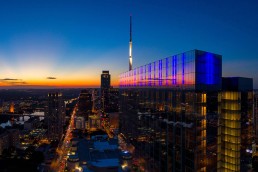
(USA) – Fisher Marantz Stone has announced the opening of a new studio in Austin, Texas.
Alongside existing studios in New York and Seattle, the new Austin office will offer a strategic geographic presence that will allow the firm to better serve its clients both around the US and the world.
The Austin studio will be led by Senior Associate Katheryn Czub, with support from Principals Paula Martinez-Nobles and Michael Hemmenway.
Fisher Marantz Stone has completed many projects across Texas over the past four decades, with highlights including San Pedro Creek Culture Park in San Antonio; Austin-Bergstrom International Airport; One Allen Center in Houston; and the Raymond and Susan Brochstein Pavilion & Central Quadrangle at Rice University, Houston.
[d]arc sessions inspires Rako to highlight sustainability in new brochure
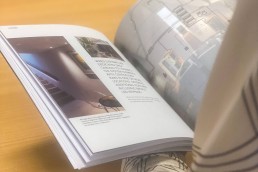
(UK) – Rako has launched an environmentally friendly new brochure for 2023; featuring insights, products, technical information and case studies, the brochure offers an overview of the Rako product range, including multiple user interfaces.
The application of Rako’s products and wired and wireless systems are also demonstrated through helpful illustrations and project examples.
Conscious that print material can be less desirable these days, Rako were keen to create a considered piece that was sustainably produced, while portraying the luxury and quality of the Rako brand. The finished brochure is printed on recycled paper stock and is a carbon neutral print product. It is also wrapped in a compostable sleeve, which can be disposed of with food waste or in a compost bin.
The decision came after Rako attended [d]arc sessions – an event in which sustainability was a core focal point.
Peter Broome, Director at Rako, comments: “[d]arc sessions really inspired us to shout a little more about what we are doing at Rako to improve our products and processes to be more sustainable. It was evident from our meetings with lighting designers and specifiers at [d]arc sessions that sustainability was incredibly important to them and their clients across the globe.
“Sourcing and recommending sustainably produced products that have longevity are a key criteria for these specifiers. Whilst we had been doing much to be greener for some time, we are grateful to [d]arc sessions for helping us realise this and subsequently communicate these pledges to our clients. Without participating at [d]arc sessions in Mykonos and Ras Al Khaimah, our awareness and understanding of just how much sustainability matters to this audience would not have been realised. We look forward to the next [d]arc sessions in Croatia with vigour and enthusiasm.”
Within the brochure, Rako has highlighted the ongoing initiatives it is doing to lessen its impact on the environment, which include removing polystyrene chips, bubble wrap, and plastic tape from its consignment packaging and replacing them with recycled paper alternatives. Currently, 79% of the company leased vehicles are either fully electric or hybrid, and the company offers employees a ride to work scheme to support employees who are within cycling distance.
By Spring 2023, solar panels will also be installed across Rako’s offices and manufacturing facility, increasing its use of green energy. All of the initiatives can be found within the brochure, available to view on the Rako website here.
Lutron - Athena Wireless Processor
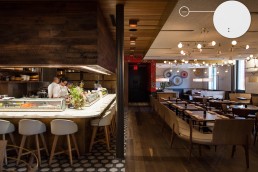
Lutron has introduced the Athena wireless processor to its Athena lighting control system. The new processor is right sized for smaller spaces, and yet easily scalable for use in larger projects. With the Athena wireless processor, Athena systems do not require panels, and work with a wide range of both wireless and wired devices, saving electrical closet space and giving designers, architects, and engineers greater flexibility.
Design professionals have come to expect increased versatility from the building systems they use. As the latest enhancement to Lutron’s Athena lighting control system, the Athena wireless processor empowers designers and their clients with tools that support future-proof lighting systems, and insights that drive efficient business decisions.
The Athena system has been designed to bring a connected lighting solution for smarter spaces and more human centric experiences, and now the Athena wireless processor expands system capabilities to enhance the simplicity, value and flexibility of projects.
Ideal for both small, luxury boutique applications and large office projects, the Athena wireless processor makes Lutron Athena the most complete, versatile, Ketra-ready control system for your most innovative and sustainable projects. Each Athena wireless processor can easily marry third-party fixtures and Ketra in the same application, layering in any control strategy – occupancy, vacancy, and daylight sensors, as well as touchscreens, keypads, and Pico wireless remotes all in a single control package.
With the Athena wireless processor and its advanced software and app control, designers can exceed clients’ expectations while respecting their budgets and schedules. The single-device processor combines all the Athena cloud-connected benefits and features and does not require separate Lutron panels or hubs. System software, controls, shades, and drivers can now communicate wirelessly to the Athena system, increasing design flexibility, minimising required closet space, and delivering a cloud-connected solution.
The Athena wireless processor complements system enhancements introduced in late 2022 to make Athena systems even more capable.
Athena wireless node is an ultra-small, individual, wireless fixture control packed with technology to ensure you can easily and quickly adjust light settings by fixture, zone, or a combination of both. With this new option, the Athena system can be wired and/or wireless and controlled with granularity down to the individual fixture.
Athena dashboard is analytical software that visualises complex occupancy and energy data in intuitive reports and makes them easily accessible to inform business decisions and occupant-friendly lighting adjustments. Designed to be cloud-connected, the Athena dashboard offers automatic and continuous updates.
The upgraded, cloud-connected Athena system allows designers to do more with a single system and expands data-analytic capabilities. Ongoing Athena system enhancements support the need for connected solutions that deliver building management insights, simplify ongoing system adjustments, and continue to add value over time.
In an era when building technology can struggle to keep pace with innovation, connected Athena systems receive regular software updates, ensuring the system gains functionality and capability over time.
Chris Udall, Senior Product Manager at Lutron, said: “The beautiful thing about the new Athena wireless processor is its ability to serve a wide range of space types; it is equally at home in smaller, boutique applications and large, multi-story office buildings. Regardless of the application, all the software and analytical features are at your fingertips. The new processor delivers a cloud-connected Athena solution without taking up closet space or requiring new wiring.”

Howard Brandston, lighting design pioneer, dies aged 87
(USA) – Howard Brandston, founding member of the IALD and pioneer of the lighting design profession, has passed away at the age of 87.
Born in Canada, Brandston moved to the United States at the age of 9, growing up in New York. From an early age, Brandston had a passion for theatre and art that was encouraged by one of his early mentors – his art teacher at Lincoln High School in Brooklyn, Leon Freund.
Speaking to arc in 2008, he said: “Leon had been involved in the government sponsored WPA projects of the Depression. He called us his ‘Art Squad’; in art studio, he would say to the class ‘You have a blank piece of paper in front of you: it represents an opportunity to create a work of art. Let’s see what you can do.’”
Brandston’s interest in the arts eventually led to him studying Theatrical Illumination at Brooklyn College. Following his studies, Brandston worked as an assistant to lighting luminary Stanley McCandless, whom he credited as being a major influence and inspiration on both his work and his design philosophy.
Following the overriding ethos of “Rules are a substitute for thinking, and I wasn’t going to stop thinking,” Brandston branched out from theatre lighting into architectural lighting design, initially alongside McCandless, before taking a job with architectural lighting designer Seymour Evans, whom Brandston described as “a character beyond belief”.
From here, Branston established his own lighting practice, Howard Brandston Lighting Design Inc – now known as Brandston Partnership Inc (BPI) – in 1965. Through this, one of Brandston’s first major projects was the Canada Pavilion at Montreal Expo in 1967; this in turn led to an opportunity to work on the American Pavilion at Expo 1970 in Osaka, Japan.
In the following 50 years, BPI has completed more than 5,000 projects around the world, and has expanded from its New York headquarters to offices in Shanghai, Beijing, Shenzhen, Chengdu, Singapore and Seoul.
Notable projects from Brandston’s illustrious portfolio include the restoration of the Statue of Liberty; the Detroit City lighting masterplan; the Petronas Twin Towers in Kuala Lumpur (formerly the tallest building in the world); the American Museum of Natural History, New York; and the Marina Bay Financial Centre in Singapore.
Alongside his stellar work with BPI, Brandston was also passionate about teaching – he led a design studio at Rensselaer Polytechnic Institute (RPI), and was actively involved in the Lighting Research Institute, The Lighting Research Center at RPI, and the Lighting Research and Education Fund. In 1981, he also founded the Annual Workshop for Teachers of Lighting, and endowed the annual Brandston Student Lighting Competition as part of the awards programmes of the Illuminating Engineering Society of North America (IESNA).
Brandston was also one of the founding members of the International Association of Lighting Designers (IALD), establishing the association in 1969. Speaking to online lighting platform Lytei, he recalled its formation: “We were setting the standard; we were all looking for excellence; we all had the same goal, even if we didn’t have the same methods; we were all heading in the same direction, even if it was by a different path.”
Across his career, Brandston received many lighting awards, including the Lifetime Achievement award with the IESNA and IALD; Fellow status with the IALD; Honorary Fellow of the Chartered Institution of Building Services Engineers (CIBSE); Honor Award for Contributions to Architecture from the American Institute of Architects (AIA); and he has been inducted into the Interior Design Hall of Fame.
Longtime business partner Robert Prouse, who retired from BPI in 2018, announced the news of Brandston’s passing on LinkedIn. He said: “It is my sad duty to tell you that Howard Brandston passed away peacefully this afternoon, after a few days in hospice care. For those that didn’t know him, he was a towering figure in architectural lighting design. He was a founding member of the IALD, Past President of the IESNA, and recipient of many awards.”
Speaking of Brandston's legacy, IALD President Mônica Luz Lobo, said: "Words can't express the contribution he made to our profession. To refer to Howard as an icon in the lighting design profession only begins to touch upon his impact and importance. He is warmly remembered and revered, and the IALD community worldwide owes him immense thanks for his talent, care, and contribution over a lifetime of fantastic achievement."
Considered by many to be one of the founding fathers of modern architectural lighting design, Brandston leaves behind a rich legacy, and will be long remembered for his invaluable contributions to the lighting design profession.
“Light is everything. Light is life. It is art, it is science, it is whatever you wish to make it.” – Howard Brandston, 1935 - 2023
Watch a six-part interview series with Brandston, filmed by Lytei in 2020, here.