

Astro Concrete Eclipse
Presented at this years’ Euroluce, Astro’s striking Eclipse wall light is now available in a smooth Concrete finish. Celebrating the character and charm of raw material aesthetics, the Eclipse Concrete presents lighting in an architectural form. Each light is individually cast by reinforcing raw concrete with weatherproofing additives, producing a robust and authentic product with natural imperfections. Appearing to float on the surface, the Eclipse Concrete produces a soft glow that blends into its surroundings, complementing the architecture around it.

David Morgan Review: Ligman L-Column
David Morgan gets up close and personal with the latest product from Ligman, the L-Column intelligent light column. To be exhibited at Lightfair International, the L-Column combines lighting, security and smart city elements in one integrated system.
When a lighting company started in Bangkok in 1995 by Sakchai Manawongsakul, manufacturing high-quality exterior luminaires, grows into a global lighting manufacturer, it seems likely that there will be some interesting product developments in the works.
Now employing 520 people, with four factories, offices in thirteen countries and more than 100 distributors, recent expansions for Ligman included last year’s opening of its European factory in the Czech Republic and a new global headquarters building in Bangkok, alongside the first of a number of planned flagship stores opened in Bangkok and Singapore, as well as new Ligman offices in the UK, France and China.
The Ligman approach to luminaire design has been straightforward, with a focus on the commercial exterior lighting market. The product range has expanded over the years to cover both interior and exterior lighting. Products are well constructed, in most cases with a simple clean and geometric design aesthetic, and good lighting performance.
Martin Valentine was recruited in 2017 as Ligman’s Global Design Director to oversee the development of more complex lighting systems. Valentine’s extensive experience as a leading lighting designer in the UK, and as in-house consultant to the Abu Dhabi city, gives him a unique perspective for this new role with Ligman.
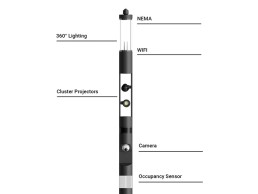
The first result of Valentine’s efforts is the L-Column intelligent light column, which combines a remarkably wide variety of lighting, security and smart city elements in one integrated system.
Valentine was heavily involved with the research and design of the L-Column since the idea was first raised. It took just under one year to bring this development through to manufacture and it was officially launched in March this year.
The research, design and development process for the range was undertaken by the in-house management team with Stephen Dunk heading product design, supported by input from an industrial design practice.
Valentine was keen to ensure the system offers excellent lighting performance and that the lighting elements would not be compromised in order to fit them within the pole diameter. A fully integrated visual appearance where all the elements share a common design language was also a key requirement.
The results of this do not disappoint. A circular 216mm diameter extruded base column has a minimum height of three metres and a maximum height of eight metres when fitted with the various lighting and other modules.
A variety of new lighting modules have been developed as part of the L-Column range and standard Ligman luminaires can also be incorporated. Ligman’s post top lanterns, such as Anesti, Laluna or Macaron, coordinate visually with the geometry of the column and will provide good urban ambient lighting to the base of the column.
The 360-degree luminaire module provides up to 6,000 lumens with an efficiency of up to 101 lumens per Watt. 3000K or 4000K 80 CRI LEDs are the standard options. Four lighting distributions are achieved with the use of optical controllers, including two elliptical distributions of 134 x 48 degrees and 134 x 54 degrees.
A Wifi hub can also be incorporated in this 360-degree luminaire module as part of a Smart City system.
Single and twin street lighting pole modules enable any of the thirteen ranges of Ligman street lighting luminaires to be mounted, although some of these designs will integrate visually better than others with the rest of the system.
Two sizes of aimable projector modules house either two or four LED projectors, which incorporate a COB LED light engine with four distributions. Anti-glare snoots and other accessories are available for these projectors. A decision was made not to enclose the projectors within a clear window detail in order to allow wider aiming angles to be achieved. Thermal management of the projectors will also be easier without any enclosure to trap heat.
It is understood that a number of additional lighting elements will be added in future, including colour-changing beacons that can be used for decorative, wayfinding or indicator functions.
The non-lighting elements include daylight and proximity sensors, CCTV with single and twin modules, a weather station, loudspeakers, an intercom and an electric vehicle charging station.
The Ligman L-Management system offers a complete addressable project lighting monitoring and control solution and can provide additional information to a control centre such as digital video surveillance, air pollution level monitoring, asset tracking and an intercom for face-to-face communication.
Assets can be tracked through RFID monitoring and security can be increased with the use of 360-degree zoomable surveillance cameras. The weather station and its pollution monitors will even allow a city to implement traffic calming policies and meet international WHO targets.
Using wireless technology, gateways and a data concentrator, street lights become smart, talking through a mesh network to the control centre. The hardware and software tools provided by Ligman provide live information to the control centre, allowing local authorities to monitor the health of the city by displaying not only the status of the luminaires but also the power consumption and usage.
L-Column is an ambitious addition to the Ligman range, which should enable more complex urban lighting projects to be undertaken. Although the range was only launched in March this year, I spotted it at LEDucation in New York, and the reaction so far from specifiers around the world has been very positive.
In less than 25 years Ligman has grown into a global player and developed a solid product range, which is why this is a company to watch and see what they deliver next.
Ocean Wonders: Sharks!, USA
Ocean Wonders: Sharks! is an example of how developed lighting solutions create a dramatic effect but are also environmentally aware. Focus Lighting’s design incorporate both striking lighting schemes that are both aesthetically pleasing and safe for the natural habitats and marine life.
Focus Lighting, a New York-based architectural lighting design firm, teamed up with the Wildlife Conservation Society (WCS), an organisation that manages five of New York City’s six zoos and aquariums, to design the lighting for Ocean Wonders: Sharks!, a 57,000sqft, three-storey exhibit building next to the Coney Island boardwalk.
Christine Hope, Principal Designer at Focus Lighting spoke to arc about the ideas behind the firm’s design concepts: “From the beginning of the project, the goal was to design an experience that communicates the importance of ocean conservation and the vital role sharks play in our ecosystems. Each design element works to support this goal.”
Frustratingly for the teams, the project took over a decade from start to finish, with significant delays as a result of structural damage caused by Hurricane Sandy, which in turn created additional challenges, like constantly changing and updating lighting technologies and the changes in work personnel.
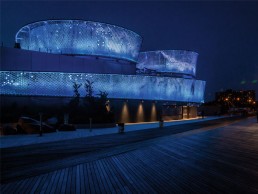
The visitor’s journey into the exhibit begins at the exterior of the building when they are presented with a 1,000ft long shimmering wall that wraps the exterior of the building. The wall, designed by environmental artist Ned Kahn, utilises the wind power of the coast to move 33,000 aluminium plates that flap and reflect light. Each night after sunset, a five-hour long programmed light display, designed by Focus Lighting, illuminates the wall with a carefully curated set of scenes inspired by ocean life.
As the sun sets, the automatically triggered display shifts from less saturated tints of cyan and emerald and transitions the building into richer tones of blue and purple as night falls. The colours and rhythms of the natural wind are reminiscent of the natural bioluminescent tides and backlight flickers through, creating a silvery shimmer of fish-like scales across the wall.
“The nighttime look of the shimmer wall was critical to creating the sense of excitement we were trying to achieve with this project,” explained Hope.
“Its impact on the Coney Island skyline is unparalleled and captures the curiosity of everyone who sees it.”
In the base of the wall, two rows of Philips Color Kinetics LED strips are used to illuminate the aluminium flaps. White uplights behind the shimmer wall bounce off the swinging panels and directly into the viewer’s eyes as a quick sparkle, while the Philips Color Kinetics LED grazers in front of the wall paint the surface in vivid colours that can be seen up and down the boardwalk and the beach.
Moving through into the building, visitors are led on a dramatic journey that takes them further into the deep ocean.
“Our lighting is designed to help present the natural beauty each experience is meant to evoke and create the illusion of complete immersion,” explained Principal Lighting Designer at Focus Lighting, Brett Andersen.
“One of our key challenges was accurately replicating the various underwater environments from which the animals come. We worked closely with WCS’s diving team to find the exact water colours and light levels seen at various depths and regions of our oceans. For instance, the exhibit’s second large tank is a full cylinder that replicates an area of the harbour called the New York Bight, with each species on display native to that area. We developed alongside WCS the colour of the water seen when diving in this area at a depth of 60-80ft below the surface.”
Upon entering the aquarium, the first tank visitors experience is the Coral Reef tank, a tunnel designed to have the look and feel of a bright and colourful coral reef. For this effect, the lighting team specified RGBW LED fixtures to light the tank, which allowed them to tune the lighting to the exact colour quality needed in order to make the coral stand out.
Working above and around water required a number of unique mounting techniques. At the Coral Reef tank, for instance, each light was mounted above the water on a custom designed trolley system. This allowed for precise fixture placement around the deeply textured coral, all while mitigating sightlines into the fixtures. The system also makes maintenance easy as the fixtures can be pulled back over solid ground.
The New York Bight tank has a custom designed mounting structure with a white painted ceiling above that allow carefully tuned RGBW floodlights to reflect off and into the tank. This creates a soft even glow of light that is experienced at a depth of 60-80ft. Smaller, direct accent spotlights mounted to the top of the mounting structure add subtle, natural feeling highlights.
The Canyon’s Edge is the exhibit’s deep ocean shark tank, which the team wanted to have a dark and ominous feel. Cool LED spots create shafts of ‘sunlight’ in narrow strips of the sandy bottom along the front edge of the tank, and then the exhibit falls off into darkness. The deeper recesses of the tank are flooded with blue LED light so sharks are barely visible in the murky waters, before suddenly coming into view as they approach the front of the tank. The viewer’s room is in complete darkness so nothing reflects onto the tank and distracts from the spectacle.
Hope explained further: “In the Meet The Shark room, where the majority of the exhibit’s information is presented, lighting levels are higher than most other areas so that visitors can read the various bits of information. While at the Canyon’s Edge, the exhibit’s largest and final tank, the observation area was left dark to offer visitors a grand, theatre-like view of the animals before parting.
“The decision to exclusively use LEDs grew as technology advanced over the course of the project. Once the colour quality, output and performance of the LED accents and floodlighting were at an acceptable level, revising our specifications became the clear choice,” she explained.
“On the interior, we were able to fine-tune the colours we used to highlight various elements of coral or rockwork in the tanks, while also minimising the difficult access of tanks for maintenance. On the exterior, Philips Color Kinetics’ linear RGB fixtures allowed us to create infinite combinations of colour movement while we created the lighting art-piece. We used ETC Paradigm control racks and processors for all the interior and exterior lighting, along with a Mosaic processor to programme and run the exterior nightly lighting show.”
The team worked to support a storyline with light throughout the interpretive exhibit designs, whether it was with the light theming elements or the live animals. Keeping the lighting out of view was an important factor of keeping the environment feeling authentic and immersive and not staged. “The display lighting had to be flexible and easily adjustable, yet very well-hidden so as not to distract from the exhibits themselves,” explained Hope.
Linear cove accents from Philips Color Kinetics, track accents from Juno and tapelight accents from Luminii were utilised throughout the exhibition, while Focus Lighting used Lumenpulse Lumenbeam accents at the tanks.
“The lighting at the tanks had to properly illuminate the water without creating hotspots or glare. Our goal was to make everything feel very natural,” Hope continued.
After the lengthy fourteen-year process, this aquarium has created an educational and aesthetically pleasing environment for all to appreciate the depths of our oceans.
“Much of the success of this project is in the emotional connection we are able to evoke among visitors,” Hope reflected.
“This is a direct result of the way lighting integrates with each experience and creates a feeling of authenticity that the visitors will remember long after visiting the aquarium, and hopefully, encourages them to take action in the effort to preserve our oceans.
“The project was very collaborative; each design element needed to support the others to create a cohesive, memorable experience that quickly drives home the exhibit’s key message: preserving our planet’s oceans,” she added.
“The final lighting design is almost exactly what we envisioned so many years ago. In fact, we have photos of the exhibit today that look nearly identical to early renderings of the project. For us, that is an immense accomplishment.”

Sharon Stammers
Editorial Assistant Sarah Cullen sat down with Sharon Stammers of Light Collective, to discuss her professional history and the conception of Women In Lighting.
For our first instalment of the Women in Lighting feature, we thought it only appropriate to begin with the woman at the front of this initiative, Sharon Stammers. arc sat down with her to discuss her career history, her place as a woman in the lighting industry, and how Women in Lighting came about.
Stammers began her studies in Wales, completing a degree in Theatre Studies. Wanting to stay out of the spotlight (a trait that has followed her throughout her education and career), Stammers opted to focus her studies behind the scenes, in particular on sound, set design and lighting.
“I used to daydream about lighting up large things like mountains, valleys or bridges, but never dreamt there was a job out there where people did these things (pre-internet days)!” Stammers reminisced.
“I attempted a few mini light interventions of my own – waving a large projector out of a window to project images onto the buildings opposite – but my plans were a bit too ambitious for Aberystwyth!”
From the very beginning, Stammers has had a love for literature and telling a story. Imagining she would follow a career in something book or theatre-related, a continuous theme following her was to tell a story or follow a narrative.
“One of the main things that I have learnt from working with light is that design is driven by narrative. The best lighting schemes, the best events, the best installations or campaigns all have a story that underpins every element and therefore my desire to tell stories gets fulfilled using the medium of light.”
After graduating, Stammers moved to London to begin work in the theatres. Not an unusual job per say, but perhaps for a woman at the time, she started work as a stage electrician. “My first day at work consisted of sorting out coloured gels in a cupboard. I spent a lot of time up a ladder and didn’t really know what I was doing. I used to hide fittings that I couldn’t fix and was shouted at in public during a concert for dropping the follow-spot. I was also once fired from another job due to the lack of expertise in programming a lighting desk.
“I love the fact I was told I would never work in lighting again, and here I am, nearly 30 years on!”
Aspiring to be a Theatre Lighting Designer, Stammers quickly became unsatisfied with working on the fringes. “Hardly anyone came to see the shows, you had to take all the lights down once the show was over and only the actors got to fully experience the lighting,” reflected Stammers.
Taking all of her experience in the theatre, Stammers went on to complete a City & Guilds Electricians qualification that gave her the confidence to persevere in the then male dominated industry, where she became the Technical Director at a venue in Brixton.
“Once I discovered there was a real job where lighting was permanently installed in places where people lived and worked, I decided to apply to the MSc course at the Bartlett, UCL.
“I did the course part time in 1995 and started work at the now legendary Lighting Design Partnership. Nearly everyone worked there at some point – Barry Hannaford, Gary Campbell, Mark Major etc.”
Entering an industry very different to that of the theatre, it didn’t take long for Stammers to find her feet and “graduate from photocopying spec sheets and sending faxes to running projects”. This expanse in knowledge brought confidence and she began inheriting larger lighting projects as designers moved on from the company, some of which included the London Coliseum and Somerset House.
Stammers was initially inspired to become a Lighting Designer and create the kind of schemes she would see in magazines, but after having her first child, it quickly became more difficult to work full time.
“I looked for an alternative way to be a part of the industry and found a role as the UK Co-ordinator for the PLDA, which no longer exists, when I became pregnant with my second child.
“This role meant travelling to other lighting events and talking to other designers in the UK and abroad, and learning about other aspects of the profession that I had not previously considered. I later learnt that my now business partner had recommended me for that role!”
During her time at PLDA was also when she met Martin Lupton. “It turns out he had never liked me previously, but we realised we were very good at coming up with creative ideas to promote the association and that we didn’t mind speaking out together on issues that others shied away from,” she explained.
In 2008, the pair started Light Collective, a lighting consultancy that embodies an array of lighting-based work. “We really struggle to categorise ourselves given that our body of work is so diverse.
“Our creative portfolio of work houses more than architectural lighting design and has grown to encompass many innovative projects that include marketing campaigns, competitions, curated exhibitions, lighting awards, branding, trade stands and shows, epic parties, pop-up events, guerrilla lighting, community projects, light education and light art installations.
“Our clients have ranged from the small scale to the large: designing for a school in Glasgow where the brief was set by the kids themselves, to a shopping mall in Kuwait, lighting an exhibition at the Museum of London, to starting a campaign for promoting Women in Lighting. We like to describe ourselves as lighting evangelists and light activists.”
Reinforcing their self-dubbed title of light activists, Light Collective continued on the Guerrilla Lighting initiative, originally set up by Lupton and his colleague Laura Bayliss when working at BDP. Other initiatives include co-founding the Social Light Movement and helping organise the Noche Zero event in Chile with Paulina Villalobos.
Stammers and Lupton have worked hard to promote the lighting industry across the world, tailoring their choices of projects to include many designers as their creative collaborators.
Another passion the two share is documenting light. Using film as their method of documentation, they established Light Collective TV on YouTube to capture and record their journeys and projects over the years, presenting a visual diary of Light Collective.
When asked about the changes in the industry over her career to date, Stammers explained the shifts in both technology and personnel: “Technically, it’s an unrecognisable landscape. When I started, there were many light sources – metal halide, tungsten, fluorescent etc., and you chose your source according to the task. Today, in the majority of cases, LED has supplanted all of these light sources. This observation was the inspiration behind making the Perfect Light project. This was a film looking at our ubiquitous use of LED that we made with the kind support of Citizen LEDs. We wish we had made it five years earlier and maybe two versions that would have allowed us to document the changes, with a third one in another five years time!
“In terms of gender equality and being a woman in the industry, the numbers have radically changed – 20 years ago I was often the only woman in a meeting, on a manufacturers trip or giving a talk. Now, there are many more female designers - this balance can only improve things for everyone,” she added.
Referencing the ILDS (arc’s International Lighting Design Survey), Stammers believes the growth of the profession and the growth in the number of lighting design courses are both testimony to this development in gender balance.
“If you look at the quality and diversity of the awards entries and the schemes featured in magazines, such as arc, you can see how the quality of lighting design has grown, and this filters down,” elaborated Stammers.
“Through the Women in Lighting project we have discovered that the profession is developing in countries that we were never aware of – Panama and Sudan for example – and this is great news.
“However, there is still a long way to go. There are a lot of good designers and high quality lighting manufacturers in the market now and by showing the world what good lighting looks like and talking about it on as many different forums as possible, we can help.”
Further to this, Stammers has observed an industry-felt fear that lighting designers may get left behind as technology advances at a rapid rate, and light has the potential to become another digital add on. She reinforces that it is important to make sure this doesn’t happen and that lighting designers “don’t get crushed in the rush to add technology to projects or lost within marketing stories”.
The concept of Women in Lighting originated after a showing of the Perfect Light in New York, when female audience members approached Light Collective to ask why they hadn’t included many women in the film.
“We were shocked by the observation, as it had never occurred to us that we had mainly interviewed men. I guess we were suffering from the same unconscious bias that exists in many professions,” reflected Stammers.
After some research, a general trend of a lack of females in conference line-ups, award juries and magazine panels became very apparent. Wanting to redress this imbalance, Light Collective set out to create an online platform where women in the industry can source inspiration, network and share their stories.
“We would like the website to be a massive database of women in lighting that can create inspiration or enable people to search for a female mentor, designer or speaker,” explained Stammers.
“[For the website] We initially planned to do twelve interviews, but I think by the end of May we will have done 50. We planned to ask 20 women to be ambassadors for the project in their country and help spread the word - today we have 58 women in 58 different countries.”
formalighting has also played a big part in supporting the project, in particular Sharon Magnaghi, who has taken a personal interest in Light Collective’s efforts, and is an ideal supporter as a leading female in the company.
“We have been critiqued that the project is unnecessary, but this has mainly been from European or American white males!” exclaimed Stammers.
“This project has revealed to us that there are many areas of the world where lighting design is not well established and the women involved are finding it difficult, so now more than ever, we think the project is necessary. It’s easy for us to forget in the UK that women struggle in other countries for general equality, let alone in the lighting industry. If you add into that the unconscious bias we are observing and the overwhelming support we have had from so many women in so many countries, then we are more convinced than ever that this project is necessary.
“There is also a general critique that this is just a feminist agenda – to quote Gloria Steinem (that famous feminist!), ‘A feminist is anyone who recognises the equality and full humanity of women and men’. Women in Lighting is about inclusivity and balance and how this is beneficial to the profession as a whole. Anyone against that must be crazy…”
Something Stammers and Lupton have observed since the launch of Women in Lighting is the need for support. As Lupton notes: “One of the things that has come out of the interviews is that women need more encouragement to step up. They are not as ego driven as the men in the industry who will step forward to promote themselves, but if they see the purpose of stepping up is also to create a positive role model for other women in lighting and their company, then they are really open to it.”
Generally speaking, Stammers has found her time in the lighting industry as a female almost non-problematic. Championing it as a great industry to be a female in, she boasts the fact that women can indulge in both creative and technical aspects of a project and there are no barriers to break through, apart from your own fears, in order to achieve great things. “The fact that we slot into many other industries like engineering and contracting, which are predominantly male, has sometimes been an issue but with good role models – and there are now many female ones – everything is surmountable,” she explained.
Like Lupton had witnessed, Stammers explained one of the main challenges the women interviewed for Women in Lighting mentioned was confidence, or lack thereof, and how scary it is to stand up and talk about their work. Having a platform and female network that demonstrates public speaking within the industry is now providing the role models for others to follow suit.
“I can safely say that each and every time I have had to present something or showcase a project, I have been terrified. I still am now even after all this time. However, I feel very strongly that in order for women to feel able to stand up and talk about their work, they need to see other women doing it. Hopefully, in a small way, I may have helped,” admitted Stammers.
“I have been incredibly lucky to find a work partner that balances me so well. The things that Martin does well, I am not so good at, and vice versa. We have supported each other in the work/family balance (once taking four kids to a meeting), and this has made a lot of things possible that I might not have been able to do otherwise.”
Finding support for Women in Lighting is strongly driven by the females in the industry, but having support from the men is also vital. As Lupton explained, it is a team effort that will create a harmonious balance for the lighting community: “As a man being part of Women in Lighting, I generally feel like a bit of an imposter. But, as the aim is to achieve a gender balance, which is positive for all involved in the industry, then it’s probably appropriate that the project is driven forward by both of us equally!
“I would really like to see more men stand up and support the project. We are working hard to think of ways that can happen; it can be as simple as putting themselves out there saying they support it and also making sure that they ensure there is gender equality in their company, on any conferences they curate or at any other opportunity.
“Working in partnership with Sharon for the past ten years has been, and continues to be, a great experience. Her enthusiasm and professionalism are second to none. There is a well-known phrase used to describe some people, ‘All fluff and no substance’ – Sharon is the total opposite of this, she is all substance and no fluff! She continues to inspire and challenge me on a daily basis to be better at what we do.”
As a female journalist in a nearly all-male office (aside from Helen Ankers, the editor of darc magazine), it is exciting to be a part of arc as an official media supporter for the initiative. We will be covering an array of professional female designers and projects headed by leading women in the industry, and much more, in upcoming editions of the magazine.

Mark Elliott
Following the announcement of the recent merger between PointOfView and Firefly Lighting Design, to become Firefly Point Of View (FPOV), arc sat down with Mark Elliott, Global Creative Director, to discuss the merger, and the growing standing of lighting design in Australia.
How did you get into lighting design?
I think, like many others did 20+ years ago, by accident. I studied as a furniture designer; and worked in that field for a short time, but then saw a job as a junior lighting designer for Lumino Lighting. From there my passion for architecture was reinvigorated and it was the launchpad for me to collaborate with architects and designers I would probably never have been able to work for in their fields as an architect or interior designer. From Lumino I moved to work with Barrie Wilde at BDP. Barry was one of the pioneers of lighting design in the UK and it was great to work with someone like that early in my career. From BDP I joined Isometrix and Arnold Chan’s team there. This experience really sculpted my career and exposed me to the very best in architecture and design, collaborating with global leaders and Pritzker Prize winners. Following a move to Sydney in 2005, I joined another pioneer of lighting design, Andre Tammes and LDP, working on a number of large hospitality projects in India and China, which then took me to my current role at PointOfView, (now FPOV) where we grew the studio from four people to a team of 40+ across eight offices today.
You left Isometrix to move to Australia. What were the reasons for the move?
Like many people early in their careers, I was looking for new challenges, mostly personal. I was very happy with my role at Isometrix and in fact discussed with Arnold the possibility of continuing my role in Australia. At the time Australia wasn’t really on the world stage for architecture and design, so it didn’t make sense; but the lure of sunshine and an easy way of life was too strong. Little did I know that “work hard play hard” was invented by the Australians, and specifically Sydneysiders, where the working environment is very demanding.
How does lighting design differ in Australia compared to the UK?
It’s a much smaller industry in Australia, which means competition is much stronger between those at the top. We have been very lucky to be prominent in Australia at the time where Asian investment has driven the quality of design and demands of clients to a higher level. Over the last decade I would say that design is on a par with the rest of the world and we see global design leaders like Foster + Partners, MAKE, Jean Nouvel, Frank Gehry, etc, working in Australia. This then lifts the practices of all other consultants and in response a knock-on effect for all clients to push harder for innovation and excellence to stand above their competitors. The Australian market, I believe, is a leader in sustainable design, implementing the ban on the GLS earlier than many other parts of the world, which led to the early adoption of LEDs project-wide. In fact I think that The Collins Bar in Adelaide in 2013 was the first full LED project we completed, where we implemented very early warm dim technology from acdc. That was a game changer for me, where we could get back to the warm, night time hospitality environment that was lost when halogen was no longer usable.
We spoke to you twelve years ago, just as you moved to Australia. How has lighting design developed there since you arrived?
Twelve years ago I felt that the industry was a long way behind. I think the investment from Asia, together with the advances in technology meant that the demand for specialists has grown to deliver environments to meet client expectations and code requirements.
Today, Australia is up there with the best, delivering projects around the world, with global clients and collaborators. FPOV is testament to that, where we now have studios in Hong Kong and London, working on all continents (apart from Antarctica!).
And how has PointOfView expanded in that time?
I joined POV in 2005, at that time there were four of us in Sydney. We have grown with the industry and, hopefully, through the quality of our work. In 2010 we took ownership over from David Becker, POV’s founder, and have been growing organically ever since. I always judge myself on the projects we currently work on rather than our past, always striving for better results and more prestigious projects. We also merged with Tony Dowthwaite Lighting Design in the Gold Coast, Tony is the third in my list of lighting design pioneers, I believe TDLD was the first independent lighting design consultancy in Australia.
How did the merger with Firefly Lighting Design come about?
POV was looking to grow internationally, many of our hospitality clients in Asia enjoyed working with us but needed a local presence; and Firefly were looking to be part of a larger team to have more capacity to service clients. John Lau, Director of Firefly and I worked together at Isometrix, Peter Veale, Co-Director at Firefly, also worked at Isometrix, before my time. So, we knew each other, the way we worked, and our design philosophies were attuned, so a merger would form a true partnership and extension for both studios.It’s a continuation of our organic growth, an expansion of clients, market knowledge, global abilities, sharing of resources and an expansion and growth of expertise and experience, all with a view to deliver better and more innovative results for our clients.
You’ve also recently moved back to the UK. What were the reasons behind the move?
As part of the merger my role became a global one, to be the glue between each office to ensure the sharing of ideas, experience and consistency of delivery and creativity. To ensure that we all really benefit from the ‘global studio’ ideal and to ensure we don’t all work in silos, which would defeat the purpose.
Finally, what can we expect to see from FPOV in the near future?
I believe we are working on the world’s leading and most aspirational hospitality project in Crown Resort Barrangaroo, a $2.2billion project, with a global design team including Wilkinson Eyre, Meyer Davis and Bates Smart. Also in the works, Resorts World Manila, the $1billion Castle Towers Shopping Centre with Woods Bagot and UNStudio, the soon to be completed Jumeirah Sadiyaat Island Resort and the landscape and urban environment of the recently opened Jean Nouvel National Museum of Qatar. Beyond that, bigger and better things…

Tadao Ando
Robert Such sits down with renowned Japanese architect Tadao Ando to discuss the integral role that light and shadow can play in creating objects of architectural beauty.
The Minamidera Art House Project guide, standing at the entrance to the rectangular wooden building that houses James Turrell’s lighting installation, politely instructs each visitor to keep a hand on the wall when inside the building. It’s not clear why we need to do this, but it soon makes sense - it’s pitch black inside. Only after a few minutes do my eyes become accustomed to the darkness, and a faint rectangular light starts to appear out of the gloom. It’s some distance away across the dark interior, but it’s hard to tell how far…
Designed by Japanese architect Tadao Ando, the Minamidera Art House Project building that houses Turrell’s lightwork stands on the island of Naoshima in Japan’s Seto Inland Sea. Naoshima is one of a number of islands on which stand museums, art spaces and outdoor artworks.
Admired by Ando, the American light artist James Turrell is one of many architects and artists that have influenced the way that Ando has worked with light throughout his life. Ando has joined forces with Turrell on projects numerous times, and Turrell’s work continues to be an inspiration. Turrell also has lightworks in the Chichu Art Museum on Naoshima - a museum also designed by Ando.
“It is particularly important,” said the 1995 Pritzker Prize winning Ando, “to take steps forward when building a museum for contemporary art. Artists are very courageous. They are stepping forward all of the time. Architects must do the same.
“We must share the fear of challenging the unseen world. We are all humans, and we can be courageous, but we cannot escape fear when taking risks. As long as you dare to step forward, and have some experience, you are not likely to fail.”
As for architects that inspired him, it was Le Corbusier that had a strong influence on Ando’s early career. He first became aware of the Swiss-French architect’s work while perusing the bookshelves in an old bookshop in his hometown of Osaka.
“I first laid my eyes on a portfolio of Le Corbusier in the art section of that bookstore,” Ando explains. “Immediately, I felt in my bones - this is it.” At that time he was, he says, “very passionate about life, but my destiny was yet to be defined.” It was a life-changing turning point for the 20-year-old would-be architect who was then working part-time at an architecture firm.
The Le Corbusier book was too expensive to buy straight away though, so Ando saved up and was able to buy it about a month later. Then he read it “page by page, every night until I grew tired of it”, he says.
“Even though my knowledge was not extensive enough to understand the intricacies of modernism, the contents of the book were utterly fascinating. Each page was beautifully laid out with close-up and wide-angle architectural photographs in addition to attractive plans and sketches.”
Wanting to be able to design in this way, he “traced Le Corbusier’s floor plans over and over again”.
Born and raised in Osaka in a traditional residential neighbourhood, Ando’s home was a small terraced house. He describes it as “a dark place with little light and small windows”.
“In the dim interior, I appreciated what little light we received. I would often fill my cupped hands with light coming into my room. Since then, this is the type of architecture I’ve wanted to build: architecture that values light and reminds me of the same feelings I experienced as a child.
“Nature in the form of light, water, and sky restores architecture from a metaphysical to an earthly plane and gives life to space. A concern for the relationship between architecture and nature inevitably leads to a concern for the temporal context of architecture. I want to emphasise the sense of time and to create compositions in which a feeling of transience or the passing of time is a part of the spatial experience.”
Another book that had a profound influence on the young Ando was a thin, but influential book called In Praise of Shadows by the well-known Japanese writer Jun’ichirō Tanizaki. The book details Tanizaki’s thoughts on light and shadows in various aspects of Japanese culture. “The balance of light and shadow is always difficult. Without shadow, one cannot fully appreciate light,” says Ando.
Inside another of Ando’s well-known works, the Ibaraki Kasugaoka Church in Ibaraki, just outside Osaka, light and shadow also play a key role in a visitor’s experiential appreciation of the building interior. More commonly known as the Church of the Light, the building’s most striking feature is a cruciform opening, cut out in the concrete, in the wall facing the congregation.
It is also a project that Ando returned to time and again to try and convince the client to remove the glass that was installed to keep out the rain and wind. When Ando first designed the Church of the Light in 1989, he proposed that the cross be open to the elements in order “to introduce pure and natural light into the space,” he says. The client refused to remove the glass.
Ando eventually gave up, so he did the next best thing: make a life-size replica of the church, for an exhibition. In his version there was no glass, just as he wanted it to be. “In comparison to the original church, the experience of light had significantly intensified,” he says.
When Ando thinks of great uses of light in architecture, it is monasteries that come to mind, such as the Thoronet Abbey and the Notre-Dame de Sénanque Abbey in France. “The light found inside these religious buildings create space and carry life.
“When I first entered Abbaye du Thoronet, I encountered a feeling of great power. In the profound silence of the place, I became aware of the light transcending the severity of religious precepts. In order to appreciate the beauty of light and the spaces it illuminates, darkness is absolutely necessary.”
Necessary, yes; yet in the Minamidera Art House Project, where there is no light at all at first, the complete darkness in the building is unnerving. But the mystery and the eventual surprise revelation make Turrell’s light artwork, and the islands in the Seto Inland Sea generally, well worth visiting - just like the architectural works of Japan’s most famous architect, whose thoughtfully designed and beautifully made works can be found all over Japan and in many other locations around the world, and who believes that although shadows are necessary, “light is pivotal for the livelihood of humankind”.

Lumileds appoint new CEO
(USA) - Dr. Jonathan Rich joins Lumileds as CEO,
taking over from Mark Adams
Dr. Jonathan Rich has
been appointed as the new Chief Executive Officer of Lumileds, the company has
announced.
Dr. Rich most recently
served as Chairman and CEO of Berry Global, a Fortune 500 specialty materials
and consumer packaging company, from 2010 to 2018. He succeeds Mark Adams, who
has stepped down as CEO and from the board of directors, but will remain in an
advisory role to the company.
“I am very pleased to be
joining Lumileds, and I am looking forward to building on the company’s
differentiated lighting technology foundation to increase the value we can
deliver to customers across a broad set of industries,” said Dr. Rich. “The
opportunity for lighting innovation to make a positive impact on safety and
sustainability is tremendous.”
Before holding the
position of Chairman and CEO and Berry Global, Dr. Rich was President and CEO
at Momentive, a speciality chemical company based in Albany, New York. Prior to
that, he held positions with Goodyear Tire & Rubber Company, first as
President of the Global Chemicals business and subsequently as President of
Goodyear’s North American Tire Division. He spent his formative years at
General Electric, first as a research scientist at GE Global Research and then
in a series of management positions with GE Plastics. He received Bachelor of
Science degree in chemistry from Iowa State University, and a Ph.D. in
chemistry from the University of Wisconsin-Madison. He has been a visiting
lecturer at Cornell University Johnson School of Business since 2017.
Rob Seminara, Chairman
of the board at Lumileds, said: “Mark Adams has made significant contributions
to Lumileds during his tenure, leading the transition to an independent company
and cultivating a culture of innovation and customer focus.
“On behalf of the Board
of Directors of Lumileds, we would like to thank him for his service to the
company and wish him the very best in his future endeavours. We are very
excited Jon will be joining Lumileds to drive the next phase of innovation and
growth and we look forward to working with him again.”
Mark Adams added: “It
has been a great experience leading Lumileds’ transition to an independent
company that is focusing on delivering lighting solutions that truly make a
positive impact in the world. I would like to thank the employees of Lumileds
and the Apollo team for their support and wish the company much success in the
future.”
Liz West to present Live Colour installation at Clerkenwell Design Week
(UK) – In collaboration with Domus, Liz West will present a vivid light installation in Domus’ lower ground floor area.
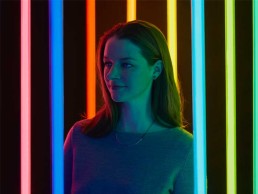
For the duration of Clerkenwell Design Week, the British artists will display Live Colour, a vivid environment that mixes luminous colour and radiant light against a backdrop of Domus white XL format Magnum porcelain slabs. West has imagined the space with red, yellow, blue, green and pink rotating washes of each colour, with a pure light as part of the cycle to normalise the overall colour intensity.
The installation uses Rosco’s patented SL1 Mix LED technology to create accurate Rosco gel matches and intense, saturated colour. Through West’s multi-sensory art, visitors to Live Colour will experience pure colour in an immersive environment like never before.
Visitors are encouraged to wear white to experience the full impact of colours and trigger a multi-sensory experience that encourages viewers to question their reactions to colour. How does each colour make you feel? What is your favourite colour? Did you feel as you expected you would when immersed in a certain colour? How does white feel once having experienced other bright colours?
“Live Colour plays with people’s individual perception of colour, challenging how they feel when immersed totally in one colour, then quickly drowned in another in deep contrast,” explained West.
“Colour is a universal language that is understood by all, althrough we
each bring to the work our individual memories and lived experiences of colour.”
As well as the installation, as part of Domus’ Clerkenwell Design Week lunchtime talks, West will be giving a talk at 1pm on Tuesday 21 May, with a focus on this new project, the psychology of colour and how the experience of seeing and feeling colour and light can enhance wellbeing.
www.domusgroup.com
www.liz-west.com
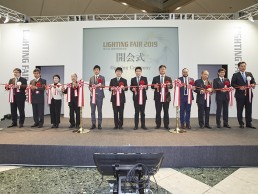
Lighting Fair 2019 looks to the future of connected light
(Japan) - More than 57,000 visitors travelled to
Tokyo for this year’s Lighting Fair.
The Japan Lighting
Manufacturers Association, in association with Nikkei, has hailed Lighting Fair
2019 as a success.
The event, held at the
Tokyo International Exhibition Center, saw visitor numbers reach 57,422 people
over four days from March 5-8. These visitors came from various diverse
industries, from construction, distribution and manufacturing to retail, facilities
management and design.
The theme for the 2019
edition of Lighting Fair was “Lighting
will be connected, tomorrow will be changed”. As part of this theme, in a
commemorative seminar on the opening day of the show, the Japan Lighting
Manufacturers Association published for the first time “Lighting Vision 2030”:
a new growth strategy for the lighting industry, while new programs examining
the “future that lighting will change” were introduced, observing the future of
lighting from various angles, including national projects, expectations toward
lighting, and a forecast of the future lighting market.
Across the show, 170
exhibitors, both domestic and international, introduced a number of new
lighting applications using LED, illuminations to produce comfortable
atmospheres utilising control functions, cutting-edge lighting apparatus,
systems and related components.
Meanwhile, the Space
Rendering Zone - new to this year’s show - attracted many visitors. Connected
through lighting, the services and solutions on show here related to spatial
presentation, combining light, acoustics, images and videos.
An adjacent zone, known
as “co_re_ca_light Studio”, brought together the apparatus and services that
link with lighting from a variety of fields. With panel exhibitions, real
machine demonstrations and mini-seminars, this zone helped to promote a deeper
understanding of the wider potential of connected lighting to the audience.
Through cooperation with
the Japanese chapter of the IALD, the event organisers were able to conduct a
number of additional projects outside of the show, highlighting some of the
city’s wonderful lighting projects from various angles. An outdoor tour to
cruise Tokyo by night with lighting designers, including Motoko Ishii, the
International Lighting Design Seminar, presented by famous local and
international designers, and an indoor tour to visit various booths accompanied
by narrations from lighting designers, all proved very popular, each attracting
large audiences.
After the fair, the Japan
Lighting Manufacturers Association said “Japan has raised the proposition to
stock 100% of high efficiency lighting such as SSL by 2030. Aiming at reaching
this goal, we believe the significance of holding this fair will keep rising in
our society as the demand increases for promoting the lighting culture and
contributing to the global environment.
“Lighting Fair is
determined to keep providing the base from which to continue transmitting the
latest information toward the spatial construction for lighting and comfortable
urban development.”

Issue 108
arc Feb/Mar 2019 – Issue 108
Everybody’s talking...
At last year’s [d]arc room, we facilitated a panel discussion about Human Centric Lighting (HCL) chaired by leading expert Asst. Prof. Dr. Karolina Zielinska-Dabkowska. Featuring Mark Ridler, Director of Lighting at BDP; Rebecca Weir, Creative Director at Light iQ; Stephen Lisk, President of CIBSE; and Iain Carlile, President of SLL, the debate was lively and proved that there were many more questions than answers. So much so that we have reprised the discussion in this issue with a professional paper from Zielinska-Dabkowska and input from lighting designers about the subject, including practical examples of where HCL is used in their schemes.
HCL is often claimed to be the next development stage in the evolution of lighting design, yet the concept seems to have been around forever. Indeed, when we announced the HCL discussion on Twitter, some bright spark commented that this was old news and we shouldn’t have been giving it any further thought.
Last year, according to market research company ElectroniCast, the global consumption value of modules/devices in HCL reached $617.6 million, and is forecast to increase 38% in 2019 to $850.9 million. Unsurprisingly, the critic was someone who worked for a manufacturer who made lighting products that claimed to have solved the HCL conundrum, a very lucrative market. Unsurprisingly, they are wrong.
It has become increasingly obvious how complex it is to imitate natural light, and that far more research is required to identify what is needed to apply artificial light safely. Indeed, Dr Russell Foster who identified the eye’s third photosensitive cells whose function is unrelated to vision, recently stated: “We can’t develop human-centric lighting until we know what impact light has upon human biology across the day and night cycle.”
Lighting designers, and especially lighting suppliers, need to take note. There is a long way to go.
Talking of debate at [d]arc room, we are delighted to announce that, this year, [d]arc room will have its very own hall at London Design Fair during London Design Festival in September. Attracting 30,000 visitors, the event will aim to showcase 75 architectural and decorative lighting companies to the design community. Please contact us if you’d like to be involved.
Paul James
Editor
arc
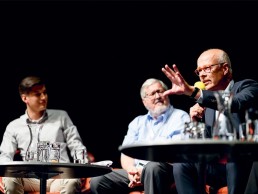
TiL announces 2019 programme
(Austria) - The 2019 edition of Trends in Lighting Forum + Show will focus on the future of lighting.
TiL 2019 (Trends in Lighting Forum +Show) has, for the third year in a row, created an event programme that seeks to bridge the gap between architecture, application, design and technologies.
Joining more than 1,700 delegates and 100 exhibitors in Bregenz this year will be experts from lighting design, architecture, planning, investment and research. The varied speakers will be sharing their knowledge on key trends in lighting, including Smart Lighting, new lighting design approaches and applications, connectivity and IoT, and Human Centric Lighting.
These chosen specialists will hope to inspire attendees with their future visions, creative designs, trend insights, and research findings in more than 60 carefully selected lectures.
Exploring the future, and what it might bring to the applications of light, and how it will shape trends, is a key focus of this year’s event, with a keynote presentation from Keith Bradshaw of Speirs + Major, entitled New Perspectives in Lighting Design, that will see him share his vision.
Also looking ahead to the future will be the CEO panel discussion onFuture Luminary Design, and a workshop from USA-based Lumentix called What Will Lighting Become?
"TiL 2019 is an interactive and insightful information hub created by, and for, experts in lighting design, architecture, planning and investment in order to collectively build the future of light,” said Siegfried Luger, Event Director.
“It is designed especially to bridge the gap between application, design and technology. Bringing together those who strive for excellence in the application of light with those who are researching and developing the technologies that will enable and drive them.”

Glamox acquires Luxonic Lighting
(Norway/UK) - The
acquisition will see both Glamox and Luxonic Lighting strengthen their position
in the UK lighting market.
Glamox has entered into an agreement to acquire 100% of the
shares of Luxonic Lighting and its subsidiaries.
Luxonic Lighting was established in 1986, and is a UK-based
lighting company with a strong brand and its own manufacturing plant in
Basingstoke. Glamox has been present with its own subsidiary in the UK since
1967, and the acquisition strengthens the companies combined position in the UK
lighting market with complementary sales reach and product offering.
Rune Marthinussen, CEO of Glamox, said: “We are excited about
this strategic opportunity, that will allow us to further strengthen our
position in the UK lighting market.
“The UK market is one of the largest lighting markets in
Europe and Luxonic Lighting is a strong system solution provider, with a high
service level and local manufacturing that is highly recognised by customers.”
Nick Tavaré, Managing Director of Luxonic Lighting, added: “We
are very pleased to become part of the Glamox Group. The acquisition marks the
start of an exciting new phase for Luxonic Lighting, moving from 33 years as an
independent business to being part of an international group with all the
advantages that brings, but without losing our well-established identity to the
UK.
“We look forward to further serving our existing and new
clients by providing them with an even stronger offering through the support of
Glamox.”
